

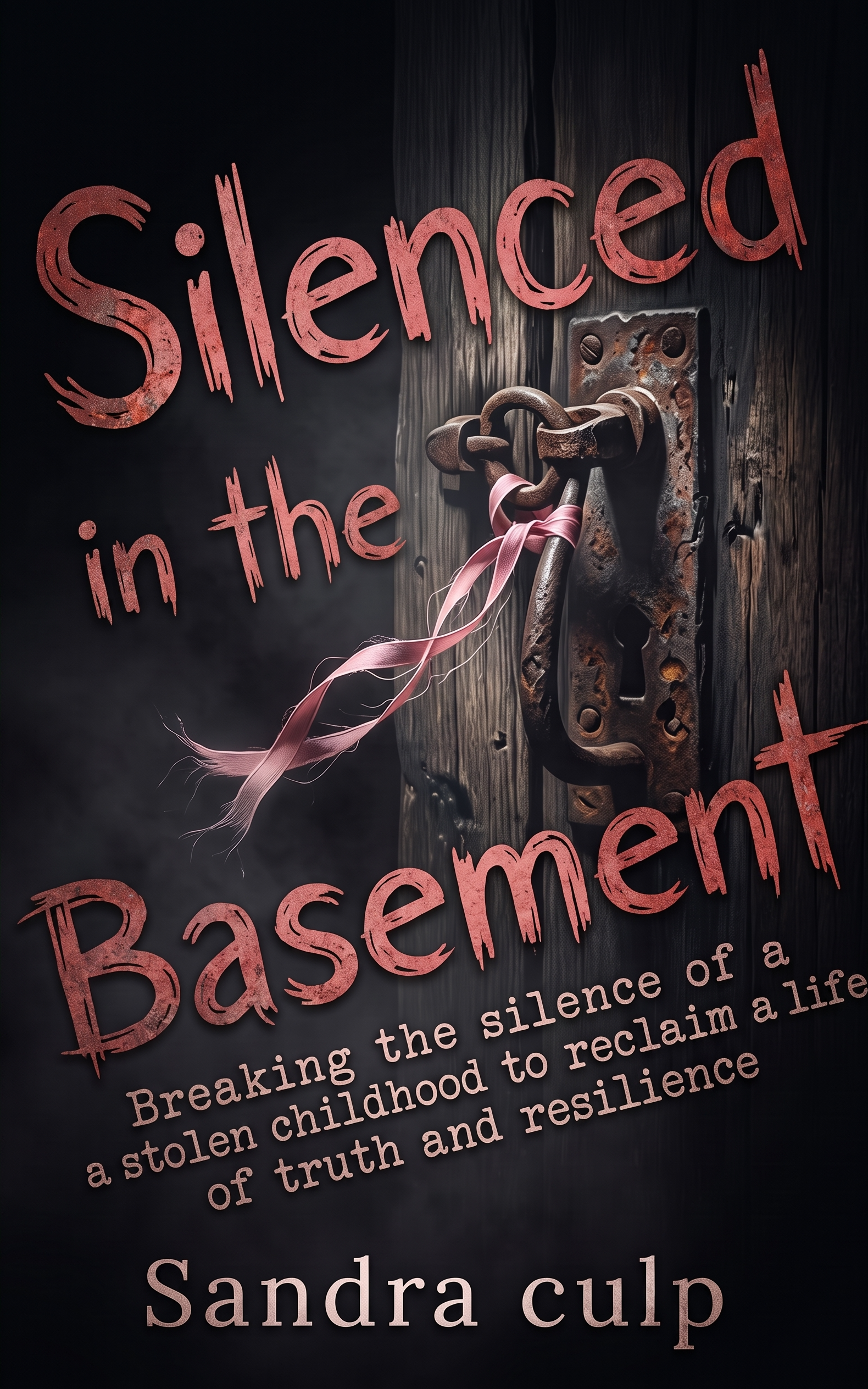
Silenced in the Basement
Breaking the silence of a stolen childhood to reclaim a life of truth and resilience
by Sandra culp
In 1972, the basement of a small-town home became a vault for a nightmare no child should endure. For Sandra Culp, the walls of her family home didn’t offer protection; they served as the backdrop for a harrowing betrayal by those she should have been able to trust most. Silenced in the Basement is the raw, unflinching account of a young girl navigating a world of profound isolation. Subjected to repeated abuse by her own brother and a neighbor’s son, Sandra found herself trapped in a cycle of fear and helplessness. When she turned to her parents for help, she was met with a devastating wall of denial. Her only allies were her beloved dog and cat—the only sources of unconditional love that kept her from breaking, and the very reasons she kept her secrets buried to stay safe. This is more than a memoir of trauma; it is a powerful roadmap to survival. Through vivid reflection on the grooming process and the psychological toll of parental betrayal, Sandra Culp traces her journey from a silenced child to a woman reclaiming her agency. It is a testament to the enduring strength of the human spirit and a beacon of hope for anyone seeking to find their voice after years of darkness.
- Biography
- Overcoming Adversity
- Family Memoir
- Survival Memoir
The Neighbor’s Garage and the Broken Neighborhood
The heavy wood-and-metal door of the garage slid downward with a loud, metallic rattle, the bottom rubber seal hitting the concrete floor with a dull thud that cut off the bright afternoon sun. In an instant, the world shrank. The cheerful sounds of children yelling, bicycle tires crunching on gravel, and the distant hum of a lawnmower on our suburban street vanished, replaced by a heavy, suffocating silence. The air inside was thick and hot, smelling of motor oil, damp concrete, and gasoline. It was July of 1970, and I was eight years old. A moment before, I had been a child playing pretend in the dirt. Now, I was standing in the dark, my heart beating hard against my ribs, wondering why the light had been shut out.
My neighbor’s sons, two boys several years older than me, stood between me and the door, while their sister stood quietly nearby, watching us. In our small town, everyone knew everyone. Families left their front doors unlocked, and children roamed free from morning until the streetlights flickered on. The neighborhood was supposed to be a safe haven, a quiet collection of lawns and houses where nothing bad ever happened. The boys were people I saw almost every day, familiar faces from a family my parents respected. They were not strangers hiding in the dark woods at the edge of town. They were the boys next door, the ones who helped their father wash their car on weekends and waved politely to my mother. But in the dim light of that garage, surrounded by lawnmowers, rusted garden tools, and shelves of half-empty paint cans, their familiarity shifted into something unrecognizable.
I did not have the vocabulary for what happened next. At eight years old, my understanding of the world was built on simple rules: obey adults, be polite, and play nice. I had no words for violation, no concept of boundaries, and no understanding of bodily autonomy. When they stepped closer and told me we were going to play a new game, my mind tried to frame it within the boundaries of childhood imagination. But as their hands moved, and as their sister watched in silent complicity each time they took me in there, the game felt wrong, heavy, and terrifying. It was a physical invasion that left me frozen, my muscles locking up as my brain struggled to process the contradiction of what was happening. People I knew, in a place I had passed a hundred times, were doing something that made me want to shrink into the concrete floor and disappear.
The confusion was absolute. When you are a child, you believe that the people around you are good, especially those who belong to the comfortable world of your neighborhood. You do not expect danger to wear a clean shirt and live in the house next door. As the minutes stretched out in that hot, oil-scented space, I felt my sense of self begin to fracture. My mind drifted upward, away from my physical body, focusing instead on the dust motes dancing in the thin sliver of sunlight that managed to peek through the gap at the bottom of the garage door. I watched those tiny specks of light, wishing I could be as small and weightless as they were, free to float out of the dark and back into the summer air.
When the door finally rattled upward again, the sudden rush of bright July sunlight hurt my eyes. The warmth of the sun felt different now; it did not warm me, it only made me feel exposed. I walked back out onto the street, my legs shaking, carrying a weight that had not been there an hour before. The other children were still playing, their laughter ringing out as if the world had not just cracked open. I walked toward my house, the taste of copper in my mouth and the smell of the garage clinging to my skin and clothes. I wanted nothing more than to run to my mother, to have her hold me and wash away the dirt and the confusion that felt like a physical layer on my body.
I found my mother in the kitchen, her back to me as she washed dishes at the sink. The familiar, comforting smell of dinner cooking filled the room, a sharp contrast to the oil and gasoline that still filled my nose. I stood near the doorway, my voice small and trembling as I tried to put the unthinkable into words. I told her that the neighbor’s sons had taken me into the garage and done something bad while their sister watched. I did not have the correct anatomical terms, so I used the simple, clumsy language of an eight-year-old child, pointing to my body and describing the fear that had gripped me in the dark.
My mother did not turn around immediately. When she did, her face was not filled with the protective anger or concern I had desperately hoped for. Instead, her expression was tight, her eyes looking past me rather than at me. She sighed, a sound of irritation rather than comfort, and wiped her soapy hands on a kitchen towel. She told me I was making things up, that I had a wild imagination, and that I shouldn't say such terrible things about nice children from a good family. She told me to go wash my face and get ready for dinner, warning me never to speak of it again because it would cause trouble with the neighbors.
In that moment, the silencing began. The dismissal was like a physical blow, sharper and more enduring than the violation in the garage. My mother’s refusal to see my pain was a secondary trauma, one that reinforced my sudden, profound isolation. By protecting the facade of a peaceful neighborhood and the social standing of our family, she chose to ignore the reality of what had happened to her daughter. The message was clear: my truth was inconvenient, dangerous, and unwelcome. To speak it was to threaten the fragile peace of our home, and so, the words died in my throat.
I retreated to my room, sitting on the edge of my bed as the internal monologue of a betrayed child began to take root. I wondered what I had done wrong. If my mother, the person who was supposed to protect me from the dangers of the world, did not believe me, then the fault must lie with me. I must have invited the boys’ actions, or perhaps I had misunderstood the game. The burden of guilt shifted from the perpetrators to the victim, a heavy, dark stone that I tucked deep inside my chest. I watched my mother’s face closely over the next few days, noticing how she looked away whenever we passed the neighbor’s house, or how she changed the subject if anyone mentioned their names. She knew, at some level, but she had decided that the truth was simply too heavy for our family to carry.
This dynamic is a classic example of what psychologists call the "Good Neighbor" syndrome. In tight-knit communities, social standing and public reputation are often used as shields to deflect accusations of predatory behavior. A well-liked neighbor, a polite teenager, or a respected family man is viewed as incapable of such acts, and the community will often band together to protect the status quo rather than believe a child’s cry for help. The child is sacrificed on the altar of social politeness. For me, this meant that the neighborhood garage remained a monument to my silence, a place I had to walk past every single day, knowing that my tormentor was safe behind his family’s good reputation while I was trapped in my own mind.
As the years passed, the events of that afternoon in 1970 began to echo through my life in ways I did not fully understand until I reached adulthood. The mind has a way of locking away memories that are too painful to process, but the body does not forget. It holds onto the tension, the smells, and the terror, waiting for a trigger to bring it all back to the surface. For decades, I struggled with an intense, irrational fear of enclosed spaces. The simple act of entering an elevator, a windowless room, or a small storage closet could trigger a wave of panic that left me gasping for air, my heart racing just as it had behind the heavy wooden door of the garage.
Worse than the claustrophobia, however, was the deep-seated distrust of friendly people. Whenever a neighbor tried to welcome me, offer help, or strike up a casual conversation, a wall of suspicion would immediately go up. I viewed friendliness not as kindness, but as a tactic, a grooming behavior designed to lower my defenses before the inevitable betrayal. The "Good Neighbor" syndrome had taught me that those who appear the most harmless are often the most dangerous, and that the community would always choose to protect the polite predator over the victim. It took years of intensive therapeutic work to realize that this hypervigilance was a survival mechanism born in the dark of that garage, a shield I had built to ensure I would never be caught off guard again.
Reflecting on this initial violation, I can see how the betrayal by both the neighbor and my parents laid the groundwork for the years of silence that would follow. When a child is abused, it is a terrible thing. But when the child seeks help and is rejected by their caregivers, the damage is multiplied tenfold. This is the essence of "betrayal trauma." A child’s primary instinct is survival, and survival depends entirely on the attachment to their caregivers. When those caregivers demand silence as the price of that attachment, the child has no choice but to comply. I learned that to keep my mother’s love and to maintain my place in the family, I had to split myself in two: the outward-facing girl who smiled and played pretend, and the inward-facing girl who carried the dark secret of the garage.
This division of the self is a survival strategy, but it comes at a terrible cost. It teaches you to ignore your own instincts, to doubt your own senses, and to accept the unacceptable. It prepares you to be victimized again, because you have been trained to believe that your boundaries do not matter and that your voice has no power. The silence that began in the garage in 1970 was not just a temporary quiet; it was a physical and emotional state that would define my childhood and make me vulnerable to the even darker shadows that were waiting for me in the basement of my own home.
The body’s memory is an extraordinary, terrifying thing. Even when we try to bury our past, sensory triggers can bring it back in an instant. For survivors of childhood trauma, recognizing these triggers and learning how to navigate them is a crucial step toward reclaiming agency. When the smell of motor oil or the sound of a heavy door sliding shut threatens to drag me back to 1970, I have had to learn grounding exercises to keep myself anchored in the present. If you find yourself overwhelmed by sensory memories, these simple, practical steps can help bring you back to safety:
- The 5-4-3-2-1 Technique: Focus on your current surroundings and name five things you can see, four things you can physically feel, three things you can hear, two things you can smell, and one thing you can taste. This forces your brain to process the safety of your present environment rather than the danger of the past.
- Physical Grounding: Press your bare feet firmly into the floor or hold a cold object like an ice cube. The intense physical sensation helps break the loop of a flashback and reminds your body that you are here, now, and safe.
- Controlled Breathing: Inhale deeply through your nose for four seconds, hold for four seconds, and exhale slowly through your mouth for six seconds. This physiological shift signals to your nervous system that the threat has passed.
Trauma often begins with a breach of trust in the very places where we should feel most secure. The neighborhood, the home, the yard—these familiar landscapes can become minefields when boundaries are crossed and caregivers turn away. If we are to protect the children in our lives, we must be willing to look past the comfortable facades of our communities and listen to their voices, no matter how inconvenient or uncomfortable their truths may be. We must be willing to break the silence, even when it means facing the darkness next door.
Questions for Reflection
As you read through this chapter and consider your own history, take some time to reflect on the following questions. If you are a survivor, these prompts may help you identify the early patterns of silence in your own life:
- What were the "safe" spaces in your childhood that actually felt dangerous or uncomfortable to you?
- How did your parents or caregivers react when you expressed fear, discomfort, or hesitation about a specific person, neighbor, or relative?
- In what ways did you learn to silence your own instincts as a child in order to maintain the peace or keep the approval of the adults around you?
The Cold Stairs to the Basement
A basement is supposed to be a place of ordinary things. Christmas decorations in cardboard boxes. A washing machine that groans and shudders on the spin cycle. Bicycles waiting out the winter. In most houses, it is the least remarkable room, a place you visit for ten minutes at a time to fetch something or put something away. It is not supposed to…