

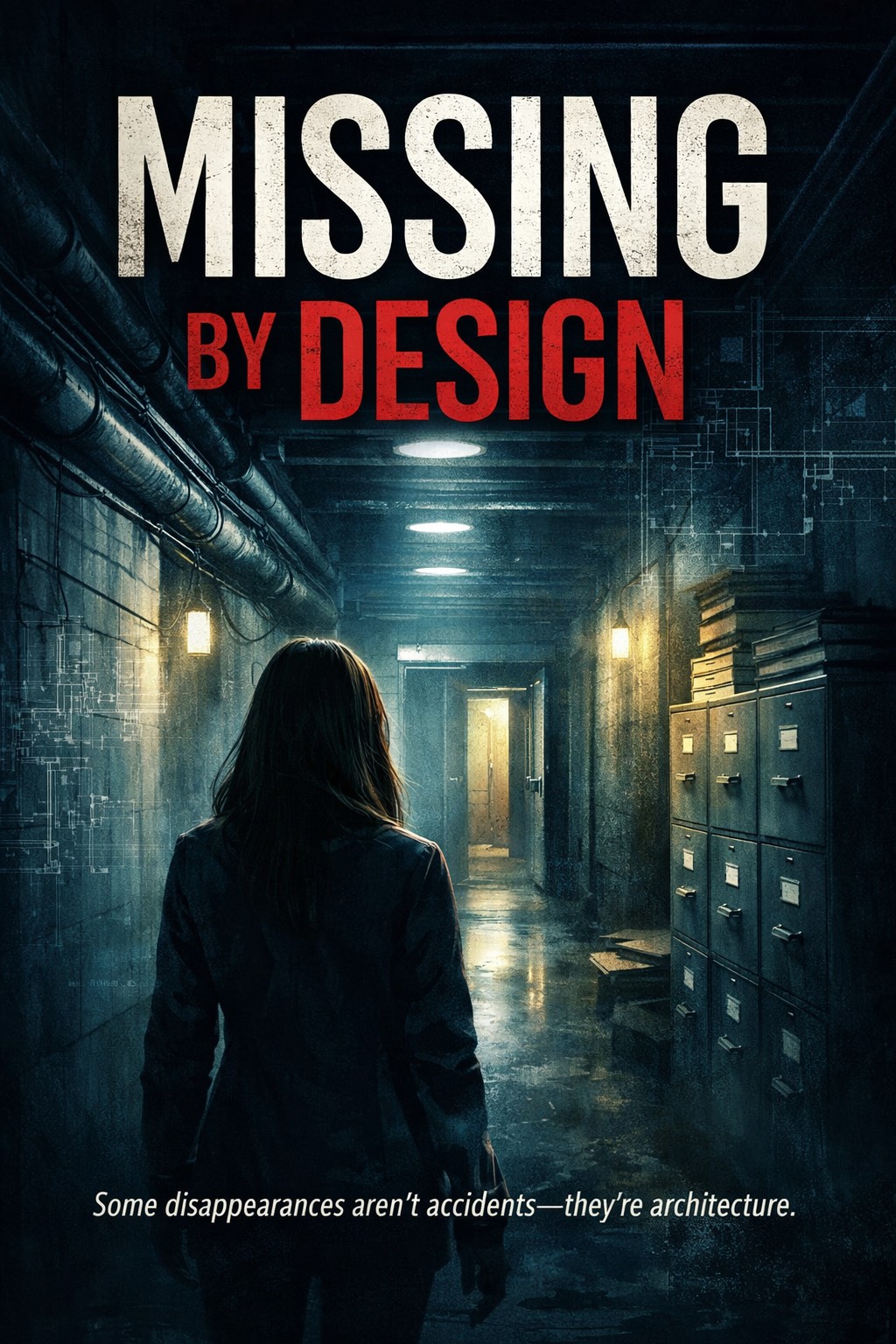
Missing by Design
A forgotten file, a deadly surveillance program, and the secrets they will kill to keep.
by SARAH J FANNIN
Some secrets are buried in the archives for a reason. Criminal psychology professor Sarah Whitmore is used to analyzing the minds of killers, but nothing prepared her for the discovery she makes in the sub-basement of the university archives. Deep within the dust, she finds the file of Iris Cadwell, a student who vanished in 1973 without a trace. The records reveal a disturbing truth: Iris was being tracked by a clandestine surveillance program called the Campus Stability Initiative. As Sarah digs deeper into the decades-old disappearance, the shadows of the past begin to move. She finds an unexpected ally in a former investigator, Elias Thorne-Lowry, but she also catches the eye of the charming Jesse Hallaway—a man whose warmth masks a predatory nature that has remained unchecked for fifty years. The university administration isn't just watching Sarah; they're closing in. From staged accidents to a modern-day surveillance net, the institution is determined to protect its legacy. If Sarah can’t expose the truth about the Annex—a hidden facility for 'troublesome' students—she won’t just lose her career. She’ll be the next one erased from the records. In this chilling race against time, Sarah must decide who to trust before the university labels her unstable and locks her away forever.
- Psychological Thriller
- Mystery
- Detective Story
- Missing Person
- Murder Mystery
The Forgotten Folder
I used to think the Langford Archives were a refuge.
Most people hated the place. It was tucked away in the sub-basement of the west wing, a sprawling concrete labyrinth that the university’s modernization efforts had conveniently forgotten. It was too cold in the winter, the chill seeping out of the foundation like a slow-moving ghost, and too stale in the summer when the air became a thick, breathless soup. Rows of dented filing cabinets stretched into the gloom, their olive-drab paint chipping away in jagged flakes. Paper dust floated in the air like tired snow, settling on my sleeves and coating the back of my throat with the taste of pulverized history. But to me, it was quiet in the way a church is quiet—thick, watchful, almost respectful. Down here, the frantic pulse of the campus died. The egos of tenured faculty and the high-pitched anxieties of undergraduates couldn’t penetrate the three feet of reinforced concrete above my head.
January of ‘76 was the month that illusion died. Or perhaps it was simply the month I stopped being a tenant of the basement and became its subject.
The wind clawed at the narrow, street-level windows that afternoon, rattling the panes hard enough to make the glass chatter in its lead frames. It was a rhythmic, violent sound, like someone trying to get in. I was halfway buried in case studies for my criminal psychology lectures, my desk a precarious island of yellowing folders and half-empty coffee cups. I was flipping through brittle reports about disappearances nobody had solved and nobody talked about anymore—the ghosts of Kentucky’s past. It was routine work. Familiar. Safe. I liked the dead cases because they didn’t talk back. They didn’t require the messy, immediate empathy of a living patient. They were puzzles made of ink and bone.
That’s when I found the folder.
I had been reaching for a box of 1974 departmental budget reports, hoping to find a lead on a missing faculty stipend, when I saw it. It was wedged sideways between two heavy leather-bound journals, shoved so deep into the shadows of the shelving unit that only a sliver of the tab was visible. It looked deliberate. It looked like someone had pushed it there in a heavy, desperate hurry and hoped it would disappear into the tectonic shifts of the university’s overstuffed memory. I reached back, my fingers brushing against the cold steel of the shelf, and hooked the edge of the cardboard. It resisted for a second, snagged on a stray staple, then slid free with a dry, rasping sound.
The tab read: Iris Cadwell—1973.
The name tugged at something faint and submerged in my memory, a ripple in a dark pond. Cadwell. I closed my eyes for a second, letting the mental archives of my own childhood in this town whir into place. I remembered the whispers now. I had been a teenager then, but some things stick. Dorm gossip that turned into local legend. Waitresses at the campus diner repeating theories over lukewarm coffee. Police interviews that clogged the evening news for a week. Then nothing. Silence had settled over the whole thing like heavy dust, and eventually, the town had simply moved on to the next tragedy. People don’t like unsolved mysteries; they prefer a clean ending, even if it’s a lie.
I pulled the folder onto the center of my desk. The paper crackled under my fingers, a sharp, brittle protest against being disturbed. I opened it, and the smell of mildew and old adhesive hit me—the scent of a secret rotting in the dark.
Inside the folder was a chaotic collection of reports, typed notes, and photographs. Her picture sat on top, clipped to a standard registrar’s form. Iris Cadwell. Art history student. Louisville native. Vanished three years earlier. She was smiling in the photo, a copper ponytail messy and windblown, her face round and friendly. It wasn’t a posed portrait. It wasn’t forced. She looked... alive. It was the kind of smile that makes you think of sunlight even when you’re standing in a room that smells like damp concrete. Her eyes were bright, intelligent, and entirely unaware that she was about to become a footnote in a forgotten file.
I began to leaf through the pages, expecting the usual police summaries. Instead, I found something far more clinical. And far more disturbing.
There were logs. Not police logs, but internal university documents. They were typed on heavy bond paper with the university seal at the top, but the department wasn’t listed. Instead, each page was stamped in faded red ink: Campus Stability Initiative. I frowned, the tip of my pen hovering over my legal pad. I’d been at Langford for years, first as a student and then as faculty. I knew the history of this institution like the back of my hand. I knew the scandals of the twenties and the expansions of the fifties. But I had never heard of the Campus Stability Initiative. The name itself felt wrong—too sterile, too bureaucratic. It sounded like something designed to manage a riot, not a student body.
The logs were meticulous. They weren’t just reports of a missing girl; they were records of her life before she disappeared.
October 14, 1973: Subject observed at Fine Arts Building, 4:15 PM. Left via north exit. Traveled alone to University Library.
October 16, 1973: Subject met with unidentified male at 10:00 AM. Conversation lasted twelve minutes. Subject appeared agitated. Male exited campus via 4th Street.
My heart gave a slow, heavy thud against my ribs. This wasn’t an investigation. It was surveillance. The university had been following her. They had been watching her walk to class, watching her eat her lunch, watching her talk to friends. There were black-and-white photographs tucked between the logs—grainy, long-distance shots taken from high angles. One showed Iris sitting on a bench, her head tilted back as she laughed. Another showed her entering a dorm, the blurred edge of a window frame visible in the corner of the shot. The person taking the photos had been hiding. They had been hunting her with a lens.
I turned another page, my breath catching. There were handwritten notes clipped to the back of the surveillance logs. The handwriting was cramped, precise, and signed only with initials I didn’t recognize. But the content made my skin crawl. They were assessing her. They were measuring her "stability," her "compliance," and her "risk to the institutional image."
I reached the bottom of the stack and found a small, leather-bound notebook. It was Iris’s journal. The cover was stained with something dark—coffee, or perhaps something worse. I opened it to a page marked with a dried, pressed flower. The entry was dated November 2nd, 1973. Just two weeks before she vanished.
He’s there again, she had written. The ink was smeared in places, as if her hand had been shaking. I saw him near the sculpture garden. He doesn’t look like the others. He’s tall, broad—like he could just swallow the space around him. He doesn’t look at me; he looks through me. I told the Dean’s office. I told them I felt like I was being hunted. They told me I was stressed. They told me to take a sedative and focus on my finals. But I’m not crazy. I can feel him. He’s like a cold draft that follows me into every room.
I stared at the words until they began to blur. The description was chillingly precise. She wasn't describing a ghost; she was describing a predator. And according to these logs, the university knew. They had been watching her while someone else was watching her, and they had done nothing but record the countdown to her disappearance.
“Stability,” I whispered. The word felt like ash in my mouth. To the men who wrote these reports, stability wasn’t about Iris’s safety. It was about the lack of friction. It was about making sure the machine kept humming, even if a few parts got crushed in the gears.
I realized I couldn’t leave this here. If I put this folder back, it would be swallowed by the archives again, and Iris Cadwell would remain a ghost. I shoved the folder into my satchel, the weight of it feeling much heavier than a few pounds of paper. I felt a sudden, urgent need to be out of the basement. The silence that had once felt respectful now felt like a gag.
I gathered my things, my movements jerky and uncoordinated. I left the archives, the heavy steel door clicking shut behind me with a finality that made me jump. I hurried toward the elevator, my boots echoing on the linoleum. The campus was quiet now, the late afternoon light fading into a bruised purple. Most of the staff had gone home. The hallways were long stretches of shadow and fluorescent hum.
I reached my office on the third floor and fumbled with my keys. Once inside, I didn't turn on the overhead lights. I sat at my desk, the only illumination coming from the streetlamps outside my window. I spread the contents of the folder out again, my mind racing. As a criminal psychologist, I was trained to see patterns. I was trained to look for the "why" behind the "what." But this... this was a pattern of institutional betrayal. The Campus Stability Initiative wasn't a safety program. It was a containment strategy.
I kept staring at Iris’s smile in the photograph. It felt like an accusation. You found me, she seemed to say. Now what?
By the time I finished reading the last of the handwritten notes, the clock on my wall was ticking toward 6:00 PM. The building was dead. I felt a strange, vibrating tension in my limbs, the kind of hyper-focus that usually signaled the start of a long research bender. But this wasn't research. This was something else. This was a haunting.
I stood up, my chair creaking in the silence. I needed to go home. I needed to put some distance between myself and that folder before I started seeing shadows where there were none. I grabbed my coat and my satchel, checking the lock on my door twice. The hallway was a long, dark throat. The lights were on a timer, and half of them had already flickered out for the night.
I started toward the stairs, my heart rate picking up for no reason I could name. I told myself it was the caffeine. I told myself it was the case studies. I told myself I was just tired.
That's when I felt it.
The sensation.
It was a sudden, sharp prickle on the back of my neck, like a drop of ice water sliding down my spine. It was the feeling of being watched. Not by a camera, and not by a ghost, but by something heavy and physical. Something with weight.
I stopped. My breath hitched in my chest, and I forced myself to stand perfectly still. I didn't turn around. I listened. The building groaned, the old pipes sighing in the walls. Far off, a radiator hissed. But underneath those sounds, there was a rhythm. A slow, steady breathing that didn't belong to me.
I turned my head slowly, looking back down the long stretch of the corridor toward the faculty lounge. The shadows there were deep, pooling in the recessed doorways.
And there he was.
A man was standing at the far end of the hallway. He was tall, broad-shouldered, and perfectly still. He was a silhouette carved out of the darkness, his presence so massive it seemed to warp the very air around him. He didn't move. He didn't speak. He just stood there, watching me from the gloom. I couldn't see his face, but I could feel the heat of his gaze. It was a stare that didn't just see me—it measured me. It was the look of a man who knew exactly how much space I took up in the world.
My blood turned to slush. He’s tall, broad—like he could just swallow the space around him. Iris’s words screamed in my head.
I blinked, my eyes stinging from the dry air.
When I opened them, the hallway was empty.
The shadows were just shadows again. The doorway to the faculty lounge was vacant. There was no sound of retreating footsteps, no door clicking shut. There was only the hum of the building and the frantic drumming of my own heart against my ribs.
I stood there for a long minute, my hand gripping the strap of my bag so hard my knuckles turned white. I was a professional. I dealt in the mechanics of the human mind. I knew about pareidolia—the tendency to see patterns in random data. I knew about the effects of sleep deprivation and stress on the visual cortex. I knew that my research into the "psychology of the disappeared" was finally making me paranoid. It had to be that. It was the only thing that made sense.
But as I hurried toward the exit, my boots pounding a frantic rhythm on the stairs, I couldn't shake the feeling that the "stability" of my world had just fractured. The archives weren't a refuge anymore. They were a hunting ground. And I had just picked up the scent of the wolf.
The cold air of the January night hit me like a physical blow as I pushed through the heavy oak doors of the psychology building. I didn't look back. I didn't look at the windows or the shadows beneath the trees. I just walked, my head down, the folder in my bag feeling like a live coal against my hip. I told myself I was safe. I told myself the man in the hallway was a trick of the light. But deep down, in the part of my brain that hadn't been educated out of its primal instincts, I knew better.
The university was watching. And now, someone was watching the university.
I reached my car and fumbled the key into the lock, my hands shaking so badly I scratched the paint. I climbed inside and locked the doors, the click of the tumblers sounding like a gunshot in the quiet street. I sat there for a moment, staring at the dark silhouette of the campus buildings against the winter sky. They looked like teeth.
I looked down at the passenger seat where my bag lay. Iris Cadwell was in there. Her smile, her copper ponytail, her terror. And the men who had watched her go. I realized then that I wasn't just investigating a cold case. I was stepping into a stream that had been flowing underneath this university for fifty years, a dark, silent current that pulled people under and left nothing but dust behind.
I started the engine, the heater blowing cold air into the cabin. I had to know. I had to find out what the Campus Stability Initiative was, and I had to find out what happened to the girl who saw the man in the sculpture garden. Even if it meant the man in the hallway started looking for me.
I drove away from the curb, my eyes flicking constantly to the review mirror. The streets were empty, the houses dark and judgmental. I felt like a stranger in my own town, a ghost haunting the living. By the time I reached my apartment, the adrenaline had faded, leaving behind a hollow, aching exhaustion. But my mind wouldn't stop. It was already connecting the dots, drawing the lines, circling the names.
I spent the rest of the night with the lights on, the folder spread out on my kitchen table. I read every word again. I looked at every photograph. I traced the signature of the "Stability" officers until my fingers were stained with ink. I was looking for a crack in the wall, a way to see behind the curtain of the institution.
In the quiet of the 3:00 AM hour, I found one more thing I had missed. It was a small, handwritten note tucked into the very back of Iris’s journal, written on a scrap of paper that looked like it had been torn from a sketchbook.
They think they own the silence, it read. But the silence has a voice if you know how to listen. Don't trust the Dean. Don't trust the doctors. Trust the things they try to bury.
I leaned back in my chair, the wood creaking in the silence of my apartment. Outside, the wind was still clawing at the world, a relentless, hungry sound. I looked at the note, then at the photograph of Iris.
“I’m listening, Iris,” I whispered.
The illusion was dead. The refuge was gone. And as I finally closed my eyes for a few hours of fitful sleep, I knew that the hunt had already begun. The only question left was who was the hunter, and who was the prey. I was a criminal psychologist. I should have known the answer. But as the shadows of the room seemed to stretch and reach toward the table, I realized that some patterns are too big to see when you’re standing in the middle of them.
I woke up four hours later to the sound of my own heart hammering. The sun was a pale, sickly yellow against the frost on my windows. I felt aged, as if the knowledge in that folder had added years to my soul overnight. I made coffee, my movements mechanical. I didn't look at the folder again until I had a cup of black coffee in my hands. It sat there on the table, a silent witness to a crime that didn't exist on any official record.
I knew what I had to do. I couldn't go to the police—not yet. If the university had been running a surveillance program in 1973, they likely had friends in the department. I needed someone who was outside the system, someone who knew the old secrets but wasn't beholden to the new ones. I needed a lead.
I thought about the man in the hallway again. My rational mind tried to dismiss him, but the image was burned into my retinas. The way he stood. The way he occupied the space. It wasn't the posture of a security guard or a worried colleague. It was the posture of a man who was comfortable in the dark. A man who was used to being the thing that people were afraid of.
I picked up my phone and dialed the number for the university’s personnel records. I needed to see who was on the payroll in 1973. I needed to see who was still around.
As the line rang, I looked out the window. A black SUV was parked across the street, its engine idling, a thin plume of exhaust rising into the cold air. It was probably just a neighbor. It was probably just a coincidence.
But I didn't believe in coincidences anymore.
I believed in surveillance. I believed in stability. And I believed that Iris Cadwell was trying to tell me something from the bottom of a forgotten folder. The game was on, and I was already behind. I just had to hope that I was smart enough to stay alive long enough to finish it.
The voice on the other end of the line was crisp and professional. “Personnel, how can I help you?”
“This is Professor Whitmore,” I said, my voice steady, practiced. “I’m doing some historical research for a lecture series on the evolution of campus security. I was wondering if I could get access to the staff directories from the early seventies?”
“I’m sorry, Professor, but those records are restricted. You’ll need a clearance from the Dean’s office for anything older than ten years.”
I felt a cold knot tighten in my stomach. The Dean’s office. Of course.
“I see,” I said. “Thank you.”
I hung up. The wall was already going up. The institution was protecting itself. It was a reflex, a muscle memory developed over decades of burying the truth. But they didn't know that I had the one thing they couldn't control. I had the folder. And I had the names.
I looked back at the surveillance logs. One name appeared more than any other in the margins, written in a different hand, as if someone had been auditing the logs after the fact.
Miller.
No first name. Just Miller.
I grabbed my coat. I had work to do. And as I walked out of my apartment, I didn't look at the black SUV. I just kept walking, my eyes fixed on the horizon, waiting for the next shadow to move.
A Voice from the Past
The name Miller was a ghost in the margins, a handwritten haunt that kept appearing in the surveillance logs of 1973. It was scribbled with a heavy hand, the ink bleeding through the cheap bond paper like a bruise. Finding him wasn't as hard as I expected; the dead are often easier to track than the living, but the retired and the disgraced leave a…