

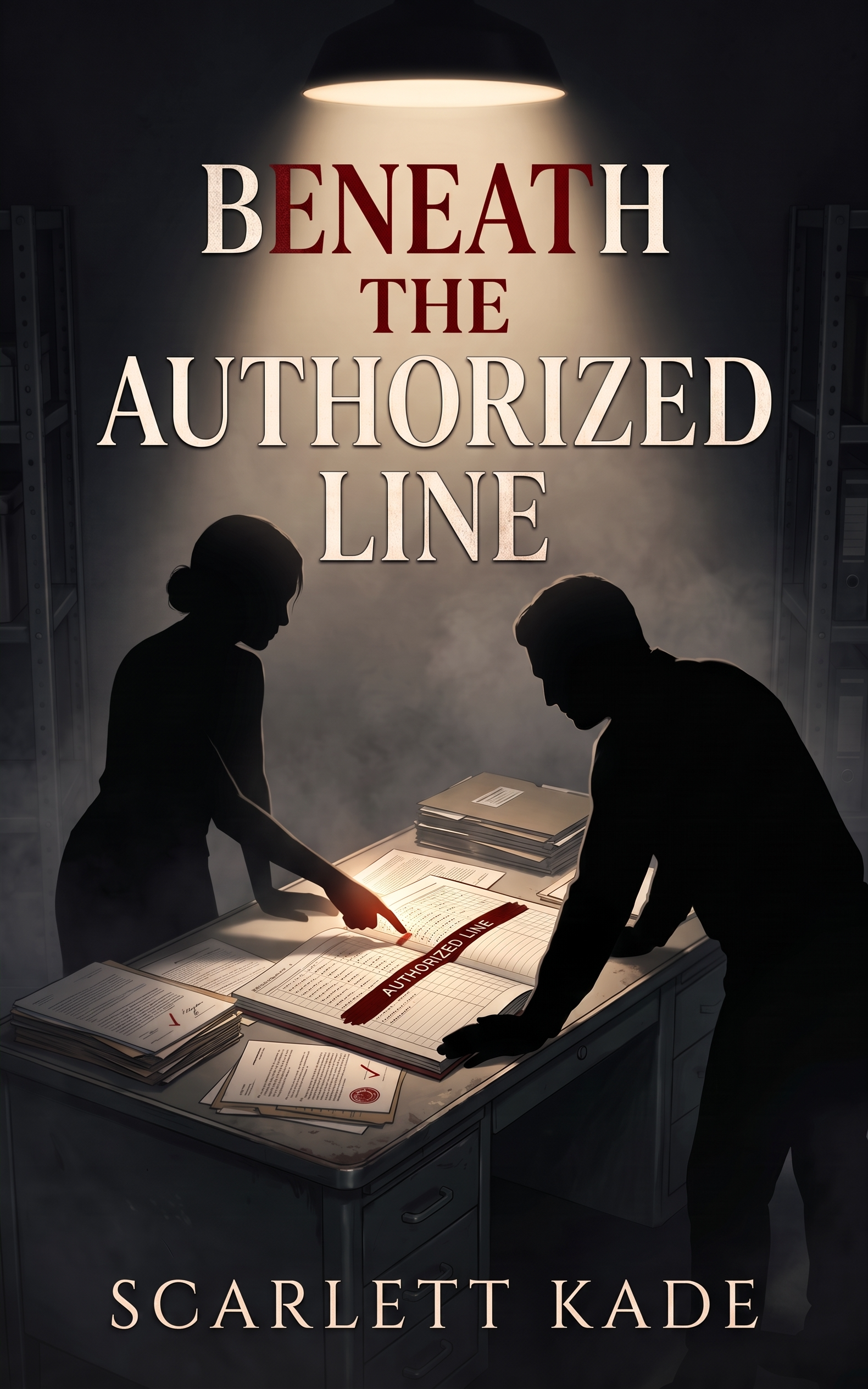
Beneath the Authorized Line
by Scarlett Kade
Matteo Rusk is trained to find the breach before it becomes a body count. As a Moretti internal-security investigations officer and breach-response lead, he trusts verified evidence, controlled access, and no one’s convenient story. Renata Sable audits the movement records that keep powerful people protected—and notices inconsistencies someone wants buried. Her work puts her inside the leak investigation, while her withheld context makes her loyalty impossible to read. Forced into reluctant cooperation, Matteo and Renata must test each other’s claims while an information pipeline threatens the organization from within. Suspicion becomes competence-based recognition, then earned trust, but the truth carries a cost neither can absorb alone. In a world where protection is never entitlement and every record can be weaponized, they must choose whether partnership is possible before the next breach closes around them.
- Romance
- Thriller
- Mafia Romance
- Dark Romance
- Contemporary Romance
- Slow Burn Romance
The assignment
The message arrived without a subject line.
Matteo Rusk read it once on the secure terminal, once from the printed page, and a third time with the screen dark.
A discrepancy had appeared in a movement record connected to a compromised Moretti information route. The record concerned access, transfer, and forwarding. The assignment required a breach-response review, immediate containment, and a determination of what could be verified before anyone decided what the discrepancy meant.
No conclusion had been attached.
That was the first thing Matteo trusted about it.
The second was the absence of a name.
Names made people careless. They invited the mind to build a story before the evidence had earned one. A name brought history, loyalties, debts, and old judgments into a room where all Matteo had was a line of data that did not belong where it had been placed.
He lifted the printed page and held it beneath the desk lamp.
The page contained less than a page of information. A reference to an internal movement schedule. A time window. An access notation. A forwarding marker that appeared to have been copied from one record into another. The entries did not contradict one another in any obvious way. That was what made them dangerous.
A clean lie was easier to find than a nearly clean one.
Matteo set the page beside the terminal and folded his hands. He had been given four things: a route designation, a date range, a record type, and an instruction not to escalate until the evidence had been personally verified. The instruction had come from above him, though the message did not say from where above. That, too, he let sit without weight. Authorization was a fact. The source of the authorization was not yet a fact he needed.
He allowed himself thirty seconds to consider what the discrepancy could mean, and then he stopped, because thirty seconds was the amount of time it took for consideration to become conviction, and conviction was the thing he was assigned to prevent in himself as much as in anyone else.
He had learned that the hard way, once. He did not revisit the memory. He simply respected the boundary it had taught him, the way a man who had broken a bone still favors the leg long after the break has healed, without needing to remember the fall each time he favored it.
Verified. Believed. Suspected. Inferred. Rumored. Unknown.
He wrote the six words on a fresh sheet of paper, in a column, the way he always did at the start of a review. Beneath each word he would place what belonged there, and nothing would move up the column until it had earned the move. It was a small ritual. It kept his hand from writing conclusions his evidence had not paid for.
Under Verified, he wrote: a movement record, connected to the compromised route, containing an access notation and a forwarding marker inconsistent with the record's stated origin.
Under everything else, he wrote nothing.
He picked up the internal line and requested archive access for the record's physical counterpart. Digital entries could be altered by anyone with the right permissions and enough patience to cover the alteration. Physical logs, stored two floors below the security division in a room built before anyone had thought to make paper obsolete, could still be altered, but the alteration left a different kind of trace. Ink did not lie the way a database did. It lied more slowly, and it lied with its hands.
The archive clerk on duty did not ask questions. He never did. He slid the request through the intake window, checked Matteo's credentials against the authorization on file, and disappeared into the stacks without comment. Matteo appreciated the silence. He had worked with men who felt obligated to fill quiet rooms with small talk, as if silence itself were evidence of something wrong. It wasn't. Silence was simply silence, and most of the truth in his line of work arrived without commentary.
Before the folder arrived, Matteo checked the authorization line again. The request allowed him to compare the physical counterpart with the digital entry. It did not authorize a broader personnel search, and it did not authorize him to treat the archive as a shortcut to a name.
He wrote that limitation in the margin of the request.
Scope: record comparison only.
The words looked almost unnecessary. That was how he knew they belonged there. A boundary was most useful before anyone felt tempted to cross it.
The clerk returned with a single folder, thin, bound with a cotton tie instead of a clasp. He set it on the counter and slid a log sheet toward Matteo for signature. Matteo signed, noted the time, and carried the folder to one of the small reading tables set against the far wall, away from the counter, away from the window, in the corner where the light was worst and the privacy was best.
He untied the folder with care.
Inside was the physical movement log, a printed manifest summary, and a forwarding authorization slip. The manifest concerned a transfer scheduled to pass through the Chicago rail terminal during a window that fell squarely within the compromised route's operational period. The log entry recorded who had accessed the manifest, at what time, and for what stated purpose. The forwarding slip recorded where a copy of that manifest had subsequently been sent.
Matteo read the log entry first.
The access time was logged correctly. The stated purpose matched a legitimate compliance function, the kind of routine audit check that happened dozens of times a week across the organization's logistics arm without anyone thinking twice about it. Nothing about the access itself raised a flag. People pulled manifests to confirm schedules, confirm cargo counts, confirm nothing more exciting than whether a shipment had left on time.
The forwarding slip was where the trouble began.
The slip recorded a secondary distribution of the manifest, a copy sent onward under a marker that, according to the compliance code printed at the bottom of the sheet, should only have been used for internal escalation between two specific departments. The marker on this slip had been used correctly in form and incorrectly in substance. It was the right stamp on the wrong document, or perhaps the right document routed to the wrong place under a stamp that made the routing look ordinary.
Matteo studied the marker for a long moment, turning the slip under the desk lamp the way he had turned the printed page in his office an hour earlier.
It was not a forgery. That was his first read, and he made himself test it twice before he trusted it. The ink matched the stamp used elsewhere in the archive during the same period. The pressure and alignment matched a hand accustomed to using the stamp correctly, not someone fumbling with an unfamiliar tool. Whoever had applied the marker to this slip had applied dozens like it before, on documents where the marker belonged.
Which meant the anomaly was not in the stamp. It was in the decision to use it here, on this manifest, at this time, for a document that had no obvious reason to be escalated between those two departments at all.
He set the slip down and returned to the log entry, checking the access record against the manifest's own routing history, a longer document folded into three sections at the back of the folder. The routing history showed the manifest's ordinary path: origin, initial audit, storage. It did not show a step that would have justified the escalation marker. There was no incident flag, no compliance exception, no note from a supervisor requesting secondary review. The manifest, by every visible measure, had been an unremarkable shipment record, and it had been forwarded as though it were not.
Matteo sat back in the hard chair and let the fluorescent hum fill the space where his thoughts would otherwise have started running ahead of the evidence.
A record had been accessed for a legitimate reason. Somewhere in that legitimate access, or shortly after it, someone had used a valid internal marker to send a copy of that record somewhere it had no procedural reason to go. The access itself was clean. The forwarding was not. And nothing in the paperwork told him whether the person who accessed the manifest was the same person who had applied the marker, whether the forwarding had happened by mistake, by habit, by instruction from someone else entirely, or by something worse.
He wrote under Verified: the manifest's access record is consistent with routine compliance function. The forwarding marker is procedurally valid in form but unsupported by any documented justification in the routing history.
Under Suspected, after a long pause, he wrote: the forwarding may represent an unauthorized secondary distribution connected to the compromised route.
He looked at the word Suspected and did not like how close it sat to the top of the page. He had promised himself the column would only move as fast as the evidence moved it, and the evidence had moved fast this time, faster than he liked. That unease was itself useful information. It told him the discrepancy was not trivial. It also told him to be careful, because urgency was the emotion most likely to make a careful man skip a step. He closed the folder and retied the cotton band, though he did not return it to the clerk yet. Before he handed anything back, he needed to know one more thing: whether this manifest, this specific transfer through the Chicago rail terminal, had crossed any other desk in the organization during the compromised window. If it had touched only one hand, the discrepancy might be a single error, a misapplied stamp, a moment's carelessness by someone under too much pressure and not enough sleep. If it had touched more than one hand, the discrepancy became a pattern, and patterns were the only thing in his line of work that mattered more than individual mistakes.
He carried the folder back to the intake counter and requested the full custody chain for the manifest, every hand that had touched it from origin to storage, cross-referenced against personnel schedules for the compromised window. The clerk took the request without expression and told him it would take longer, that a custody chain pull required a second authorization tier that Matteo's current clearance covered but that would need to be logged separately, with its own timestamp, its own record of who asked and why.
Matteo signed the second authorization without hesitation. He understood the layering. Every request left its own trace, and every trace could later be checked against every other trace, which meant that even his own inquiry into the discrepancy would become, eventually, a record someone else could audit. He did not mind. A man with nothing to hide left a clean trail behind his questions, and if the day ever came when someone reviewed his conduct in this matter, he wanted that trail to show exactly what it showed now: a methodical man asking narrow questions in the correct order, refusing to leap.
While the clerk processed the second request, Matteo returned to the reading table and opened his own notebook, the one he kept separate from any official file, the one that existed only to hold the questions he had not yet earned the right to ask out loud.
Who else touched this manifest.
Why this manifest, out of the dozens that moved through the same terminal in the same window.
Whether the marker had been used elsewhere, on other records, during the same period, in a pattern rather than a single instance.
He did not write a name in the notebook. There was no name to write. That absence sat with him differently than it had in his office an hour earlier, when the missing name had felt like a kindness, a way of keeping his mind clear. Down here, in the cold light of the archive, the missing name felt like the beginning of a much longer list, a list that would eventually require names whether he wanted them or not, because records did not forward themselves. Somewhere behind the marker on that slip was a hand, and behind the hand was a decision, and decisions belonged to people. He was not ready to think about which people. Not yet. He had one verified fact, one procedurally troubling gap, and a request for a custody chain that would either confirm the discrepancy as isolated or reveal it as something wider. Anything past that point was architecture built on sand, and Matteo Rusk did not build on sand. He had learned that lesson once, thoroughly enough that the memory no longer needed to surface for the caution to hold.
The clerk returned sooner than promised, which meant either the request had been simple to fill or someone above Matteo had flagged the inquiry for priority handling. He did not ask which. He accepted the second folder, thinner than the first, and carried it to the same table in the same corner, because a man who changed his habits in the middle of a review was a man inviting his own bias to find a new angle to work from.
The custody chain confirmed what the routing history had already suggested. A small number of individuals had handled the manifest between its origin and its storage, each recorded with a time and a stated function, each function ordinary on its face. No name jumped out as anomalous. No single entry showed a person outside their normal duties. The chain, in other words, told him nothing that resolved his suspicion and nothing that dismissed it either. It only confirmed that whatever had happened, had happened inside the ordinary machinery of the organization, using ordinary access, by someone who understood the machinery well enough to move through it without triggering an obvious alarm.
That, more than the marker itself, was the detail Matteo carried back up the stairwell an hour later, when he returned both folders to the archive counter and signed the release log a final time.
Whoever had forwarded that manifest under an internal marker it did not deserve had known exactly how the marker was supposed to be used. They had known which two departments it typically connected. They had known how to make an unauthorized distribution look, to a first read, like nothing more than a routine escalation. That kind of knowledge did not belong to an outsider. It belonged to someone inside the compliance structure itself, someone who moved through movement records the way Matteo moved through evidence columns, someone fluent in the language of the very system meant to catch them.
He climbed back to his office, closed the door, and sat with the six words still written at the top of his private column.
Verified. Believed. Suspected. Inferred. Rumored. Unknown.
He added one new line beneath Suspected: the individual responsible for the forwarding likely holds legitimate access to movement and compliance records, and understands their internal use well enough to disguise an unauthorized distribution as a routine one.
He did not write a name.
He still did not have one, and even if a name had surfaced in the custody chain, he would not have moved it up the column on the strength of proximity alone. Proximity was not proof. Access was not guilt. A hundred people touched compliance records every week without ever bending a single procedure out of shape, and Matteo had built his entire method on refusing to let the fastest story win simply because it arrived first. What he had, at the end of the day, was a confirmed procedural gap connected to the compromised route, a forwarding pattern that pointed toward someone fluent in the system rather than a stranger exploiting it from outside, and a rising, disciplined suspicion that the breach he had been sent to investigate ran closer to the organization's own compliance structure than the original message had let him assume.
That suspicion was not proof.
It was not even close to proof.
But it was enough, finally, to justify the next authorization he would need to request, and enough to keep him at his desk long after the building around him had gone quiet, staring at a column of six words and a single unfilled line where a name would eventually have to go.
The audit trail
The discrepancy was not loud. Renata Sable had learned long ago that the records worth worrying about never were. A number that jumped off the page announced itself, invited scrutiny, got caught. The ones that mattered slid past on the strength of looking correct, the way a counterfeit bill passes because the paper feels right in the hand and no on…