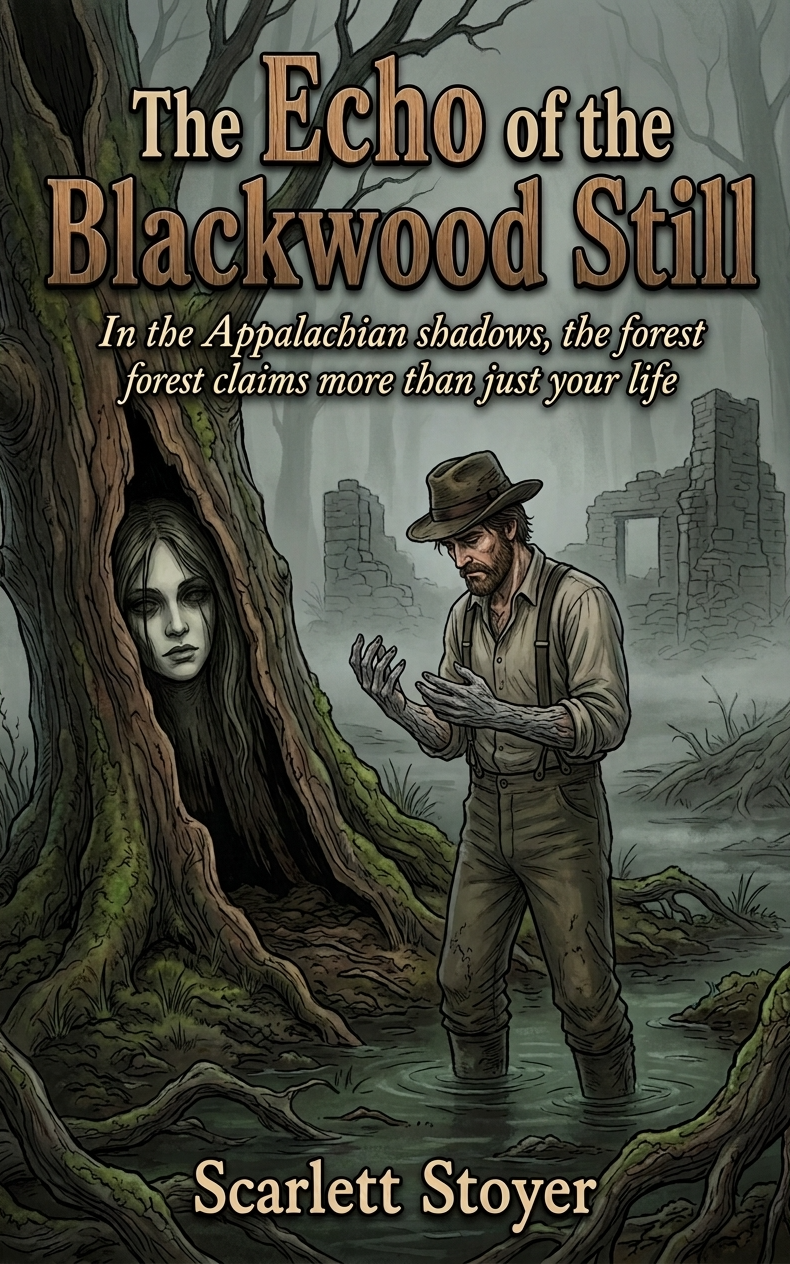
The Echo of the Blackwood Still
In the Appalachian shadows, the forest claims more than just your life
by Scarlett Stoyer
The woods have a memory, and they are hungry for a new shape. Philadelphia, 1892. Silas Vance is a man hollowed out by scandal. A disgraced taxidermist with a ruined reputation, he flees to a remote Appalachian valley to harvest rare peat moss for a wealthy collector. It is his final chance at redemption, but the soil holds secrets more ancient than the trees. While digging near the ruins of an abandoned distillery, Silas unearths a hollowed-out trunk containing a woman named Cora. She is perfectly preserved, yet something is deeply wrong. She mimics his heartbeat. She repeats his words. As Silas becomes obsessed with his find, the transformation begins. His skin turns to gray bark, his reflection shifts into Cora’s likeness, and his lungs fill with the suffocating scent of sawdust. Local woodsmen speak of the Distiller—a man who traded his soul to the forest to steal the identities of the living. To stop his body from turning to timber, Silas must trek into the heart of the Blackwood Still to find a hidden grave. But the forest is patient, and it does not like to give back what it has claimed. Scarlett Stoyer delivers a chilling masterpiece of folk horror that asks: what happens when your own nature turns against you?
- Horror
- Historical Fiction
- Folk Horror
- Gothic Horror
- Supernatural Horror
- Victorian
The Formaldehyde Ghost
The wagon driver did not look at Silas Vance when he spoke, nor did he look at the valley that yawned before them like a gargantuan, moss-slicked throat. He merely gripped the reins of his shivering team, his knuckles white against the rough leather. The air here was different from the soot-clogged winds of Philadelphia. It was heavy, wet, and carried a cloying sweetness that reminded Silas of fruit left to rot in a cellar. It was a suffocating atmosphere that seemed to press against the lungs before one even drew a breath.
"You’ll want to be inside before the light goes, Mr. Vance," the driver said, his voice a low rasp that barely rose above the creak of the wooden wheels. "The timber... it has a way of talking when the sun dips. Best not to listen. Best to keep your ears stopped and your door bolted."
Silas adjusted his wire-rimmed spectacles, his long, skeletal fingers brushing against the cold glass. His hands were a map of his profession, permanently stained a dull, jaundiced yellow by formaldehyde and the harsh tannins used in the preservation of hides. He looked at the driver with a gaze that had long ago lost its warmth, a clinical stare that saw muscle and bone where others saw a man. "I am a man of science, sir," Silas replied, his voice clipped and formal. "Timber does not talk. It decays, it grows, and it provides shelter. Anything else is merely the wind or the overactive imagination of the uneducated."
The driver didn't argue. He simply spat into the mud and flicked the reins. When the wagon reached the edge of the clearing, he didn't wait for Silas to unload his trunk with care. He heaved the heavy leather case onto the damp earth with a dull thud and turned the horses around before the dust had even settled. Silas stood alone, the silence of the Blackwood Valley rushing in to fill the space where the wagon's clatter had been. It was late autumn, 1892, and the world felt as though it were being slowly drained of its color.
Silas turned toward his new residence. It was a rotting structure, a cabin that seemed to be sinking into the dark, loamy earth near the edge of a stagnant creek. The logs were slick with a prehistoric-looking moss, and the roof sagged like the spine of an old, dying beast. He picked up his specimen case, the weight of the scalpels and jars inside a familiar comfort. This was his exile, his penance for the scandal that had stripped him of his laboratory and his reputation. The Thorne family had offered him a way back—a chance to harvest the rare peat mosses of the valley for their collection—and Silas was not in a position to refuse, no matter how much his soul recoiled at the isolation.
As he stepped onto the porch, the wood groaned beneath his high boots, a sound like a pained intake of breath. He pushed the door open and was immediately hit by the scent of old damp and wood rot. It was a thick, physical presence that coated the back of his throat. He set his case down on a scarred table and began to unpack. Out came the Victorian frock coat, heavy and smelling of cedar and chemicals. He laid out his tools with a meticulousness that bordered on the obsessive: the silver-handled scalpels, the tweezers, the glass vials that would soon hold the secrets of the Blackwood soil.
He paused when he heard a sound from outside. It wasn't the wind, and it wasn't the rustle of leaves. It was a sharp, rhythmic clicking. Silas walked to the door and looked up at the skeletal branches of the trees that hemmed in the clearing. A dozen birds sat there, their feathers a dull, oily black. They were not singing. They didn't chirp or warble. Instead, they clicked their beaks in a precise, mechanical cadence. Click-clack. Click-click-clack. It sounded like the ticking of a thousand pocket watches, a cold and artificial noise that set his teeth on edge. Nature here seemed to have forgotten its own music, opting instead for the mimicry of gears and levers.
"Fascinating," Silas whispered, though a cold shiver traced a path down his spine. He reached for his notebook to record the behavior, but his hand hesitated. The birds stopped their clicking all at once, their heads swiveling in perfect unison to look at him. Their eyes were like pinpricks of obsidian, devoid of the spark of life. Silas retreated into the cabin and closed the door, sliding the rusted bolt home.
As night descended, the valley transformed. The shadows didn't just grow long; they seemed to thicken, becoming a physical substance that pooled in the corners of the room. Silas lit a single tallow candle, the flame flickering in the drafts that whistled through the gaps in the logs. He sat at the table, trying to focus on the terms of his contract, but his attention was pulled toward the floorboards. From deep within the earth, a sound began to rise. It was a heavy, rhythmic thrumming, like the beat of a gargantuan drum buried miles beneath the peat.
Thump-thump. Thump-thump.
Silas pressed his hand to his chest. His heart was racing, a frantic bird against the bars of its cage. To his horror, he realized the rhythm from the earth was shifting. It slowed, then pulsed, then settled into a steady cadence that matched his own heartbeat with terrifying precision. Every time his heart skipped a beat in fear, the earth mirrored the hesitation. It was a geological impossibility, yet the vibration was real enough to rattle the glass jars on his table.
He stood up, his legs feeling like lead, and moved to the window. The moon was a pale, sickly sliver behind the clouds, but there was enough light to see the treeline. He gasped, his breath fogging the glass. When he had arrived, the wall of oaks and hemlocks had been at least fifty yards from the porch. Now, they seemed to have crept forward, their gnarled roots clawing at the edge of the clearing. The trees leaned inward, their branches interlacing like the fingers of a giant's hand, effectively blocking out the horizon. The forest was no longer a backdrop; it was a cage.
"It is an optical illusion," Silas muttered, his voice cracking. "The shift in light, the density of the fog... it distorts the perception of distance."
He sat back down at the table, his breath coming in short, ragged gasps. He needed to write to the Thorne family. He needed to report his arrival and the commencement of his work, perhaps to anchor himself to the world of the living and the rational. He pulled a sheet of parchment toward him and dipped his pen into the inkwell. But as he tried to form the first letter, his hand began to shake with a violent, uncontrollable tremor. It was as if his very bones were vibrating in sympathy with the drum in the earth.
The pen jerked across the page. A glob of dark ink spattered the white surface, fanning out in a jagged, irregular pattern. In the dim candlelight, it didn't look like ink at all. It looked like a fresh arterial spray, a dark red stain that mocked his attempts at composure. Silas stared at the mess, his mind spiraling back to the scandal in Philadelphia—the smell of the illegal specimens, the way the flesh had felt under his knife, the cold realization that he had crossed a line he could never uncross.
He looked at his hands. Under the yellow stains of the formaldehyde, his skin looked pale, almost translucent. He could see the veins beneath, blue and pulsing. He felt a sudden, irrational urge to peel back the skin to see if there was wood underneath instead of muscle. The thought was a fever dream, a manifestation of the isolation, yet he couldn't shake the feeling that the valley was watching him, waiting for him to break.
The clicking of the birds started again outside, louder now, a frantic staccato that filled the cabin. Silas blew out the candle, unable to bear the sight of his own shaking hands. He sat in the darkness, the heavy drum of the earth beneath him and the mechanical birds above him, wondering if the dawn would ever come, or if the Blackwood Valley had already decided to keep him for its own collection.
The Collector's Debt
The first grey light of dawn did not so much break over the Blackwood Valley as it did seep through the canopy like woodsmoke. Silas Vance had not slept. He had spent the remaining hours of the darkness sitting upright in a ladder-back chair, his fingers tracing the cold, oily steel of a scalpel he had kept unsheathed on the table. The rhythmic dru…