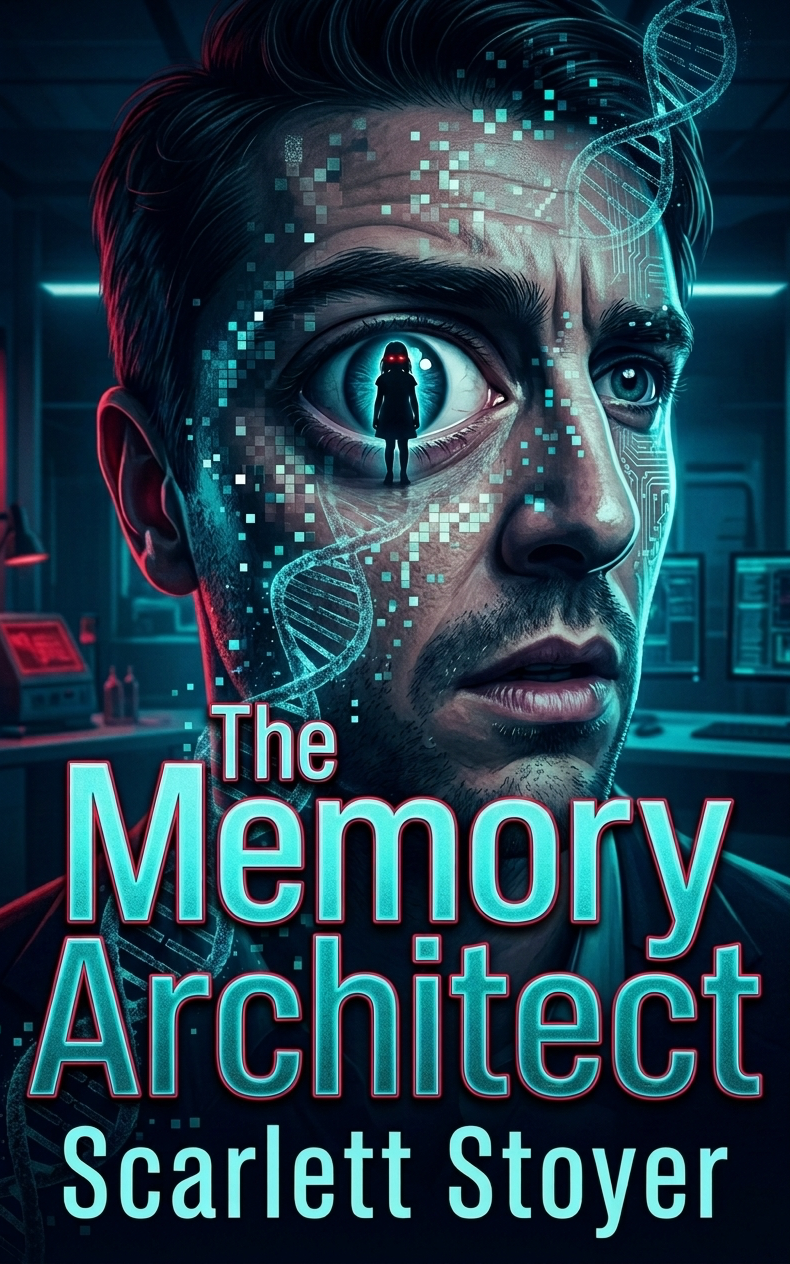
The Memory Architect
Your memories are his masterpiece, but his own life is a carefully constructed lie
by Scarlett Stoyer
At Aethelgard Genetics, Aris Thorne is a master of nostalgia. As a forensic architect, he designs flawless digital memories for the wealthy, allowing them to inhabit childhoods they never truly had. But perfection has a glitch. A mysterious girl with crimson eyes is appearing in unrelated simulations, a ghost in the machine that Aris can’t explain. When he tries to delete the anomaly, the world he knows begins to dissolve. His laboratory access is revoked, his bank accounts are emptied, and his very identity is erased from the national database. Aris is no longer a citizen—he is a security threat. On the run through a rain-slicked city that doesn't recognize him, Aris discovers a terrifying truth: his own memories of a lonely childhood were manufactured in the very labs where he worked. The red-eyed girl isn't a coding error; she is a biological prototype and the key to a conspiracy that spans decades. With the ruthless Detective Silas Kray closing in, Aris must infiltrate the heart of Aethelgard to reclaim his past. But in a world where memories can be built and deleted, how do you know who to trust—especially when you can’t even trust yourself?
- Thriller
- Science Fiction
- Psychological Thriller
- Conspiracy Thriller
- Near Future
- Genetic Engineering
The Crimson Glitch
The memory smelled like cut grass and chlorine.
Aris Thorne leaned back in his ergonomic chair and let the render breathe, watching the simulation unfurl across his three monitors in real-time. A suburban backyard, circa 1994. A sprinkler arcing lazy parabolas over a sun-bleached lawn. A woman in a floral sundress — the client's mother, reconstructed from a handful of faded photographs and a forty-minute intake interview — standing at a screen door with a glass of lemonade. The light was perfect. The shadows fell at exactly seventeen degrees, consistent with a July afternoon at this latitude. He had calibrated it down to the hum of cicadas in the oak tree, cross-referenced against regional entomological data from that decade.
This was what Aris did. He built the past.
Aethelgard Genetics marketed it as "experiential heritage restoration," and the clients — the wealthy kind, the kind who could afford gene-sequencing vacations and neural-link subscriptions — paid extraordinary sums to have their haziest, most precious recollections rendered into something they could actually inhabit. Aris found the whole enterprise vaguely cynical. He also found it immaculately satisfying, the way a watchmaker might feel satisfaction: not in the watch's purpose, but in the precision of its gears.
He tapped his temple twice, a habit he'd developed sometime in his mid-thirties that he'd never managed to shake, and zoomed the viewport into the far-left corner of the yard.
He almost missed her.
She was standing at the edge of the fence line, half-obscured by the shadow of the oak tree, perfectly still in a way that no child ever actually stood. A yellow sundress, slightly stained at the hem. Hair the color of winter. And her eyes — even rendered small in the corner of the frame, even at forty pixels wide — were wrong. They were red. Not the warm hazel or watery blue that populated his asset libraries. A deep, arterial crimson, like something biological and alarming.
Aris sat forward.
He pulled up the scene's asset manifest and scrolled through it methodically. Lawn. Sprinkler model. Oak tree, variant B. Mother character, custom build. Lemonade glass, prop class. There was no child asset in this scene. He had not placed one. His source code contained no reference to a child character at all.
"What the hell are you," he said to the empty lab.
The lab gave no answer. It was 11:40 p.m. and the Aethelgard simulation floor was deserted, lit only by the cold blue glow of idle workstations. He was always the last one here. He was always the last one everywhere.
He ran a string check, then a dependency audit, methodically peeling back layers of code looking for an orphaned asset, a corrupted import, a rogue texture file that had hitched a ride from somewhere. Nothing. The girl existed in the render and nowhere else in the data architecture. She was a ghost in his machine, which was not technically possible, and Aris distrusted things that were not technically possible.
He opened his archive and pulled up the last two completed projects. A wedding memory for a client named Hargrove. A graduation sequence for a woman named Dietrich, class of 2019, reconstructed from a campus she had described as "a little blurry, honestly." He loaded both renders side by side and began scanning backgrounds with the methodical patience that made him good at this job.
The girl was at the Hargrove wedding. Standing behind a row of folding chairs near the garden wall, half-turned, watching the ceremony with those unnatural red eyes. She was at the Dietrich graduation too, visible for less than three seconds of runtime, at the edge of the bleachers in the same stained yellow dress.
Aris sat very still for a long moment. He tapped his temple three times.
Three unrelated clients. Three separate projects, each built from scratch in an isolated rendering environment. The girl had no source file, no assigned metadata, no generation timestamp. She had simply appeared, the same way a crack appears in a wall: quiet, patient, and structurally significant.
This isn't a rendering error, he thought. It's a signature.
He tagged all three instances for immediate deletion, flagged the anomaly in the project logs with a priority-one marker, and submitted the purge request. The system processed for two seconds, which was two seconds longer than it should have taken, and then returned a dialogue box he had never seen before in eleven years of working at Aethelgard.
ADMINISTRATIVE OVERRIDE — ACCESS RESTRICTED. CONTACT SYSTEM ADMINISTRATOR.
He tried again. Same result. He tried routing the deletion through the maintenance terminal on the adjacent workstation. The override followed him there too, as if it knew where he was sitting. He stared at the message until the words stopped meaning anything, then shut down his monitors and gathered his jacket from the back of his chair.
Outside, the city was cold and close, towers of glass and steel rising against a smudged orange sky. He walked the six blocks to his apartment building with his hands in his pockets, running the code architecture over in his head the way other people counted sheep. By the time he reached his door, he had convinced himself there was a rational explanation. Some kind of administrative lock placed on client files during a compliance review. It happened occasionally. He would sort it out in the morning.
He sat at his kitchen desk and opened his personal cloud account, intending to distract himself with old photographs, the handful of images from his childhood at the Linden Street group home that he kept in a private folder. Something to remind himself of solid ground.
The login screen rejected his password.
He typed it again, carefully. Rejected. He requested a recovery link to his registered email address. The system returned a message informing him that no account matching his credentials existed in the database.
Aris looked at the screen for a long time. He told himself it was a server lag. A routine sync error. These things happened. He closed the laptop and went to bed, and if some part of him recognized that the ground had already shifted beneath his feet, he was too tired — or too afraid — to name it.
In the dark behind his eyelids, a girl in a yellow sundress stood very still at the edge of a fence, watching him with red eyes that did not blink.
The Cold Shoulder
He arrived at 6:40 a.m., a full ninety minutes before the building's general population trickled in. The lobby's biometric turnstile read his palm and let him through without hesitation, which felt, in some small way, like the last normal thing that would happen to him all day. Sterling's office was on the fourteenth floor, behind a corridor of fr…