

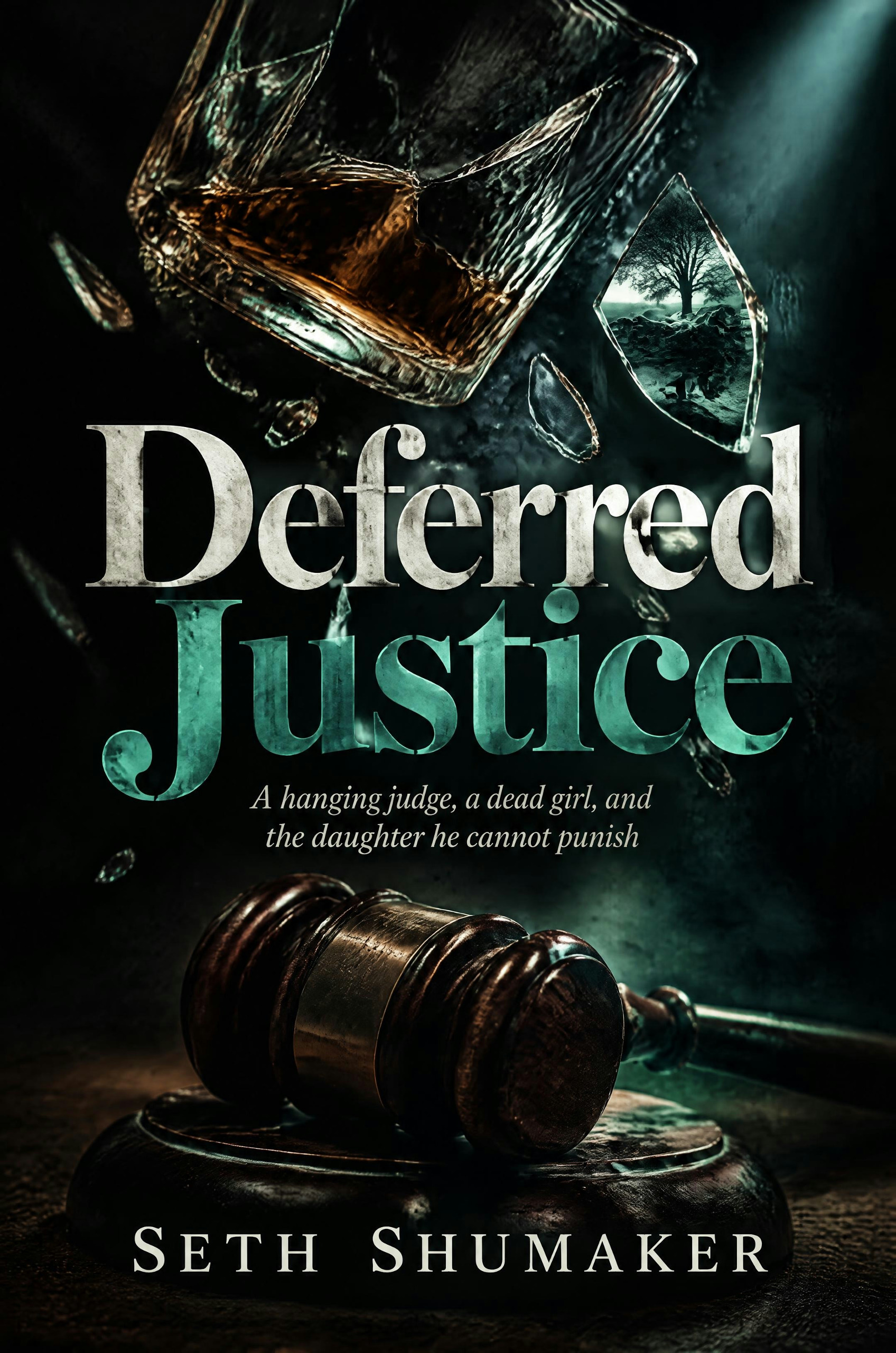
Deferred Justice
A hanging judge, a dead girl, and the daughter he cannot punish
by Seth Shumaker
Circuit Judge Gerald Pendleton built his name on putting drunk drivers in prison. In rural Blackwood County, that reputation is the law. Then his sixteen-year-old daughter, Lois, wraps her sedan around an oak after a party. Her best friend, Chloe Miller, dies on impact. Gerald reaches the wreck before the sirens. He hides the empty vodka bottles. He tells himself he is protecting his child. What he is protecting is a thirty-year legend. To keep Lois off a felony docket, he cuts a quiet deal with Walter Crosby, a defense attorney who has wanted leverage over the bench for decades. They import an ambitious city prosecutor hungry for the county's inner circle, and they recruit a compliant associate judge who owes Gerald her seat. In closed chambers they stitch together a deferred prosecution and community service. No conviction. No scandal. The machine holds. Lois wants to confess. An investigative reporter is counting minutes in the crash timeline. Walter starts collecting favors for his worst clients. Gerald learns what it costs to keep a girl out of prison: he has to corrupt the system he spent a lifetime building. Deferred Justice is a legal thriller about power, guilt, and the moment a hanging judge discovers he is not above the law he sold.
- Thriller
- Mystery
- Literary Fiction
- Legal Thriller
- Crime Thriller
- Legal Mystery
The Wreck on Miller's Creek
The telephone on the bedside table rang four times before the sound cut through Gerald Pendleton's sleep. He reached across the mattress with the practiced, economical motion of a man who disliked wasted effort, lifting the receiver to his ear while the grandfather clock in the downstairs hallway began its slow chime for midnight. Outside the bedroom window, rain beat against the heavy glass in long, sweeping sheets that rattled the sash.
"Gerald Pendleton," he said, his voice level and dry, already clearing the fog of rest.
The sound on the other end was not speech. It was a jagged, sucking gasp, wet and frantic, followed by a scream that sounded torn out of raw meat. For three seconds, he listened to the metallic shriek of rain against a car roof and the stutter of someone choking on their own tongue.
"Lois," he said, sitting upright. The linen sheets pooled around his waist. "Lois, speak clearly. What is your location?"
"Dad," she choked out. The connection buzzed with static, then dropped down into a low, breathless whimper that set his jaw tight. "Dad, the tree. The tree by the creek. Chloe won't move. She won't wake up, Dad. There's blood on the glass. There's so much blood on her face."
"Listen to my voice," Gerald said. His tone dropped an octave, slipping instinctively into the cold, measured cadence he used when sentencing men to ten years at hard labor in the state penitentiary. "Stop crying and listen. Are you on Miller's Creek Road?"
"The big oak," she wept, the phone rattling violently against what must have been her teeth. "Past the culvert. I tried to turn. The wheel wouldn't turn, Dad, it wouldn't turn, and we hit it so hard—"
"Did you dial the county dispatcher?"
"No. I called you. I called you first."
"Do not call them," Gerald ordered. He swung his long legs over the side of the bed. His bare feet met the cold pine floorboards. "Do not dial nine-one-one. Do not leave the vicinity of the vehicle. Stay off the phone until I arrive. Lois, do you understand my instruction?"
A wet sob was her only answer before the line died.
Gerald set the receiver into its cradle without haste. His mind moved in clean, geometric lines, discarding panic before it could take root in his chest. He stood, dressing in the dark from long habit: wool trousers, thick woolen socks, heavy leather boots, and a dark canvas barn coat that had hung on the mudroom peg since last winter. On his way down the corridor, he did not look toward his daughter's empty bedroom. In the kitchen, he snatched his heavy brass flashlight from the drawer beside the sink and took the keys to the Lincoln Town Car from the pewter bowl on the sideboard.
The garage door groaned upward, exposing the driveway to a downpour that turned the gravel into a brown slurry. He backed down the drive, shifted into drive, and accelerated into the dark country roads of Blackwood County.
The wipers fought a losing battle against the deluge. Water pooled across the blacktop of State Route 9, reflecting the yellow glare of his halogen headlamps in long, oily ribbons. For twenty years, Gerald had ruled the county courthouse from an elevated mahogany bench, earning an untouchable reputation across the state for his zero-tolerance policy on vehicular offenses. In his courtroom, men who blew over the limit did not receive deferred dispositions or second chances. They received maximum statutory sentences, delivered with sharp lectures on civic responsibility and personal accountability. He had sent fathers of four to county work farms for second-offense misdemeanors. He had broken young men who wept before his rail, telling them that the integrity of the law was absolute, an immutable standard that spared neither rich nor poor.
He turned hard onto Miller's Creek Road. The tires lost grip for half a second on the wet shoulder before the heavy sedan righted itself. The road narrowed here, winding through thick stands of loblolly pine and black walnut where county maintenance crews rarely bothered to paint fresh center lines. The creek ran parallel to the asphalt forty feet down a steep, weed-choked ravine that swallowed the light from his high beams.
A mile past the old Miller homestead, the headlights caught the jagged reflection of safety glass scattered across the pavement like coarse rock salt.
Gerald slowed the car to an easy halt fifty yards back. He left his parking lights on and took the heavy flashlight from the passenger seat. Stepping out into the rain, the cold water soaked through the canvas of his coat within seconds, plastering his silver hair to his forehead. The air smelled of gasoline, burnt rubber, and crushed pine needles.
The blue sedan sat crumpled against the ancient white oak that anchored the outside bend of the creek curve. The front bumper had collapsed inward like an accordion, folding the hood back toward the cracked windshield. Steam still drifted from the cracked radiator core, hissing softly against the falling rain.
Gerald stepped through the slick mud of the shoulder. "Lois?" he called out, his voice sharp and controlled.
A shape moved near the rear fender. His daughter was sitting on the wet clay, her back pressed against the trunk of the crushed car. She was wearing an oversized collegiate sweatshirt that hung loose on her narrow frame, the front soaked with road grime and dark red spatters that were still tacky. Her right wrist was bent at a sickening, unnatural angle, already swelling beneath the sleeve. A deep laceration across her left temple bled freely into her hairline, staining the pale skin of her neck.
"Dad," she whispered. Her lips were gray, shivering uncontrollably. "Dad, she won't move."
Gerald did not touch her immediately. He directed the beam of his flashlight past her, illuminating the passenger side of the vehicle. The door had been driven inward three feet into the cabin. Inside, sitting entirely motionless beneath the buckled roof, was Chloe Miller. The girl's head was thrown back against the torn fabric of the headrest at an angle that no human neck could survive. A thick, dark stream of blood had run from her nose into her open mouth and dried across her chin. Her eyes were wide, glassy, and fixed on the exposed wiring of the dome light. There was no breath in her chest. There was no pulse in the pale throat when Gerald reached through the shattered window frame and pressed two fingers beneath her jawline. The skin was already cool to the touch.
Death had been instantaneous. The sheer violence of the deceleration had crushed the passenger compartment like an empty tin can.
Gerald pulled his hand back. He wiped his fingers against the wet canvas of his coat. A cold tightness seized his chest, not of fear, but of absolute calculation. Chloe Miller was the daughter of Dan Miller, a man who had served on Gerald's campaign committee fifteen years ago, a man who owned the county feed mill and sat in the front pew of the Methodist church every Sunday morning.
He turned the beam of the flashlight back into the cabin, pointing it down into the driver's footwell.
There, resting against the twisted clutch pedal and the crushed console, were two glass fifths of cheap vodka. One was shattered, its sweet, medicinal stench filling the enclosed interior, masking even the metallic odor of Chloe's blood. The second bottle was intact, half-empty, sloshing gently in the puddle of rainwater gathering on the rubber mat.
Gerald looked back down at his daughter. He knelt beside her in the mud, bringing his face close to hers. The sour, burning stink of cheap alcohol rolled off her breath with every ragged gasp she took.
"Lois," he said, keeping his voice dead and steady. "How much did you drink?"
"We were at the quarry," she sobbed, rocking back and forth, clutching her broken arm against her stomach. "Just some cups. Just two cups with orange juice. I told her I could drive. I told her the roads were fine, Dad. I killed her. Oh God, I killed Chloe. Please tell me she's just knocked out. Please, Dad, go help her—"
"Quiet," Gerald commanded. The word was a slap. She flinched, shrinking back into the mud.
"Listen to me," he said, staring directly into her wide, terrified eyes. "You will not say those words again. You will not repeat that sentence to anyone who approaches this car. Do you understand what happens to a driver who kills their passenger with alcohol in their blood in this county?"
Lois stared at him, her chest heaving, tears washing pale tracks through the blood on her cheeks. "Dad, please—"
"Felony vehicular manslaughter," Gerald said with chilling precision. "Ten to twenty years in the women's facility at Vandalia. Your life will end tonight on this road if you speak. Do you understand what I am telling you?"
She shook her head weakly, incapable of processing the words, caught in the grip of pure, animal shock. "I have to tell her mom. I have to tell Mrs. Miller—"
"You will tell no one," Gerald whispered. "Not tonight. Not tomorrow."
He rose to his feet. He did not look at the sky or hesitate to weigh the morality of the moment. Thirty years of stern, unyielding adherence to the criminal code evaporated in the space of three heartbeats, replaced by the primal necessity of preservation. He reached through the broken driver's side window, ignoring the jagged teeth of safety glass that caught on his canvas sleeve. He took hold of the intact vodka bottle by its neck, pulling it out into the rain. Then he reached down and gathered the larger fragments of the broken fifth, wrapping them tightly in an oily rag he pulled from the car's trunk.
Gerald walked with purposeful strides to the lip of the ravine. The creek surged thirty feet below, swollen by three days of relentless autumn rain, churning brown water and debris toward the river basin. With a clean, powerful swing of his right arm, he hurled the glass bottle far out over the dark void. A faint splash was swallowed entirely by the roar of the current. He tossed the wrapped shards after it, watching them vanish into the thick briars along the creek bank.
He returned to his daughter. He took a clean handkerchief from his trouser pocket and wiped the rain and blood from her forehead, pressing firmly on the cut to slow the flow. "A deer crossed the asphalt," Gerald said. His voice was steady, monotonous, drilling the words into her consciousness like an instructor before a deposition. "You were driving thirty miles an hour. You swerved on the slick blacktop to avoid the animal. The steering linkage failed. The car hydroplaned into the timber. Repeat it."
"I was drunk," she choked out, her voice rising into hysteria. "I can still taste it, Dad! I was driving too fast—"
Gerald grabbed her uninjured shoulder, his grip tightening until she gasped in pain. "You will not destroy this family," he said between clenched teeth, his hazel eyes cold as river stone behind his spectacles. "You will say what happened to the car, or you will rot in a cell before your seventeenth birthday. A deer crossed the road. The tires lost traction. You did not have a drink tonight. Lois, look at me."
She looked up at him, her mouth trembling, broken and entirely emptied of will. She nodded once, a faint, terrified jerk of her chin.
In the distance, the faint, wailing rise of a siren cut through the sound of the rain. The red and blue pulse of light began to flicker through the pine trees half a mile down the straightaway.
Gerald stood up, straightened his canvas coat, and walked to the edge of the asphalt to meet the approaching vehicle. His spine was rigid, his shoulders square, every trace of frantic motion purged from his frame. When the white cruiser of the Blackwood County Sheriff's Department pulled onto the shoulder, its spotlight sweeping across the shattered oak and the mangled sedan, Gerald was already standing in the center of the road, one hand raised with quiet, absolute authority.
Deputy Tom Vance killed the siren, leaving only the flashers revolving in the darkness. The young deputy stepped out into the rain, his yellow slicker shining, adjusting his duty belt with an anxious, uncertain hitch of his hip. When his flashlight hit Gerald's face, Vance froze, lowering the beam respectfully toward the judge's boots.
"Judge Pendleton?" Vance said, his eyes darting from Gerald to the crumpled wreckage behind him. "My God, sir. We got an open-line hang-up traced to this cell tower just ten minutes ago. What happened here?"
"It is my daughter's vehicle, Tom," Gerald said. His voice was perfectly modulated, projecting the somber, steady authority that had commanded courtroom number two for twenty years. "She was traveling home from the high school library study group. A buck came out of the timber just past the bend. She attempted to brake on the slick surface, but the rear tires lost purchase, and the steering box appears to have locked. She struck the tree."
Vance swallowed hard, stepping past the judge toward the wreckage. "Is anyone—"
"Chloe Miller was in the passenger seat," Gerald said, stepping alongside the deputy, his tone flat and grave. "She is deceased, Tom. Blunt force trauma to the cervical spine upon impact. There was nothing to be done for her."
Vance went pale under the rim of his Stetson. "Chloe? Dan Miller's girl?"
"Yes," Gerald said quietly. "It is an unspeakable tragedy. A horrific mechanical failure on an unlit county road. Lois is over there on the shoulder. She has a severe concussion and an open fracture of the radius. She is in profound medical shock."
Vance jogged over to the girl, dropping to one knee beside her. "Lois? Can you hear me, honey? The ambulance is about two minutes out. Just hold still."
Lois looked up at the deputy, her teeth chattering so hard the sound was audible over the rain. Her gaze drifted toward the passenger side of the car, where Chloe's body remained slumped in the shadows. "Tom," she whispered, her voice cracking. "I... I was going too fast. We were drinking... we were—"
Gerald stepped forward immediately, his heavy leather boot coming down firmly in the mud beside the deputy's knee. He placed a large, firm hand over his daughter's mouth, pretending to adjust the cloth against her bleeding temple while his fingers gripped her jaw with crushing force.
"She is completely delirious, Vance," Gerald stated, his voice cutting across the girl's mumbled protests with cold, immovable weight. "She has suffered a catastrophic head injury. Her statements are non-volitional and entirely incoherent. She has no idea where she is or what has transpired."
Lois tried to pull away from his hand, her muffled sobs choked off beneath his palm, but Gerald did not yield an inch. He kept his weight planted above her, his eyes locked on the young deputy.
Vance looked up, intimidated by the towering figure of the senior judge, a man who held the power to review every arrest warrant the sheriff's department filed in the county. "Yes, sir," Vance said quickly, backing away an inch. "Head injuries do that. People say all kinds of crazy things when they're rattled like this."
The distant roar of the county rescue unit grew louder, its twin sirens echoing off the limestone cliffs flanking the creek. The red wash of emergency lights painted the tree trunks in blood-colored strokes as the heavy ambulance turned onto the shoulder, followed closely by a second patrol cruiser.
Gerald did not remove his hand until the paramedics swung out of the cab with their trauma bags. When the lead medic, an older man named Higgins who had testified in Gerald's court dozens of times, hurried forward through the mud, Gerald took charge of the scene before a question could be asked.
"Higgins," Gerald said, stepping between the medic and the wreck. "Chloe Miller is gone. Focus all your attention on Lois. She has a traumatic head wound and is experiencing violent acute shock. She needs a sedative immediately to prevent further trauma-induced convulsions before you transport her to Memorial."
Higgins looked at the judge's grim, unyielding face, then down at the shivering girl who was trying to speak through her tears. "Understood, Judge. We'll get her stable right now."
The medic drew a pre-filled syringe from his kit, swabbed Lois's uninjured arm through a tear in her sleeve, and drove the needle home. Lois gasped once, her eyes widening in betrayal as she looked up at her father. Within twenty seconds, the tension leaked from her limbs. Her head lolled back against the wet trunk, her eyelids fluttering shut as the drug took hold, burying her confession beneath a thick, chemical silence.
Gerald stood over her as they loaded her onto the backboard, his face an impenetrable mask against the pouring rain. The secret was sealed beneath the black water of the ravine, and the machinery of his court was already turning to protect its own.
Hospital Chambers
The fluorescent lights of the trauma corridor hummed with an uneven vibration that Gerald felt behind his molars. Blackwood Memorial had not replaced the ballasts in ten years, and the white tiles below them smelled of cold chlorine and sour mop heads. He kept his spine straight against the wall outside Treatment Room 3, his heavy wool trousers sti…