

The Other End of the Pipe
The Practical Guide to Rural Sanitation, Septic Systems, and Off-Grid Wastewater Management
Most people only think about water when they turn on the faucet. But when municipal utilities do not exist, what happens after the drain is pulled determines whether a homestead thrives or faces catastrophic failure. The Other End of the Pipe provides a direct, comprehensive manual for mastering the complete household water loop on rural and self-reliant properties. Rather than relying on guesswork, this guide breaks down exact daily consumption volumes, revealing how to comfortably navigate dry spells on twenty gallons per person per day using the Half Bucket Method. Demystify the unseen mechanics beneath your property. Learn how to separate blackwater from graywater using gravity-fed wood chip mulch basins, preserve the delicate biological balance of your septic tank, and execute correct sizing and setback standards. For remote or off-grid sites lacking traditional plumbing, discover exact construction specifications for clean outhouses, emergency bucket setups, and controlled composting systems that eliminate odors and pests. From handling local health permits to following an all-season diagnostic maintenance playbook, this essential handbook ensures your property remains sanitary, self-sufficient, and protected against devastating drain field collapses.
- Instructional Guide
- Home Improvement
- DIY & Crafts
Section 1: The Cycle You Are Actually Running
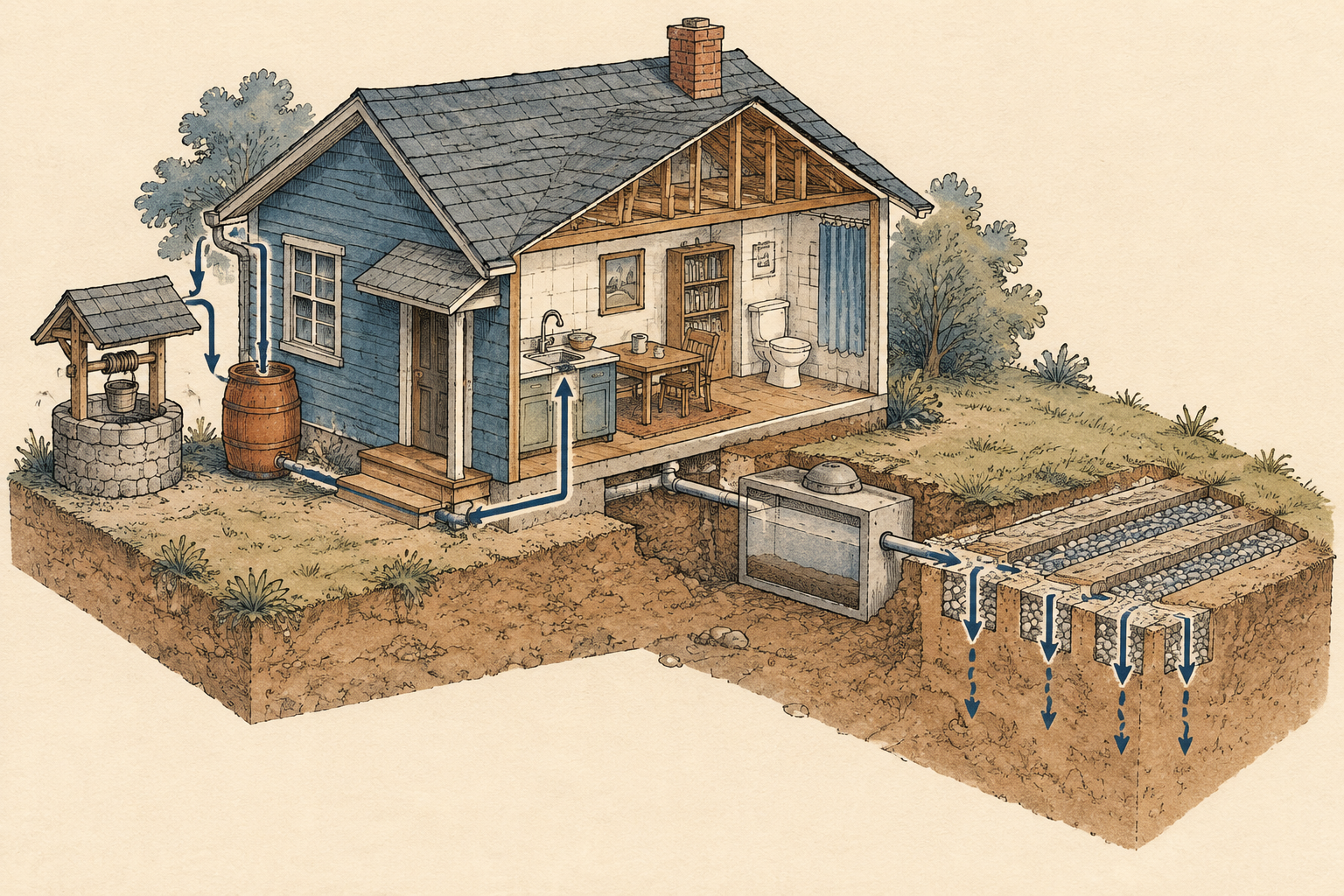
Most households think about water in one direction. Water comes in, it gets used, and the rest is somebody else's problem. That works while a utility owns the pipe. On land with a well, a tank and a drain field, it stops working, because the place the water goes is a system you own as well: a drain, a tank, a field, a patch of ground that takes what is left.
Think of your household as a loop with three points on it. What comes in. What gets used, and for what. What leaves, and where it lands. A household can spend years perfecting the first point, adding storage and pumps, and still be blindsided by the third, which is where most rural plumbing problems actually start.
The loop also sets a limit nobody mentions. Your well might make two hundred gallons a day and your drain field might take eighty. The lower number is your real household capacity, and it is almost always the field. Households learn this the week guests arrive, laundry runs all day and the downstairs drain starts gurgling.
So before anything else, measure the loop. Read your water meter or count what your pump delivers. Note the week your use was highest, since peak week is what your system actually has to survive. Then look at where it drains: a septic tank and field, an outhouse, a graywater line to a mulch basin, or a pipe to a municipal sewer if you are on the edge of town. Each of those has a limit, and none of them announce it.
Three numbers make the rest of this book easier. Gallons in per day. Gallons per person per day, which is the figure that lets you compare your household to a normal one. And gallons out, split into water that can go onto the ground and water that carries what the ground should not receive.
You will be able to state all three by the end of section 2. Most people cannot, and that gap is why the same problems repeat: a field that never recovers, a tank pumped more often than it should be, a smell that comes back every summer, a garden that gets a graywater dousing whether it needed one or not.
Two failures repeat often enough to name now, because both are cheap to prevent and expensive to fix. The first is overloading the field. A drain field infiltrates at a rate set by the soil under it, and once the soil is saturated faster than it drains, the water finds the surface instead. That shows up as a wet patch, then as a smell, then as a system the county wants replaced. The second is putting the wrong thing down the drain. Grease, wipes, medicine and harsh cleaners cost more to remove from a tank than they ever saved in the kitchen, and a field clogged with grease or solids does not recover.
There is also a cost reason to know your loop. Every gallon that goes down a drain is a gallon you either pumped, treated or hauled. A household that trims its heaviest water use by a fifth does not just save water, it buys years of life from a tank and a field that are sized for a normal house.
This book covers what happens after the tap. If your water supply itself is the problem, that is a different set of work, and it starts on the other side of the pump, not here. Everything below assumes water arrives and you need to know where it goes, how much goes, and how far the household can stretch it before something gives.
Section 2: How Much a Household Really Uses, Room by Room
The figure to learn first is not your total. It is gallons per person per day, because that number travels. A rural household with older fixtures typically lands between 55 and 65 gallons per person per day indoors. A household that has replaced toilets and showerheads in the last decade often lands near 40.Here is where the water goes in a househo…