

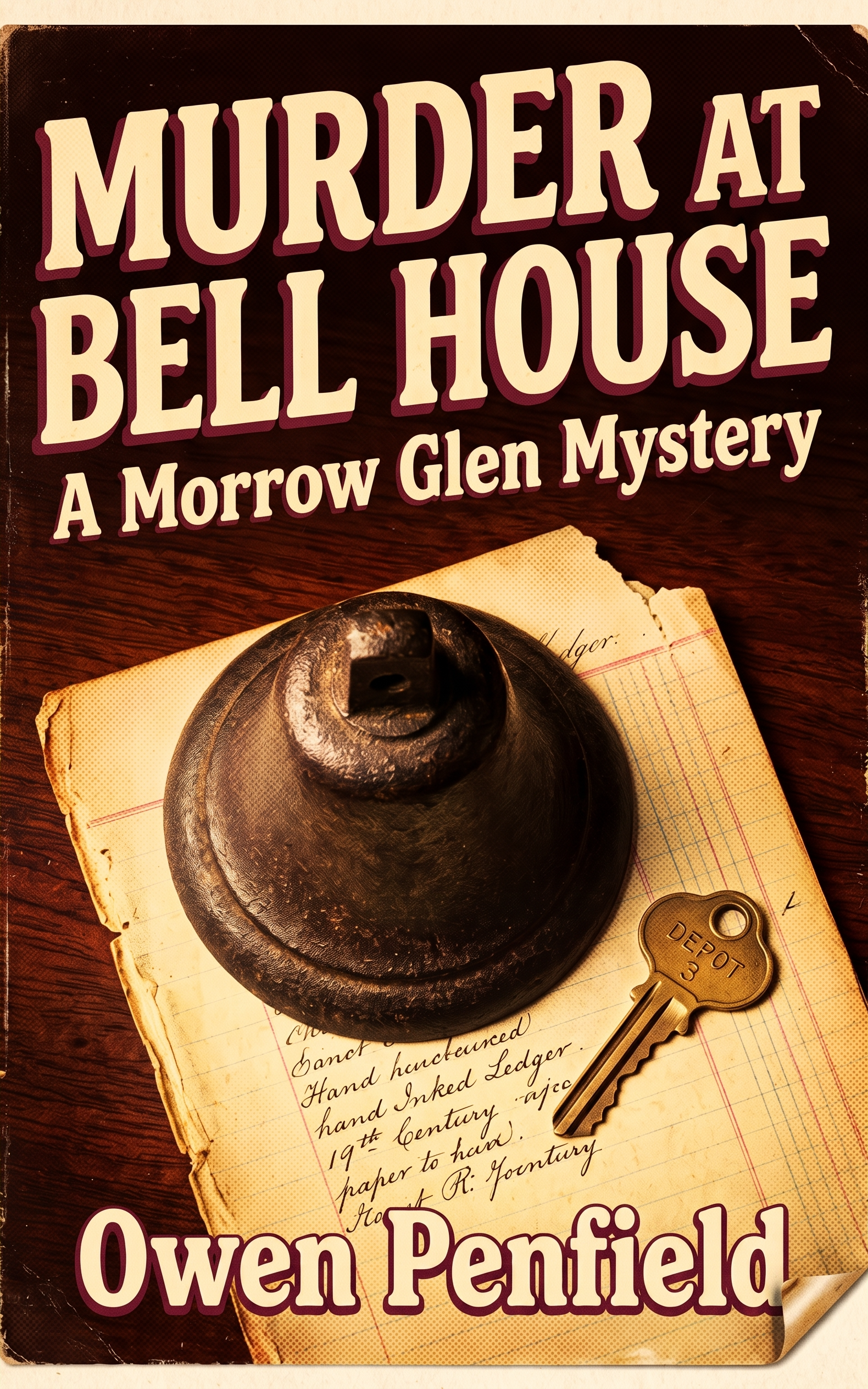
Murder at Bell House
by Shaun O'Connor
Former emergency dispatcher Evan Mercer returned to Morrow Glen for a quiet life running the local weekly newspaper. But when historic Bell House Inn owner Eleanor Bell leaves him a cryptic envelope containing a brass key, a torn ledger page, and a desperate warning, Evan is drawn into a dark local conspiracy. Hours later, Eleanor is found dead at the bottom of a narrow staircase. The police suspect a tragic fall, but Evan's trained ears and keen eye for detail tell a different story—one of staged crime scenes, hidden debts, and silent betrayals. Armed with seventeen years of listening to what people avoid saying, Evan uncovers a web of secrets entangling local developers, ambitious historians, and trusted friends. With the help of precise timelines and forgotten archives, he must piece together the truth before the killer wipes Morrow Glen's history clean. In a town built on heritage, some secrets are worth killing to protect. Can Evan expose the truth in print, or will his first major headline be his last?
- Mystery
- Cozy Mystery
- Small Town Mystery
- Murder Mystery
- Amateur Sleuth
The Morning Envelope
Rain had been falling over Morrow Glen since well before sunrise, the kind of steady, patient rain that soaked into brick and asphalt without any hurry to stop. By the time I reached the town square, the sidewalks along Main Street had darkened to a deep red-brown, and shallow puddles had gathered at the curbs where the drains couldn't quite keep pace. Heritage Weekend banners hung limp between the old iron lampposts, their gold lettering blurred by the wet.
I unlocked the door of the Ledger office a few minutes after eight and stepped inside to the familiar smell of old paper and cold coffee grounds. Across the square, a municipal truck had already backed up to the gazebo, and I watched through the front window as Brian Erickson climbed out of the cab and started unloading wooden barricades from the truck bed, one at a time, stacking them near the corner where the festival map showed the vendor tents would go. He worked without hurrying, the rain running off the hood of his jacket, occasionally glancing up at the courthouse clock as though checking his own pace against it.
I carried yesterday's mail to my desk and sorted it while the coffeemaker in the back room worked through its slow ritual. Two advertising renewals, a notice from the water utility about a scheduled shutoff on Elm Street, and a folded note from a resident on Birch Avenue who wanted the Ledger to know, in no uncertain terms, what she thought of the new parking meters near the library. Nothing that couldn't wait until after the coffee.
Seventeen years of taking calls at a dispatch console had left habits that never quite left me, even three years into running a newspaper. I wrote down times without meaning to. I noticed when someone repeated a phrase they'd used minutes earlier, or when their voice changed pitch on a detail they hadn't planned to mention. None of that made me anything more than an editor with good ears. It did mean that when the bell over the door rang at seventeen minutes past eight, I knew before I looked up that it was Maya, because nobody else in Morrow Glen let the door swing shut behind them quite that hard.
"You skipped breakfast again." She set a paper bag from the Copper Kettle on the corner of my desk, close enough that the smell of bacon and toasted bread reached me before she did. Rain had darkened the shoulders of her jacket, and a few curls had escaped the band holding her hair back.
"I had coffee."
"Coffee is not breakfast, Evan. Coffee is a beverage that pretends to be breakfast when people are too stubborn to eat like adults." She dropped into the chair across from my desk without being invited, which was also fairly typical. "Eat. I made the eggs myself this morning because Danny called in sick, so you'd better appreciate it."
I unwrapped the sandwich and took a bite mostly to keep the peace. She watched me with the satisfaction of someone who had accomplished her mission for the day.
"How's the square looking?" I asked, tipping my head toward the window. "Big weekend for you."
"Half my regulars are already asking whether I'm doing the pie contest again this year." She reached over and turned one of my file folders so the edge lined up with the others on my desk, an old habit of hers that had nothing to do with tidiness and everything to do with restlessness. "Rain's supposed to clear by early afternoon, according to the radio. Eleanor's people are hoping it does, since she's got half the reception set up on the lawn behind Bell House."
"She would pick the one weekend without a guarantee of sun."
"She'd pick the weekend and dare the sky to argue with her." Maya smiled, then her gaze drifted past me, out toward the far corner of the square, and something in her expression shifted, just slightly. I turned to follow her line of sight.
Across from the gazebo, near the old hardware store that had sat empty since the spring, someone had taped a sheet of white paper inside the front window. From this distance I couldn't read it, but a woman in a raincoat had stopped on the sidewalk to look at it, and after a moment she took out her phone and photographed it.
"Any idea what that's about?" I asked.
"No."
"You said that fast."
"I own a diner, not the town's information desk." She picked up my stack of mail, glanced at the return addresses without much interest, and set it back down, closer to the edge of the desk than where it had been. I moved it back.
She noticed, the way she always did, and let it go without comment, which from Maya counted as a kindness. She finished what was left of her coffee, glanced at the clock, and stood, already reaching for her jacket.
"I've got a full house coming in for the pancake breakfast before the parade route opens," she said. "Try to eat the rest of that before it gets cold, and try not to spend the whole festival hiding in here with the door locked."
"I have a paper to run."
"You have a paper that comes out once a week, Evan. The town will forgive you an hour outside." She paused at the door, hand on the frame, rain still coming down steady beyond the glass. "Come by later if you get a chance. I'll save you a piece of pie before Margaret gets to the whole tray."
"Tell my mother I said hello and that she owes me a rematch at cribbage."
"Tell her yourself. I'm not getting in the middle of that." The bell rang again as she left, and I watched her cross the square toward the Copper Kettle, dodging a puddle that had spread out from beneath the gazebo steps.
I ate the rest of the sandwich at my desk and had just started drafting a short piece on the parade route changes when the phone rang, the old landline on the corner of my desk that mostly rang with complaints about delivery days or people wanting to place a classified ad. I picked it up on the third ring.
"Morrow Glen Ledger, this is Evan."
"Mr. Mercer." The voice was crisp, unmistakably Eleanor Bell's, the kind of voice that had chaired more committee meetings than most people in Morrow Glen had attended. "I need a few minutes of your time, and I would prefer this conversation stay between us for the moment."
"Of course, Mrs. Bell. What can I do for you?"
"I would rather not discuss it over the telephone." A brief pause, the kind that suggested she was choosing her next words with some care. "Someone has been stealing from this town, Mr. Mercer, and doing it in plain sight, which is the part I find most difficult to accept. I have spent the better part of a year confirming what I suspected, and I intend to bring it to a close before this weekend is finished."
I set down my pen. "That's a serious accusation."
"I do not make accusations without evidence. I make accusations when I am certain, and I am nearly there." Her voice didn't rise, didn't waver, but there was an edge in it I hadn't heard from her before, something tighter than her usual composure. "I would like you to meet me at Bell House this evening, during the reception. Come to the side entrance near the garden, not through the front with the guests. I have documents I want you to see, and I would rather explain them to you myself before anyone else has the chance to explain them away."
"What time would you like me there?"
"Half past seven. The reception will be well underway by then, which will give us the privacy we need." Another pause, shorter this time. "I want this handled correctly, Mr. Mercer. Not quietly swept aside the way certain things in this town so often are. I trust you understand the difference."
"I do."
"Good. Half past seven, then. The side entrance." She ended the call without the usual pleasantries, which struck me as entirely in character. Eleanor Bell had never wasted words on people she considered competent enough not to need them.
I sat for a moment with my hand still resting on the receiver, running the conversation back through my head the way I might have replayed a strange call at the dispatch desk, listening for anything I might have missed the first time. Stealing from the town in plain sight. It wasn't the kind of phrase people used carelessly, and Eleanor Bell had never in my experience been a careless woman.
I decided the piece on parade route changes could wait. I grabbed my camera from the shelf behind the desk, pulled my jacket off the hook, and stepped out into the rain to get a few shots of the square before the crowds arrived. It was, after all, still my job to cover Heritage Weekend, whatever Eleanor Bell was preparing to hand me later that evening.
Main Street had begun to fill in the way it always did on the first morning of the festival, vendors wheeling folding tables into position under dripping canvas awnings, a woman from the historical society arranging a table of pamphlets near the courthouse steps, two teenagers stringing a banner between the hardware store and the bank that read WELCOME TO MORROW GLEN HERITAGE WEEKEND in faded gold letters that came out for this same occasion every year. Brian had finished with the barricades and moved on to setting up sawhorses at the mouth of Elm Street, where the parade would eventually turn.
"Getting soggy out here," he said as I passed, nodding toward my camera. "You'd think after forty years somebody would schedule this thing for July."
"Tradition," I said. "Nobody wants to be the one who changes it."
"Ain't that the truth." He hefted another sawhorse into place and glanced toward the hardware store, where the sheet of white paper still hung in the window. "You seen that notice? Went up sometime overnight. County code inspector's tag on it. Nobody's said much about it yet."
"I'll take a look before I file anything," I said, though my mind was still circling back to Eleanor's call. I photographed the vendor tables, the banner going up, a cluster of volunteers unloading folding chairs from a trailer near the gazebo, and worked my way down the block toward the bakery, where the delivery truck from earlier had finally pulled away and left a clean stretch of wet sidewalk in its wake.
By the time I made my way back to the office, the rain had thinned to something closer to mist, and the square had begun to take on the look it wore every year during the festival, colorful and a little chaotic, more people than usual moving between the shops. I climbed the two steps to the Ledger's front door and stopped.
A manila envelope lay on the floor just inside the threshold, close enough to the door that it must have been pushed through the mail slot, or slid beneath the door itself while I was out on the street with my camera. Block letters across the front read EDITOR, written in dark ink with no return address and no stamp.
I picked it up and closed the door behind me. It had some weight to it, more than a letter or a flyer would carry, as though it held more than paper. I turned it over once, studying the handwriting, then set it on my desk beside the coffee mug I hadn't finished, next to the folder Maya had straightened without asking and I had straightened again without thinking.
Whoever had left it hadn't waited to be seen, and hadn't knocked. I looked out through the front window at the square, at the vendors and the volunteers and the rain still coming down in a fine gray curtain over the courthouse clock, and wondered, not for the first time that morning, exactly what Eleanor Bell had been so careful not to say over the telephone.
The Service Staircase
I set the envelope on my desk and looked at it for longer than I needed to. Block letters, dark ink, no return address, no stamp. Whoever had left it had not wanted a name attached to it, which in a town the size of Morrow Glen was its own kind of statement. I turned it over once more, then used my thumb to break the seal along the flap. Something …