

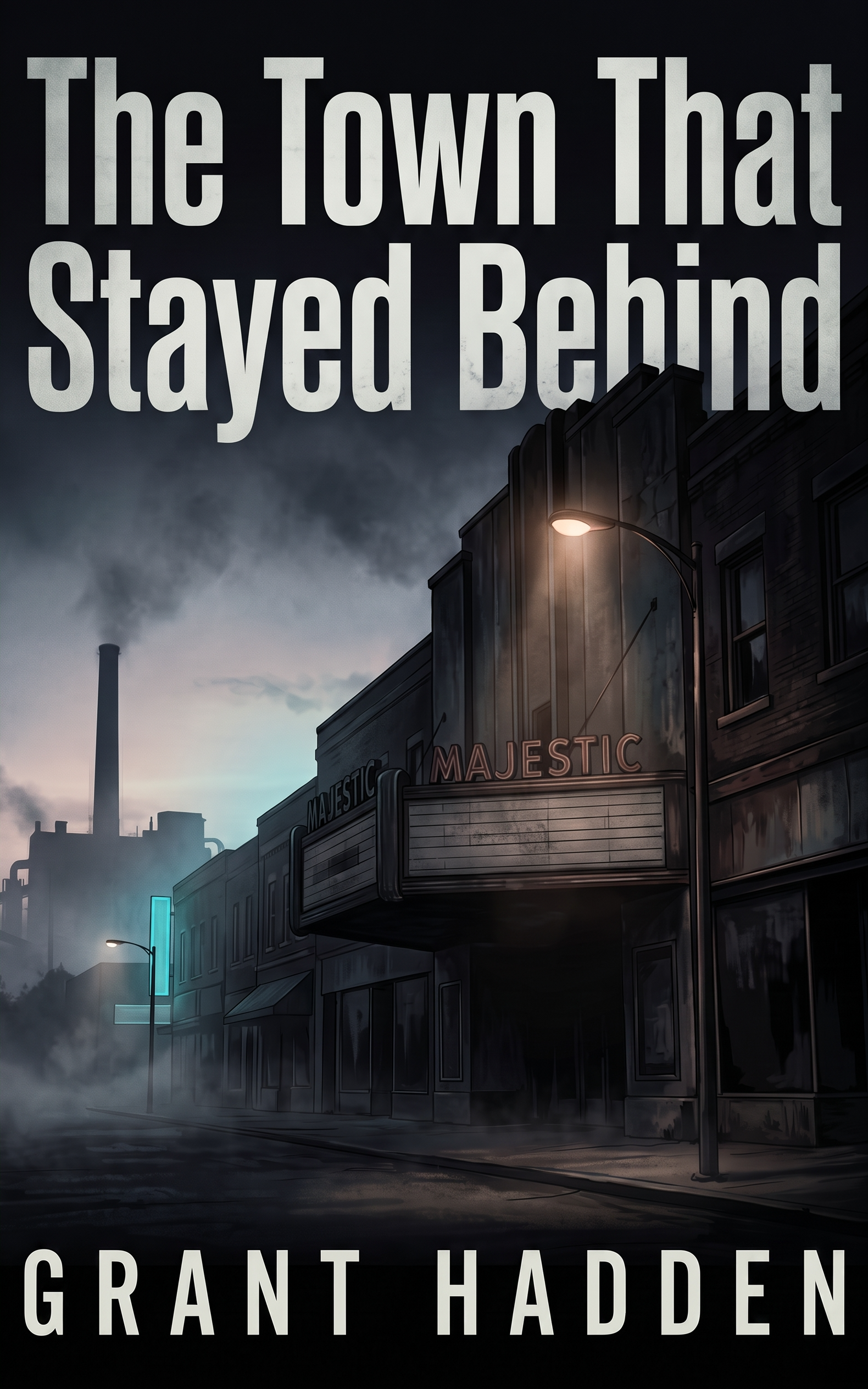
The Town That Stayed Behind
by Shaun O'Connor
Tessa Ward left Blackridge the summer Lucas Avery died. Now, more than twenty years later, she returns only to settle her late mother's estate and get out again. But Blackridge is still haunted by the night Lucas fell inside the condemned Majestic Theater—and by the lie his friends told afterward. When former classmate Jamie Cole reaches out claiming he has proof of what really happened in 2004, Tessa is too late to save him. Jamie is found murdered at the Majestic, positioned at the very spot where Lucas died. As county major-crimes detective Marcus Bell begins investigating, witnesses tied to the old tragedy start turning up dead in abandoned buildings across town. With a killer methodically erasing anyone who can reconstruct the truth, Tessa is forced to confront the part she played in Lucas's final hours. Relying on the sharpened instincts she developed in emergency dispatch, she follows buried records, broken timelines, and small acoustic clues through Blackridge's shuttered streets and decaying industrial corridors. In a town where silence has been mistaken for survival, Tessa must uncover who turned one terrible night into a lifetime of violence—before she becomes the final casualty of the town that stayed behind.
- Thriller
- Mystery
- Crime Fiction
- Small Town Mystery
- Murder Mystery
- Psychological Thriller
The Voicemail at Dusk
The bypass had done more damage to Blackridge in six years than Tessa remembered the mill layoffs doing in the two decades before it. She noticed it the moment she turned off the interstate, taking the old exit instead of the new one that fed drivers straight past town toward the interstate motels and the gas stations that had replaced them. Route 9 used to carry a steady current of semis and out-of-state plates heading toward the lake resorts. Now it carried almost nothing. She drove the last four miles into town without meeting another car.
Main Street still had its bones. The old limestone bank building stood on the corner where it always had, its windows dark, a real estate sign taped inside the glass instead of a teller's counter. The hardware store had become a vape shop, then apparently closed too, judging by the plywood behind the OPEN sign someone had forgotten to flip. Streetlights came on early this time of year, and by the time Tessa reached the four-way stop at Ashland, half of them buzzed a faint amber that did more to announce the dark than push it back.
She slowed without meaning to when the Majestic came into view. The theater had been closed since before she left for good, but someone had kept paying the electric bill on the marquee for years after that, out of stubbornness or nostalgia or both, until eventually even that stopped. Now the letters were gone except for a scattered few, spelling nothing, protecting patches of the metal underneath from two decades of weather while the rest had gone the color of a dirty nickel. Plywood sealed the box office and the double doors beside it. A tangle of dead ivy climbed the brick near the alley, thick enough that it looked less like decoration and more like the building was being slowly absorbed by the block around it.
Tessa did not slow down because the building meant anything to her. She told herself that firmly, the way she told herself a lot of things about Blackridge these days. She slowed down because a decade of teaching municipal employees how buildings failed had left her unable to pass a structure like that without cataloging its condition. Roofline sagging on the north side. Water staining beneath two of the second-story windows. A building like that did not stay empty out of neglect alone. Somebody had to actively decide, year after year, not to deal with it.
She kept driving.
Her mother's house looked exactly as she had left it that morning, which was to say worse than she remembered from her childhood and better than she had feared when the attorney first called. The porch light was on a timer nobody had adjusted in years, so it came on too early and stayed on too late. Flattened boxes leaned against the front window where she had left them after her second trip to the storage unit. Somewhere behind that window sat forty years of a woman's life, sorted into three piles that Tessa had promised herself would be simple: keep, donate, throw away. Nothing about the house had turned out to be simple yet.
She parked in the driveway and sat for a moment with the engine ticking as it cooled, looking at the gutter that had pulled away from the roofline on the east side. That was a fix for tomorrow, or for whoever bought the place after her. She reached for her bag on the passenger seat and her phone slid out with it, screen lighting briefly before going dark again. She had left it facedown most of the day. Every buzz seemed to bring some fresh piece of her mother's unfinished business: a password the bank needed, a form the county recorder wanted notarized, a hospice invoice that had somehow arrived three separate times. She picked it up anyway, because ignoring it had stopped working around noon.
One voicemail. Jamie Cole. Left eleven minutes ago.
Tessa had not spoken to Jamie in probably fifteen years, not since a mutual friend's wedding where they had exchanged the kind of small talk people used to avoid larger subjects. She knew he had moved out of state, married, had a father who was sick for a long time and then wasn't. She had not expected to hear his voice again in Blackridge, and certainly not tonight, on the day she happened to be back clearing out her mother's house.
She pressed play.
"Tess. It's Jamie." A pause, longer than the sentence needed. "I heard you were in town. I need to talk to you about something." Another pause. Traffic moved behind him, a slow hum rather than the tight, close sound of someone standing on Main Street. "About that night. The Majestic." His voice caught slightly on the name of the theater, the way a person's voice catches on a word they have avoided using out loud for a long time. "I found something when we cleaned out Dad's place. Some old notes. A tape. I should have called you a long time ago, Tess. I'm sorry."
The message ended there, cut off by the time limit or by Jamie himself, she couldn't tell which.
Tessa sat with the phone against her ear for a few seconds after the recording stopped, listening to nothing. Then she played it again.
The second time through, she paid less attention to what he said and more to how he said it. Jamie had always talked fast when he was nervous, sentences running together until somebody had to stop him and ask him to slow down. This was not that. This Jamie chose each phrase with the deliberate care of someone crossing a room he knew had loose floorboards. The pause before that night was not a man searching for a word. It was a man deciding whether to say it at all. The pause before I found something was longer still.
She thought of Lucas Avery the way she always did when anything touched that year, not as a full memory but as pieces that arrived out of order. The creak of the lower balcony railing under weight it had not been built to hold in twenty years. Her own voice, eighteen and too high, saying they needed to call someone right now. Nolan's hand closing around her wrist, steady, certain, telling her to wait, just wait, they needed to think first. The pay phone six blocks away, its metal cord cold under her fingers, and the story she gave the dispatcher that was true in every detail except the ones that mattered.
Twenty-two years, and the version everyone accepted still did not match what she remembered happening in that building. She had never told anyone that. Neither, apparently, had Jamie, until now.
Tessa called him back.
It rang twice before dropping straight to voicemail, the kind of interruption that meant either a call in progress or a phone deliberately declined. She left no message. There was nothing efficient to say into a recording, and she was not in the habit of leaving voicemails that mattered.
She sat in the driveway a moment longer, looking at the dark shape of the house, at the boxes waiting behind glass for decisions she had not made yet. Jamie had said he was in town. He had mentioned the Majestic by name, unprompted, which told her more than the rest of the message combined. People did not casually bring up a condemned theater unless they had a reason for it to be sitting at the front of their mind.
She backed out of the driveway before she had fully decided to.
Main Street was even quieter than it had been twenty minutes earlier. Murphy's Tavern still had its three pickups angled along the curb, and somewhere past the four-way stop a dog barked twice and went silent. Tessa parked half a block from the Majestic, in the loading zone nobody enforced anymore, and got out into air that had turned cold enough to fog when she breathed.
The front of the theater was exactly as it had been on her drive in. Boarded, dark, indifferent. She walked the width of the block anyway, past the alley that ran along the building's east side, the one that led to the loading dock and the old service door the crew had used decades ago to bring in equipment without hauling it through the lobby. Weeds had come up through the cracked asphalt, tall enough now to brush her knees. A single security light mounted above the loading dock buzzed with the particular hesitation of a bulb close to failing, throwing more shadow than light across the brick.
The service door stood open.
Not wide. Just a hand's width, the kind of gap a person left when they meant to come back through in a hurry, or when a lock that should have caught simply hadn't. Tessa stopped at the mouth of the alley and looked at it for a long moment, the cold working its way up through her boots, her breath slow and even out of old habit rather than calm.
She thought about calling Jamie's name into the dark of the alley. She thought about the eleven-minute gap between his message and her arrival, and about a phone that rang twice before it stopped. Somewhere behind that door was the same lower balcony, the same rotten railing that had never been repaired because nobody owned the building long enough to bother, and twenty-two years of a story she had never once said out loud in full.
Tessa took out her phone, thumb hovering over Jamie's contact, and stepped closer to the open door.
The Balcony Floor
Tessa called Jamie's name once before she stepped through the gap in the door, and once again after, the sound of her own voice swallowed almost immediately by the dark. She did not go in the way a person walks into a familiar room. She went in the way she had trained municipal employees to enter a structure they did not trust: one hand on the fram…