

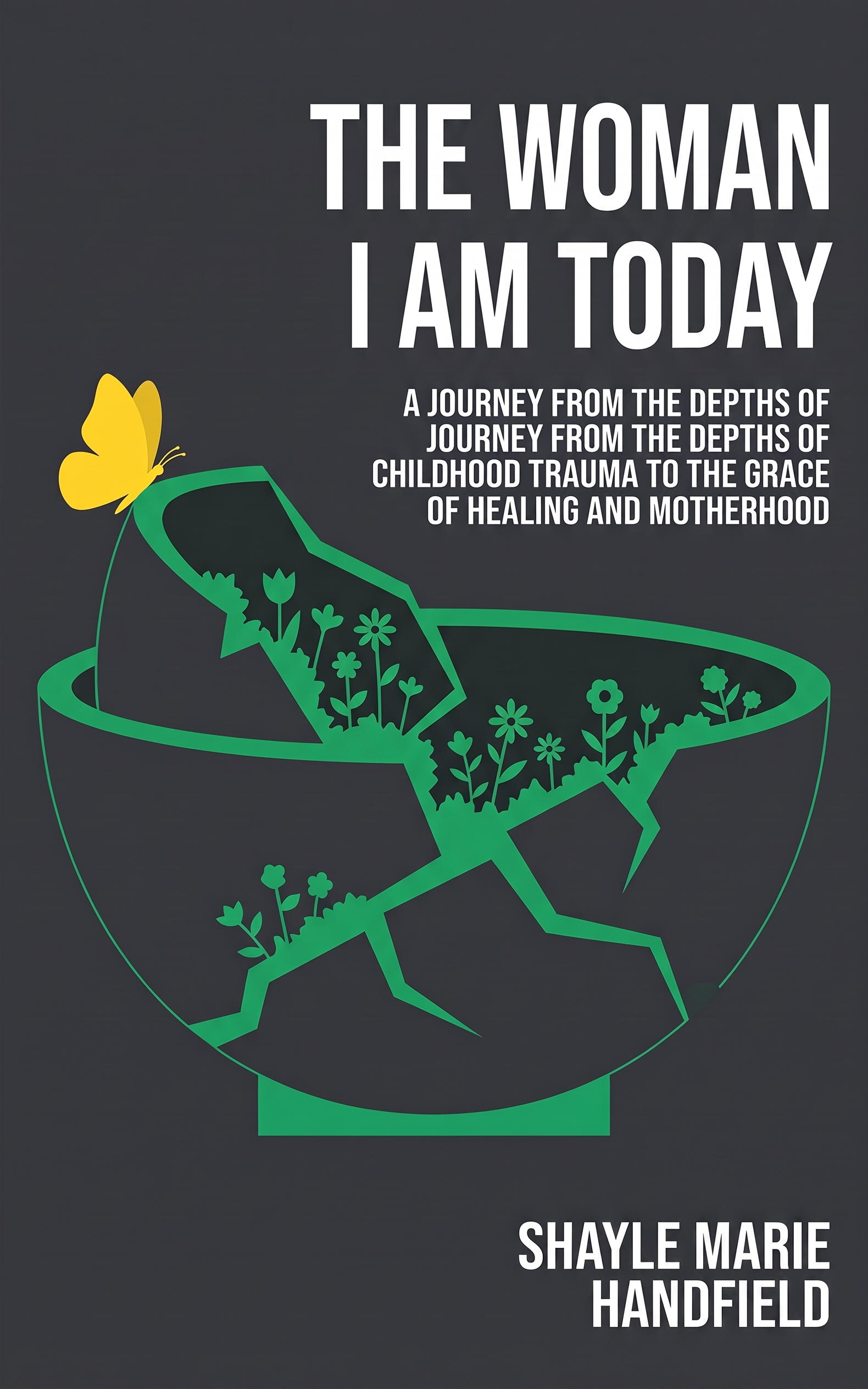
The Woman I Am Today
A journey from the depths of childhood trauma to the grace of healing and motherhood
by Shayle marie Handfield
How do you find your way back when your innocence was stolen before you even knew its name? In this raw and unflinching memoir, Shayle Marie Handfield pulls back the curtain on a life defined by the unthinkable. From the early manipulation of childhood grooming and sexual violence to a harrowing descent into crack cocaine and survival on the streets by age thirteen, her story is a testament to the resilience of the human spirit. For years, the shadows of addiction, prostitution, and physical violence threatened to swallow her whole, leading her through the revolving doors of rehab and the crushing weight of suicidal ideation. But the cycle of trauma was not her final chapter. Everything changed with the heartbeat of her unborn daughter. The Woman I Am Today follows Shayle's arduous, non-linear path from a broken girl to a woman who chose to fight for a better life. Through the quiet power of art, the dedication of homeschooling, and the profound peace of a stable home, she proves that survival is an hourly choice. This is more than a story of addiction and abuse; it is a roadmap for anyone seeking to transform their deepest pain into a life of meaning and quiet triumph.
- Biography
- Overcoming Adversity
- Addiction & Recovery Memoir
- Survival Memoir
- Coming of Age Memoir
Before Kindergarten
My five-year-old daughter stood in front of the mirror near the front door, obsessing over her socks. One of the seams was slightly crooked, sitting at an awkward angle across her toes. She stamped her small foot, pulled her sneaker off, and yanked the fabric until it felt right. She was worried about whether her friends at daycare would notice her mismatched hair clips or if she would get to be the line leader during the walk to the playground. I watched her from the kitchen counter, holding a warm mug of coffee in both hands, feeling the steam rise against my face.
She looked up at me with her bright, unclouded eyes, seeking validation. "Mommy, do these match?" she asked, holding up two hair clips that were slightly different shades of pink. She had no fear in her expression, no quick calculation of my mood, no searching my face for hidden signs of irritation or danger. She simply asked her question, expecting love, patience, and a straightforward answer.
Watching her pull her sneaker back on, a sharp contrast settled in my chest, heavy and familiar. When I was her age, right before I started kindergarten, my worries had nothing to do with socks or playground games. I was already carrying something that no young child should ever have to hold.
The memories from that summer do not come back to me in a continuous film. They arrive in sharp, static fragments, like old photographs left out in the sun until the edges curl and the colors fade into harsh shades of yellow and grey. I remember the smell of sun-baked grass drifting through the screen window, mixed with the faint scent of copper and lemon pledge cleaner. I remember the harsh yellow kitchen light overhead, buzzing softly against the silence, and the quiet hush of an afternoon when the rest of the house felt empty. The linoleum was cool beneath my bare feet, a brief relief against the damp heat of late July. I was five years old, small for my age, with thin legs and hair that was always falling into my eyes, and I was desperately eager to please everyone around me.
In our house, summer moved at a sluggish pace. The days stretched long and humid, filled with the drone of cicadas in the elm trees outside and the rhythmic thrum of an old box fan turning back and forth on the living room floor. When you are five, time feels endless. An afternoon can feel like a whole lifetime. I spent those long hours wandering between the tiny backyard and the shadowed hallway, looking for small tasks to do, looking for ways to make myself useful to the adults and older kids who moved through my world.
I wanted to be good. I wanted the adults in my life to look at me and see a girl who was doing everything right, a girl who never caused trouble or made a mess. If someone asked me to fetch a glass of water, I ran as fast as my small feet could carry me. If someone told me to sit quietly, I sat on the edge of the sofa without moving a single muscle, holding my breath so I wouldn't disrupt the room. That desire to be approved of, to be loved and praised, was the exact doorway through which the betrayal walked.
Childhood vulnerability is rarely about physical weakness alone; it is anchored in the desperate need for belonging and approval. When an adult or an older youth tells a young child that they are special, or that they are being trusted with an important task, that child does not question the motive behind the words. They absorb the praise like dry soil absorbing rain. I lived for those small nod of approval, the brief pats on the head, the casual words that confirmed I was being a good girl. I had no defense mechanism against manipulation because I didn't yet know that manipulation existed in the world.
It took one person, one day, to set my life on a course I never could have imagined taking place. He was an older teenager in my family, someone who felt vast and adult-like to my five-year-old self. He was someone who belonged in my world, someone whose presence was regular, normal, and entirely unquestioned by anyone in the household. He ate dinner at our table, reaching across the oilcloth tablecloth for the bread. He sat on our sofa with his sneakers kicked off, watching television after school. He was a constant, comfortable fixture in the background of my childhood.
Because he was family, he carried an automatic immunity from suspicion. He was granted unrestricted access to the house, to the living room, and to me. My parents trusted him without second thought; he was part of the fabric of our everyday lives. When you grow up in a family, you are taught implicitly that the people inside your house are your protectors. You are taught that safety lives indoors and danger lives out on the street with strangers. Nobody warns a five-year-old girl about the people who sit at her own dinner table.
He sat me down one afternoon when we were alone in the living room. The rest of the family was out, the errands of the day keeping them away for hours. The TV was off, its black glass screen reflecting our pale silhouettes in the dim light. The house was completely still, save for the hum of the refrigerator in the nearby kitchen. His voice was calm, measured, and almost instructional, like a patient teacher explaining an important lesson I had to master before I could be allowed to grow up.
He sat on the worn floral couch, leaning forward slightly, resting his elbows on his knees. There was no urgency in his posture, no shift in his demeanor that might have alerted a child to danger. Everything about his body language signaled that this was an ordinary moment, a helpful conversation between an older relative and a little girl who was about to enter the big world of school. That calmness was the most deceptive part of it all. It stripped the moment of any immediate red flags, wrapping the encounter in a false sense of security and domestic normalcy.
“You’re going to kindergarten soon,” he told me. His hands rested flat on his knees. “And the kids at school are going to laugh at you if you don’t know how to do things right.”
I looked up at him, my legs dangling off the edge of the seat, my small brown sandals kicking gently against the base of the couch. The idea of other children laughing at me made my stomach tighten into a hard, cold little knot. I had nightmares about being singled out, about standing alone while a circle of faces pointed and laughed. "What kind of things?" I asked, my voice barely louder than a whisper.
My heart was already starting to beat a little faster, driven by the pure, uncomplicated anxiety of a child wanting to fit in. I pictured the big yellow school bus I had seen driving through our neighborhood, filled with older kids leaning out the windows. To a five-year-old, school is an uncharted territory full of unknown rules and potential hazards. I was desperate for a guide, someone who could give me the secret roadmap to navigating kindergarten without making a mistake.
“Kissing,” he said. He didn’t raise his voice or lean in too quickly. He made it sound like tying shoes, buttoning a coat, or reciting the alphabet. “Everyone at school knows how to kiss. If you don’t know how, they’ll all think you’re weird. They’ll hate you.”
He delivered the lie with complete conviction, tapping his finger against his knee as if stating an undeniable fact of nature. He knew exactly which emotional buttons to push. He understood that at five years old, the threat of being rejected by peers, of being labeled "weird," was a terrifying prospect. He took my natural desire for social survival and weaponized it, turning my fear of rejection into the mechanism that would force my compliance.
The threat was quiet, but to a five-year-old, it was absolute. I didn’t know any other children yet outside of brief, supervised encounters at the grocery store or the neighborhood park. I didn’t know what kindergarten was actually going to be like. I had no baseline for what teachers expected or what five-year-olds actually did all day. I only knew that I wanted to belong. I wanted to fit in, to have friends, to sit at the small tables and draw with crayons without being laughed at. And more than anything, I trusted the older boy sitting beside me to tell me the truth about the world outside our front door.
Children possess an innate bias toward believing older authority figures. When an older family member speaks, their words carry the authority of law. It never crossed my mind that he could be lying to me. It never occurred to me that a person I saw every day, someone who shared meals with my family, would fabricate an elaborate lie just to manipulate a little girl. My trust in him was total, uncritical, and complete.
“I’ll teach you,” he offered. “So you’re ready.”
That was how it started. It didn’t begin with force, anger, or open violence. It began with a lesson. He framed it as a secret favor, something special and kind he was doing just for me to protect me from the cruelty of other kids at school. In my small, eager mind, I felt a strange sense of relief and gratitude. I thought I was being helped. I thought I was being prepared for a major milestone in my life.
This is the insidious nature of grooming. It operates under the cover of benevolence. By framing the abuse as protection or education, the abuser ensures that the child feels indebted to them rather than threatened by them. I didn't see a predator sitting on the sofa next to me; I saw a savior who was taking the time to teach me how to survive the scary world of kindergarten. That subtle psychological shift made me an eager, cooperative student in a lesson that was designed to destroy my boundaries.
The practice started with simple, seemingly harmless requests. Standing still on the braided rug in the living room. Turning my face toward his when he spoke. Letting him show me where to put my small hands on his shoulders. Every instruction was given in that same calm, matter-of-fact tone, as if we were practicing spelling words, tying knot patterns, or folding paper boats to float down the driveway gutter after a rainstorm.
He moved slowly, deliberately avoiding any sudden motions that might startle me. He corrected my posture with soft touches, telling me to stand taller or turn my head a certain way. "Good," he would say, his voice flat and encouraging. "Just like that. You have to learn how to do it without thinking about it." I concentrated as hard as I could, focusing all my energy on following his directions precisely, terrified of making a mistake that would prove I wasn't ready for school.
I remember how cold his hands felt against my bare arms, contrasting sharply with the heavy, muggy heat of the house. His fingers were long and dry, leaving a faint pressure on my skin that seemed to linger long after he pulled away. Whenever I flinched, hesitated, or stepped back, he stopped immediately. He didn't raise his voice or show anger. Instead, he would look at me with a disappointed expression and remind me of the consequences in the same level, reasonable tone.
That tone was far more effective than anger would have been. If he had yelled, I might have run away or cried out for help. If he had shown aggression, my natural survival instincts might have kicked in. But his level, matter-of-fact delivery kept my internal alarm bells quiet. It convinced me that my hesitation was the problem, that my discomfort was just a childish reaction I needed to overcome if I wanted to grow up and fit in.
“You want the other kids to like you, don’t you?” he would ask.
“Yes,” I’d whisper.
“Then you have to do it right. We have to keep practicing.”
Over the weeks that followed, as July turned into the sweltering heat of August, the lessons expanded. What started with kissing slowly and methodically turned into other demands. He told me that taking off my clothes was part of getting ready too, that grown-up girls had to know how to be comfortable without their shirts or shorts on so they wouldn’t be embarrassed or cry during school health checks.
He sat me down and explained the process in meticulous detail, weaving a plausible fiction that my five-year-old mind had no way of debunking. He spoke with the quiet authority of an adult who knew how the world worked, creating an elaborate lie out of whole cloth. I listened intently, absorbing every word as absolute truth, convinced that every other child in town was undergoing the exact same preparation in their own homes.
He explained that the nurses at school inspected all the children on the very first day, and if I got scared, cried, or tried to cover myself, everyone would laugh at me and call me a baby. Every step of the abuse was wrapped in the same logical, persuasive package. It was all framed as essential preparation. It was all framed as necessary for my own good.
He normalized the erosion of my bodily autonomy piece by piece. By connecting the removal of my clothing to school readiness, he stripped away my natural instincts of modesty and self-preservation. If I felt a wave of shame or unease, I suppressed it immediately, telling myself that being brave now meant I wouldn't be humiliated later. He took my desire to be brave and mature and used it to dismantle every boundary I possessed.
I remember the heaviness in the room during those sessions. The way the late afternoon light filtered through the dusty yellow blinds, casting long, geometric, striped shadows across the faded floral floorboards. The air always felt thick, hot, and stale, like it was too heavy to pull into my small lungs. The smell of old upholstery, dust, and his sour sweat seemed to hang trapped in the quiet corners of the room.
Time seemed to slow down until every second felt stretched to its breaking point. I would stare at the pattern of the sunlight on the floor, watching tiny dust motes float lazily through the air beams. They moved so slowly, completely unbothered by the stifling heat or the silence of the house. I wished I could be a dust mote, weightless and unfeeling, floating far above the living room couch, completely out of reach of anyone's hands.
Outside, I could hear cars occasionally passing on the asphalt road, the low, steady drone of a lawnmower several blocks away, or the distant, rhythmic barking of a neighbor’s dog tied up in a yard. They were the ordinary, mundane sounds of an ordinary summer day continuing uninterrupted just beyond the windowpane, completely untouched and unbothered by what was happening on the other side of the glass.
That disconnect between the world outside and the world inside the living room was profound. Outside, the sun was shining, adults were working in their gardens, and life was moving forward in normal, predictable patterns. Inside, behind closed blinds and locked screen doors, my understanding of physical safety was being systematically dismantled. The contrast made me feel entirely isolated, as if the living room existed in a separate realm where normal rules no longer applied.
Inside, I was learning a different set of rules. Rules that no five-year-old child should ever have to comprehend, let alone master to survive her own living room.
I learned that my body was not entirely my own, that it was a instrument to be managed to keep adults happy and prevent conflict. I learned that my own internal feelings of discomfort, disgust, and fear were wrong, and that the instructions of an older person always took precedence over my own instincts. These lessons were absorbed quietly, deeply, settling into my bones until they became the default setting for how I navigated the world.
I learned to freeze. I learned that if I stayed very still, held my breath, and remained completely quiet, the moments would pass faster. I learned to fix my eyes on a small water stain on the plaster ceiling, tracing its discolored outline over and over—it looked like a tiny, isolated island with jagged, rocky shores surrounded by a vast white sea. I counted the concentric rings of the water stain, counting up to fifty, then starting over at one, while his hands moved over my small, defenseless body.
The water stain became my anchor. If I focused all my vision on that little island on the ceiling, I could pretend that the rest of the room didn't exist. I memorized every shade of brown and yellow in the plaster, every tiny crack that radiated outward like a spiderweb. By focusing entirely on an inanimate object above me, I could quiet the rising panic in my chest and keep myself from screaming or crying out.
I became an expert at leaving my own skin, floating upward toward that plaster ceiling, retreating deep into the shadowed back of my mind where his quiet voice was reduced to a muted, distant hum and the physical sensation of his touch couldn’t fully reach me. I learned how to separate my physical body from who I was inside. My body was on the couch, enduring the lesson, but the real me was floating near the ceiling light, safe and untouched.
This mental retreat was my first experience with dissociation, a survival mechanism that would follow me for the rest of my youth. At five years old, when you cannot physically escape a traumatic situation, your mind creates an escape route of its own. It severs the connection between awareness and physical sensation. It protects the core of who you are by abandoning the vessel. It was a brilliant, necessary defense mechanism for a helpless child, but it laid the groundwork for a lifetime of feeling disconnected from my own flesh and blood.
Whenever it was over, he would pat my shoulder gently, smooth down my hair, and offer a thin, approving smile. “Good girl,” he’d say, his voice dropping back into that casual, family-member tone. “You’re doing so well. You’re going to be the smartest girl in your class.”
He would help me straighten my clothes, making sure every button and hem was back in place before anyone else came home. The sudden shift from the violation back to casual affection was disorienting. He rewarded my compliance with praise, reinforcing the idea that I had done something good, something that made me worthy of his approval. That praise was poison, but to a five-year-old hungry for validation, it felt like relief.
He always reminded me that our lessons were an absolute secret. “If you tell anyone, they won’t understand,” he said, leaning down so his face was close to mine, his eyes steady and serious. “They’ll be mad at you for doing it wrong. They'll think you're a bad girl. This is just between us.”
He repeated this warning every single time, planting the seeds of isolation and guilt deep within my mind. He made sure I understood that speaking out would bring ruin, not help. By threatening me with the anger and rejection of my parents, he created an impenetrable wall around our encounters. I believed him implicitly; the idea of my mother being angry with me was far more terrifying than the lessons themselves.
The word *secret* carried weight. It turned the betrayal into a shared bond, making me an active participant in my own abuse. I believed him completely. I believed that if my mother or father found out, I would be the one in trouble. I would be the one who had done something bad, shameful, and forbidden. So I kept my mouth shut. I locked the truth behind my teeth and carried it around with me like a heavy, sharp stone in my pocket, feeling its rough edges press against my ribs every time I took a breath.
That burden changed me from the inside out. The open, easy nature of my early childhood began to vanish. I became cautious, guarded, always checking the reactions of the adults around me to see if they could look at me and tell what had happened in the living room. I felt marked, stained by a secret that I didn't fully understand but knew I had to protect at all costs to keep my family from falling apart.
When the first day of school finally arrived in early September, I put on my new outfit—a bright yellow cotton shirt with small printed daisies across the fabric, and my favorite pair of stiff blue jeans. My mother brushed my hair until it was smooth and shiny, tying it back with matching yellow ribbons. The kitchen smelled of toasted white bread, melted butter, and fresh coffee brewing on the counter, filling the morning with a familiar, comforting warmth.
Everything about the morning was orchestrated to be a joyful milestone. My mother was smiling, bustling around the kitchen packing my lunchbox with a ham sandwich and an apple. My sister was finishing her cereal, talking about her own teachers. From the outside, we were the picture of a normal, happy family sending their youngest off to school. But beneath my crisp new clothes, my skin felt tight and cold, as if I were wearing a costume that didn't fit.
She took my picture on the front porch with my sister, smiling proudly behind the camera lens. "Look right here, honey! Big smile!" she called out. I smiled back immediately, carefully positioning my feet together and curving my lips into a bright, pleasant expression, just the way I had been taught to do whenever adults were looking at me. I knew how to perform. I knew how to project the exact image of a happy, obedient child.
Click. The camera shutter snapped, capturing a freeze-frame of a little girl in yellow ribbons standing on a sunlit porch. That photograph still exists somewhere in an old family album. Looking at it now, you would see a perfectly normal five-year-old child eager for her first day of school. You wouldn't see the tension in her hands, the tightness around her eyes, or the heavy weight she was carrying behind that practiced, polite smile.
On the outside, I looked like every other five-year-old lining up outside the red-brick elementary school doors. I had my brand-new backpack tucked securely over my narrow shoulders and my plastic lunchbox held tightly in my right hand. But inside, I felt entirely different from the children standing around me on the crowded asphalt playground.
The air was crisp with the sharp chill of early autumn, filled with the loud chatter of parents saying goodbye and children shouting to friends they hadn't seen all summer. Buses idled nearby, spewing diesel exhaust into the cool morning air. I stood amidst the chaos, completely rigid, feeling like an imposter who had wandered into a world where she didn't belong. The other children were vibrant and wild; I felt like a ghost walking among them.
I watched the other kids laughing and running across the pavement, chasing each other around the freshly painted hopscotch grids and yellow game lines. They seemed impossibly light. They moved without thinking, shouting, tripping, and giggling without checking over their shoulders, completely uncaring about how they looked, what they said, or who was watching them from the school steps.
Their freedom was astounding to me. They threw their bodies around with wild abandon, scraping their knees and bouncing right back up, oblivious to the concept of surveillance or threat. They were completely present in their skin, living entirely in the moment. I watched them from a distance, feeling a profound separation, as if an invisible wall of glass stood between their unburdened childhoods and my shadowed reality.
I stood near the tall brick wall of the school building, my back pressed firmly against the cool mortar, watching everyone with a careful, vigilant eye. My small hands stayed clamped tightly around the vinyl straps of my backpack. I was waiting for someone to notice that I knew things I wasn’t supposed to know. I was waiting for the teacher to line us up, call my name, and test us on the private, shameful lessons I had been forced to learn all summer long.
My heart hammered against my ribs every time a teacher walked past holding a clipboard. I thought the clipboards contained lists of our secrets. I expected the principal to step up to the microphone, look directly at me, and announce to the entire playground that I was a bad girl who had done dirty things in her living room. The anxiety was a physical knot in my throat, making it difficult to swallow the morning air.
It didn’t take long for the morning to unfold and for me to realize that none of the other children were talking about kissing. None of them were worried about health checks, taking off their clothes, or proving they were grown-up. They were talking about morning cartoons, showing off their light-up sneakers, and arguing noisily over who got to sit next to the window during story time. The realization settled in slowly, like cold water seeping into a leather boot, chilling me from the inside out.
I sat at my small wooden desk, staring at the colorful alphabet border lining the top of the chalkboard. The teacher, a kind woman with soft glasses and a gentle voice, passed around box after box of fresh crayons and sheets of thick drawing paper. She didn't ask us to demonstrate any secret lessons. She asked us to draw a picture of our favorite animal. I held my green crayon with trembling fingers, looking around the room at the other children who were already happily scribbling on their papers without a care in the world.
There had been no lesson required. There was no test to pass.
The entire premise upon which my summer had been shattered was a complete fabrication. Kindergarten was just finger-paint, alphabet songs, milk boxes, and nap time on small woven mats. There were no invasive health checks, no requirements to prove maturity, no expectations that five-year-olds should act like adults. The realization was devastating in its quiet simplicity.
The quiet horror of that realization didn't hit me as immediate rage or panic. It hit as profound, overwhelming confusion. The family member I trusted implicitly had lied to me, but my five-year-old brain couldn't process the concept of such deliberate, calculated manipulation. Instead, I assumed I must have misunderstood his words. Or worse, that there was something inherently broken, wrong, or dirty about me that made those lessons necessary for me alone, while the other children were allowed to remain pure and innocent.
I sat at my desk, gripping my crayon until my knuckles turned white, internalizing the shame that belonged entirely to my abuser. If the lessons weren't required for kindergarten, then why had they happened? The only answer my child's mind could construct was that I was inherently flawed. I concluded that I was different from the other children, marked by some invisible flaw that invited boundary violations and required secret conditioning.
That confusion laid the foundation for all the destructive years that followed. It established a baseline pattern in my mind: older authority figures held absolute power over my reality, my body was something to be offered up or used to secure safety and approval, and my own internal feelings were entirely secondary to keeping the peace and pleasing the people around me.
This distorted world view became the lens through which I viewed every relationship moving forward. I grew up believing that love was conditional, that safety had to be earned through self-sacrifice, and that my personal boundaries were meaningless obstacles that stood in the way of making others happy. The grooming had succeeded not just in violating my body, but in completely rewiring my understanding of human connection and self-worth.
When you are taught at five years old that your physical boundaries are negotiable if it makes someone older happy, you don't grow up knowing how to say no. You don't know that your body belongs to you, protected by an absolute right to personal safety. You grow up learning how to endure discomfort, how to minimize your own needs, and how to survive the destructive choices made by people bigger, louder, and more powerful than you.
You become a chameleon, constantly shifting your personality and suppressing your instincts to appease the potential threats in the room. Saying "no" feels like a dangerous, forbidden act that will inevitably lead to conflict, rejection, or abandonment. So you say "yes." You comply. You endure. You learn to detach your mind from your physical self whenever the world becomes too overwhelming, repeating the exact same dissociation tactics you learned on the living room rug before kindergarten.
I spent that entire first year of kindergarten being the absolute perfect student. I raised my hand quietly without making a sound. I lined up first whenever the teacher called our group. I cleaned up my wooden blocks and crayons long before anyone else even started gathering their things. Teachers praised me endlessly to my mother, admiring how mature I was beyond my years, how quiet, helpful, and agreeable I remained throughout the busy school day. They didn't see that my obedience wasn't maturity at all. It was survival. It was hyper-vigilance disguised as good behavior.
I was terrified of making a mistake. I believed that if I slipped up, if I broke a rule or made a mess, the thin veil protecting my secret would tear open, and the truth would spill out for everyone to see. So I policed myself relentlessly. I sat straight in my chair, kept my hands folded on my desk, and followed every instruction with military precision. The praise I received from adults only reinforced the mask, teaching me that keeping quiet and being useful was the only way to stay safe.
Every time an adult walked into the classroom, my eyes followed them automatically, tracking their movements like a radar. I watched their body language, the tight or relaxed muscles in their face, the tone of their voice, and the speed of their steps across the floor. A sudden, loud footstep on the linoleum tile made my shoulders tense up to my ears. A sharp, annoyed intake of breath from a teacher made me freeze in my seat, waiting for the blow to fall.
My nervous system was trapped in a perpetual state of high alert. While other five-year-olds were engrossed in finger-painting or giggling over silly rhymes, my brain was constantly scanning the room for potential threats, analyzing micro-expressions, and calculating safety margins. I was exhausted before lunch every day, consumed by the massive amount of energy required to stay vigilant in a room full of unpredictable adults.
I learned to read a room in seconds, anticipating mood shifts before the adults themselves were even fully aware of them. I became an expert at pleasing everyone around me, anticipating their needs before they spoke them out loud, because I believed that pleasing people was the only fragile barrier standing between me and profound harm.
If a teacher looked tired, I handed her a box of chalk. If a classmate was crying, I brought them a paper towel before being asked. I turned people-pleasing into a survival art form, molding myself into whatever shape I thought the adults needed me to be. But this hyper-awareness came at a devastating cost: I completely lost touch with my own inner voice. I had no idea what I liked, what I felt, or who I was when I wasn't busy anticipating the desires of others.
Now, standing in my sunlit kitchen decades later, watching my own daughter tie her shoes near the front door, I feel the long, dark shadow of that summer reaching across time to touch my heart. My daughter complains loudly because her socks feel strange on her toes, her voice full of indignance and expectation. She demands that I fix it immediately, completely confident that her personal physical comfort matters, completely confident that her voice will be heard, respected, and answered. She has no concept of having to hide her body, no concept of keeping uncomfortable secrets to protect the fragile emotions of the adults around her.
Her world is filled with light, predictability, and safety. When she is uncomfortable, she speaks up. When she is frightened, she runs toward me, not away. She owns her body completely, asserting her rights over her own skin with the fiery confidence of a child who has never been taught that her boundaries are negotiable. Watching her demand comfort and respect fills me with an overwhelming mixture of fierce pride and deep, aching sorrow.
She is safe. And in watching her absolute safety, I am slowly learning how to give myself permission to grieve for the small, silent little girl who wasn't. I grieve for the five-year-old who spent her summer sitting on a faded floral couch, learning how to disappear into the plaster ceiling. I grieve for the little girl who walked into kindergarten carrying a stone of shame in her pocket, believing that she was broken and inherently flawed.
For decades, I buried that grief beneath layers of anger, addiction, and self-destruction, believing that looking back would break me. But seeing my daughter flourish in the warmth of unconditional safety opened a doorway in my heart. It showed me what childhood was supposed to look like. It showed me what I should have had, and in that realization, the ice around my oldest memories finally began to thaw into tears of self-compassion.
It took me decades to understand that what happened to me that summer before kindergarten was not my fault. For years, I carried the shame like a dark, indelible stain on my skin, believing that because I had said yes, because I had complied, because I hadn't fought back or screamed, I was somehow responsible for my own violation. But a five-year-old child cannot consent to her own exploitation. A five-year-old child cannot outsmart a predator who uses trust, love, and social survival as weapons of control.
The responsibility for abuse belongs one hundred percent to the abuser, never to the victim, no matter how quiet or compliant that victim was forced to be. Unraveling that core belief was the hardest work of my recovery. I had to go back into the dark rooms of my memory, find that terrified five-year-old girl sitting on the living room rug, and tell her the truth that no one gave her back then: *You did nothing wrong. You were just a child.*
I wasn't a bad girl who needed to be fixed or punished. I was just an innocent child who wanted to be loved, approved of, and prepared for the world, taken advantage of by someone who knew exactly how to manipulate those pure, childish desires against me.
Recognizing that fundamental truth didn't instantly erase the past or heal every scar, but it began to shift the unbearable weight in my chest. The invisible stone I had carried in my pocket for so long finally started to crumble into dust, piece by piece. And as I watched my daughter grab her bright pink backpack, adjust her hair clips, and head toward the open front door, ready to face her small, ordinary, wonderful day, I knew that breaking the cycle of abuse was the greatest gift I could ever give her—and the only true, sacred way to honor the quiet child I used to be.
She turned back at the threshold, giving me a bright, effortless wave. "Bye Mommy! See you after school!" she called out, her voice ringing clear and free across the morning air. I waved back, smiling with a genuine warmth that reached all the way to my eyes. As she bounded down the porch steps into the morning sun, unburdened and safe, I took a deep breath, stepped into the light, and finally let the past go.
Recognizing that truth didn't erase the past, but it began to shift the weight. The invisible stone I had carried in my pocket for so long finally started to crumble. And as I watched my daughter grab her backpack and head toward the front door, ready to face her small, ordinary day, I knew that breaking the cycle was the greatest gift I could ever give her—and the only true way to honor the child I used to be.
Waiting in the Other Room
A year had passed since the lessons began, and by then I had turned six. The seasons had turned once, then twice, bringing the heavy summer humidity back into our small house, but the house itself hadn't changed, and neither had the rules that quietly governed it. I no longer needed reminding about kindergarten, or what the teacher might say, or wh…