

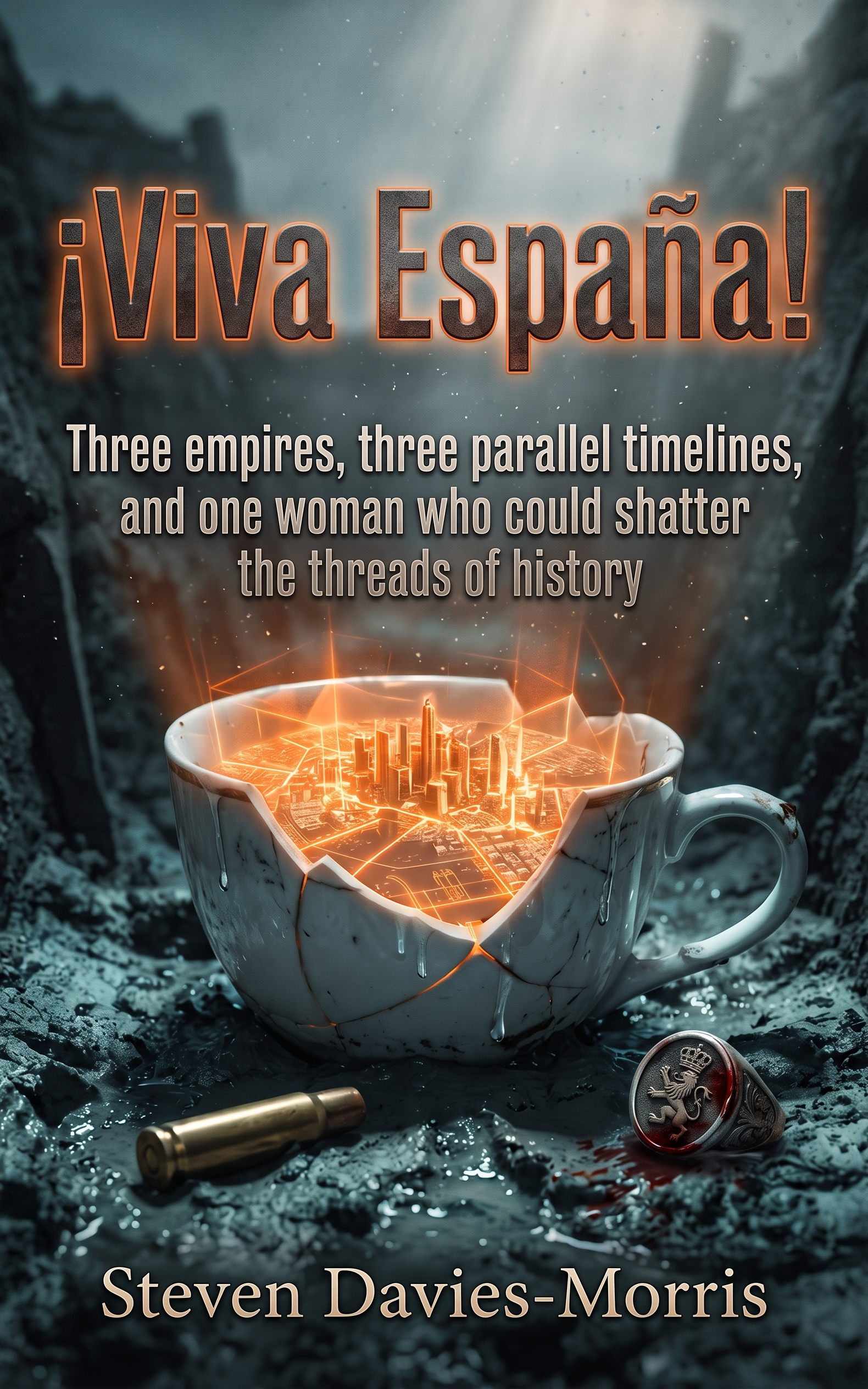
¡Viva España!
A desperate mission across timelines to save a dying world's last hope
by Steven Davies-Morris
Two worlds are dying, and the only salvation lies in the blood of the past. In the year 2150, Timeline One is a desolate wasteland. Humanity’s last hope rests on the Chronos Project, a daring plan to reach back into the chaos of the Spanish Civil War. Their objective: extract the Spanish royal family from 1937 to serve as the genetic and cultural seeds for a new civilization. Gabriel de la Cruz, a battle-hardened veteran, leads his special forces team into the brutal trenches of the Guadarrama mountains. But the mission fractures the moment he encounters Isabella Maria de Borbon—a princess who has traded her crown for a rifle to fight with the Republican militia. As Gabriel struggles to secure his targets, a shadow from a third, technologically superior timeline emerges. Javier de Valera is a man with a dark agenda, introducing future weaponry to ensure a fascist victory that will rewrite the multiverse forever. Caught between shifting loyalties, ideological doubt, and a war that refuses to stay in the history books, Gabriel must decide what is worth saving: the future he was sent to protect, or the woman who represents the soul of the past. ¡Viva España! is a sweeping epic of time travel, sacrifice, and the enduring power of heritage.
- Historical Fiction
- Literary Fiction
- Science Fiction
- Thriller
- Parallel Worlds
- Time Travel
Ghosts Of The Pyrenees
The cold came down from the peaks armed with bad intent. It pressed through wool and leather and settled into the joints, and the men who crouched among the rocks had long since stopped expecting warmth. February 1945 in the Pyrenees was not a season. It was a sentence to days and nights of torment. The gray stone of the mountains offer no comfort, only a hard shelf to hold bodies that had forgotten the meaning of a soft bed. A bitter wind howled through the narrow passes, carrying the scent of pine and frozen dirt, slicing through the layers of mismatched gear like a dull blade.
Eleven Maquisard fighters lay distributed across a shelf of granite above the road, their breath rising in pale threads that the wind quickly erased. They had been still for two hours. Nobody complained, nobody whinged. These men did not complain, not to these two. They knew the price of a loose word in the high passes, where the echo of a cough could draw a mortar round from the valley garrisons. At the forward edge of the outcrop, pressed against stone that had been cold since before any of them were born, the man waited.
He wore a thick balaclava pulled to the bridge of his nose, British-issue wool, and a militia coat with no insignia on the collar. The Sten gun across his forearms was loaded, cocked, and on safety. He did not budge. His fingers, encased in stiff wool gloves, remained hooked near the trigger guard. He watched the road below with the particular stillness of someone who had learned that movement cost lives. His eyes, dark and flat, tracked the gray ribbon of gravel that cut through the gorge below, waiting for the crack of headlights to break the heavy mountain dark.
Fifteen meters to his left, the deputy commander lay in a similar posture among a cluster of low boulders. She had a Sten of her own and a canvas satchel across her back. Between the balaclava and the upturned collar of her leather jacket, only her green eyes were visible. They were tracking the far bend of the road, where the pine trees closed in and the path narrowed to a single vehicle width. She had picked this spot herself, three days prior, walking it alone at dawn with a compass and a notebook, calculating angles of fire and lines of retreat with the precision of someone who could no longer afford to be wrong. There was a quiet intensity to her posture, a focus that shut out the biting wind and the slow numbness creeping into her limbs.
The convoy appeared at 02:17 by the man’s reckoning. First came the sound, a laboring engine working against the steep gradient, then the blackout-dimmed headlamps cutting pale ovals through the mountain fog. One command car, a Volkswagen Kübelwagen with a pennant on the antenna, led the way. Behind it, two supply trucks, canvas-sided and riding heavy on their suspension, bounced over the rutted dirt. A third vehicle, another VW, brought up the rear. Four guards were visible on the trucks, their collars turned up against the wind, rifles slung carelessly over their shoulders. Two more sat in the Kübelwagen. The contents of the rear car remained unknown, obscured by the swirling mist.
The man did not signal. He had no need to. Every fighter on that ridge had memorized the plan. They knew the Kübelwagen was his, that the deputy commander would take the lead truck, that the flanking teams would seal both ends of the kill zone the moment the first shot broke the silence. He let the convoy crawl deeper into the throat of the pass, the lead vehicle grinding gears as it hit the steepest part of the climb.
He waited until the command car was directly below, its engine note dropping as the driver eased the throttle on the grade. Then he fired. The Sten chattered in short, controlled bursts. The windshield of the Kübelwagen dissolved into a shower of glittering sugar. The driver slumped forward over the wheel, and the vehicle rolled left, its front wheel dropping into the drainage ditch with a hard metallic crunch that stopped it dead. From the left, the deputy commander’s weapon opened up simultaneously, and the lead truck’s cab took a heavy burst that killed the engine and the passenger in the same moment. The driver threw open his door and fell onto the road, his life gone before his boots hit the wet gravel.
The flanking teams did their work in under ninety seconds. The guards on the truck beds tried to bring their rifles around in the darkness and the confusion and found no clear target, only muzzle flashes from three different elevations. Two went down in the initial volley, their bodies tumbling into the dirt like discarded sacks of flour. A third jumped from the tailgate and ran ten meters before a burst from the right flank caught him across the back. He went down hard, sliding in the slush, and did not get up.
The rear VW reversed, its tires spinning on loose stone, throwing up a cloud of gravel. It made perhaps forty meters before the satchel charge the deputy commander had placed that afternoon, buried beneath the road surface at the natural choke point, detonated. The blast was a brief, blinding flash of orange that threw the car sideways into the rock face. A heavy rain of metal and dirt fell back to the earth, and steam rose from the crumpled hood. No one emerged from the wreckage.
Silence returned to the pass, broken only by the ticking of cooling metal. That and the distant sound of wind moving through the pines. The man came down the rock shelf at a controlled run, two fighters moving with him in a practiced sweep pattern. His boots crunched on the gravel, his eyes scanning the dead for any sign of movement. The trucks were intact, which was the point. He pulled back the heavy canvas on the first and found what the intelligence had promised: crates stenciled with medical crosses, others packed with dried goods and tinned rations meant for a Nationalist garrison sixty kilometers south.
Villages along that road had been going hungry since September. They would not go hungry this week. He gave the order with a quick hand signal, and his men began transferring crates with quiet, urgent efficiency. The deputy commander came to stand beside him at the Kübelwagen. She looked at the two dead men inside it without expression, her breathing steady. She had a small cut above her right eyebrow, likely from a rock chip thrown by a ricochet, and she pressed her sleeve against it once and then ignored it. He glanced at her. She met his eyes over the top of her balaclava. There was no triumph in her gaze, no revulsion either. Just the acknowledgment that it was done and that they were both still standing, and that those two facts were enough.
He reached into his coat and removed a single folded sheet of paper. He had written it himself that morning in the kitchen of the safehouse, in careful block letters, the ink slightly smeared where his hand had pressed it flat. He placed it on the blood-spattered seat of the command car, weighted down by the dead officer’s empty pistol. The words were in Spanish, because this was Spain, and because some messages carried no weight in translation: ¡La República sigue viva!
He stepped back and looked at the paper for a brief moment. Then he turned away and climbed into the dark, the rocks swallowing him whole. Behind him, his fighters disappeared in ones and twos into the thick mist, the stolen medicine moving with them up the goat paths toward the valley. A few meters back, keeping watch over the rear of the retreating column, the final fighter fell into the rearguard overwatch position. This soldier did not wear the ragged garb of the local Maquisards. Beneath her heavy coat, the stars and stripes on her shoulders caught the faint moonlight, marking her as an OSS officer. She held her Sten gun at the ready, her eyes scanning the dark slopes behind them, ensuring their retreat remained clean.
Far below, on the main road, the first sound of distant engines reached the pass. Reinforcements, still twenty minutes out. There was nothing left for them to find but wreckage and two names they had given up trying to trace. The man waved his free hand in the air. "Vámonos!"
Red Sky And Ash
The sky over Madrid in the year 2150 was not blue, nor was it black. It was a heavy, static ceiling of industrial ash that seemed to press the very breath back into the lungs of anyone foolish enough to look up. It smelled of sulfur, wet concrete, and the distinct, metallic tang of a dying world. Down in the subterranean concrete vault of the Chron…