

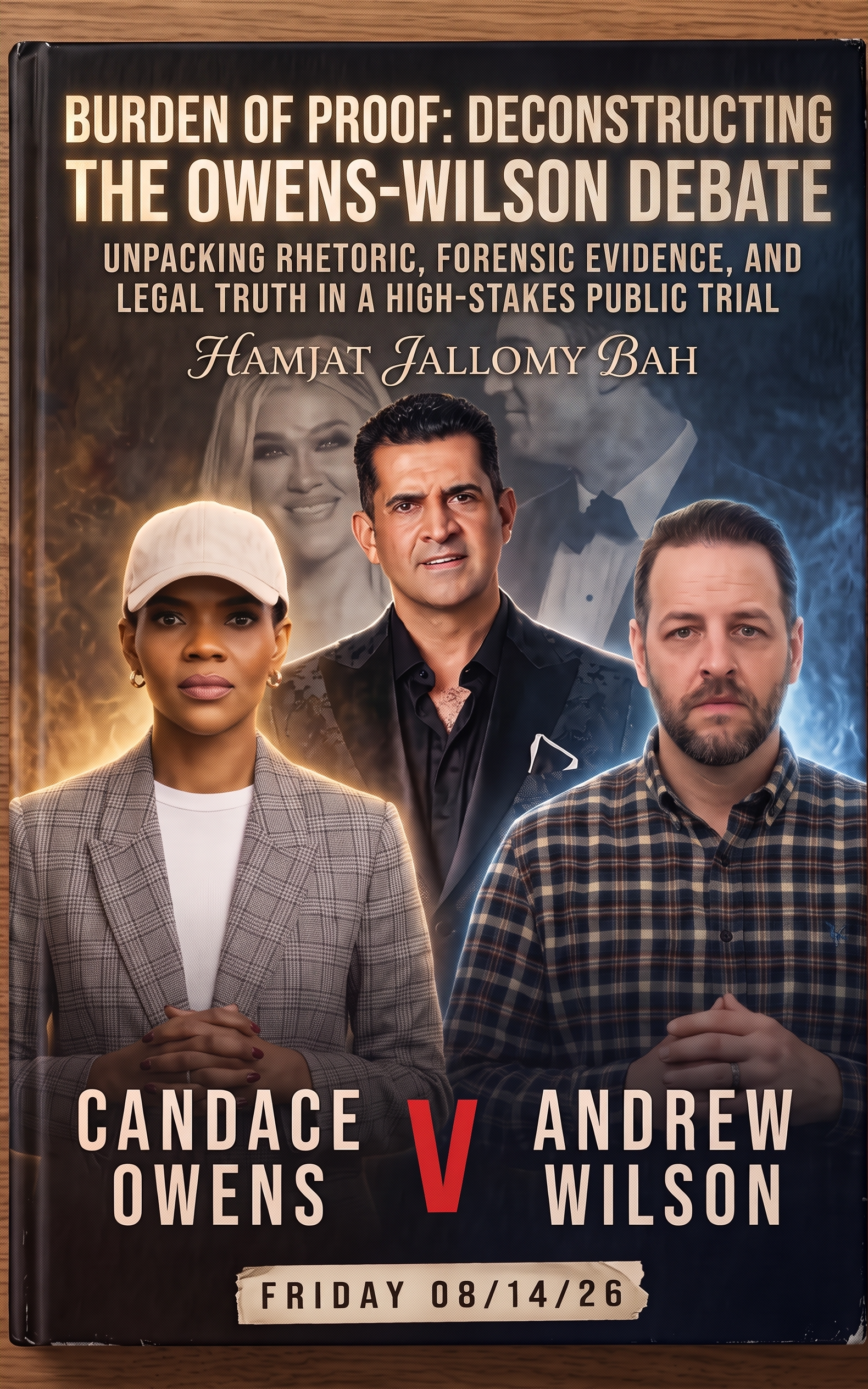
Burden of Proof: Deconstructing the Owens-Wilson Debate
Unpacking Rhetoric, Forensic Evidence, and Legal Truth in a High-Stakes Public Trial
by Hamjat Jallomy Bah
When modern political commentary clashes with the strict standards of criminal jurisprudence, where does the truth actually lie? In this incisive and meticulously researched analysis, Hamjat Jallomy Bah deconstructs the high-profile public debate between Candace Owens and Andrew Wilson regarding the tragic death of Charlie Kirk and the state's case against Tyler Robinson. Moving beyond sensational media narratives, Burden of Proof separates persuasive speculation from admissible courtroom facts. Bah systematically examines contested crime scene evidence, autopsy records, ballistic analyses, digital timelines, and witness credibility. Readers will explore how rhetorical framing, media incentives, and algorithmic outrage distort the public's perception of reasonable doubt. Featuring structured comparative scorecards and rigorous legal breakdowns, this book offers a masterclass in dissecting modern true crime discourse. Whether you are a legal professional, true crime enthusiast, or critical thinker navigating an era of institutional skepticism, this indispensable guide equips you with the analytical tools to evaluate complex criminal trials and uncover the truth behind the headlines.
- True Crime
- Educational & Academic
- Court Cases & Trials
- Forensic Investigation
- Law & Legal Studies
The Arena: Trial by Media Versus the Court of Law
On a Friday August 14th 2026, roughly eleven million people watched two commentators argue over the death of Charlie Kirk and the criminal case against Tyler Robinson. The setting was a live-streamed debate stage, not a courtroom. Yet within minutes, the language of the courtroom had taken over the conversation. Words like "evidence," "chain of custody," and "burden of proof" flew back and forth between Candace Owens and Andrew Wilson as if the two of them were standing before a judge rather than a camera crew. That collision, between the vocabulary of law and the format of televised argument, is the subject of this book. This chapter sets the terms of that collision.
Owens is a media figure with a large following built on skepticism toward official institutions. Her career has been defined by a willingness to question consensus narratives, whether the subject is public health policy, election administration, or now, a homicide investigation. Wilson arrived as something closer to a legal explainer, a commentator whose reputation rests on procedural precision and a refusal to get ahead of the facts. Their exchange was not simply a disagreement about details. It was a disagreement about method. Owens wanted to ask what looked wrong. Wilson wanted to ask what could be proven. Those are two different questions, and the entire debate turns on the fact that both sides frequently answered the wrong one.
Two Theses, One Case
Owens's central argument, stated plainly, is that the investigation into Kirk's death was compromised from its earliest hours. She points to inconsistencies in initial police statements, gaps in the public timeline, and what she describes as a rush to name a suspect before physical evidence had been fully processed. Her thesis is not that Tyler Robinson is innocent in some abstract sense. It is that the process which produced his arrest cannot be trusted, and that the public has a right, even a duty, to interrogate that process rather than accept it on faith.
Wilson's counter-thesis is procedural rather than factual. He argues that criminal cases are governed by established thresholds of proof that exist precisely to prevent public sentiment from substituting for verified fact. According to Wilson, the state does not need to satisfy cable news or social media before a case proceeds. It needs to satisfy a judge at the level of probable cause, and later, a jury at the level of proof beyond a reasonable doubt. Everything else, in his framing, is noise. He is not arguing that Robinson is guilty. He is arguing that the legal system has rules for determining that question, and those rules do not include a live audience vote.
Both positions contain a version of the truth. Owens is right that public institutions have, historically, made errors that only came to light because outside pressure forced a second look. Wilson is right that criminal procedure exists because untrained speculation, however well-intentioned, has a poor track record of reaching accurate conclusions. The problem is that neither debater fully credits the other's point. Owens treats procedural caution as a euphemism for cover-up. Wilson treats public skepticism as a symptom of ignorance rather than a response to real institutional failures. The debate, in other words, is less a search for truth about the Kirk case than a proxy war between two views of American institutions.
The Case of Sarah Jenkins
To understand why this proxy war matters beyond the debate stage, consider Sarah Jenkins. Jenkins served as a juror in a different high-profile homicide trial several years earlier, a case that, like the Kirk investigation, generated saturation media coverage before formal proceedings even began. In interviews conducted after the verdict, Jenkins described a specific difficulty that had nothing to do with the facts of the case and everything to do with the environment surrounding it. She had watched hours of cable news coverage before ever receiving a jury summons. By the time she sat in the jury box, she had already absorbed theories, expert commentary, and confident predictions about guilt that had never been tested in a courtroom.
During deliberations, Jenkins later admitted, she caught herself repeatedly reaching for details that felt true but that she could not locate anywhere in the actual trial exhibits. A commentator had mentioned a piece of forensic evidence on television. A juror in the room believed it had been introduced at trial. It had not. The information existed only in the media ecosystem surrounding the case, not in the sworn record the jury was legally required to consider. Jenkins described the sensation as trying to separate two glasses of water that had already been poured into the same pitcher. Once the mixing happens, undoing it takes real effort, and some residue almost always remains.
This is not an isolated psychological quirk. It is a predictable outcome of trial coverage in the modern media environment, and it is the exact danger Wilson invokes when he warns against premature public theorizing. When millions of potential jurors are exposed to confident narratives before a single exhibit is entered into evidence, the pool from which any jury is drawn becomes contaminated in ways that are difficult to detect and nearly impossible to fully correct through jury instructions alone. Judges can tell jurors to disregard what they saw on television. They cannot reach into a juror's memory and delete it.
Owens would likely respond, and has responded in similar contexts, that the alternative, silence in the face of institutional stonewalling, carries its own cost. If media pressure had never been applied in past cases of wrongful conviction or investigative negligence, some of those cases would never have been reopened. The Central Park Five case, the wrongful conviction of numerous individuals overturned decades later through advocacy and journalism rather than internal police review, stands as a real example of outside pressure correcting institutional failure. Owens's argument is that the public cannot always wait for official channels to police themselves, particularly when those channels have a documented history of getting it wrong and taking years to admit it.
Both arguments are legitimate. The Jenkins case shows the cost of premature narrative formation. The history of wrongful convictions shows the cost of unchecked institutional deference. The tension between these two costs is not a debate-stage invention. It is a real and unresolved feature of how the American legal system interacts with a media environment that did not exist in its current form when most procedural rules were written.
Rhetorical Strategy on Display
Watching the debate closely reveals two distinct rhetorical toolkits, each suited to a different kind of persuasion.
Owens relies heavily on what might be called pattern recognition rhetoric. She strings together a series of individually minor anomalies, a delayed statement here, an unexplained gap in a timeline there, an inconsistency between two press briefings, and asks the audience to notice the cumulative shape those anomalies form. This is a powerful technique because it mirrors how people naturally process uncertainty. Humans are pattern-seeking by design, and a sequence of small irregularities can feel more convincing than any single piece of hard evidence. Owens also uses emotional appeals to a sense of justice, framing her skepticism as advocacy on behalf of truth and the public's right to know, rather than as accusation against any particular institution.
Wilson counters with procedural formalism and cross-examination technique. Rather than disputing each individual anomaly Owens raises, he frequently asks a narrower question: does this anomaly meet the legal threshold required to affect the outcome of a case? A gap in a press timeline, he argues, is not the same as a gap in the chain of custody for physical evidence. A delayed public statement from police is not the same as a delayed forensic report submitted to the court. Wilson's technique is to separate what is dramatically interesting from what is legally material, and in doing so, he often succeeds in lowering the emotional temperature of Owens's claims. He also employs a burden-shifting demand, repeatedly asking Owens to specify what admissible evidence would need to exist to change her mind, a question designed to expose whether her skepticism is falsifiable or simply permanent.
Neither approach is without cost. Owens's pattern recognition, taken too far, becomes what statisticians call the Texas sharpshooter fallacy, the tendency to find a meaningful pattern in random noise after the fact, simply because enough data points exist to connect in some configuration. Wilson's formalism, taken too far, risks dismissing legitimate public concern as mere emotionalism, a posture that can come across as tone-deaf when the underlying anomalies, even if legally immaterial, remain factually unexplained.
Auditing the Opening Evidence
The early portion of the debate rests heavily on three categories of public record: initial police press releases, the publicly available arrest affidavit for Tyler Robinson, and media transcripts from the first seventy-two hours of coverage.
The initial press releases, as Owens correctly notes, contain internal inconsistencies regarding the timeline of Robinson's identification as a suspect. One release places the identification roughly six hours earlier than a subsequent statement from the same department. Wilson's response is that timeline discrepancies in early press communications are common in active investigations, where information is often released in stages by different personnel with incomplete knowledge of the full case file. Both points are factually accurate. A discrepancy exists. Discrepancies of this type are also common in early-stage investigations generally, and do not by themselves indicate wrongdoing.
The arrest affidavit, a public document outlining the probable cause basis for Robinson's arrest, is treated very differently by each debater. Owens focuses on what the affidavit does not include, specific forensic confirmations that later appeared in media leaks but were absent from the sworn document itself. Wilson focuses on what the affidavit is legally required to include, arguing that a probable cause affidavit exists to justify an arrest, not to serve as a comprehensive presentation of the state's full evidentiary case. This distinction matters enormously and will recur throughout later chapters. An affidavit is a threshold document. A trial is where the complete evidentiary record is meant to appear.
Media transcripts from the first days after Kirk's death show a pattern familiar to anyone who has followed high-profile cases in the past decade: early reporting filled with unconfirmed detail, competing anonymous sources, and confident on-air speculation that in several instances was later walked back without correction or apology. This pattern is central to Wilson's argument about jury pool contamination. It is equally central to Owens's argument that official sources, by failing to provide timely and consistent information, created the vacuum that speculative media coverage rushed to fill. Here again, both critiques land, and both point to the same underlying failure: a communication gap between law enforcement and the public that neither side of the debate can fully resolve through rhetoric alone.
Strengths and Weaknesses, Side by Side
A structured comparison helps clarify where each debater succeeds and where each falls short.
| Dimension | Candace Owens | Andrew Wilson |
|---|---|---|
| Core appeal | Public distrust of institutions | Legal precision and procedural discipline |
| Primary strength | Connects scattered anomalies into a coherent public narrative | Distinguishes legally material facts from dramatic but irrelevant details |
| Primary weakness | Treats unanswered questions as proof of deliberate concealment | Can appear dismissive of legitimate anomalies by hiding behind statutory technicality |
| Risk to public understanding | Encourages premature conclusions before verified facts exist | Risks losing public trust by seeming indifferent to real institutional failure |
This table is not a scorecard declaring a winner. It is a diagnostic tool, and readers will encounter versions of it throughout the book as later chapters examine ballistics, autopsy findings, and digital forensics in greater detail. The pattern established here, useful skepticism paired with overreach on one side, technical accuracy paired with tone-deafness on the other, repeats itself across nearly every major point of contention in the broader debate.
Why the Rules Exist
It is worth pausing on why the burden of proof rests entirely on the prosecution, a principle Wilson invokes repeatedly and correctly throughout the exchange. The rule is not a technicality invented to protect the guilty. It exists because the state holds enormous power relative to any individual defendant. Police departments have investigative resources, forensic labs, subpoena power, and prosecutorial staff. A defendant has, in most cases, none of these things by default. Requiring the state to prove its case beyond a reasonable doubt, rather than requiring the defendant to prove innocence, is a structural check on that imbalance of power.
This principle has a direct bearing on how the public should interpret the debate itself. When Owens raises an unanswered question, that question is legitimate to ask. It is not, however, legally equivalent to a gap in the prosecution's case that would require an acquittal. Speculation, however reasonable, is not evidence. A defense attorney does not need to prove an alternative theory of the crime. The state must prove its own theory, fully, with admissible evidence, to the satisfaction of twelve jurors. Owens's rhetorical strategy sometimes blurs this line, implying that an open question about the investigation is itself a form of doubt sufficient for acquittal. Wilson is correct to push back on that framing, even when his manner of doing so can feel unsympathetic to real public concern.
At the same time, Owens's underlying instinct, that institutions deserve scrutiny rather than automatic deference, is not irrational. The history of American criminal justice includes enough documented cases of investigative shortcuts, tunnel vision, and outright misconduct that public skepticism carries its own evidentiary weight, even if that skepticism cannot substitute for courtroom proof. The challenge for any careful observer of this debate, and of the broader case, is holding both truths at once: institutions deserve scrutiny, and scrutiny is not proof.
Setting the Baseline
The clash between Owens and Wilson is, at its foundation, a clash between two different systems for arriving at truth. Media platforms reward speed, confidence, and narrative coherence. A commentator who says "I don't know yet" loses viewers to one who offers a definitive theory, whether or not that theory survives contact with the actual evidentiary record. Legal systems, by contrast, are built to reward patience, verification, and the slow accumulation of admissible fact. A prosecutor who moves too fast risks losing a conviction on appeal. A defense attorney who moves too fast risks missing exculpatory evidence buried in a file that has not yet been fully reviewed.
These two systems are not merely different in tone. They are different in purpose. Media exists to inform and, increasingly, to engage an audience whose attention is the actual product being sold. Courts exist to determine legal guilt or innocence under a standard designed to minimize the risk of convicting an innocent person, even at the cost of occasionally letting a guilty person go free. When these two systems collide, as they did in the Owens-Wilson debate, and as they do in nearly every high-profile American criminal case since the advent of cable news, the result is a public conversation that borrows the vocabulary of law without always respecting its constraints.
The chapters that follow will apply this baseline to the specific factual disputes at the center of the case: the crime scene itself, the autopsy findings, the ballistics analysis, the chain of custody for physical evidence, and the digital trail that investigators used to track Tyler Robinson in the days after Kirk's death. In each instance, the same underlying tension identified here will reappear. One side will ask what looks suspicious. The other will ask what has been proven. Readers equipped with the distinction established in this chapter, between an interesting anomaly and admissible evidence, between institutional skepticism and legal doubt, will be far better positioned to evaluate those later, more technical disputes on their own merits rather than on the persuasive skill of whichever debater speaks last.
Two questions are worth holding onto as the book proceeds. First, how has social media commentary reshaped public expectations about the pace of a legal investigation, and what happens when the public demands answers on a timeline that forensic science and legal procedure were never designed to meet? Second, can independent media investigation genuinely assist law enforcement, as Owens's model implies it sometimes does, without simultaneously polluting the evidentiary record and the jury pool, as Wilson's model warns it inevitably will? There is no clean answer to either question. There is only the ongoing, unresolved negotiation between two systems that were never designed to work together, and that the Kirk case has forced into direct confrontation.
Defining Reasonable Doubt: Standards of Proof in High-Profile Homicides
In American criminal law, the highest evidentiary threshold is proof beyond a reasonable doubt. It is not an impossible standard, but it is intentionally demanding. When the state brings charges against an individual in a homicide case, it takes on the full burden of proving every statutory element of the offense. The defendant does not have to pro…