

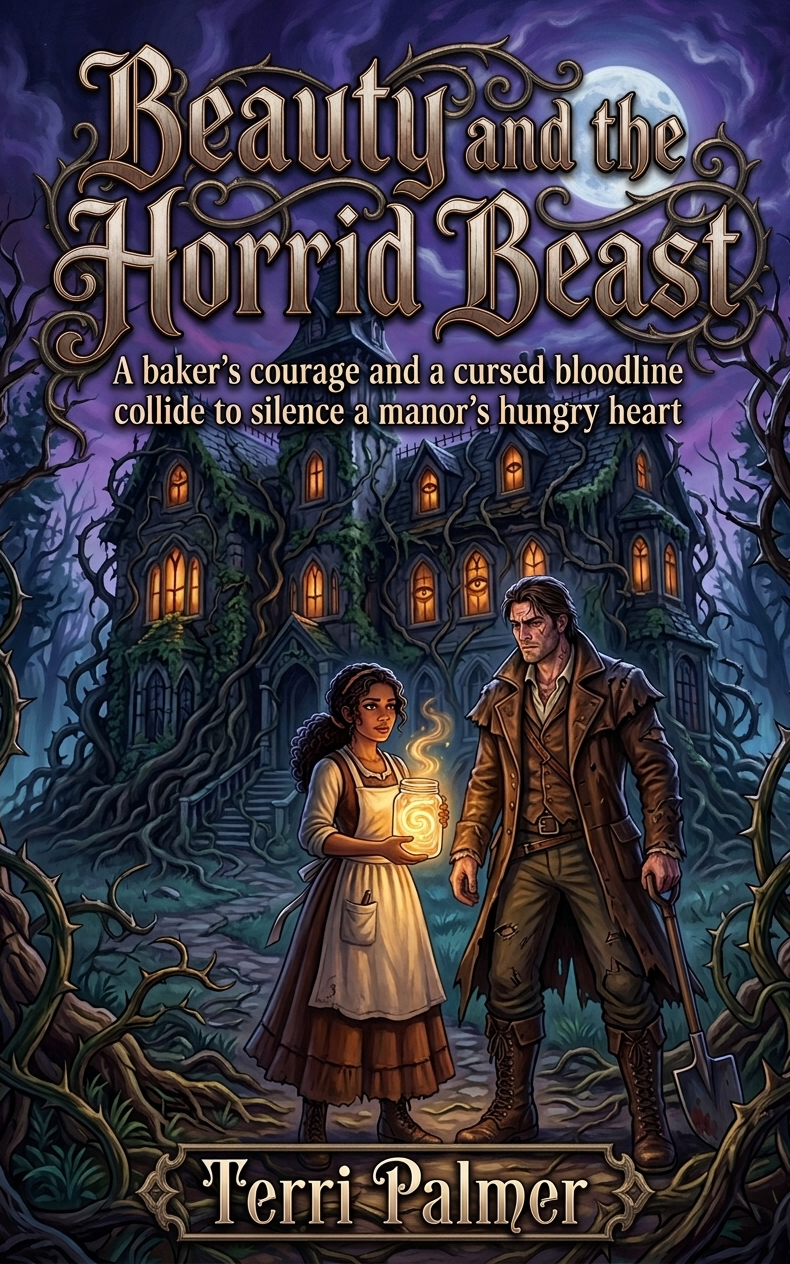
Beauty and the Horrid Beast
A baker's courage and a cursed bloodline collide to silence a manor's hungry heart
by Terri Palmer
In the village of Oakhaven, everyone knows to fear Blackwood Manor and the scarred groundskeeper the locals call 'the Beast.' But Serafina, a baker's daughter with a practical mind and a sharp wit, sees through the superstition. When she stumbles into the estate's sprawling garden, she discovers a terrifying truth: the manor is alive, a sentient parasite held in check only by magical roses and ancient blood. After an accidental misstep awakens the house's primal hunger, the walls begin to shift and the foundations groan with a need to feed. Lucian, the last heir of the Blackwood line, is a man bound by duty to a monster that wants to consume him. With the house expanding and the villagers gathering with torches at the gates, Serafina realizes her mastery of fermentation might be their only salvation. In a race against time, Serafina and Lucian must combine her alchemical knowledge of yeast with his ancestral blood to craft a poisoned starter—a deadly brew designed to induce a permanent slumber in the house’s wooden heart. To save themselves, they must venture into the belly of the beast and sacrifice the only home Lucian has ever known. Can a simple baker silence a centuries-old curse, or will the manor swallow them both whole?
- Fantasy
- Cozy Fantasy
- Fairy Tale Retelling
- Mythological
- Quest Adventure
The Flour and the Folklore
The village of Oakhaven smelled of wood smoke and fresh bread before it smelled of anything else, and that was exactly how Serafina liked it.
She stepped into the warmth of her father's shop with flour already dusting her forearms and sleep still heavy in her eyes. The ovens had been lit since midnight. They breathed steadily now, puffing warm air through the low-ceilinged room, and the loaves of rye dough set to proof on the long wooden table had swelled beautifully overnight, round, full and hopeful as a held breath.
Ovens are alive, he said.
She believed him. She believed him about the ovens. She did not believe him about the manor.
"Dravic was at the well again before sunrise," her father said, not quite casually. His hand found her shoulder, heavy and warm. "Says the attic windows were glowing last night. Both of them. At the same time. Like eyes."
Serafina did not look up from the loaf "Dravic once told the entire market square that the river was flowing backwards," she said. "It was a reflection."
"He's old, not foolish."
"I glanced toward Papa, at the careful worry in his face. "Blackwood Manor has stood empty for thirty years. An empty house gets damp. Damp houses grow things. Something in the walls caught the moonlight slightly. "Stay away from the tree line today," he said. It was not a question.
She smiled at him, said nothing, and began wrapping a small loaf of rye in a clean cloth.
Old Dravic found her on the street outside the bakery not an hour later, his milky eyes wide and his breathing coming in that familiar wheeze, as though alarm itself became an exertion. He pointed one gnarled finger toward the dark line of the forest at the village's northern edge, beyond which the roof of Blackwood Manor could be glimpsed on clear days, slate-grey and sagging at the center like a sunken cake.
"The stones are hungry," he told her, solemn as a funeral. "You can hear it at night, if you're brave enough to listen. The house breathes, girl. It breathes and it waits." grounds — he is no man. No man has eyes like that."
"What sort of eyes?" Serafina asked, because she was genuinely curious.
Dravic opened his mouth, then closed it, apparently dissatisfied that she had not shuddered. "Hungry ones," he said at last, and shuffled away.
The butcher, passing by with his cart, leaned in to add that he had seen a shadow taller than a carriage lurking by the gate not two weeks past. Serafina decided the butcher had seen what he wanted to see, which was usually a reason to talk.
She picked up her basket and walked north.
The path to the manor's boundary was not a proper road, just a worn suggestion of one, the grass pressed flat by decades of people going close enough to feel brave and then turning back. The village fell quiet behind her, the way it did when someone does something the rest of them had already decided was foolish. The trees on either side of the path grew older as she walked, and stranger, their roots lifting out of the earth and curling back under like sleeping fingers. The birdsong thinned. Then it stopped.
Serafina noticed the quiet the way she noticed when dough stopped rising — not with alarm, but with attention. She slowed her steps and looked around properly.
The trees at the manor's perimeter leaned away from the stone wall, almost imperceptibly, the way plants lean from a cold draft. Not fallen, not dead. Simply — reluctant. As though they had decided, over a very long time, that distance was the wiser policy.
The iron gate was enormous, taller than two men and thick with rust at its hinges, but the vines that wound through its bars were anything but rusted. They were dark green and heavy, pulsing with a thickness that seemed too deliberate for something merely growing. Serafina watched them from the corner of her eye. When she looked directly at a tendril, it was perfectly still. When she let her gaze drift, she could have sworn the nearest one had shifted, just a fraction, curling toward the latch.
She looked at it directly. It was still.
She kept her eyes on it a moment longer, then looked away on purpose.
It moved. She was almost certain.
Beyond the gate, the garden stretched in a state of strange grandeur, overgrown in some places and fastidiously tended in others. And there, in the tended part, stood a man.
He was tall and broad-shouldered, his back to her, bent over a cluster of roses that grew in a perfect circle at the garden's heart. The roses were extraordinary; even from this distance, through iron bars and the grey morning light, not quite frost and not quite light. The man moved among them with a care that bordered on reverence. His hands, scarred and large, turned each bloom as gently as Serafina's father turned new loaves.
The village called him the Beast.
What Serafina saw was a gardener who had not been brought a decent loaf of bread in far too long.
She set her basket down, straightened her apron, and waited to be noticed.
The Scars of the Gardener
She called out to him the way she called out orders around the cool iron bars of the gate. "I've brought rye bread." The man in the garden went still. He did not turn at once. He straightened slowly, like something accustomed to bearing weight, and when he finally turned to face her, Serafina did not step back. She had promised herself she wouldn't…
Want to read the rest?
Get the full book here: