

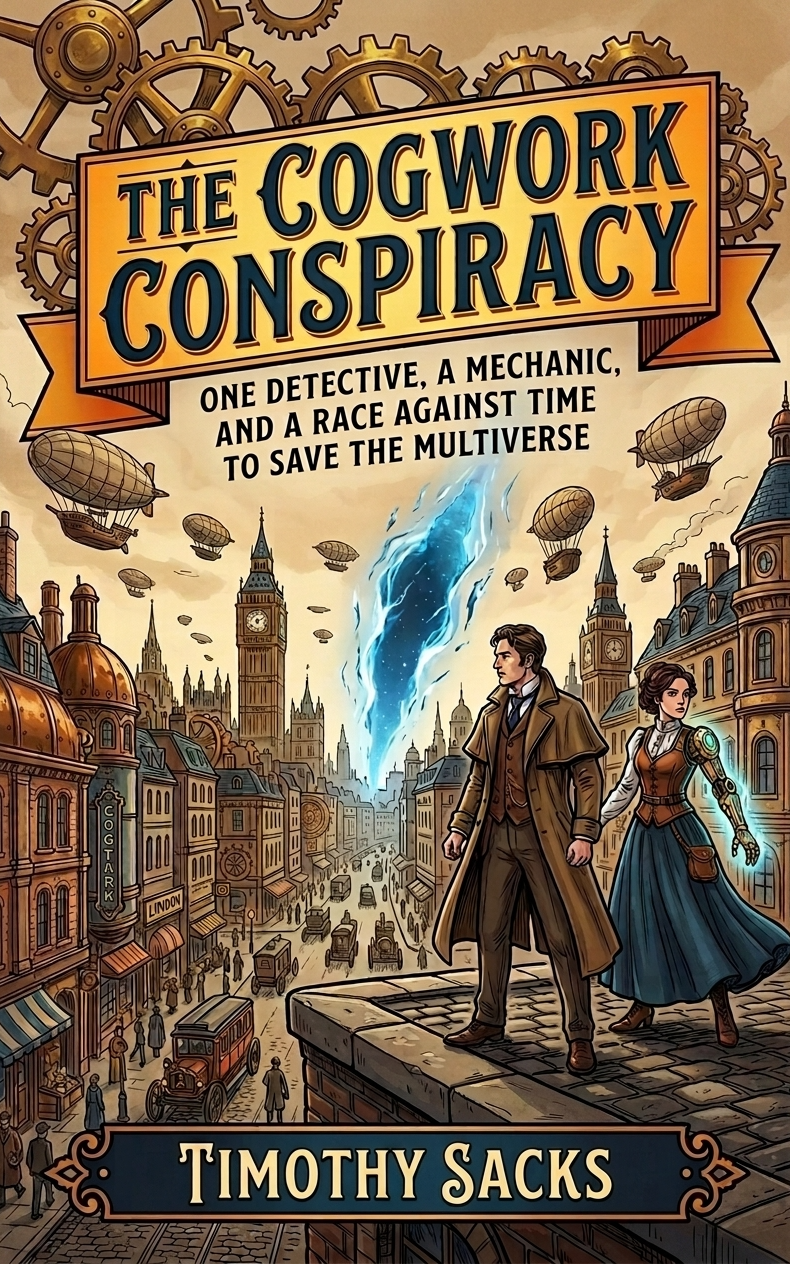
The Cogwork Conspiracy
One detective, a mechanic, and a race against time to save the multiverse
by Timothy Sackrider
eIn a London where steam and gears rule the streets, Jasper Sterling-Holloway is a detective with nothing left to lose. But when a routine investigation reveals a modern credit card—an artifact from a world that shouldn't exist—Jasper realizes his reality is being rewritten. Enter the world of Dime Jumpers: criminals who use rare, expiring Driftstones to tear through time and space. Teamed with Kit Mallory, a brilliant mechanic with a clockwork prosthetic, Jasper must track down the bandits who stole the legendary Cogwork. Their pursuit leads them into a web of cross-dimensional conspiracy orchestrated by the ruthless industrialist Archibald Vane-Garrison. Vane-Garrison doesn't just want power; he wants to merge parallel dimensions into a single, twisted empire. From sky-pirates to high-tech ruins, Jasper and Kit must navigate the unpredictable nature of the Driftstones before their own history is erased forever. With every jump, the stones lose their power, and the clock is ticking. The Cogwork Conspiracy is the first pulse-pounding installment of The Driftstone Chronicles. Perfct for fans of Sherlock Holmes and Indiana Jones, this steampunk adventure proves that even in a world of clockwork, time is the ultimate enemy.
- Crime Fiction
- Adventure
- Steampunk
- Science Fiction
- Exploration
- Time Travel
The Impossible Plastic
The vault door hadn't been touched.
That was the first thing Jasper Holloway-Pike noted when he stepped into the lower level of the Bank of England at half past seven in the morning, his charcoal duster still damp from the fog outside. The door was a masterpiece of iron and engineering, three feet thick, its locking mechanism a configuration of eighteen interlocking gears that required two separate keys and a six-digit combination to open. Every gear was in its correct position. Every tumbler sat undisturbed. Not a scratch on the brass facing, not a smear of oil on the handle. The door might as well have been admired all night by the most careful of guards.
Behind it, the vault was completely empty.
Inspector Rowan Finch stood with his arms crossed and his mustache doing the thing it always did when he was irritated, which was bristle outward like a threatened cat. He was Jasper's former superior, and he wore that former like a weapon. "We're calling it a conjuring trick," Finch said. "Some theatrical criminal, gas-smoke and mirrors. The gold will turn up in a warehouse by Thursday."
"The gold," Jasper said, crouching near the vault floor, "did not walk out through an intact door." He pulled his examining monocle from his bandolier, a brass-rimmed lens fitted with a spectral filter, and held it to his eye. The floor near the far wall showed a faint discoloration, a pale ring of oxidation about four feet in diameter. The metal at the center looked older, more stressed, like iron that had been subjected to years of pressure in the span of a few seconds. "Whatever removed the gold, it wasn't theatrical."
That was when he saw it. Half-tucked against the baseboard, nearly invisible against the dark stone floor. A small rectangle of blue plastic, no bigger than a playing card, with a gold chip embedded in its face.
He picked it up with two fingers and turned it over. Raised numbers ran across the front. An expiration date: 04/2027. At the bottom, a company name in clean, machined typeface: Garrison Capital Consolidated.
"What have you got there?" Finch asked.
"Residue," Jasper said, and pocketed it.
Finch wasn't satisfied, but then Finch hadn't been satisfied with Jasper since the Morrow Street incident three years prior, when Jasper had filed a report describing an object recovered from a murder scene that had no business existing in 1902. The report had been buried. Jasper had been stripped of his rank shortly afterward, the official reason being insubordination, the real reason being that someone powerful hadn't wanted the question asked.
"Leave the object with the evidence clerk," Finch said. "And leave the case to actual inspectors."
"I don't work for you anymore." Jasper straightened, adjusting his bandolier. "You made that exceptionally clear."
"I can make it clearer. Push this, Holloway-Pike, and I'll have your recovery license revoked before you get back to whatever hole you've crawled into. The city doesn't need a disgraced inspector playing at detective with borrowed tools."
Jasper looked at the empty vault, at the oxidized ring on the floor, at the ceiling where the gas lamps had flickered and left a faint scorch pattern he recognized from other scenes, other cases, other objects that shouldn't exist. He looked at Finch, at the careful blankness behind his superior's irritation, and understood that the man was not merely dismissing the evidence. He was afraid of it.
"Good day, Inspector," Jasper said, and walked out.
His office was two floors above a clock shop on Aldermast Street, and the irony of that arrangement had never been lost on him. The walls were covered in maps, newspaper clippings, and a running tally of what he privately called displacement events, incidents where the physical world had briefly stopped making sense. He had sixty-three documented cases. Finch had buried all of them.
He set the plastic card on his desk and brought the monocle back to his eye, this time switching the filter to its highest-magnification setting. The card's surface, smooth to the naked eye, revealed a microscopic grid of text under the lens. Manufacturing codes, mostly. Distribution data. But there, in the lower corner, a string of characters that resolved into a company identifier: GCC Parallel Acquisitions Division, Class-7 Authorization.
Garrison Capital Consolidated. Archibald Garrison. The wealthiest man in the city, whose factories produced machinery a full generation ahead of anything his competitors managed, whose patents kept appearing faster than any single engineering team could reasonably develop them. Jasper had always suspected the man's technological edge was borrowed from somewhere. He hadn't imagined it was borrowed from when.
He sat back in his chair and pressed two fingers against his temple. The gold hadn't been stolen. The vault showed no signs of forced entry, no signs of any entry at all. The oxidation ring on the floor matched the residue patterns from the Morrow Street case, from the Threadneedle warehouse fire, from the dockside incident last autumn that the Metropolitan Gear-Guard had officially classified as a gas explosion. The gold had been phased out, removed from one layer of reality to another, leaving nothing behind but a stressed floor and a piece of plastic from a year that hadn't happened yet.
His previous disgrace hadn't been a failure of judgment. It had been a cover-up.
He was still sitting with that thought when the flicker of movement across the street caught his eye. A figure stood in the mouth of the narrow alley facing his window, dressed in a long coat that seemed to shift color with the fog, gray one moment and deep blue the next. The figure wasn't moving. It was simply watching his window with the patient stillness of someone who had been waiting a long time and expected to wait longer still.
Jasper held the figure's gaze for a moment, then looked deliberately down at the card on his desk. When he looked up again, the alley was empty.
He pulled on his duster and reached for his hat.
There was only one person in the city who understood strange technology well enough to tell him what he was actually holding, and she worked down at the Iron Docks in a workshop that smelled of coal smoke and machine oil. Kit Mallory, they called her. The girl with the brass arm.
He was going to need her to look at this card before whoever had left it in that vault decided they wanted it back.
The Girl with the Brass Arm
The Iron Docks smelled the way Jasper imagined the inside of a furnace might smell if you mixed it with low tide and machine oil — not entirely unpleasant, but aggressively present. He followed the waterfront south from the main pier road, past stacked crates of brass fittings and coils of pressure hose, until he found the address he'd memorized fr…
Want to read the rest?
Get the full book here: