

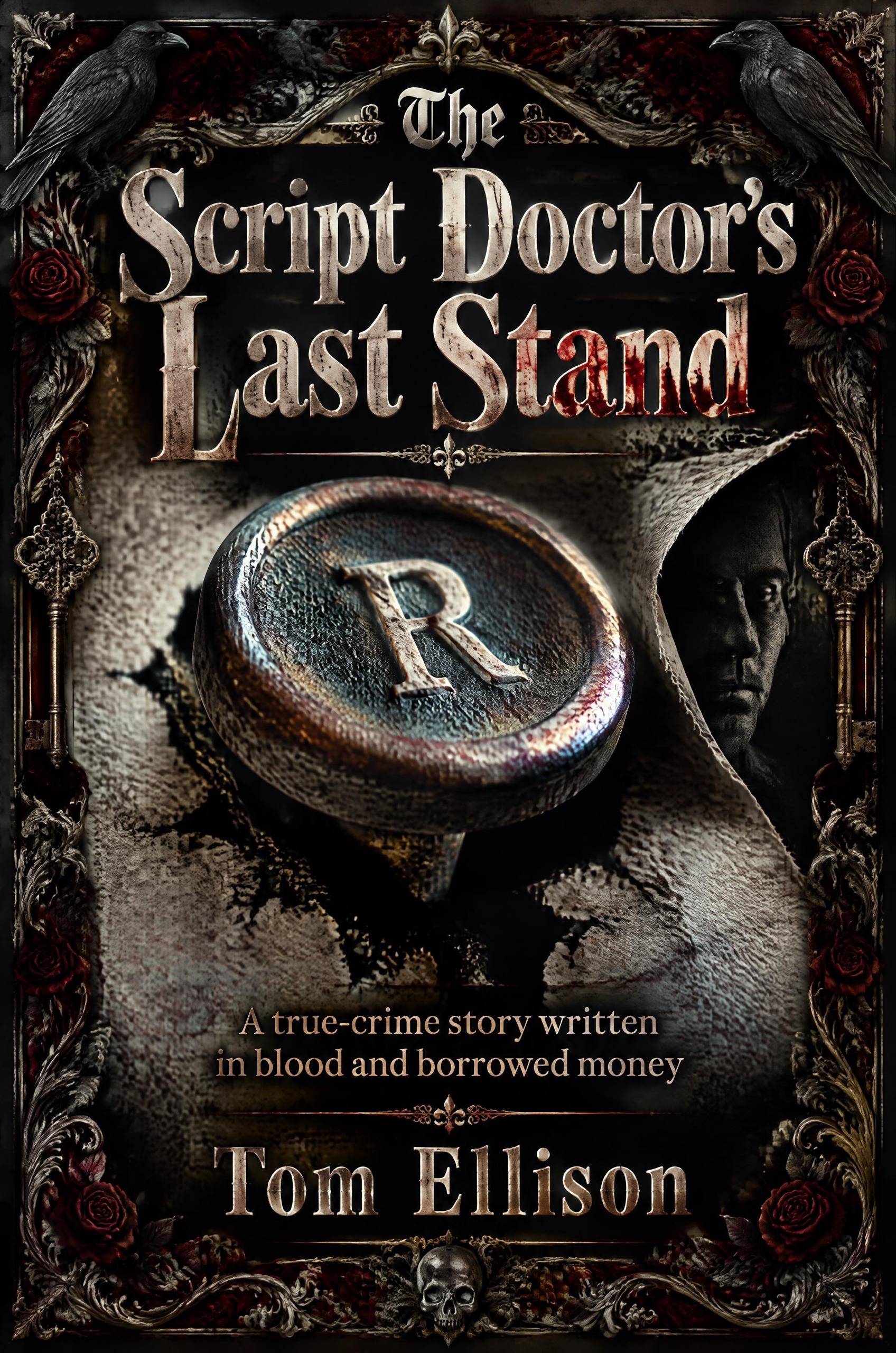
The Script Doctor's Last Stand
A true-crime story written in blood and borrowed money
by Tom Ellison
Harvey Cantor is a Hollywood script doctor with a cocaine habit, fifty thousand dollars in debt, and one last bad idea. He flies to San Quentin to interview Jose Ramon Morales, a lifer who claims he can curse a man through his name on a page. Morales warns him. Harvey laughs. He steals the story anyway. Then he steals money from his friends to bet on a stock tip. Then he snorts the money. Then he runs to a frozen lake house in New Hampshire with a finished manuscript and a desperate need to be admired by the first local who will look at him twice. Ray looks at him twice. Ray is twenty-two, cold-eyed, and using him. Harvey knows. Harvey does not care. When the money runs out and the police close in, Harvey Cantor has one scene left to write. He writes it with Stan's revolver. Chapter 1: The Raconteur is a true-crime novel about the stories we tell ourselves so we can keep going — and the moment those stories fail.
- Thriller
- Crime Fiction
- Literary Fiction
- Psychological Thriller
- Crime Thriller
- Character Study
The Raconteur
The air conditioning inside the commissary at Paramount hummed at an aggressive, arctic pitch, but I was sweating through the collar of my linen shirt anyway. At five-foot-eight and an unapologetic two hundred and forty pounds, I didn't sit in a banquette so much as colonize it. I spread my soft, ring-adorned hands flat against the mahogany tabletop, leaned over my cobb salad, and paused just long enough for the table to register the silence.
Silence was an instrument I tuned with surgical care.
"So the network exec looks at me, guy’s thirty-two, wearing a quarter-zip that screams my stepfather owns a hedge fund, and he says, 'Harvey, the protagonist lacks emotional clarity in act three,'" I said, my pitch dropping an octave, deadpan and raspy. "And I told him, 'Brandon, sweetie, if you had emotional clarity at fifty-two, you wouldn't be paying two thousand dollars an hour for a dominatrix who speaks only in iambic pentameter.'"
The table broke into shrill, hungry laughter. Two staff writers from the procedural across the lot nearly choked on their sparkling waters; an associate producer tapped her silver spoon against the saucer in pure, performative delight.
I smiled, letting the roll of my double chin settle pleasantly against my unbuttoned collar, even as my thumb worked a frantic, silent circle against the signet ring on my pinky finger. It was the smile of a seasoned court jester who knew precisely where the king kept the executioner's axe. For twenty years, I had kept rooms warm. I was the writer you hired when the pilot draft was limp and needed seven punch-ups per page, or when the sitcom veteran refused to come out of his trailer until somebody who understood Catskills timing sat him down and flattered him into makeup. I was an institution of West Hollywood dinners, table reads, and late-night drinks at Musso & Frank.
Yet when the laughter died down, leaving only the clink of cutlery and the dull roar of the room, I felt the cold draft again. The procedural was winding down. The sitcom I'd worked on during the fall hadn't been picked up for back nine episodes. The residuals that used to arrive with comforting quarterly heft were trickling in as thin, three-digit paper crumbs.
I signaled the waiter with a breezy flick of two fingers, slid my corporate Visa into the faux-leather folio without looking at the subtotal, and held my breath until the terminal chirped approved. It was three hundred dollars from its hard limit. As the waiter bowed away, I caught the associate producer eyeing the gold trim on the card, her expression tinged with that ravenous respect only Hollywood reserves for people who seem utterly indifferent to the bill. I gave her my best avuncular wink, tucked the merchant copy into my breast pocket, and stepped out into the blinding white heat of Melrose Avenue.
My condo off Fountain Avenue greeted me with the dull slap of cool stale air. I pushed open the double doors, my wingtips sliding over a drifts of envelopes scattered across the marble foyer: three certified letters from the leasing company, a collection demand from Equinox, an overdraft notice from City National, and a fluorescent pink shutoff warning from the Department of Water and Power. The heavy stench of a dying lemon candle failed to mask the musk of damp carpets and dry rot.
I dropped my keys onto the credenza and stood before the hallway mirror. In the merciless afternoon light slanting through the blinds, I didn't look like a raconteur. There had been a year, maybe '98, when the Warner pilot went to series, where I spent twenty minutes every afternoon smoothing pomade through thick, dark waves and admiring the sharp, theatrical line of my jawline in barber shop plate glass. Now, the glass gave back only a slack, graying double chin, pitted pores around the nose, and the yellowed, bloodshot eyes of a man who hadn't slept four consecutive hours since Thanksgiving. Fifty-two wasn't an automatic death sentence in Los Angeles, but being a heavy-set, gay, semi-employed script doctor with bad knees, empty accounts, and an empty bed certainly felt like one. The boyfriends, if one could even call the smooth twenty-somethings who hung around for dinners at Craig's and weekend runs to Palm Springs "boyfriends," had evaporated the exact moment the luxury car leases and black cards could no longer be floated.
It wasn't my first time running out of runway. In the late eighties, before I’d fully surrendered to the truth of what I wanted, there had been Brenda. Brenda, whose father, Carmine DiSalvo, controlled half the wholesale spirits distribution between Newark and Philadelphia, a man who wore diamond pinky rings and kept four Sicilian enforcers on retainer for when freight vanished from the docks. When Brenda walked into the master bedroom of our Englewood colonial on a Tuesday afternoon and found me tangle-limbed with an eighteen-year-old pool boy from Tenafly, she hadn't cried. She had simply picked up the kitchen phone and dialed her father.
Within six hours, two heavy sedans with Jersey plates were idling at the curb outside my brownstone office. Carmine hadn't threatened a lawsuit; he had sent word through a cousin that I would be found floating face down in the Hackensack Meadowlands before the week was out. I vomited bile into the brass office umbrella stand, sweat soaking the armpits of my shirt cold until my knees gave out against the radiator.
Sick with dread and shivering, I did the only theatrical thing I knew how to do. I tore off my necktie, slashed my wrists just shallowly enough on an antique letter opener to bleed convincingly over the Turkish rug, and dialed 911 screaming of biblical voices and burning brimstone in the vents. When the paramedics kicked in the door, I was thrashing on the parquet, weeping operatically and babbling in stage tongues about angelic retribution.
The intake at St. Vincent’s was brisk and brutal. They stripped me under buzzing strip lights, took my cufflinks, belt, and gold watch, and shoved my soft bulk into a teal paper gown that gaped open at the back. For ninety-two days, behind heavy reinforced fire doors and chicken-wire glass, I performed madness like a veteran headliner. I took the daily chemical bath, thick, yellow Thorazine crushing my brain down into leaden soup, and navigated a dayroom populated by the walking ruins of Manhattan. There was an ex-paralegal named Sal who spent sixteen hours a day scraping dried wax from the linoleum seams with an expired MetroCard, muttering depositions to the baseboards, and a gaunt former showgirl named Rita who wore three knit cardigans in the dead of July and wept softly whenever someone shuffled a deck of cards. I played endless, silent hands of gin rummy with a catatonic former furrier who stared straight through my forehead while Carmine's muscle staked out the East Village. The ward smelled of crushed chlorpromazine, floor wax, scorched rubber soles, and steamed cabbage, but every locked heavy-steel door was a moat Carmine's boys couldn't cross. By the time Brenda’s lawyers brought the divorce papers to the visitor’s room, I had surrendered the colonial, her dowry, and every cent in my accounts, signing with blue ink and trembling fingers. The asylum had stripped me raw, but the padded cell had kept me alive.
The rent was three thousand dollars a month, due four days ago. The Mercedes out front was eighty-two days delinquent, and twice this week I had spotted a flatbed with repo plates idling down at the curb by Crescent Heights. I pressed a hand flat against the soaked linen of my ribs, feeling the heavy, sickening stutter of my heart. The funny man was cornered, and the house lights were already coming up.
The South Cellblock
The visitor’s room at San Quentin had the flat, clinical geometry of a school cafeteria, drained of all dignity by strip lighting and scuffed linoleum. I had flown to Oakland on a whim, my plane ticket charged to an already shivering credit card. I’d gotten onto the story through an old acquaintance from my apartment complex who had been working as…