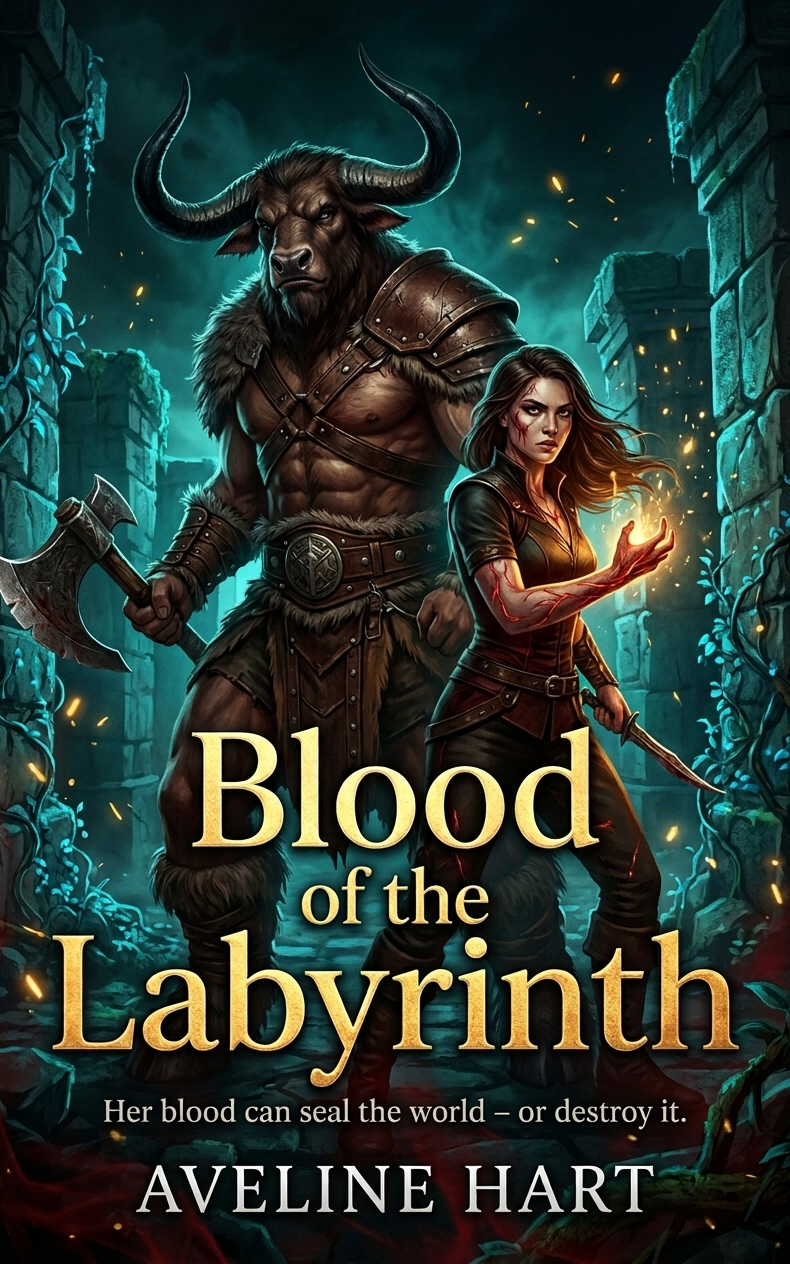
Blood of the Labyrinth
Her blood can seal the world - or destroy it.
by Aveline Hart
Betrayed by her own blood and sold into a realm of monsters, Elara Thorne expected chains. Instead, she got Kaelor Ashhorn. A feared minotaur warlord with deadly horns, brutal strength, and a reputation for destroying anyone who threatens his people. But Kaelor doesn’t treat Elara like prey. He treats her like something far more dangerous. Because Elara’s blood can awaken the ancient Labyrinth buried beneath the world—and powerful enemies will burn kingdoms to control it. With beast clans at war, a ruthless High Fey queen circling from the shadows, and an ancient force stirring behind sealed stone, Elara is caught between becoming a weapon… or becoming the one thing capable of stopping the apocalypse. The only complication? The monster sworn to protect her may be the greatest threat to her heart. Blood of the Labyrinth is a dark monster romantasy featuring a possessive minotaur warlord, explicit spice, enemies-to-lovers tension, political intrigue, dangerous magic, and a heroine who refuses to be owned.
- Epic Romantasy
- Monster Romance
- Dark Fantasy
- Explicit Fantasy Romance
- Minotaur Monster Romance
- Dark Romantasy
The Scent of Burning Ash
The dead town still smelled like wet ash and the copper sting of old blood.
I moved through it anyway, because the alternative was standing still, and standing still in places like Black Hollow had a way of becoming permanent.
The ruins were skeletal. Roof beams had collapsed inward like broken ribs, and whatever fires had eaten through this place had been thorough enough to strip the walls down to blackened stone. Charred timber jutted from the ground at odd angles. What had once been a market square was now a flat expanse of scorched earth and wind-scattered ash, still soft underfoot despite however many seasons had passed since the burning. Rain had come recently. The whole place smelled of it, that heavy mineral dampness pressing down from a sky the color of bruised iron, and underneath it, the ghost of something older. Older and worse.
I kept my hand near the longer of my two daggers and my eyes moving.
The grain shipment had passed through here six hours ago, according to the tracks. Three wagon wheels, two sets of horse hooves, and at least four men on foot, one of them dragging his left leg. I'd been following the trail since before dawn, cutting east through the Scorched Borderlands. My eyes stung with a gritty, dry heat from too little sleep, and a faint tremor worked its way through my fingers whenever I let my hand drift from my belt—the predictable tax of too much bitter coffee brewed over a fire too small to be safe.
The refugees at the Millhaven hollow needed that grain. They were down to root paste and rain-caught water, and while I had no particular interest in being anyone's savior, I had a very particular interest in the information their elder had promised in exchange for consistent supply runs. Information cost less than steel and lasted longer, and in my line of work, it was the only currency that never devalued.
So I tracked stolen grain through a dead town in the rain.
A fine life.
I paused at the edge of what had been a cooperage, pressing my back against the only standing wall and scanning the open stretch ahead. The tracks veered left here, toward the Whispering Thickets, which was a name given by someone with either a sense of poetry or a sense of humor, because there was nothing whimsical about that tree line. The Thickets were a narrow band of dense, gnarled forest that pressed up against the old border markers, the kind of place where sound behaved strangely, where a snapped twig echoed three seconds too late from the wrong direction, and your own voice felt flat and instantly muffled, as if the damp moss were actively swallowing the air before it could reach your ears, leaving you feeling slightly too thick in the lungs.
The kind of place you didn't follow tracks into without a very good reason.
I had several reasons. None of them felt good.
But I went.
The silence hit me the moment I crossed the tree line, and not the comfortable kind of silence that settles after a long night. This was the other kind, the kind that had weight and texture, the kind that meant every living thing in the area had already decided to be somewhere else. No insects. No birds stirring in the branches overhead. Even the wind had pulled back, leaving the leaves motionless despite the storm pressure still building in the sky above.
My heartbeat felt very loud.
I slowed. Put each foot down with deliberate care, testing for dry leaves and snapping twigs before committing my weight. The tracks were still visible, the dragging boot print distinct in the soft earth, but they had changed course twice in the last hundred meters in a way that no one transporting stolen grain would bother to do.
They were not leading me somewhere.
They were drawing me somewhere.
The realization arrived with cold clarity rather than panic, because panic was a luxury I had never been able to afford. I stopped moving entirely, crouched low beside a mossy boulder, and cataloged what I knew. Four men, minimum. Probably more positioned in the canopy or behind the larger formations of deadfall to my right. The dragging-foot print was deliberate, a detail designed to hold my attention on the trail and keep me from scanning the perimeter. Clever. Not clever enough, but clever.
They had positioned themselves well. I gave them that.
The first one came from my left, which was the direction I had already marked as secondary concern, which meant he had been patient enough to wait for me to dismiss him. That was the most dangerous kind of mercenary, the patient kind, and I moved before he finished clearing the undergrowth, dropping under the arc of his sword and driving my elbow into his throat with the full rotation of my shoulder behind it.
He went down hard and loud. So much for silence.
Two more broke from the right immediately, which told me they had been waiting for exactly that sound. I let the first one's momentum carry past me, catching his extended sword arm and redirecting rather than blocking, using his own forward drive to slam him into his partner. They tangled briefly. I opened a deep cut across the first man's forearm as he went down and turned to put the boulder at my back before the fourth one appeared.
He was bigger than the others, and he came in low, which meant he had done this before. I took a graze across my left ribs from his knife before I caught his wrist, twisted, and felt the joint give with a sound that made even me wince. He screamed. I put my boot into his knee and moved.
Running was not retreat. Running was tactics.
I broke hard for the eastern edge of the Thickets, where the tree line thinned enough to give me speed and sight lines. My ribs burned where the knife had caught me, not deep, not dangerous, but insistent in the way minor wounds always were, demanding attention I couldn't spare. Behind me, I could hear the two I'd knocked down recovering, voices calling to each other in the mercenary shorthand of men who had worked together long enough to stop using names.
They were organized. More organized than grain thieves had any reason to be.
The thought arrived and lodged there like a splinter as I pushed through a wall of low-hanging branches and broke into the narrower corridor of trees near the border markers. Something about this was wrong in a way that went beyond ambush mechanics. The positioning had been too patient. The numbers were too deliberate. And none of them had shouted anything about cargo or payment or the usual noise that came with mercenary work. They had simply come for me with quiet, methodical violence.
“Alive,” one of the mercenaries barked somewhere behind me, close enough that I could hear the strain in his breathing. “The Catalyst has to be breathing.”
Catalyst.
The word hit harder than the knife had.
I nearly made it to the tree line.
Nearly.
The voice stopped me three steps from open ground.
"You always were expensive, niece."
I stopped.
The world did not stop with me. Rain had finally started, a thin, miserable drizzle that caught in my hair and ran cold down the back of my neck, and somewhere behind me the mercenaries were still moving, slower now, as though they had been told there was no longer any need to rush. The realization of what that meant hit my chest first, a sharp contraction that made it hard to draw a full breath, before it spread outward to numb my fingers and pool like lead in the bottom of my stomach, each second of understanding colder than the last.
Valerius Thorne stepped out from between two ancient oaks as though he had been waiting there for a pleasant afternoon, which, knowing him, he might have been. He looked exactly as I remembered him from the last time I'd had the misfortune of breathing the same air, which was to say he looked like a man who had spent too long pretending to be better than he was. The tattered finery. The thinning hair plastered to his temples from the rain. The watery blue eyes that had always known how to arrange themselves into an expression of wounded dignity whenever he needed someone to believe he had feelings worth respecting.
He was holding something.
A flat disc of silver, palm-sized, etched with symbols that made my eyes want to slide away from them. Labyrinthine. Recursive. The kind of geometry that looked like it had been designed to be looked at from somewhere other than here. Even at ten feet of distance, the metal had a quality to it, a faint wrongness in the air around it, the way lightning smells before it strikes.
My blood knew it before my mind did.
The sensation was visceral and immediate, a sharp, pulling ache deep in my sternum, as though something inside me was straining toward the artifact against my will. Or straining away. I couldn't tell which, and the ambiguity was more frightening than either option would have been alone.
"I should have slit your throat years ago," I said.
My voice came out steadier than I expected. I was grateful for small mercies.
Valerius smiled, and the smile had the same quality it always had, the one that had fooled me when I was young enough to still want an uncle who was worth the word. He let out a slow, practiced sigh, his lower lip twitching with the perfect imitation of a tremor. The expression of a man burdened by difficult choices made on behalf of people too foolish to appreciate them.
"Yes," he said, his tone carrying the particular softness of someone who had rehearsed this. "That was always your weakness. Hesitation."
He stepped forward and lifted one hand, touching my cheek with a gentleness so deliberate it made my skin crawl. I didn't move. My daggers were in my hands but the mercenaries were close enough behind me that drawing back meant walking into them, and the silver artifact in his other hand was doing something to my concentration, pulling at it, making the edges of my focus smear in ways I did not understand and did not like.
"How long?" I asked, because knowing mattered, and because if I kept him talking I had time to find the angle I was missing. There was always an angle.
"Months," he said, with the satisfied ease of a man who had looked forward to this conversation. "You are not as difficult to track as you believe, Elara. Not for someone who knows what to look for."
"And what exactly are you looking for?"
"Your blood," he said simply, as though that were a reasonable sentence. "Which is worth considerably more than you have ever understood. Than they allowed you to understand."
The artifact pulsed.
I felt it in my teeth. In the hollow of my throat. In the marrow of my forearms where old, half-healed breaks had left the bone slightly denser than it should have been. The pulling sensation sharpened from a dull ache into something with edges, and my blood responded to it in a way that was entirely involuntary and deeply alarming, a hot, surging pressure that moved beneath my skin like something trying to answer a call I had never consented to make.
"What is that?" I said, and I hated that the words came out rougher than I intended, hated the way my voice betrayed the fact that I was frightened, not of Valerius, never of Valerius, but of the thing in his hand and whatever it knew about me that I didn't.
"A key," he said. "Of sorts. Or a lock. The scholars disagree."
He tilted the disc slightly, and the symbols on its surface caught what little gray light filtered through the canopy and threw it back wrong, refracted into colors that had no names in any language I spoke.
"The people who want you," Valerius continued, his voice taking on the particular cadence he had always used when he wanted me to understand that he had already won, "are not people you negotiate with, my dear. They are people you serve. Or, more accurately, they are people whose purposes you fulfill, whether you consent to or not. I am simply the mechanism of delivery."
"You sold my family," I said. "You sold the village. And now you're selling me."
Something moved in his expression. Not guilt, exactly. Something thinner than guilt. The ghost of a man who might have felt guilty once, a long time ago, before he had practiced his justifications often enough that they had calcified into something he had mistaken for truth.
"I made impossible choices," he said, "so that one branch of this family might survive. You were always too headstrong to understand the larger picture."
"The larger picture," I repeated.
"Yes."
I lunged for him.
Not for the artifact. For his throat. Because there was a version of this that ended with Valerius Thorne bleeding out in the Whispering Thickets and the silver disc buried under six feet of scorched earth, and I wanted that version badly enough to stop calculating and simply move.
I almost reached him.
The artifact activated between one heartbeat and the next, not with light or sound or any of the dramatic warnings that magic in stories always provided. It simply happened, the way terrible things always happened, without ceremony and without mercy. The symbols flared, the wrongness in the air collapsed inward, and something cold closed around my throat.
Cold iron.
The collar snapped into existence against my skin with a sound like a lock finding its catch, and the effect was instantaneous and total. My knees hit the ground before I understood I was falling. The strength went out of my legs, then my arms, then my hands, and my daggers dropped into the wet earth without me feeling them leave my grip. The heightened awareness I had carried since childhood, the sharpness of instinct, the extra half-second of perception that had kept me alive through a dozen situations that should have killed me, compressed down to nothing, as though someone had pressed a cloth over a flame.
I was still conscious. That was the cruelest part. Fully, horribly conscious, aware of every detail with the dull, stripped-down senses of someone ordinary, someone without the extra layer of perception I had never even thought to name until it was gone. The rain on my face. The mud soaking through the knees of my trousers. The cold of the iron against my pulse point, not just cold in the way of metal left outdoors, but cold in the way of something designed to be cold, deliberately, specifically cold, the kind that had intent behind it.
Valerius crouched in front of me.
He looked genuinely sorry, which was the most infuriating expression a human face had ever arranged itself into in my presence, and I had seen a great many infuriating expressions in twenty-five years of being alive.
"It will pass," he said, with the gentle authority of someone who had no idea what he was talking about. "The disorientation. They told me it passes."
I tried to tell him what I thought of that.
What came out was not words.
The darkness arrived in stages. First at the edges of my vision, then from the center outward, which was the wrong direction for darkness to move, but nothing about this was behaving according to any rules I recognized. The iron at my throat pulsed with a cold that had migrated from my skin into the deeper tissue, into the blood itself, muffling something I had never known was there until the moment it was silenced.
Valerius said something else. I lost the words before they reached me.
The ground was wet and cold and smelled of ash and rain and old, old blood, and the last thing I registered clearly was the sound of the mercenaries moving around me with the unhurried efficiency of men who had already been paid and had nowhere else to be.
They hadn't been after the grain.
They had never been after the grain.
The Thickets swallowed the sound of my breathing, and the dark swallowed everything else.
The Iron Collar
I awoke choking on iron and the certainty that I had already died. The certainty faded, but the iron did not. It pressed against my throat with a cold that had nothing to do with temperature and everything to do with intent, a suppression so thorough that even drawing breath felt like working against something that did not want me to function. My…