

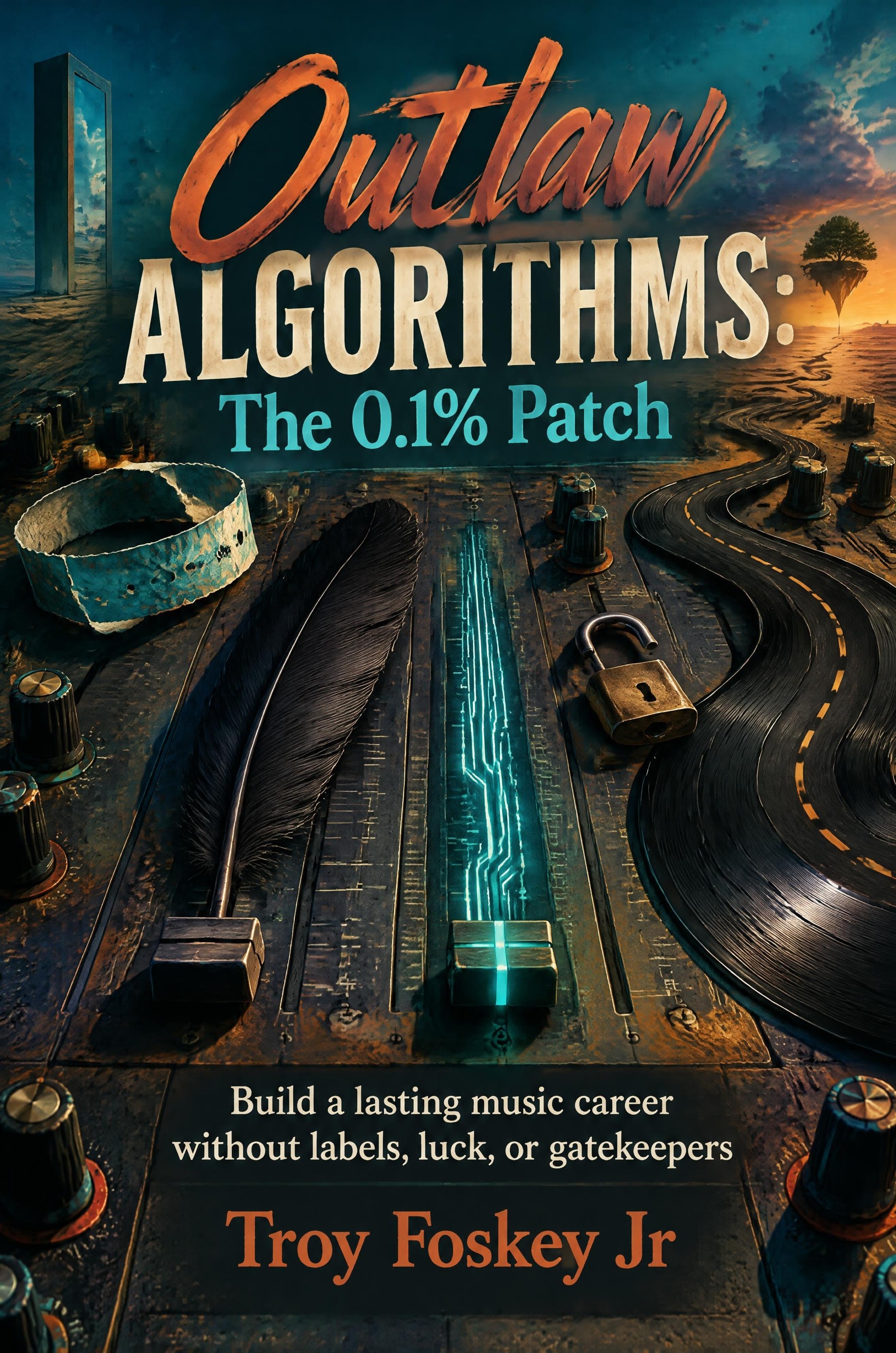
Outlaw Algorithms: The 0.1% Patch
Build a lasting music career without labels, luck, or gatekeepers
Most independent artists do not fail from lack of talent. They fail from waiting for a system that was never built to let them through. Outlaw Algorithms: The 0.1% Patch is a practical blueprint for musicians who are done treating their career like a hobby and ready to run it like a business. Through the persona of Doc Raven, it walks you from the grind of unpaid gigs and algorithmic invisibility into a disciplined operator’s mindset: grit, resilience, and success you define for yourself. You will learn how to forge a sonic identity with intentional branding and genre fusion, write songs that stick using psychology rather than guesswork, and keep momentum with a release engine you can actually sustain. Then it reverse-engineers TikTok and the streaming platforms, shows you how to own your audience through email and SMS, collaborate with strategy instead of hope, and put real infrastructure under the art: legal structure, trademarks, publishing, and daily operations. This is not a pep talk. It is the 0.1% patch: data-informed, community-first, and built for artists who intend to last.
- Business & Entrepreneurship
- Instructional Guide
- Guide book to success
- Self-Help
- Personal Branding
- Marketing & Sales
The Brink of Oblivion and the Dawn of Discipline
The hum of the refrigerator was the loudest thing in my apartment, a constant, droning reminder of my poverty. It was a cheap model, picked up secondhand, and even then, it had been a stretch, paid for in installments that felt like a physical drain. Outside, the city pulsed with a life I felt increasingly detached from. My world had shrunk to the four walls of my cramped living space, a space that doubled as my studio, my office, and my sanctuary, though lately, it felt more like a gilded cage. The dream of stages, roaring crowds, and the infectious energy of shared music felt impossibly distant, a mirage shimmering on a horizon I couldn't reach.
This wasn't the romanticized struggle often depicted in biopics or ballads. There were no dramatic, late-night epiphanies fueled by cheap whiskey and artistic torment.
Instead, there was the gnawing anxiety of unpaid bills, the dull ache of hunger that wasn't satisfied by instant noodles, and the soul-crushing weight of creative stagnation. I’d wake up with melodies in my head, only to have them evaporate with the morning light, replaced by the mundane arithmetic of survival. How many hours would I need to work at the cafe today to cover rent? Could I skip dinner again?
Would that freelance gig actually come through, or was it another phantom promise?
The financial pressure was relentless. Every creative spark felt like a luxury I couldn’t afford. Writing a song wasn’t just about inspiration; it was about time spent that could have been earning money. Recording it meant sacrificing precious funds that were desperately needed for food or utilities. Even the simple act of buying a new guitar string felt like a major expenditure. I remember one particularly bleak winter, my car had broken down. The mechanic quoted a price that was astronomically higher than anything I could reasonably afford. I stood on the sidewalk, staring at the useless hunk of metal, the cold seeping into my bones, and for the first time, I truly understood what it meant to be on the brink. It wasn't just about not making it; it was about the very real possibility of losing everything I had, which, frankly, wasn't much.
This precipice wasn't just financial; it was deeply emotional. The constant rejection, the unanswered emails to labels, the indifferent silence from streaming playlists—each one chipped away at my resolve. There were days when I’d sit in front of my laptop for hours, staring at a blank DAW screen, the cursor blinking mockingly. The well of inspiration felt dry, parched by doubt and fatigue. The self-criticism was a deafening roar, amplifying every perceived flaw in my music, every awkward lyric, every slightly off-key note. I’d listen to tracks by artists who seemed to have it all figured out, and a bitter envy would rise, a poisonous weed choking out any
remaining optimism. It was easy to fall into the trap of comparison, to believe that everyone else had a secret formula that I was missing.
The emotional toll manifested in isolation. My friends, many of whom had opted for more conventional career paths, offered well-meaning advice, but they couldn't truly grasp the unique brand of despair that comes with pouring your heart and soul into something that seemed to yield nothing but more struggle. Invitations to social gatherings became a source of stress. How could I explain that I couldn’t afford to go out, that my creative energy was spent just trying to keep my head above water? The disconnect grew, and with it, a profound sense of loneliness. Music, the very thing that had always been my solace, my closest companion, now felt like the source of my greatest pain.
The dream of musical success, once a vibrant, Technicolor vision, had become a faded, sepia-toned photograph. I’d envisioned myself on stage, bathed in light, connecting with an audience through the power of my music. But the reality was a dimly lit room, the glow of a computer screen, and the pervasive scent of stale coffee. The contrast was so stark, so brutal, that it began to feel insurmountable. This wasn’t a minor setback; it was a full-blown existential crisis for my artistic identity. The precariousness of my situation was a constant, unnerving hum beneath the surface of my daily life. Every decision, no matter how small, was weighed against the backdrop of potential failure. Could I afford to dedicate a few days to writing a new song, or did I need to pick up extra shifts at the cafe? Was it worth the energy to attend that networking event, or should I conserve my dwindling reserves of social battery?
The industry itself felt like an insurmountable fortress, guarded by gatekeepers who seemed to operate on a different planet. I’d submitted my music to countless blogs, playlists, and A&R; departments, only to be met with a deafening silence. The few responses I did receive were often form rejections, polite but dismissive, reinforcing the idea that I was just another aspiring artist lost in the noise. The algorithms, the gatekeepers of digital discovery, felt like an inscrutable, capricious deity, bestowing favor on some while consigning others to obscurity. There was no clear path, no guaranteed route to recognition. It felt like a game of chance, and I was losing.
This was the stark, unvarnished reality. It was the hunger pains, the mounting debt, the isolation, the gnawing self-doubt, and the paralyzing fear of never being heard. It was the feeling of standing on the edge of a cliff, with the roaring wind of failure whipping around me, and the vast, indifferent expanse of the music industry stretching out before me. This was the brink of oblivion, and the quiet, desperate
hope for a dawn that felt increasingly unlikely. The personal stakes were astronomically high. This wasn't just a hobby; it had become my identity, my purpose, and my potential downfall. The choices I made in this moment wouldn't just determine my career; they felt like they would determine my entire future. The dream was still alive, but it was flickering, threatening to be extinguished by the harsh realities of the independent music landscape. It was in this desolate space, however, that the seeds of a new resolve began to germinate, a quiet defiance against the overwhelming odds.
The air in my small apartment, once thick with the scent of ambition and cheap instant coffee, had begun to feel heavy with resignation. The constant hum of the aging refrigerator was no longer just a background noise; it was a siren song of my precarious existence, a rhythmic reminder of the bills that piled up like uninvited guests. The vibrant dream of connecting with thousands through my music felt like a distant echo, drowned out by the immediate, deafening roar of survival. I was standing at a crossroads, not a well-marked intersection with clear signage, but a desolate, unmarked spot where the path ahead dissolved into a fog of uncertainty.
This was the moment of truth, the critical juncture where the path diverged into two starkly different realities: the abyss of fading away, or the arduous ascent of embracing the grind.
The temptation to surrender was immense, a gravitational pull towards the comfort of the familiar, the ease of giving up. It was the path of least resistance, the silent acceptance that perhaps this dream was just that – a dream, a fleeting illusion that had no place in the harsh light of reality. This was the seductive whisper of oblivion, suggesting that I could simply cease the struggle, close the laptop, and let the music fade into the background noise of my life. It was the allure of normalcy, of trading the emotional rollercoaster of artistic pursuit for the predictable rhythm of a conventional job, of exchanging the gnawing anxiety of artistic failure for the muted contentment of financial stability. The thought was not without its appeal. Imagine, no more late nights wrestling with melodies, no more the sting of rejection from labels, no more the gnawing self-doubt that eroded my confidence with every unanswered email. I could, in essence, become "normal" again. I could join the ranks of those who had chosen the well-trodden path, who found solace in predictable incomes and structured lives, who had perhaps once harbored similar dreams but had wisely, or perhaps sadly, set them aside. The mental energy saved from this constant battle could be redirected, applied to building a more conventional life, one with a clear retirement plan and predictable career progression. It was a form of
self-preservation, a rational decision born out of exhaustion and the sheer weight of insurmountable odds. The industry, in its current form, felt like a fortress, and I, a lone soldier with dwindling supplies, was staring at its impenetrable walls. Why exhaust myself with futile assaults when a life of quietude was readily available?
However, even in the depths of this existential mire, a flicker of defiance remained. It was a small, stubborn ember, refusing to be extinguished by the winds of despair. This ember represented the raw, unadulterated love for music, the fundamental impulse that had driven me to this point. It was the understanding that surrendering wouldn't just mean the end of a career; it would mean the silencing of a fundamental part of myself. This was the dawn of discipline, the dawning realization that the very qualities that made the struggle so brutal – the passion, the relentless pursuit of a vision, the inherent vulnerability – were also the very foundations of any potential success. The concept of "the grind" began to transform in my mind. It was no longer just about the Sisyphean task of trying to "make it" through sheer force of will. Instead, it started to morph into a strategic, long-term commitment to building something sustainable, something resilient. It wasn't about chasing fleeting trends or relying on the capricious nature of algorithms or playlist curators. It was about crafting a deliberate, methodical operation, brick by painstaking brick.
This shift required a profound psychological recalibration. I had to move from a reactive stance, constantly trying to fend off the wolves of financial ruin and creative block, to a proactive one, consciously designing my path forward. This meant dissecting the very nature of my artistic endeavor. Was it a hobby I indulged in when inspiration struck and time allowed, or was it a business, albeit an unconventional one, that demanded structure, strategy, and unwavering commitment? The answer, I realized with a jolt, had to be the latter. To continue treating it as a whimsical pursuit while simultaneously expecting professional results was a recipe for perpetual disappointment. The psychological heavy lifting involved acknowledging that inspiration, while a beautiful spark, was an unreliable engine. The true power lay in discipline, in showing up even when inspiration was absent, in refining the craft through consistent practice, and in systematically addressing the business aspects that were often overlooked in the romanticized narratives of artistry.
The transformation from a struggling artist to a strategic entrepreneur wasn't a sudden metamorphosis but a series of conscious choices, each one a deliberate step away from the brink. It meant embracing the idea that every aspect of my musical journey, from songwriting and production to marketing and fan engagement, needed to be approached with the same rigor and discipline. This involved a deep dive into
understanding the mechanics of the modern music industry, not from the perspective of pleading for acceptance, but from the vantage point of building my own ecosystem. I had to educate myself on digital distribution, social media marketing, audience analytics, and the often-unseen business infrastructure that underpins even the most independent of artists. It was akin to learning a new language, a language of data, engagement metrics, and strategic partnerships.
This internal resolve was forged in the crucible of those bleak moments. The memory of that broken-down car, the gnawing hunger, the suffocating silence from the industry – these weren't just experiences of hardship; they became potent motivators. They were the fuel that ignited the engine of discipline. I started to view the "grind" not as a punishment, but as a necessary investment. Each hour spent learning a new production technique, each social media post crafted with intention, each email sent to a potential collaborator – these were not chores, but building blocks. This was the foresight required to understand that success wasn't a lottery win, but a carefully constructed edifice. It demanded patience, a willingness to play the long game, and the mental fortitude to withstand setbacks without succumbing to despair.
The psychological shift also involved a radical acceptance of personal responsibility. The days of blaming external forces – the gatekeepers, the algorithms, the lack of luck – had to come to an end. While those factors undeniably played a role, focusing solely on them was a form of disempowerment. The true power lay in identifying what I could control: my work ethic, my learning curve, my strategic approach, and my willingness to adapt. This meant shedding the victim mentality and adopting the mindset of a CEO, albeit a CEO of a one-person operation initially. This transition required a deep introspection into my own motivations and a brutal honesty about my strengths and weaknesses. If my songwriting was strong but my marketing was weak, the discipline had to be applied to rectifying that deficit. If my production was polished but my online presence was non-existent, that became the focus of my dedicated effort.
The decision to embrace the grind was, therefore, not a passive acceptance of hardship, but an active, deliberate choice to commit to a professional path. It was the conscious decision to invest time, energy, and mental capital into building a sustainable artistic enterprise, even when the immediate rewards were scarce. It was about understanding that the path to authentic, lasting success in the modern music landscape was paved not with wishful thinking, but with consistent, disciplined action. This was the moment the dream began to transform from a passive hope into
an active, albeit challenging, project. The dawn of discipline was not a gentle sunrise; it was the stark, unwavering light that illuminated the long, demanding road ahead, a road I was now choosing to walk, not by chance, but by design. The previous narrative of feeling lost and overwhelmed was being replaced by a nascent sense of agency, a dawning recognition that while the external landscape remained challenging, the internal architecture of my approach could be systematically rebuilt, stronger and more resilient than before. This was the foundation upon which a new kind of musical journey would begin, one built on the bedrock of deliberate effort and unwavering commitment.
The siren song of the Billboard charts, the glitzy promise of mainstream radio play, the fabled record deal – for so long, these were the unassailable benchmarks of success in the music industry. They were the constellations by which every aspiring artist navigated, the golden tickets that supposedly validated years of passion, practice, and sacrifice. Yet, as I stood on the precipice of my own creative and financial abyss, these very metrics felt increasingly like mirages in a desert of disillusionment. Chasing them felt akin to chasing the wind, an exercise in futility that drained my energy and obscured the true essence of why I had embarked on this musical journey in the first place. This realization was not a sudden epiphany, but a slow burn, fueled by countless hours of observing the industry from the outside, seeing talented artists falter not from lack of skill, but from an inability to align with a system that often prioritized ephemeral trends over enduring artistry.
The conventional definition of success, dictated by sales figures and chart positions, is a powerful, often seductive, narrative. It’s a narrative reinforced by media, by award shows, and by the very structure of the industry itself. This narrative suggests that true validation only comes from widespread commercial appeal, that an artist is only “successful” if they can penetrate the mainstream consciousness, if their music becomes a soundtrack to the lives of millions. But what does this metric truly measure? It measures popularity, market penetration, and often, a fleeting cultural moment. It rarely, if ever, measures the depth of artistic expression, the genuine connection forged with a dedicated audience, or the long-term sustainability of a creative career. It’s a metric designed for mass consumption, for a product to be bought and sold, rather than for an art form to be experienced and cherished. For an independent musician, clinging to these external validation points can be a recipe for perpetual disappointment. It sets up an impossible standard, one that is largely outside of the artist's direct control, subject to the whims of radio programmers, label executives, and algorithmic shifts. It fosters a mindset of scarcity, where every artist
is in a zero-sum game, fighting for a limited slice of the mainstream pie.
My own journey began with a profound love for creating music, for translating emotions and experiences into sonic tapestries. The initial dream was not about becoming a household name, but about sharing something meaningful, about finding resonance with others who felt the same way. This fundamental drive was being choked by the pursuit of an external validation that felt increasingly hollow. I had to confront the uncomfortable truth: if my definition of success was solely tied to these external, often arbitrary, metrics, then I was setting myself up for failure from the outset. The path of an independent artist, by its very nature, often diverges from the mainstream highway. It’s a path that requires charting one’s own course, building one’s own infrastructure, and cultivating one’s own community. Therefore, the metrics of success for such a journey must also be self-defined, rooted in the artist’s unique values and aspirations.
Redefining success began with a deep dive into introspection, a process that psychology, my initial academic pursuit, had always emphasized. It meant asking myself not “How many people bought my record?” but “Am I creating music that truly moves me?” Not “Am I on the radio?” but “Am I connecting with an audience that genuinely values my art?” This recalibration required a fundamental shift from seeking external approval to cultivating internal validation. It meant understanding that artistic fulfillment is not a secondary byproduct of commercial success, but often its very wellspring. When an artist is creating from a place of authenticity, when their work is a genuine reflection of their inner world, the resulting music often possesses a power and a resonance that can transcend ephemeral trends. This intrinsic motivation is a far more sustainable fuel for a creative career than the fickle pursuit of fame.
The concept of artistic fulfillment is multifaceted. It encompasses the satisfaction derived from honing one's craft, from the process of creation itself, and from the knowledge that one is expressing oneself authentically. For me, this meant finding joy in the late-night writing sessions, in the intricate process of production, in the challenge of translating a raw emotion into a finished song. It was about the mastery of my tools, the continuous learning and evolution as a musician and songwriter. This internal sense of accomplishment is immune to external validation. A perfectly crafted melody, a lyric that captures a complex truth, a production that evokes a specific mood – these are victories in themselves, independent of how many people hear them or how they are received by the wider world. This focus on the process, rather than solely the outcome, fosters a resilience that is essential for navigating the
unpredictable landscape of the music industry.
Equally important is the concept of audience connection. While the scale of the audience may differ vastly from that of mainstream artists, the depth of the connection can be far more profound. For an independent artist, the audience is not a faceless mass, but a community of individuals who have actively sought out and engaged with the music. This engagement can manifest in myriad ways: heartfelt messages from fans, enthusiastic comments on social media, dedicated attendees at intimate shows, loyal subscribers to a mailing list. These are not mere metrics of popularity, but indicators of genuine impact. When fans share how a song helped them through a difficult time, how a particular lyric resonated with their own experience, or how attending a live performance felt like being part of something special, that is a profound measure of success. It signifies that the music has transcended its status as mere entertainment and has become a meaningful part of someone’s life. This kind of connection is built on authenticity and shared values, fostering a loyal fanbase that is invested in the artist’s journey. It's a symbiotic relationship, where the artist provides the art, and the audience provides the unwavering support and affirmation that fuels further creation.
The third pillar of this redefined success is sustainable income. For too long, the romanticized notion of the starving artist has been glorified, implying that financial hardship is an inherent, even necessary, component of true artistry. This is a destructive myth. An artist cannot create at their highest capacity if they are constantly struggling to meet basic needs. Sustainable income, for an independent artist, means building a business model that allows them to dedicate their time and energy to their art without the constant specter of financial ruin. This doesn't necessarily mean achieving exorbitant wealth, but rather establishing reliable revenue streams that support a comfortable and focused creative life. This can involve a diversified approach, utilizing income from streaming royalties, digital downloads, merchandise sales, live performances, crowdfunding, licensing, and even creative collaborations or educational offerings. The key is to build a business that is resilient and adaptable, not reliant on any single, unpredictable income source. This approach moves away from the transactional mindset of selling music as a commodity and towards a more holistic model of providing value to a dedicated audience.
The importance of aligning personal values with professional goals cannot be overstated. The mainstream music industry, with its inherent pressures and compromises, can often lead artists to abandon their core values in pursuit of commercial viability. This inevitably leads to burnout, disillusionment, and a sense of
creative bankruptcy. By defining success on one’s own terms, an artist can ensure that their professional endeavors are in sync with their personal ethos. This might mean choosing to remain independent rather than sign a deal that requires artistic compromise, or it might mean declining opportunities that conflict with one's ethical principles. This conscious alignment fosters a sense of integrity and purpose, making the artistic journey more meaningful and ultimately more rewarding. It allows an artist to build a career that is not only successful in its own metrics, but also one that they can be proud of, a career that reflects their deepest convictions.
This redefined framework for success is not about rejecting the traditional industry entirely, but about recognizing its limitations and actively choosing to operate outside of its prescriptive boundaries when necessary. It’s about understanding that the digital age has democratized many aspects of music creation, distribution, and promotion, empowering independent artists to build their own platforms and connect directly with their audiences. It’s about leveraging these new tools and opportunities to create a career path that is authentic, fulfilling, and sustainable. It’s about recognizing that true success is not a destination dictated by external forces, but a continuous process of artistic growth, genuine connection, and purposeful living, measured by the internal compass of one’s own values and aspirations. This journey demands discipline, resilience, and a willingness to forge a new path, one where the artist is the architect of their own destiny, defining their own measures of achievement and finding profound satisfaction in the process of creation and connection. The goal is not to replicate the trajectory of a mainstream artist, but to build something entirely unique, something that resonates with the artist’s soul and nourishes the souls of those who choose to listen. This is the essence of building a lasting career on one's own terms, a career where the metrics of success are as rich and nuanced as the music itself. It’s about cultivating a sense of purpose that transcends commercial ambition, focusing on the enduring impact of art and the deep, personal satisfaction that comes from living a life aligned with one's creative calling.
The journey from the brink of oblivion to the dawn of discipline is not merely a matter of talent or luck; it is deeply rooted in a psychological trait that research has increasingly highlighted as a cornerstone of achievement: grit. Coined and extensively studied by Dr. Angela Duckworth, grit is defined as the sustained passion and perseverance toward achieving long-term goals. It is the tenacity, the unwavering commitment that keeps individuals striving for their objectives, even when faced with formidable obstacles and inevitable setbacks. For an independent musician navigating
the often unforgiving currents of the industry, grit isn't just beneficial; it's existential. It's the internal engine that keeps the creative wheels turning when external validation is scarce, and the path forward seems shrouded in fog.
Understanding the psychological underpinnings of grit allows us to deconstruct it into actionable components. It’s not an innate, fixed characteristic that one either possesses or lacks. Instead, grit is a skill, a mindset that can be cultivated and strengthened. At its core, grit is fueled by two key elements: passion and perseverance. Passion, in this context, is not a fleeting infatuation, but a deep-seated interest and affection for an activity or pursuit. For a musician, this translates to a genuine love for the craft of songwriting, performance, production, and the very act of creating music. It's the intrinsic joy derived from the process itself, the satisfaction of translating an abstract idea into a tangible sonic experience. This passion acts as the initial spark, the driving force that initiates the journey. However, passion alone is insufficient to navigate the arduous climb towards any significant goal. It is perseverance, the relentless effort and dedication to see things through, that transforms raw passion into enduring achievement. Perseverance is the grit that keeps an artist practicing their instrument for hours on end, refining lyrics until they sing with truth, or tirelessly promoting their work to an audience that may initially be small. It’s about showing up, day after day, even when motivation wanes, and the immediate rewards are not apparent.
The independent music landscape is a fertile ground for testing and cultivating grit. Unlike the more structured environments of traditional music industry paths, where roles and expectations might be more clearly defined, the independent artist is a jack-of-all-trades. They are the songwriter, the producer, the marketer, the booking agent, the social media manager, and often, the sole proprietor of their entire enterprise. This multifaceted role presents a constant barrage of challenges, demanding a high degree of resilience and an unshakeable belief in one's vision. The solitary nature of much of this work can amplify feelings of self-doubt and isolation, making the development of robust internal motivation crucial. When there's no label head to answer to, no manager to push for deadlines, the impetus must come from within. This is where the psychological aspect of grit becomes paramount. It’s about developing an internal compass that guides action, rather than relying on external directives.
One of the most significant psychological hurdles that independent musicians face is the management of self-doubt. The creative process is inherently vulnerable. Laying bare one’s innermost thoughts and feelings through music requires immense
courage. When that art is then met with silence, indifference, or criticism, the sting can be deeply personal. Self-doubt can manifest in numerous ways: questioning one's talent, comparing oneself unfavorably to others, or feeling overwhelmed by the sheer magnitude of the tasks involved in building a music career. Grit provides a framework for confronting and transcending these debilitating emotions. It encourages a reframing of challenges not as indicators of personal inadequacy, but as opportunities for growth and learning. This is where the concept of a "growth mindset," as popularized by Dr. Carol Dweck, becomes inextricably linked with grit. A growth mindset is the belief that one's abilities and intelligence can be developed through dedication and hard work. Individuals with a growth mindset embrace challenges, persist in the face of setbacks, and learn from criticism. Conversely, those with a fixed mindset believe their qualities are fixed traits and tend to avoid challenges, give up easily when faced with obstacles, and ignore useful negative feedback.
For an independent musician, adopting a growth mindset is a critical component of cultivating grit. Instead of viewing a poorly attended gig as a personal failure, an artist with a growth mindset might analyze what could have been done differently – perhaps the promotion was insufficient, the venue choice was suboptimal, or the setlist could have been more engaging. This analytical approach, rather than an emotional retreat, allows for continuous improvement. Similarly, a song that doesn’t resonate as widely as anticipated can be viewed not as a testament to a lack of talent, but as a valuable piece of feedback on the creative direction. This doesn't mean abandoning one's artistic vision, but rather understanding how to communicate it more effectively or how to refine the craft to better connect with an audience. The psychological shift is profound: from seeing oneself as inherently "good" or "bad" at music, to understanding that musical skill and career success are developed through diligent effort and learning.
Overcoming setbacks is an inherent part of any ambitious endeavor, and the music industry is no exception. For independent artists, these setbacks can range from failed crowdfunding campaigns and disappointing streaming numbers to canceled tours and critical reviews that miss the mark. The natural human tendency is to feel discouraged, to question the viability of the path chosen. Grit, however, teaches us to view these setbacks not as definitive endpoints, but as temporary detours. It involves developing strategies for emotional regulation and problem-solving. When a setback occurs, the first step is to acknowledge the disappointment without letting it become paralyzing. This involves a degree of emotional detachment, recognizing that the event is external and does not define one's intrinsic worth or talent. Following this
emotional acknowledgment, the focus must shift to a pragmatic assessment of the situation. What went wrong? What lessons can be learned? What adjustments can be made to the strategy moving forward? This iterative process of action, reflection, and adjustment is the hallmark of a gritty individual.
Maintaining motivation in the face of adversity is perhaps the most challenging aspect of grit. Motivation is often described as a flickering flame, easily extinguished by the winds of doubt and difficulty. Grit, in contrast, is akin to a slow-burning ember, providing a steady, reliable source of internal drive. This sustained motivation is often fueled by a clear understanding of one's "why." For an independent musician, this "why" needs to be deeply personal and resonant. It can’t simply be the abstract pursuit of fame or fortune, which are often elusive and dependent on external factors. Instead, it should be rooted in the intrinsic rewards of creation, the desire to express a unique perspective, to connect with like-minded individuals, or to make a specific kind of impact on the world. When the external motivators fade, this internal "why" becomes the anchor, providing the impetus to continue. Regularly reconnecting with this core purpose, perhaps through journaling, reviewing past creative successes, or engaging with the fans who are most impacted by the music, can serve as powerful motivational boosters.
The psychological framework of grit also emphasizes the importance of deliberate practice. This is not simply repeating an action, but engaging in focused, effortful practice designed to improve specific skills. For a musician, this might involve isolating challenging technical passages on an instrument and working on them repeatedly with intense concentration, or it might mean dedicating time to analyzing successful songs in one's genre to understand their structural and lyrical nuances.
Deliberate practice is inherently demanding and can be frustrating, as it often involves confronting areas of weakness. However, it is this focused,
discomfort-inducing effort that leads to genuine improvement and, consequently, strengthens one's sense of capability and efficacy – key components of grit. Without deliberate practice, passion can stagnate, and perseverance can become aimless effort, leading to burnout rather than progress.
Furthermore, building a support system is an often-overlooked, yet critical, aspect of cultivating grit, especially within the independent music sphere. While much of the artist’s work is solitary, human connection provides essential emotional reinforcement and practical support. This network can include fellow musicians who understand the unique struggles and triumphs of the industry, mentors who can offer guidance and perspective, and a dedicated fanbase that provides encouragement and
affirmation. Engaging with this community fosters a sense of belonging and shared purpose, mitigating the isolation that can undermine motivation. When an artist feels connected to others who are on a similar journey, or who genuinely value their work, the psychological burden of perseverance becomes lighter. The shared triumphs and commiseration over setbacks within a supportive community can be incredibly fortifying.
The concept of failure itself needs to be psychologically re-examined through the lens of grit. In many societal narratives, failure is presented as an undesirable outcome to be avoided at all costs. However, grit reframes failure as an inevitable and often essential part of the learning and growth process. It is not the absence of failure, but the response to it, that distinguishes the gritty individual. Instead of viewing failure as a permanent state of being, grit encourages seeing it as a temporary condition, a data point that can inform future actions. This requires a mental resilience, a capacity to absorb the emotional impact of failure and then systematically extract the lessons embedded within it. For instance, a musician who experiences a disappointing release might engage in a post-mortem analysis, dissecting what aspects of the release strategy, the music itself, or the promotion could be improved. This analytical approach, devoid of excessive self-recrimination, allows the artist to emerge from the experience stronger and better equipped for future endeavors.
The psychological journey of cultivating grit involves a conscious and continuous effort to develop self-awareness, resilience, and a forward-looking perspective. It is about understanding one's own internal landscape – identifying the triggers for
self-doubt, the sources of genuine motivation, and the patterns of behavior that lead to progress or stagnation. This self-awareness then informs the development of coping mechanisms and strategies for navigating the inevitable challenges. Resilience, the ability to bounce back from adversity, is not about being immune to pain or disappointment, but about possessing the psychological tools to process these emotions and regain momentum. Finally, a forward-looking perspective, rooted in the belief that future success is attainable through sustained effort, is what propels the gritty individual forward, even when the present circumstances are difficult.
In the context of an independent music career, grit is not merely about having the stamina to endure; it's about having the wisdom to adapt, the courage to persist, and the self-belief to continue creating and sharing art, regardless of external validation or immediate commercial success. It is the psychological bedrock upon which a sustainable and fulfilling artistic life can be built, transforming the precarious journey
from the brink of oblivion into a disciplined, purposeful ascent towards enduring creative achievement. It is the quiet, unwavering resolve that whispers, "Keep going," long after the applause has faded and the initial excitement has waned, guiding the artist through the labyrinthine paths of the music industry towards a destination of their own making. This internal fortitude is not a byproduct of success; it is, in large part, its prerequisite.
The realization that an independent music career is not simply a passionate pursuit but a legitimate business enterprise is a pivotal moment. It's the transition from the often chaotic, dream-driven existence of an artist to the structured, strategic mindset of an entrepreneur. This shift in perspective is not about diminishing the artistic soul of the endeavor, but about empowering it. By treating your music as a business from day one, you create the framework necessary for longevity, growth, and ultimately, the kind of sustainable operation that can withstand the industry's inherent volatility. It’s about building an empire, not just a hobby. This requires a blueprint, a foundational understanding of the core components that will support your aspirations, no matter how grand. Without this blueprint, even the most brilliant artistic vision risks crumbling under the weight of disorganization and a lack of foresight.
The first pillar of this blueprint is strategic planning. This is far more than setting vague goals like "get more streams" or "play bigger shows." Strategic planning involves a deep dive into defining your vision, understanding your current position, and charting a clear, actionable path forward. It begins with a crystal-clear articulation of your artistic identity. Who are you as an artist? What message do you want to convey? What is your unique sound and aesthetic? This clarity is the bedrock upon which all subsequent business decisions will rest. Without it, your marketing will be unfocused, your collaborations will lack direction, and your overall narrative will be muddled, failing to resonate deeply with an audience. Following the articulation of your vision, the next crucial step is market research. This doesn't mean solely looking at what's popular, but understanding your niche, identifying your ideal listener, and analyzing the competitive landscape. Who else is creating music similar to yours?
What are they doing successfully? Where are the gaps you can fill? This analysis informs your positioning and helps you carve out a distinct space in the crowded music ecosystem.
Once your vision and market position are established, the strategic plan must translate these insights into tangible objectives. These objectives should be SMART: Specific, Measurable, Achievable, Relevant, and Time-bound. For instance, instead of
"increase streaming numbers," a SMART objective might be "increase monthly listeners on Spotify by 20% within the next six months through targeted playlist pitching and social media engagement campaigns." This level of detail allows for focused execution and provides clear metrics for tracking progress. The strategic plan also necessitates an understanding of your revenue streams. How will your music and related ventures generate income? This could include streaming royalties, merchandise sales, live performances, licensing, crowdfunding, and potentially even brand partnerships. Identifying and diversifying these streams from the outset is vital for building financial resilience. A comprehensive plan will map out short-term tactics to achieve immediate goals, medium-term strategies to build momentum, and
long-term visions that guide the overarching development of your career. It is a living document, requiring regular review and adaptation, but its existence provides the essential roadmap that prevents aimless wandering.
The second critical component of a sustainable operation is resource management. In the context of an independent musician, "resources" extend far beyond just financial capital. While managing money wisely is undoubtedly crucial, it also encompasses your time, your energy, your skills, and the network you cultivate. Time is arguably the most precious and finite resource for any entrepreneur, especially an independent artist who is often wearing multiple hats. Effective time management involves prioritizing tasks that directly contribute to your strategic goals. This might mean dedicating specific blocks of time to songwriting, music production, marketing, networking, or administrative tasks. It requires a disciplined approach to avoid the constant distractions and demands that can derail progress. This is where the psychological discipline discussed earlier becomes a practical tool. The ability to say "no" to opportunities that don't align with your strategy, and "yes" to the activities that will move you forward, is a hallmark of effective resource management.
Financial management is, of course, non-negotiable. This involves meticulous budgeting, tracking expenses, and understanding your cash flow. Even with limited initial capital, a clear understanding of where your money is going allows for informed decisions about investment. Should you invest in better recording equipment, a targeted advertising campaign, or professional graphic design for your merchandise? These decisions should be guided by your strategic plan and a realistic assessment of your financial situation. Beyond money and time, your energy and focus are also vital resources. Recognizing your own limitations and avoiding burnout is paramount. This might mean scheduling downtime, delegating tasks where possible, or simply being mindful of your mental and physical well-being. Building a strong network is another
form of resource management. Your team – whether it's a trusted collaborator, a freelance publicist, or even just a supportive peer – can provide invaluable skills, advice, and emotional support that you may not possess internally. Nurturing these relationships and leveraging them strategically is a powerful way to augment your own capabilities. It’s about understanding that you don't have to do everything yourself, but you do need to manage the resources—both internal and external—effectively to achieve your goals.
The third foundational element is an unwavering commitment to continuous learning. The music industry is in a perpetual state of flux. Technologies evolve, audience behaviors shift, and new platforms emerge with astonishing regularity. What worked yesterday may not work today, and what works today may be obsolete tomorrow. A successful independent artist must cultivate a mindset of lifelong learning, actively seeking out knowledge and adapting to change. This involves staying informed about industry trends, understanding new marketing strategies, and mastering new technologies. It can also mean learning from your own experiences and the experiences of others. Analyzing what worked and what didn't in your campaigns, your releases, and your live performances provides invaluable data for future adjustments.
This commitment to learning extends beyond industry-specific knowledge. It can also involve developing a deeper understanding of business principles, marketing psychology, and even personal development. For instance, understanding the psychology of persuasion can inform your promotional efforts, while learning about project management can help you execute your releases more effectively. The digital age has democratized access to information. Online courses, industry blogs, podcasts, webinars, and forums offer a wealth of knowledge. The key is to be intentional and selective, focusing on learning that directly supports your strategic objectives. This commitment to learning also fosters innovation. By understanding the landscape and the tools available, you can identify opportunities to create unique experiences for your audience, differentiate yourself from competitors, and discover new avenues for growth. It’s about recognizing that the pursuit of knowledge is not a static endeavor, but an ongoing process that fuels adaptability and ensures the
long-term viability of your operation.
Building this sustainable operation requires a disciplined application of these principles. It’s about moving beyond the romantic notion of the starving artist and embracing the pragmatic reality of the independent entrepreneur. This involves creating systems and processes that allow you to operate efficiently and effectively.
For example, establishing a consistent content calendar for social media, setting up automated email marketing sequences for your fanbase, or implementing a system for tracking your fan engagement data are all examples of building operational efficiency. These systems free up mental bandwidth, allowing you to focus on the creative core of your work, while ensuring that the business side is running smoothly in the background.
The transition to viewing your music as a business also necessitates a certain detachment from purely emotional decision-making. While passion is the fuel, it cannot be the sole steering wheel. Data analysis, strategic forecasting, and a clear understanding of your return on investment are essential for making sound business choices. This doesn't mean sacrificing artistic integrity; rather, it means finding innovative ways to align your artistic vision with commercial viability. It's about understanding how to package and present your art in a way that resonates with a broader audience and generates the resources needed to continue creating. It's the conscious choice to build, rather than simply react. This disciplined approach ensures that the foundation you lay is not only strong but also capable of supporting the ambitious structure you intend to build. It's the difference between a fleeting spark and a lasting flame, ensuring that the passion that ignited your journey has the sustainable operational framework to burn brightly for years to come. The empire you envision will not materialize overnight, but by meticulously laying these foundational stones – strategic planning, robust resource management, and a relentless pursuit of learning – you are creating the fertile ground from which it can grow. This deliberate, systematic approach transforms the aspiration of an independent music career into a tangible, thriving enterprise, ready to face the challenges and seize the opportunities that lie ahead.
Crafting Your Sonic Identity: The Art of Intentional Branding
The journey of an independent musician, as we've begun to explore, is fundamentally an act of building. It’s about constructing a career, an enterprise, and a connection that transcends mere sound. We've laid the groundwork, recognizing the necessity of strategic planning, efficient resource management, and a commitment to perpetual learning. These…