

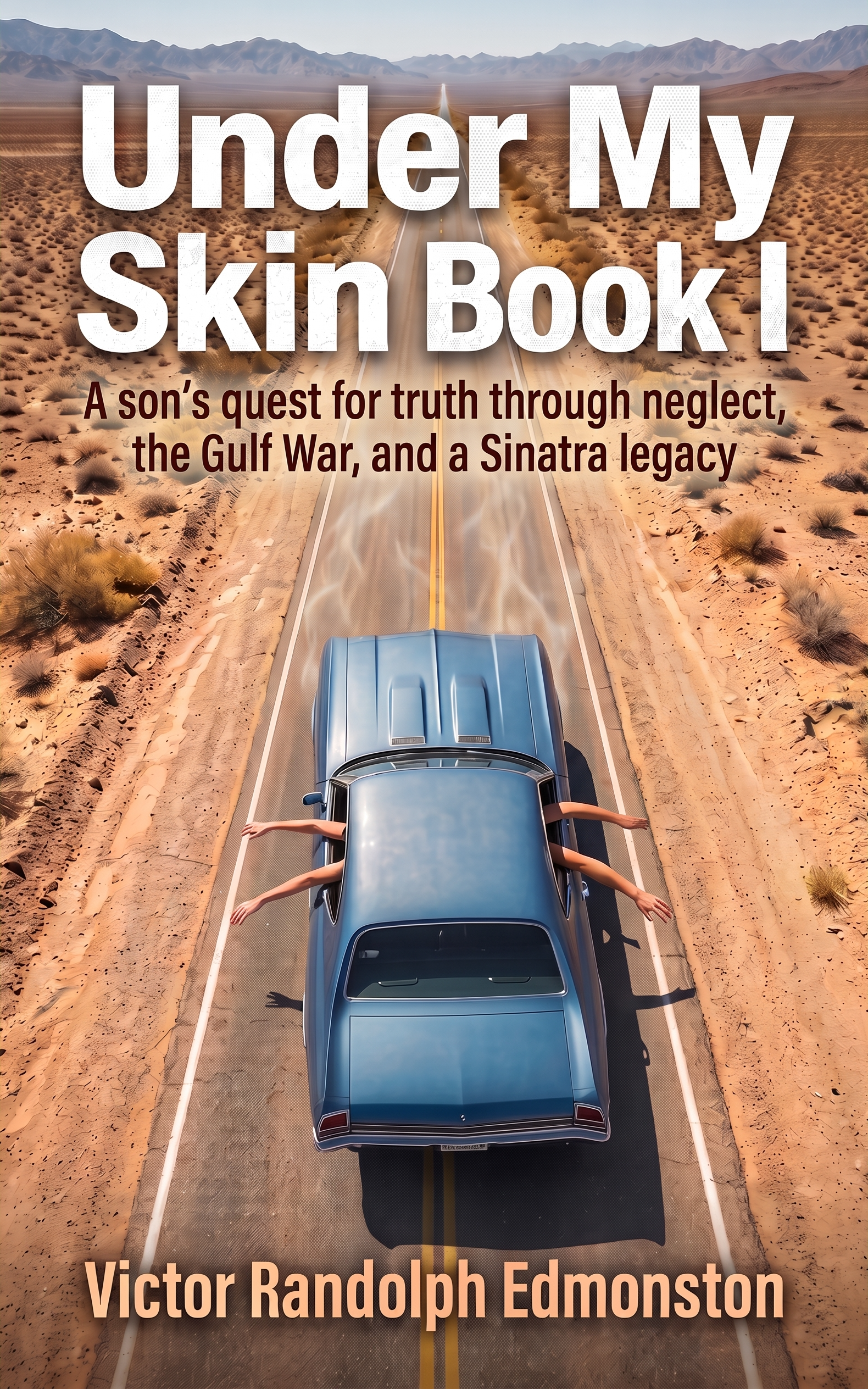
Under My Skin Book I
A son's quest for truth through neglect, the Gulf War, and a Sinatra legacy
by Victor Edmonston
Was he the son of a legend, or the victim of a grand delusion? Victor Randolph Edmonston spent his childhood as a nomad, dragged across America by his mercurial mother, Yvonne. From the neon shadows of Las Vegas to the shifting sands of foster care, Victor’s life was defined by chaos, neglect, and a singular, shocking claim: that he was the biological son of Frank Sinatra Jr. Trapped in his mother's web of manipulation and emotional abuse, Victor survived a gauntlet of trauma before finding an unlikely refuge in the 82nd Airborne Division. As a combat medic during the Gulf War, he traded his mother's erratic whims for the structured brutality of the battlefield. But the ghosts of his past followed him home. After his mother’s tragic death, Victor lands in Hollywood at the historic Villa Carlotta, surrounded by a cast of dreamers and eccentrics. There, he embarks on a high-stakes, hair-brained mission to secure a DNA sample from the Sinatra family and finally separate fact from his mother’s fiction. Under My Skin: Book I is a raw, heart-wrenching, and ultimately triumphant memoir about the scars we carry and the courage it takes to write a new legacy when the old one is built on lies.
- Biography
- Coming of Age Memoir
- Overcoming Adversity
- Family Memoir
- War & Military Memoir
- Artistic & Creative Memoir
Highway to Hell
My mother’s life before me seemed glamorous, gritty, gutsy—driven by an unbridled desire to be the life of the party, yet shadowed by an undercurrent of danger. She was candid with me, even when I was way too young to hear her stories. They entertained me for hours as we crisscrossed the country, just the two of us, on endless drives from Anchorage, Alaska, down the West Coast through Washington, Oregon, and California, then across Arizona and New Mexico to Texas and the Gulf of Mexico, through the Bible Belt to a small town near the Civil War battlefield of Chickamauga, Georgia, with occasional returns to Vegas and Chicago.
We were always on the move. I switched schools at least 25 times, attending 20 different schools between 1976 and 1987.
Through it all, my mother’s stories were the constant. Her wild tales would unfold inside whatever used car she'd picked up from a mechanic or from a used car lot somewhere along the way. My favorite was the faded red 1967 Chevy Chevelle. It was well past its prime, but for anyone who appreciated muscle cars, it was a beast—a sleeper with a 300hp V-8 lurking under the hood. The horrible paint job hid its true power, and mom had no qualms about slamming the pedal to the floor to remind us both what it could do. I heard a lot of stories in that car.
But one story she told countless times left me with nothing but questions and wounds that would take a lifetime to heal.
"Mind if I join you?" he asked, his voice smooth and polite.
"Suit yourself," she muttered, taking another drag from her cigarette.
Jilly Rizzo slid onto the barstool next to her at the Sands. He spent the next hour or so making small talk, drawing Yvonne out of her shell with stories and jokes. He had a way about him, a charm that was disarming, and slowly, she began to relax.
"My friend over there, he noticed you. Frank Sinatra. He'd like to buy you a drink."
My mother said the night she met Frank Sinatra at the Sands while she was nursing a black eye was the very same night in 1967 that that Sinatra was sporting his own banged-up face from driving a golf cart through a plate-glass window during a weekend bender.
This exchange between my mother and one of the most powerful men in America would become one of her most famous stories.
But the bruise on her face that caught Sinatra's eye came from another story of hers—one she was trying to outrun.
She had been living in San Francisco, in a stylish apartment on Nob Hill. Her neighbor across the hall was Wilt Chamberlain. It was the height of the 1967 counterculture, and my mother was at the center of it all. She was bold, charismatic, and completely feral. She threw parties that, according to her, were so legendary they were mentioned on the local news.
One night after one of her parties, the building manager, a man who had persistently been trying to get her attention, knocked on her door. It was late, but Yvonne, always up for a drink, let him in. He offered to make her a cocktail. The next thing she remembers is waking up the next day in her apartment, bruised, disoriented, and terrified.
She went to the hospital. She called the police. She filed a report. But she was a twentysomething single woman in the late 1960s with a reputation for partying, and he was an older man, a respected building manager. The system didn't work in her favor.
The police took her statement, but nothing came of it. There were no charges. No justice. Yvonne was left alone to pick up the pieces.
Her world had been turned upside down. Reeling from the assault, she did what she had always done when life became too much. She ran.
She left San Francisco temporarily, flying to Chicago to seek solace from an old flame, Saul Schwartz. Saul was a married lawyer and former lover who had remained her closest confidant. He listened, sympathized, and offered what advice he could, but his jurisdiction ended in Illinois. She was still on her own.
With nowhere else to turn and not ready to return to the apartment where the attack had happened, Yvonne headed back west, but made a detour to Las Vegas, a city she knew well. Vegas meant familiar faces and plenty of ways to take her mind off of what had happened in San Francisco.
She found herself at the Sands Hotel, sitting alone at the bar, bruised, broken, and unsure of what to do next. From where she sat, she could see into the casino. An older man approached her and struck up a conversation. His name was Jilly Rizzo. My mother always said there was something about Jilly that reminded her of her father—charming and protective.
Jilly said, "There's someone who'd like to meet you. Frank Sinatra. He's noticed you."
Yvonne barely glanced in the direction Jilly indicated. She knew the name, of course. Everyone did. Frank Sinatra was a legend whose voice defined a generation. But she also knew his reputation with women, and the last thing she wanted was to become one of his conquests. Especially not now, when she was already reeling from being taken advantage of, left beaten and bruised by another older man.
"I'm not interested," she said flatly. "I'm not some groupie. I'm not going to be another notch on his bedpost. I'm not in the mood."
Jilly leaned in, his expression serious. "I get it. But Frank's not like that. He noticed you're hurt.” He gestured to her black eye. “He just wants to talk, maybe help."
The words hung in the air and Yvonne hesitated. She didn’t want his help. But there was something in Jilly’s tone, a sincerity that made her reconsider.
Jilly didn't push, but he also didn’t leave. He kept the conversation going, charming and persistent, until she finally agreed to meet Frank.
“Fine,” she sighed. “But just to talk.”
Jilly smiled, relieved. “I promise, nothing more.”
By the time she went up to Frank’s suite, Sinatra was already in bed. Jilly encouraged her to bring Frank some aspirin and water.
"Jilly said you wanted to meet me," she said.
"I did," Sinatra replied. "You look like hell."
"So do you.”
It was a moment. A flash of connection. Then she left. But it wouldn’t be the end of their story.
The story of how she met Sinatra would morph over time. Sometimes she met him at the bar. Sometimes she was invited to a private party. But in every version, it was her black eye from the incident in San Francisco that drew him in. And in every version, Jilly Rizzo was the bridge between their worlds.
She told me that when she and Frank reconnected in Vegas weeks later, she walked into a smoky, celebrity-filled party at the Sands and they locked eyes.
"Why don’t you make us a drink?" he said.
"Why don’t you make us a drink?" she shot back.
The room froze. Then Sinatra laughed, and slipped behind the bar.
It was the moment she became more than just another girl. She could stand her ground. That was all it took. Soon, she became a regular in his world. She brought along friends. Became someone of note in a scene full of people trying to be seen.
She told me she went into a room at a party once to find Frank and a couple other guys talking. She had the black eye still, and they were all talking about it, like, “can you believe this, fucking someone beat up Yvonne here?”
They thought it was pretty fucked up. I guess her face was still pretty banged-up.
According to her, Frank offered to help.
“If you want me to do anything about it, we can take care of it for you.”
“No, no, no. You don't have to do anything to him.”
But he pressed her. “Who is the fucking guy?”
She gave him his name reluctantly. “But don't do anything. He's just a loser building manager in San Francisco. Don't waste your time with him. I'm never going back there again. I'm going to move out.”
Yvonne knew what people with mafia ties could do. Living with her father in Chicago as a teenager, she met all kinds of shady characters he associated with, heard all kinds of stories.
Just then, she noticed two brothers enter the party that were very well-known as hitmen in mafia circles. It was kind of an “oh shit” moment, a confirmation that she was amongst powerful men, men that could both help and harm her.
Yvonne eventually returned to San Francisco and moved out of Nob Hill for good. Six or eight weeks later, the building manager turned up dead in an alleyway not too far from the apartment.
She never asked Sinatra if he was involved, and he never said a word. But the idea that someone powerful might have looked out for her stuck with her. It added weight to all the stories she told me later. Those stories shaped my understanding of who she was, which, no doubt, was exactly what she intended.
But my story isn't about her life, it's about how I survived it as an accessory to a woman on the run from herself. How I rebuilt myself once I discovered that everything I thought I knew about who I was had been constructed to serve someone else's needs.
This is a story about finding truth after a lifetime of lies, and the freedom that comes from finally understanding that the most important chapters of my story are the ones I get to write myself.
A Mafia Welcome
The scorching desert sun beats down on our faded Chevy Chevelle as we cruise down an endless stretch of highway. The windows are rolled down, a poor substitute for air conditioning, and the hot wind whips my mother's blonde locks around her face. I'm slouched in the passenger seat, my t-shirt sticking to the cracked vinyl, half-listening as my moth…