

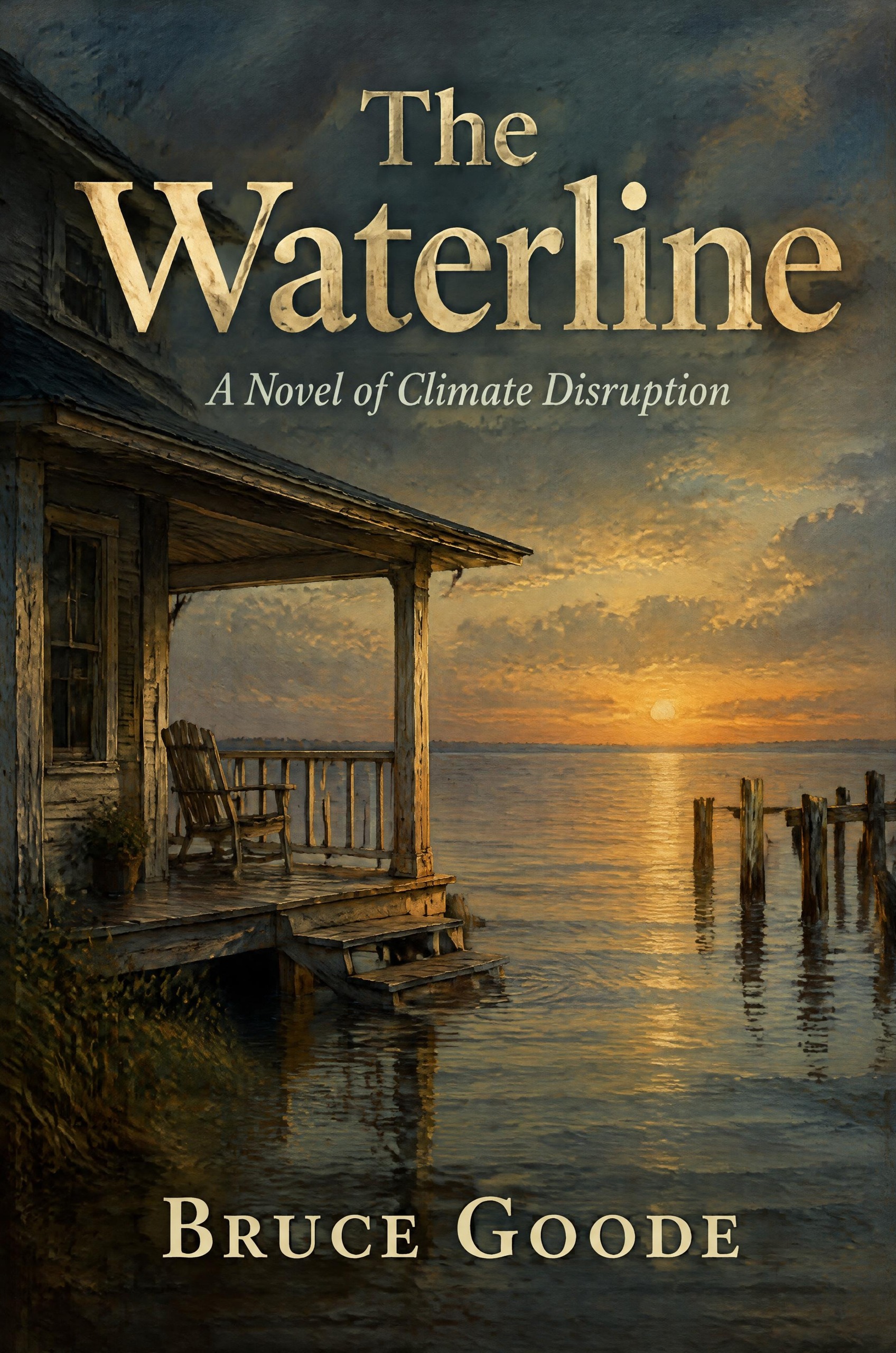
The Waterline
A Novel of Climate Disruption
by Weston Cale
One summer on a quiet southern bay, the disasters stop taking turns. It starts on a calm morning, when Tom Bell finds the bay lying over his bulkhead with no storm and no wind to blame. His pier stood for sixty years before he bought the place. He has rebuilt it twice since. Then the heat comes and doesn’t leave. The grid buckles, and ER doctor Rachel Henderson watches a week’s worth of heatstroke arrive in a single night. City engineer Sarah Vargas knows exactly which part of town will fail first, and can’t stop it. Freight dispatcher Frank Rosario watches the roads, rails, and bridges that feed the coast give out one by one. And Rebecca Chavez keeps calling neighbors to the old porch, trying to get the street to say out loud what everyone already fears. Then six weeks of drought end in forty minutes of rain. And out in the Gulf, the water is warm enough to feed something worse. The Waterline is a grounded, unsentimental novel about ordinary people living through climate disruption, not as a distant forecast, but as the water at the bottom of the porch steps.
- Literary Fiction
- Small Town Drama
- Character Study
- Family Drama
Chapter 1: The Waterline
Tom Bell · July 6 · Morning high tide, three inches over the bulkhead, no wind
Tom woke because the boards beneath the house gave a small, wet sound.
Not a knock. Not wind. Water moving where water had no business moving.
He lay still and listened. The room was dark except for the thin gray at the window. No rain ticked against the glass. The air conditioner was off, though the morning had not yet begun to heat. Somewhere below, something touched the pilings and withdrew.
Tom got up.
At the back window, the bay was the color of old tin. It had come over the bulkhead.
He stood with one hand on the sill, looking for the usual excuses. Wind would have made a ragged surface. Rain would have stippled it. A storm would have given the water a reason to be there. This was smooth water, barely moving, spread across the narrow strip of ground between the bulkhead and the house.
The bottom step was wet.
Tom put on his work shoes and went outside. The boards of the back walk held the night’s dampness, but the wet reached farther than the boards did. A dark line ran along the edge of the bulkhead, and beyond it the bay pressed into the property without hurry.
He walked down to the pier.
The first board dipped under his weight. Tom stopped and shifted back. The wood had always complained there, a soft spot near the shore end where the grain had opened. He pressed it again with the toe of his shoe. It flexed, then settled.
“Fine,” he said.
He went on, keeping one hand near the rail. The water moved under the boards and between them. It showed through the gaps in a dull, unbroken sheet. Usually the pier gave him a line to follow, a way of measuring the distance from the house to the bay. This morning the distance had collapsed. Water was beneath him, against the bulkhead, and around the lowest posts, all of it occupying the same place.
Tom stopped where the pier widened.
The bay had reached the bottom of the steps.
He looked back at the house. The raised floor, the screened windows, the porch roof. For sixty years the pier had run out over water that stayed below the bulkhead except when weather came to push it there. That was what he remembered. Not a number, exactly. A condition. Dry ground where the water now lay.
The property had been old when he bought it. The pier had already outlasted most things people called permanent. Its boards had silvered, been replaced, silvered again. It had held fishing lines, wet towels, folding chairs, and Tom’s weight when he was young enough to walk fast without thinking about where his feet landed.
He looked at the water under the steps.
The memory did not make the morning better. It made it harder to call the morning strange.
Tom turned and walked back toward the house. He did not hurry. Hurrying on the pier was how people got hurt, and there was no prize for reaching dry ground first when the dry ground had begun to move away from you.
At the kitchen sink, he filled the kettle and set it on the stove. He did not turn on the radio. The radio would have offered somebody else’s account of the morning, and Tom had his own eyes.
By the time he carried his coffee outside, the light had strengthened. The houses along the street showed themselves one by one, their roofs and porches facing the bay. Some had been raised in pieces over the years. Some had stairs that ended in patched concrete. Power lines sagged between poles. The bulkhead ran along the water like a tired boundary no one had asked to defend.
Rebecca stood on the old porch with a phone in one hand and a stack of papers in the other.
She saw him and lifted the phone.
“Did you look?” she called.
Tom held his coffee. “I looked.”
“And?”
He glanced toward the bulkhead. The water remained there, flat and patient.
“Still there.”
Rebecca did not smile. She was younger than Tom by enough years to believe that a thing could be made useful if it was named correctly. She wore work clothes and had tied her hair back. A canvas bag rested at her feet, its mouth open around a roll of tape and a handful of pens.
“People are coming by,” she said. “I want to talk before everybody gets busy.”
“Everybody’s already busy.”
“They can be busy together for twenty minutes.”
Tom looked at the papers. “What are those?”
“Notes.”
“About the water?”
“About what it means.”
He drank his coffee. It had gone bitter in the cup.
Rebecca stepped down from the porch and came toward him. She looked past his shoulder to the pier. Tom watched her do it. People looked at the pier differently when the boards were wet. They saw the height of it. They saw the spaces beneath. They saw what the water could reach if it kept being allowed to explain itself.
“How far did you go?” she asked.
“Far enough.”
“Was it unsafe?”
Tom considered the question. “It held.”
“That wasn’t what I asked.”
“It held.”
Rebecca looked at him, waiting for more. Tom turned the mug in his hands, pressed his thumb against the cooling rim, and settled his heels into the damp boards of the walk. He gave her nothing until the pause wore thin.
“I stepped where the boards were sound,” he said.
“Were they?”
“Mostly.”
She closed her eyes briefly, then opened them. “Tom.”
“I came back.”
“That doesn’t make it safe.”
“No.”
The answer seemed to trouble her more than an argument would have. She looked again at the wet boards, then at the water over the bulkhead.
A truck turned onto the street and slowed. Owen Price drove it, one arm resting against the open window. He lifted two fingers when he saw Rebecca, then parked beside the house with the blue shutters. A woman from farther down the street came out carrying a folding chair. She set it on the porch and went back for another.
Tom stayed near the bottom step.
Rebecca moved among the arrivals, pointing out chairs, asking who had seen the water at the end of the street, telling one person that Luis would be there soon. She did not speak loudly. She did not need to. The houses were close enough that a conversation could travel from one porch to the next if no one chose to stop it.
Tom watched the water instead.
A piece of marsh grass drifted against the bulkhead and stayed there. It had come in with the tide. The ordinary tide, Tom thought, though the word ordinary had started to feel like a tool with a cracked handle.
Luis arrived carrying a short length of pipe and a wrench. He set both beside the porch steps.
“What’s that for?” Rebecca asked.
“Nothing yet.”
“Then why bring it?”
“Because if something starts leaking, I’d rather have it.”
Rebecca looked at him, then at the water. Luis shrugged.
More neighbors came out. Doors opened along the street. A dog barked once and was called inside. Someone dragged a chair across a porch, the legs catching on the boards. The morning settled into place around them, almost ordinary except for the water lying over the boundary that had once kept the bay where it belonged.
Rebecca climbed onto the porch and faced the people gathering there.
Tom took the last step up. The boards were dry beneath the roof, but he could feel the dampness in the air and the weight of the bay beyond the railing.
Rebecca rested her papers on the porch rail. The top sheet lifted in the bay air, though there was hardly enough wind to move it, and she put her palm over the page.
“We should start with what we can see,” she said. “The water is over the bulkhead. It’s at the bottom of Tom’s pier. It’s along the back lots.”
Nobody answered at first.
A man from two houses down leaned back in his chair and looked toward the bay. “It’ll fall.”
Rebecca looked at him. “It may.”
“That’s what tides do.”
Tom held his coffee between both hands. The cup had cooled enough that he could stop pretending to drink it.
Another neighbor, a woman with a blue sweater tied around her waist, pointed toward the street. “It hasn’t reached the road.”
“Not yet,” Rebecca said.
The woman’s mouth tightened. “So what are we discussing?”
Rebecca glanced at the water, then at the houses behind them. “What we need to watch. Access points. The lower steps. Utilities. If it reaches the road, we need to know which way people can get out.”
“Get out of what?” the man asked. “A tide?”
“A tide that’s already where it shouldn’t be.”
Tom could feel it in the small movements around him. Someone shifted a chair away from the railing. Someone else checked the screen of a phone and turned it facedown. The neighbors had come because Rebecca had asked them, but coming was not the same as agreeing to hear what she meant.
Luis stood near the steps with the pipe and wrench beside his boot. He had his arms folded. He looked at the water, then at the pipe, as if one of them might tell him what to do with the other.
“We could check the low connections,” he said. “See if anything’s taking water. Put a temporary brace on the back steps. That would tell us more than standing around talking.”
Rebecca turned toward him. “A brace on the steps won’t tell us what happens if the road goes under.”
“The road isn’t under.”
“No.”
“And the house isn’t taking water.”
“Not yet.”
Luis rubbed his thumb across the side of his hand. “Then we start with what is happening.”
“What’s happening is the water is over the boundary.”
“It’s a high tide.”
Tom looked at him.
Luis saw the look and shrugged. “That’s what it is.”
The old porch boards gave a little beneath Tom’s shoes. They had been painted too many times, the layers raised around nail heads and worn smooth in the places people stood most often. Beyond the railing, the bay pressed against the bulkhead with the patience of something that had nowhere else to be.
Rebecca opened her notebook. “Does anybody know if this has happened here before without rain?”
“Of course it has,” said the man in the chair. “Not exactly here, maybe. We had a high one in ’09.”
“That was after a storm.”
“The storm had passed.”
“Which means there was wind, rain, and water moving in already,” Rebecca said.
He frowned at the notebook. “You’re making a distinction that doesn’t help.”
“It helps if we’re trying to understand what the water is doing.”
“It’s doing what water does.”
A woman near the porch steps gave a short laugh. “You’d think it had come up to the front door.”
“No one said that,” Rebecca said.
“Not yet.”
The woman looked toward her own house. Its lower stairs were concrete, patched at the center where a crack had widened over the years. She did not say what it would cost if the water reached there. She did not need to.
Tom watched Rebecca write something down, then cross it out.
“What do you want people to do?” Luis asked.
“Notice.”
“We’re noticing.”
“No, we’re looking at it. That’s different.”
Luis shook his head. “If there’s a leak, we fix the leak. If the steps are loose, we fix the steps. If the road floods, the town deals with the road.”
“The town doesn’t live in these houses.”
“It maintains the road.”
“Sometimes.”
The answer came too quickly. Rebecca seemed to hear it after she said it. She turned her face toward the street, where the low road ran between the houses and the water, patched and repatched, with grass pushing through the edges.
Tom remembered driving it when the bulkhead was dry and the bay stayed where it belonged. He remembered carrying lumber down the pier without stopping to check the boards. He remembered when nobody needed to say which direction to leave because leaving had not been part of the morning’s work.
A chair scraped.
One of the neighbors stood. “This is turning into something it isn’t.”
Rebecca kept her eyes on him. “What is it?”
“A conversation about a high tide.”
“Then why are you leaving?”
He glanced at his house. “I’ve got work.”
“No one’s asking you to stay all day.”
“You said twenty minutes.”
“I said we should talk for twenty minutes.”
“That’s what I mean.”
He walked down the steps. The others watched him go, but nobody called him back. His shoes made a dry sound on the street, absurdly loud against the water.
Rebecca gathered the loose pages into a neat stack. “We can keep it simple. What changes if the water reaches the road? Which houses have lower entries? Who has a way to get somewhere else? Who would need help moving equipment or getting out?”
No one answered.
The woman with the sweater looked toward Luis. “Are you asking people to leave?”
“No,” Rebecca said.
“Because that sounds like asking people to leave.”
“I’m asking what we would do if access changed.”
“Access hasn’t changed.”
Tom looked past the porch. The bottom of the road near the old bait shop was dark with water. It had not covered the pavement. It had reached the edge and stayed there, spread thinly over the gravel shoulder.
“Not yet,” Rebecca said.
The woman folded her arms. “You keep saying that.”
Rebecca’s thumb slipped on the edge of the stack, and the top two pages fanned out, one corner dropping past the railing before she clamped them tight against her chest. When she started to answer, her voice caught thin, cracking on the first breath before she could force it level again. Tom saw the fear beneath it, not large or dramatic, just present and unwilling to be carried alone.
Luis picked up the pipe. “I’m going to check the back connection.”
“Luis.”
“I’m not leaving. I’m checking it.”
“You can check it after we finish.”
“We’re not finishing anything.”
He took one step toward the house.
Rebecca turned to the neighbors. “This is what I mean. We can see the same thing and still talk as if it belongs somewhere else.”
Luis stopped. “What do you want me to say?”
“That it matters.”
“It matters if it gets into the house.”
“It matters before that.”
“Why?”
Rebecca looked down at the papers. The top page had a list of names, though Tom could not read them from where he stood. Beside some of them were short marks in pen. He wondered whether she had already decided who might need help, or whether she was only trying to give the fear a shape it could fit inside.
“Because if we wait until water is at a door, we’re already late,” she said.
A neighbor near the railing shook his head. “That’s not how it works here.”
“How does it work?”
“You watch the weather. You move things if there’s a storm. You call somebody if the road gets bad. We’ve been doing it forever.”
“Have we?”
The question made several people look at her.
Tom could hear the bay below the porch. It moved against the bulkhead without striking it. The sound was small, a soft push and release. It had no drama in it. That was the trouble.
The man who had mentioned 2009 spoke again from his chair. “You’re making people nervous for no reason.”
“They’re nervous already.”
“Not because of this.”
Rebecca looked around the porch. “Then what is it?”
Nobody spoke.
A screen door closed down the street. Someone’s dog began barking and stopped. Luis set the pipe against the porch post with more care than it required.
Rebecca said, “We don’t need to decide anything today. We need to agree on what we’re seeing.”
“That’s the same thing,” the woman said.
“No, it isn’t.”
“It always becomes the same thing.”
Tom looked at her house. At the concrete steps. At the narrow strip of ground between the back walls and the bulkhead. She had seen water there too. Everyone had. They had all seen it and kept their names for it separate.
Rebecca started to speak again.
Tom set his coffee on the porch rail.
“The water has been telling us the truth for years,” he said.
Nobody moved.
The bay remained beyond the bulkhead, flat beneath the late morning light. The sentence left no room for another example, no repair to propose, no old storm to compare it with. One by one, the neighbors stood. A chair folded. Someone picked up a phone. Luis took the wrench and left the pipe leaning against the post.
Rebecca gathered her papers but did not look at them.
Tom stayed beside the railing. Below him, the water held against the tired boundary, patient as before.
Chapter 2: A Street Without Shade
Rachel Henderson · July 9 · Heat index 117°FRachel crossed the street with her hospital badge still clipped to her waistband. The plastic card tapped against her hip as she walked, a small, regular sound beneath the heat.The roofs threw it down. Tar shingles, metal vents, pale siding, every hard surface had taken in the sun and was giving it back. …