

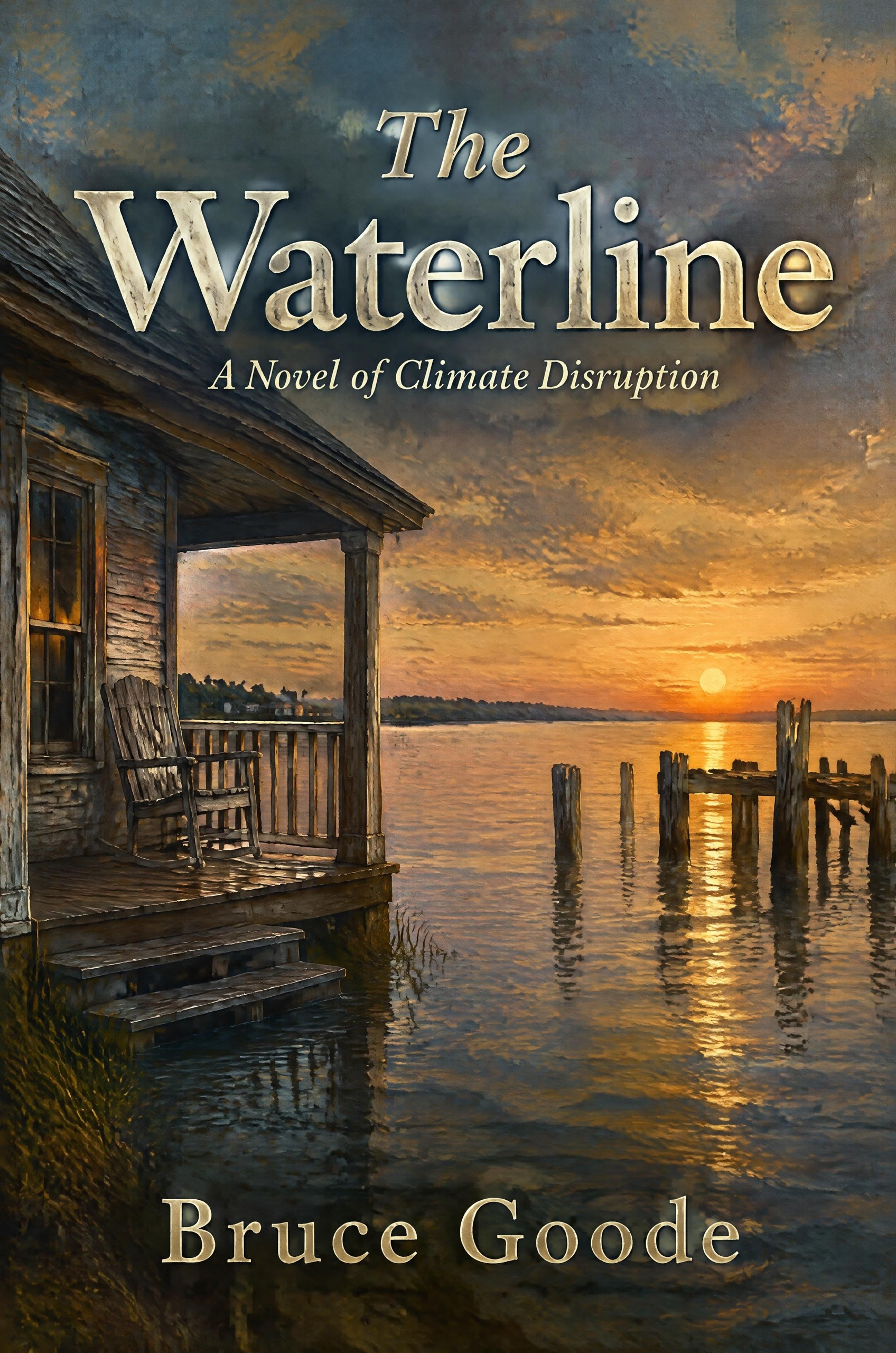
The Waterline
A Novel of Climate Disruption
by Weston Cale
For seventy-six years, Tom Bell has lived in the wooden house on pilings his father built along Pelican Bend's Intracoastal channel. The rhythm of the tides has always been his clock, steadfast and predictable. But when calm, sunny-day flooding begins creeping over his bulkhead, Tom insists the water always recedes. His thirteen-year-old neighbor, Nia, knows better. Armed with notebooks and a measuring tape, she charts a quiet, undeniable reality: the sea is rising. Over fifteen grueling months, Tom watches his beloved coast unravel. Blistering heatwaves, unpayable insurance hikes, a sudden kitchen flood, and an unyielding winter freeze slowly strip away his defenses. With each passing tide, his daughter urges him to pack up and move inland, while his neighbor Owen works beside him to elevate pilings and solder bursting pipes. Yet it is the discovery of his father's decades-old, secret tide marks in the boat shed that delivers the hardest truth of all. When Hurricane Lena bears down on the coast, Tom must confront the impossible choice between stubbornly clinging to a vanishing past and finding the grace to surrender what he loves. Luminous, poignant, and deeply resonant, The Waterline is an unforgettable portrait of legacy, community resilience, and the courage it takes to let go.
- Literary Fiction
- Small Town Drama
- Character Study
- Grief & Loss
- Book Club Fiction
The Waterline
Tom Bell woke at ten after five, as he had nearly every morning since he was a boy, and lay listening to the house. The window unit in the front room ticked as it cooled down from the night. A mockingbird was working through its list in the oleander. Under all of it, so low he felt it more than heard it, there was a sound he could not place, a soft wet knocking somewhere beneath the floor.
He put on his pants and his work shoes and went to the back window.
The channel was the color of a galvanized bucket, flat from the bulkhead to the marsh on the far side, without a ripple on it. Past the marsh, where the beach road ran along the dunes, he could hear the Gulf breaking on the sand, low and steady. There was no wind at all. The sky over the marsh was turning from gray to the faint yellow that meant another hot one. And the water had come over the bulkhead.
It lay across the strip of grass between the bulkhead and the back steps in one smooth sheet, an inch or two deep, catching the light. A plastic crab float had drifted in over the top of the wall and slapped against the bottom step. The knocking he had heard was a loose board under the back porch, lifting and settling as the water moved beneath it.
Tom stood there long enough for the coffee maker to finish behind him. He had seen water in the yard before. Every storm he could remember had pushed some of the channel over his father's wall, and a few of them had pushed a great deal more. But a storm brought wind with it, and rain, and a sky that told you what it was doing. This morning had brought nothing. The water had simply risen in the quiet and spread over the grass while he slept.
He poured his coffee black into the green mug Ellen had bought at a craft fair in 1988 and went out the back door.
The water was warm around his shoes. He waded across the yard to the foot of the pier, where his father had sunk the first piling the summer Tom turned fifteen, and rested one hand on it. The grain was silver and open from sixty years of sun. The pier itself ran sixty feet out into the channel on its old posts, with a T at the end where the family used to sit on the Fourth of July and watch the fireworks they shot off the beach across the marsh. The first thirty feet were his father's work, or close enough. The outer thirty were Tom's, rebuilt twice in the last nine years after two storms had come through and taken the span, the first one tearing away half the roof of the house along with it.
Most of the decking needed replacing again. He had meant to do it all spring.
He walked out slowly, testing each board before he trusted his weight to it, joints stiff in the damp and coffee held away from his body. The water was higher under the pier than he had ever seen it on a calm day. It slid between the posts and lapped at the bottom of the stringers, and the barnacles on the lower crossbraces, which should have been out of the water at this stage of the tide, were all under. When he reached the T he looked back at the house. From out here he could see the whole street, nine houses facing the channel on their pilings and blocks, and every one of them had water standing in its back lot.
"Well," he said.
He drank his coffee and watched a mullet jump twice near the old channel marker. Far down the Intracoastal a tug was pushing two barges east, so slowly it hardly seemed to move. It was a beautiful morning. That was the strange part. A man could stand out here and admire it.
When he walked back off the pier, Nia Vargas was at the bulkhead with a yardstick.
She was thirteen and lived next door with her mother, who was some kind of engineer for the city, and she had a way of appearing in his yard that Tom had stopped noticing years ago. This morning she was barefoot and wearing a T-shirt that came to her knees. She had pushed the yardstick down into the water where the bulkhead's top board was hidden, squinting at the number.
"Two and three-quarters," she said, without looking up. "Over the top of the wall. What do you think?"
"I think you're going to cut your feet on an oyster shell."
"I'm careful." She pulled out the yardstick, shook it, and wrote in a spiral notebook she had tucked into the waistband of her shorts. "It's for science. Mr. Delgado said we have to measure something over the summer and graph it. Everybody else is doing the rain gauge."
"You picked the channel."
"The channel's more interesting. It's doing something." She looked at him then, her face serious under a mess of dark hair. "Has it ever done this before? On a day like this?"
Tom thought about it honestly, because she had asked it honestly. He thought about seventy-six years of mornings on this property. Storms, yes. The October tides that ran high every fall and made the boys at the bait shop say the moon was close. The big storm the year he was eleven, which had put four feet of water under the house and a foot inside it. But a calm June morning with no wind and no rain, and the water standing in the grass like it lived there?
"Not that I recall," he said.
Nia wrote that down too. He wished she hadn't.
"It'll go back down," he told her. "It always goes back down."
"When?"
"By noon. You can measure that, too."
She said she would. Then she asked if she could put a mark on the pier piling so she'd have a fixed place to measure from, and Tom went back inside for a carpenter's pencil and let her draw a line on his father's post at the waterline. She wrote the date next to it in small, careful numbers. Looking at that line on the old wood gave him an uncomfortable feeling he did not care to examine.
By seven the heat was already coming up off the water. Tom ate two eggs and a piece of toast standing at the counter and then went out front to look at the street.
The low road ran along the front of the houses, patched black asphalt with grass growing up through the seams, and at the far end by the bait shop it dipped down into the marsh before it climbed toward town. The dip had water in it. Not much, maybe six inches, enough that a car would throw a wake. A man in a pickup Tom didn't know came through it too fast and sprayed salt water up onto June Patel's mailbox.
June was out on her steps when he came across. She was seventy-three, a retired school librarian who still wore reading glasses on a beaded chain, and she lived alone in the gray house with the hurricane shutters she never closed. She was standing on the second step from the bottom holding the rail. He saw why: the bottom step had pulled loose from the stringer on one side and was hanging at an angle, its nails rusted through.
"Morning, June."
"Tom. I was about to call you, but I didn't want to be a bother before breakfast."
"You're never a bother before breakfast. After lunch, maybe." He crouched down and looked at the step. The stringer was sound enough, but the bottom of it had been sitting in wet ground so constantly that the end grain had gone soft and the nails had nothing left to bite into. "When did this let go?"
"Sometime in the night. I came out to get the paper and nearly went down."
"Don't use it. Step over it. I'll be back in twenty minutes."
He went home for his tool bag, a short piece of pressure-treated two-by-six, and a box of three-inch exterior screws. It took him a little longer than twenty minutes, because the screws wanted a pilot hole in the old wood and his drill battery was low, but by eight-thirty he had cut a new cleat, set it against the sound part of the stringer, and screwed the step down to it so that it did not move when he stood on it and bounced. June watched from her porch chair with a cup of tea she had made for him and that he had forgotten to drink.
"You didn't have to do all that," she said.
"It was do all that or listen to you fall down."
"I'd have fallen quietly."
"That's what I was afraid of."
She smiled at him. June had a good smile, wry and a little sad, and since Ellen died she had become the person on the street he talked to most, though neither of them would have said so. She looked past him at the water standing in the dip of the road.
"Nia was over at your place early," she said.
"Measuring the water."
"She came by yesterday and asked me how high the water was when I first moved here. I told her I didn't know. I never thought to look." June turned her cup in her hands.
"It'll be gone by noon."
"Will it?"
"It always is," Tom said, and he went home to put his tools away.
He spent the rest of the morning in the shed behind the house going through the lumber he had been collecting for the pier. There was not enough of it. He had bought a few boards at a time over the winter whenever he went to town, and they were stacked on sawhorses under a tarp with their ends painted against splitting. He counted forty-one two-by-sixes, eighteen feet long, which was maybe half the decking he would need for the outer section. At the store's prices that would be another eight or nine hundred dollars for the rest, plus galvanized hardware, plus the two outer posts that had been leaning since the last storm and would have to be jetted out and reset.
He sat on an upturned bucket and did the arithmetic on the back of a feed store receipt. It came to more than he wanted to spend and less than he could afford. It came out that way every year.
He wanted it done by the Fourth. That was the plan he had made back in March, and he saw no reason to change it now. Mara and the kids hadn't come out for the fireworks in three summers. The first summer they had a reason, a tournament for the boy. The second summer they had another reason. Last year Mara had said on the phone that she just didn't think the pier was safe for the kids anymore. Tom had heard what she really meant. If the pier was new, if it was solid out to the end and the T had fresh boards and a good railing, there would be no reason left. They could sit out there like the old days, with Ellen's old cooler and the citronella buckets, and watch the town shoot off its money over the water.
At noon he walked back to the pier.
The water had gone down. It had pulled back over the bulkhead and out of the yard, leaving the grass flattened and shining and a long wavy line of dead marsh straw along the top of the wall. The back steps were dry. The crab float lay on its side in the mud. Under the pier, the barnacles were out of the water again, ticking and popping in the sun.
He felt his shoulders come down a little. There it was.
Nia's pencil mark was on the piling where she had drawn it, a short dark line with the date beside it. The water now was a good two feet below it. Tom stood there looking at the line for a while, at how small and neat it was, at how high it sat on the post his father had put in the ground sixty-one years ago. In all those years of standing on this pier he had never once marked the water. He had never seen a reason to. The water came up and the water went down, and his father had built everything to sit just above where it came.
The grass along the top of the bulkhead, he noticed, had a brown edge to it, a strip a foot wide where it had gone the color of old rope. Salt burn. He had seen that edge spreading since spring and told himself it was the drought.
He went inside, put the receipt with his lumber figures on the refrigerator under a magnet shaped like a crab, and called the lumberyard to ask what they wanted for sixteen-foot two-by-sixes this week.
The Dip in the Road
Mara called from the bait shop at ten on Saturday morning to say she was sitting in the parking lot waiting for the road."What do you mean, waiting for it?""I mean it's under water, Dad. At the dip. There's a man in a Corolla who tried it and he's stuck in the middle with his flashers on, and I'm not doing that in my car."Tom went out on the front …