

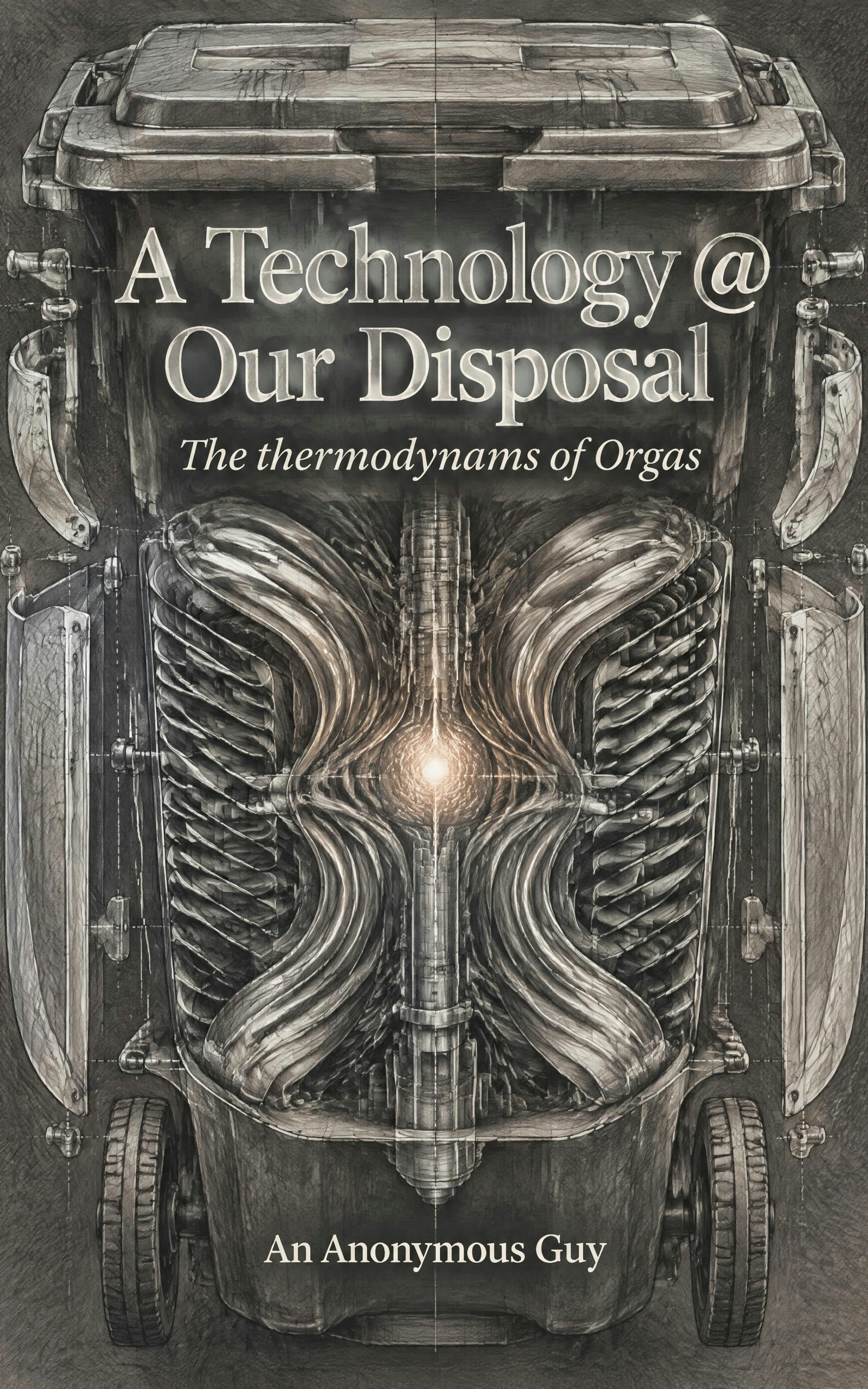
A Technology @ Our Disposal - (final draft)
The thermodynams of Orgas
by William Pierce
What if the secret to saving the planet is hidden in the laws of physics and a decades-old engineering scandal? In 'A Technology @ Our Disposal', an anonymous industry insider pulls back the curtain on a revolutionary waste management breakthrough that was buried by corporate interests and flawed focus groups in the late 1990s. This isn't just a story of what went wrong—it is a masterclass in what comes next. By applying the twelve-step thermodynamic cycle to the physical movement of domestic refuse, this book reveals a radical new framework for sustainability. Discover how compression, expansion, and heat transfer principles can transform chaotic material flows into predictable, measurable business models. From the resistance of bulk solids to the untapped potential of single-bin systems, you will explore the engineering blunders that shaped our modern landscape and the innovative solutions that could fix them. Equal parts memoir, true crime investigation, and scientific manifesto, this book provides entrepreneurs and policymakers with a concrete blueprint for the circular economy. It is time to stop treating trash as a logistical burden and start seeing it as a high-efficiency system governed by the immutable laws of science. The tools for a low-entropy future are already at our disposal.
- Historical Non-Fiction
- True Crime
- Science & Technology
- Biography
- Technological History
- Engineering
The Beginning-of-Pipe Error: When Physics Defied Curbside Recycling
STOOD UPRIGHT. CATALYST, CHAIN REACTION, 2 PARTS TOOLS & INTELIG. GOT TO DOMINANCE. SIMILAR TO STATIONARY EARTH & INT PROCESS. THEN 1ST PART OF 2ND STAGE OF LIFE. 1ST PLANTS. THEN ANIM. THEN HUMANS. ALL WANDERING COS NO KNOWLEDGE OF INC MOLEC MTN CAUSING DECAY & REDUCING BY CONCEALMENT & LATER COOLING RED. Pick up a garbage bag and drop it on the floor. Watch what happens. The contents shift, settle, compress under their own weight, and come to rest in a new configuration. That simple act, so ordinary you've probably never thought twice about it, is a demonstration of the Second Law of Thermodynamics in action. The disorder inside that bag either stays the same or increases. It never, on its own, decreases. Aluminum cans do not sort themselves away from coffee grounds. Cardboard does not separate from wet food waste. Once mixed, materials resist being unmixed with a stubbornness that has a precise mathematical description and a measurable energy cost.
This book begins with that cost. Not as an abstract concept borrowed from a physics lecture, but as a real dollar figure buried inside every council waste budget in Australia, a number that has been growing quietly for thirty years while the infrastructure that created the problem has remained almost entirely unchanged. Before we can talk about what went wrong in the 1990s, before we can examine the patent that was shelved, the focus groups that got it backwards, and the policy decisions that locked in a failing system, we need to understand the physical laws that make waste management either efficient or catastrophically wasteful. The laws don't care about politics. They don't respond to budget cycles or council elections. They apply with equal indifference to a refrigerant gas inside a compressor and to a 240-liter household bin sitting on a suburban curb in Sydney.
The Physical Law
The First Law of Thermodynamics is a statement about conservation. Energy cannot be created or destroyed; it can only change form. When you burn natural gas to power a sorting facility, the chemical energy in the gas becomes thermal energy, then mechanical energy, then electrical energy, and at each conversion step a fraction is lost as heat that disperses into the environment and does no useful work. The total energy in the universe remains constant. The useful energy available to do work steadily declines.
The Second Law of Thermodynamics is a statement about direction. In any isolated system, entropy, defined as the measure of molecular disorder or randomness, either stays constant or increases over time. It never spontaneously decreases. This is not a statistical tendency or a rough approximation. It is one of the most rigorously tested principles in all of science. Ilya Prigogine, whose work on the thermodynamics of irreversible processes earned him the Nobel Prize in Chemistry in 1977, demonstrated how systems far from equilibrium generate entropy as a fundamental feature of their operation [1]. Real industrial processes, which are never perfectly isolated, export entropy to their surroundings while maintaining internal order only through continuous energy input.
These two laws, taken together, define the operating constraints of every physical system on Earth. A refrigeration cycle works by forcing heat to flow against its natural direction, from cold to hot, by doing mechanical work on a refrigerant gas. The compressor adds energy, the entropy of the refrigerant changes in carefully controlled stages, and the net result is a cold space maintained at a lower temperature than its surroundings. This is not a violation of the Second Law. It is a demonstration of it. The system as a whole, including the compressor and the waste heat discharged to the room, increases in entropy. The local decrease in disorder inside the refrigerator is purchased at the cost of a larger increase in disorder elsewhere.
Every sorting operation in a waste management system works on exactly the same principle. You cannot recover order from disorder for free. The question is not whether you will pay an energy cost to sort materials. You will. The question is when you pay it, and how large the bill is when it arrives.
Waste as a Thermodynamic Problem
Australia's current dominant waste collection model is what industry calls the single-stream or co-mingled recycling system. Households place all recyclable materials into one bin: glass, plastic, paper, cardboard, metal. A truck collects the bin, compresses the contents, transports them to a materials recovery facility, and a combination of mechanical screens, optical sorters, magnets, and human labor separates the mixed stream back into its component materials.
From a thermodynamic standpoint, this is a system that deliberately creates disorder and then pays, expensively, to undo it. The entropy of mixing is not a vague metaphor here. It has a formal mathematical description. For an ideal mixture of n components, the entropy of mixing is given by:
ΔSmix = -R Σ xi ln(xi)
where R is the gas constant and xi is the mole fraction of each component. For real bulk solids like the contents of a recycling bin, the calculation is more complex because we are dealing with materials that do not mix at the molecular level. Instead, we use a statistical mechanics approach to quantify the number of distinct configurations the mixed material can occupy. The core principle holds regardless of the formalism: mixing increases the number of possible states the system can occupy, and reversing that mixing requires work proportional to the increase in entropy.
The Calculation: What Mixing Actually Costs
Consider a worked example that makes this concrete. Take a standard 240-liter household recycling bin with a typical composition: roughly 35 percent paper and cardboard by volume, 30 percent plastic bottles and containers, 20 percent glass, and 15 percent metals. The total mass is approximately 20 kilograms in a typical weekly collection.
Now consider two scenarios. In the first, a household deposits all materials together into a single co-mingled bin. In the second, the same household uses two separate containers: one for fiber (paper and cardboard) and one for rigid materials (glass, plastic, metal). These are the two physical states of the system before collection.
At a materials recovery facility, the co-mingled stream requires the following operations to achieve separation: initial bag-breaking and spreading across a sorting floor, a primary trommel screen to separate by size, an optical near-infrared sorter to identify plastic types, a glass-breaking screen, an eddy current separator for non-ferrous metals, and a magnetic separator for ferrous metals. At each stage, material is lost to contamination. Glass breaks and embeds in paper. Wet cardboard loses structural integrity and becomes residue. Industry data consistently shows that co-mingled systems recover between 45 and 55 percent of their input as usable secondary material. Call it 50 percent, and that is being generous.
A pre-sorted two-stream system, by contrast, requires a fiber line and a container line, both simpler operations with fewer cross-contamination pathways. Recovery rates in well-documented two-stream systems in North America and parts of Europe consistently exceed 70 percent, with paper fiber quality high enough to command premium pricing from paper mills.
For our 5-kilogram subset of mixed plastic and paper, the energy required to achieve separation in a co-mingled stream runs to approximately 0.8 to 1.2 kilowatt-hours per kilogram of recovered material, accounting for conveyor systems, optical sorters, and blower mechanisms. The same 5 kilograms arriving as a pre-sorted stream requires roughly 0.3 to 0.4 kilowatt-hours per kilogram. The difference, between 0.5 and 0.8 kilowatt-hours per kilogram, is the energy penalty for the entropy of mixing. Multiply that across the 20 million tons of recyclable material Australia generates annually, and the number becomes staggering. The single-stream system is not merely inefficient. It is a machine for converting potential value into heat and landfill residue.
Engineering the Loop
The thermodynamic argument against single-bin collection is not complicated once you see it clearly. A refrigeration engineer would never design a system that mixed the refrigerant with the coolant water, transported the mixture to a processing plant, and then separated them before use. The separation step would consume more energy than the refrigeration cycle could ever produce. Yet this is precisely the logic embedded in co-mingled waste collection.
The analogy to the twelve-step thermodynamic cycle that governs heat exchange systems, which this book will develop in detail across later chapters, is direct. In a properly designed compression cycle, each stage of the process is optimized to minimize irreversibility. The working fluid enters each stage in a well-defined state: known pressure, known temperature, known composition. Deviations from that defined state, mixing of phases, unexpected pressure drops, temperature gradients across heat exchanger walls, all represent entropy generation and efficiency losses. Engineers spend enormous effort minimizing these deviations because they know that every unit of entropy generated inside the cycle is a unit of useful work that cannot be recovered.
Waste logistics is no different in principle. The "working fluid" is the material stream. Its defined state at the point of collection, sorted by material type and kept clean and dry, determines how much useful work can be extracted downstream. Every act of mixing at the collection point is an irreversible process. Once a glass bottle shatters against a wine bottle and the fragments contaminate a stack of cardboard, the thermodynamic work required to recover that cardboard as usable fiber increases sharply. The entropy has been generated. It cannot be un-generated. It can only be paid for.
The single-bin system introduced to Australian households in the late 1980s and consolidated through the 1990s was, from an engineering standpoint, a decision to deliberately generate entropy at the cheapest possible point in the collection chain and then pay for it, at great expense, further downstream. The justification at the time was participation rates. Households would recycle more if the system was simpler. One bin, no sorting required. The logic was sociological, not thermodynamic, and it was wrong on both counts. Participation rates in co-mingled systems are not consistently higher than in well-designed source-separation systems, and the material recovered is worth significantly less.
Closed Systems, Open Systems, and the Leaking Loop
Thermodynamics distinguishes between closed systems, which exchange energy but not matter with their surroundings, and open systems, which exchange both. A sealed refrigerant circuit is an approximation of a closed system. A waste management supply chain is definitively open: material enters from households, energy enters from electricity grids and diesel trucks, and outputs include recovered materials, residue sent to landfill, and waste heat from processing equipment.
In an open system, the entropy balance must account for both internal entropy generation and the export of entropy to the environment. A well-designed circular material loop minimizes internal entropy generation by maintaining material streams in well-defined, low-disorder states, and minimizes entropy export by ensuring that outputs are either re-used or safely absorbed. What Australia's current system does, instead, is generate high internal entropy through co-mingling, then export that entropy to landfills and atmosphere through low-quality residue and energy-intensive processing.
Prigogine's insight about irreversible processes is directly applicable here. Systems that operate far from thermodynamic equilibrium, as all living systems and all active industrial systems do, can maintain local order only by continuously importing energy and exporting entropy [1]. The measure of how well a system performs this exchange is its efficiency at converting energy inputs into ordered, useful outputs. A waste management system optimized around thermodynamic principles would treat every point of entropy generation as a loss to be minimized, not a convenience to be accepted.
What This Means for Green Startups
For entrepreneurs trying to build businesses in the waste and circular economy space, the thermodynamic framework is not academic. It is a diagnostic tool. When a logistics operation is losing money or struggling to scale, the problem can almost always be traced to an entropy leak: a point in the material flow where disorder is being created faster than it can be managed.
Common entropy leaks in waste logistics include the following:
- Collection points where multiple material types are combined because separate collection is considered logistically inconvenient.
- Storage conditions where moisture, temperature variation, or mechanical damage degrades material quality before processing.
- Processing steps that are designed for average inputs rather than specific material states, creating variable output quality that downstream buyers cannot rely on.
- Transportation legs that mix material types to fill truck capacity, undoing upstream sorting at a lower cost than the sorting originally required.
Each of these leaks has an energy cost and a revenue cost. The energy cost is the additional processing work required to recover usable material from a degraded stream. The revenue cost is the difference between what a clean, well-defined material stream commands on secondary markets and what a contaminated, mixed stream is worth, which is often nothing, or less than nothing once gate fees are factored in.
The path to a profitable, scalable green business in this sector runs directly through entropy minimization at the source. This means designing collection systems that preserve material state, storage systems that protect material quality, and processing systems that operate on defined, consistent inputs. It means treating the material stream with the same discipline that a chemical engineer treats a process stream: knowing the composition, controlling the conditions, and measuring the outputs against a defined specification.
Businesses that apply this discipline consistently find that their unit economics improve in a measurable, predictable way. Contamination rates drop. Secondary material prices improve. Processing costs fall as equipment operates on consistent feed material rather than unpredictable mixed loads. The financial model becomes more stable because the physical model is more controlled.
The Stage Is Set
The laws of thermodynamics did not change in 1988 when Australia's waste collection systems began their shift toward co-mingled bins. They did not change when focus groups in the mid-1990s told researchers that households preferred the convenience of single-bin collection. They have not changed since. What changed was the institutional willingness to treat waste as a physical system governed by measurable laws, rather than as a social problem to be managed through behavioral incentives and council policy.
The story of how that shift happened, and what was lost in the process, begins with a bin patent and a company called Oates Pty Ltd. The engineering solution that could have set Australian waste management on a low-entropy path was sitting in a design office, ready to be manufactured. What happened to it is a case study in how good physics gets overruled by bad sociology, and how the costs of that decision get quietly distributed across decades of council budgets and degraded material streams.
Understanding the thermodynamic framework laid out in this chapter is necessary preparation for that story. Because the failure was not just institutional or political. It was a failure to take seriously the physical constraints of the system being designed. Entropy always wins in the end. The only choice is whether you pay attention to it from the start, or spend thirty years paying for having ignored it.
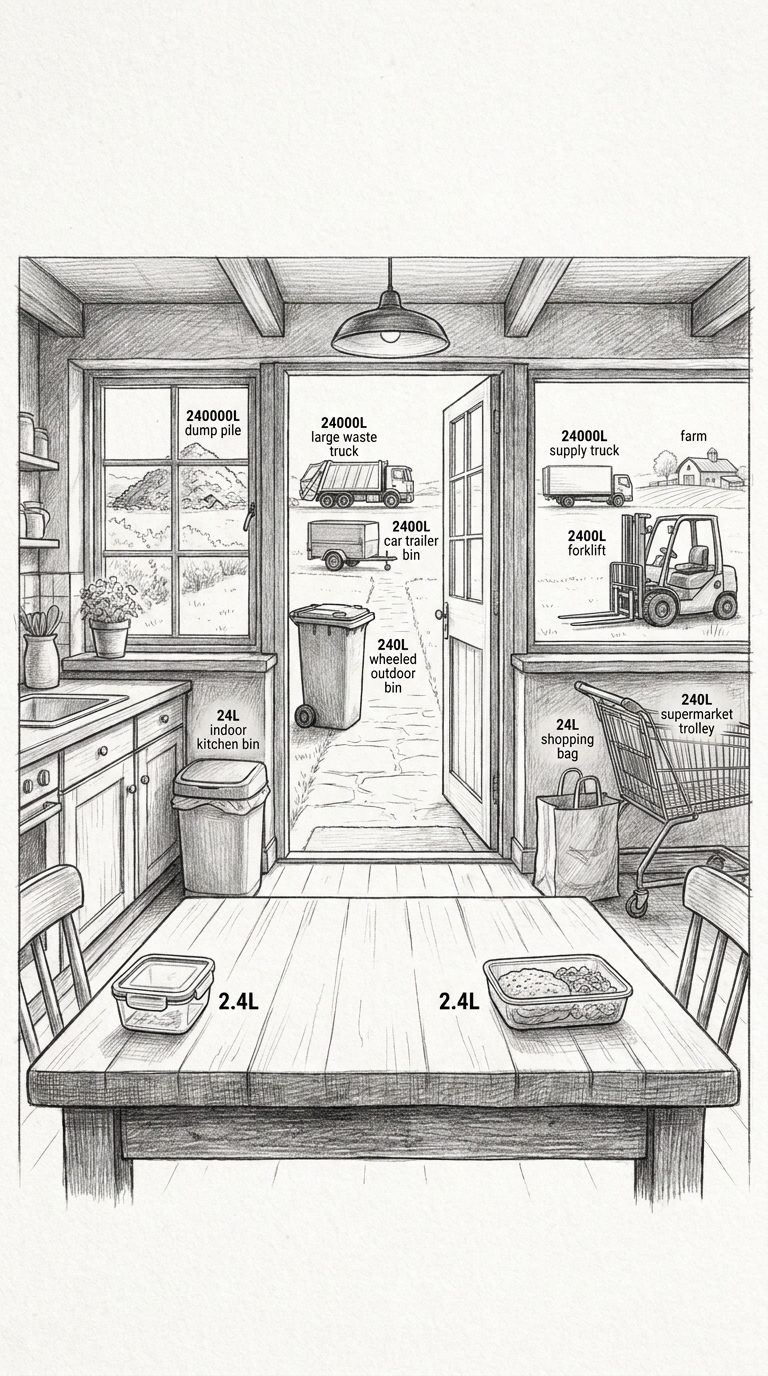
The Thermodynamic Parallels: Heat Engines and Refuse Cycles
In 1997, a man could still get excited about a bin. That sounds absurd now, but context matters: the recycling industry in Australia was young enough that a genuinely clever piece of mechanical engineering could look like a gold rush. The country was generating more domestic waste each year, landfill costs were climbing, and the political pressure …