

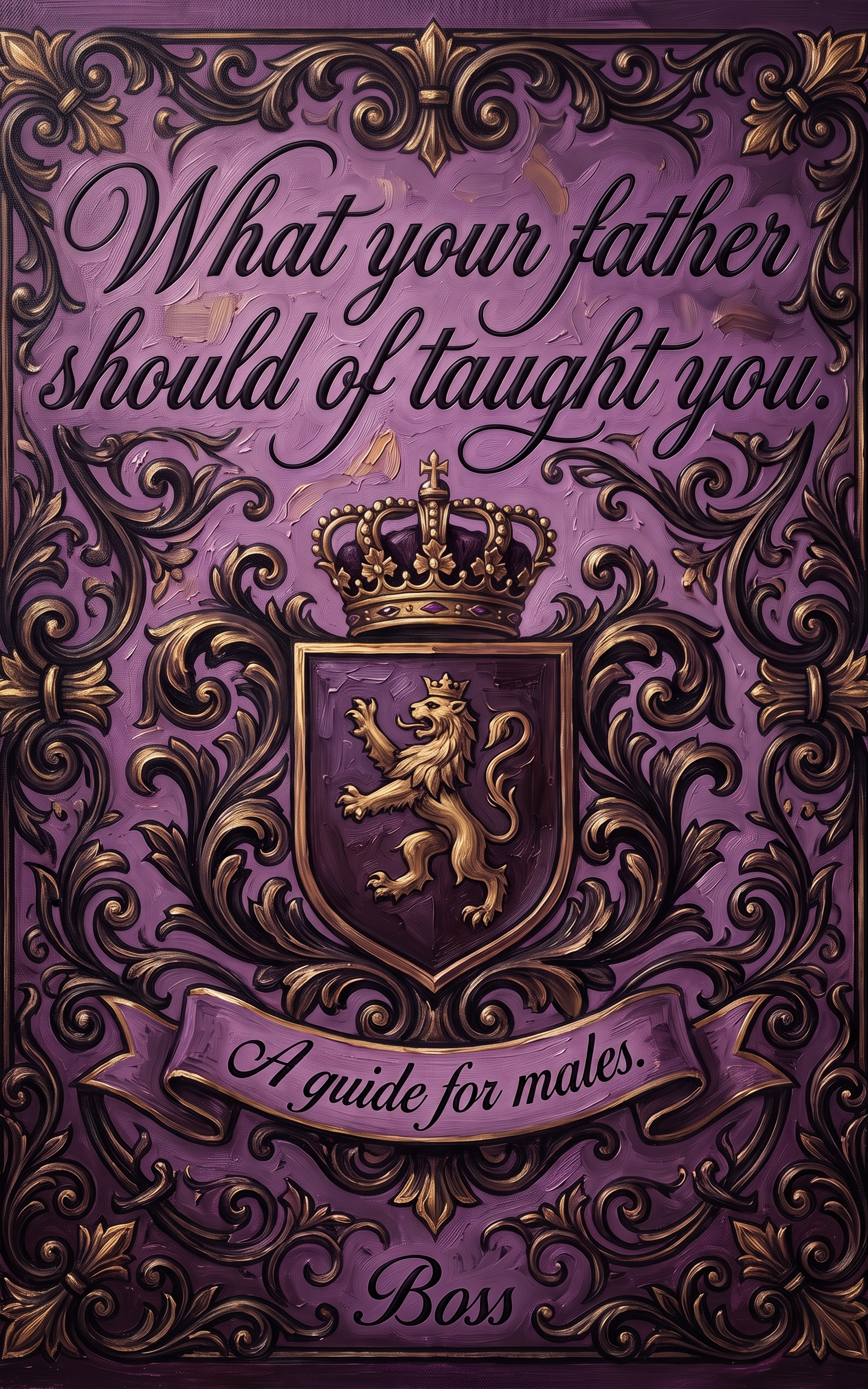
What your father should of taught you.
-A guide for males-.
by Boss
Modern society has forgotten what it means to be a man, leaving a generation of males to navigate the world without a compass. What Your Father Should Have Taught You is the essential manual for the man ready to step into his power as the King of his own life. This isn't just a guide; it is a restoration of traditional values for the modern age. Within these pages, you will discover the pillars of true masculinity: honor, integrity, and the art of self-sufficiency. Learn how to build a 'Kingdom' by defining and protecting the roles of your Queen, Prince, and Princess. Master the financial strategies required to generate generational wealth without the burden of interest or the necessity of traditional university degrees. From the Art of War to the intricacies of money management and law, author Boss provides the hard truths and practical skills every man needs to protect his legacy. Whether you are learning to navigate contracts, mastering survival skills, or exploring the power of a positive mindset, this book serves as the fatherly wisdom that has been missing for far too long. It is time to stop wandering and start leading. Your legacy begins here.
- Self-Help
- Business & Entrepreneurship
- Finance
- Instructional Guide
- Mindset & Motivation
- Productivity & Time Management
The Individual King: Mastering Honor and Integrity
The modern world is suffering from a quiet, devastating famine. It is not a lack of food, technology, or material wealth. It is a famine of character. Walk into any boardroom, scroll through any social media feed, or observe the average modern household, and you will see the wreckage of a society that has traded deep-seated virtue for cheap convenience. We live in an era where men are told that their value lies in their utility, their wealth, or their social media presence, while the state of their soul is completely ignored. This is a lie designed to keep you weak, dependent, and easily controlled. The truth is simple: a man who cannot govern his own character can never govern a business, a family, or a legacy. Before you can build a kingdom, you must first master the territory between your own ears. You must become an Individual King, and that mastery begins with two ancient, non-negotiable pillars: honor and integrity.
To the modern ear, the word "honor" sounds like a relic from a medieval museum, something associated with dusty suits of armor and long-forgotten battles. The world has redefined honor as reputation, fame, or social status. This is a dangerous misunderstanding. Reputation is merely what other people think you are; honor is who you actually are when you are entirely alone. It is your internal operating system, a rigid, self-imposed code of conduct that dictates your behavior when there is no audience, no praise, and no threat of getting caught. True honor is not a performance. It is a quiet, steady commitment to a standard of excellence that you demand of yourself, regardless of what the world around you is doing.
Historically, the "man of his word" was the cornerstone of any healthy civilization. In generations past, massive business transactions, peace treaties, and family alliances were sealed not with hundreds of pages of legal jargon, but with a firm handshake and a direct look in the eye. A man’s word was his bond, and to break that bond was to commit social and financial suicide. If you could not be trusted to keep your word, you were cast out of the marketplace and the community. Today, we have replaced this personal accountability with endless contracts, lawyers, and regulatory bodies, yet we are less secure than ever. We have more rules and less trust. To reclaim your masculinity, you must return to the standard of the ironclad word. When you make a promise, whether to your wife, your business partner, or yourself, it must be treated as a sacred oath. If you say you will do something, it must get done, even if it costs you time, money, or comfort. This level of reliability is the absolute prerequisite for any form of lasting success.
Integrity is the twin pillar to honor. The author C.S. Lewis famously wrote: "Integrity is doing the right thing, even when no one is watching." This definition is incredibly practical. Think of integrity as structural soundness. When we say a bridge has structural integrity, we mean that it can support weight, withstand storms, and remain firm under pressure because its internal design is solid and free of hidden flaws. A man of integrity is structurally sound. He does not have one set of values for his business partners, another for his wife, and a third for when he is traveling alone in a foreign city. He is integrated. He is the same man in the dark as he is in the light. This consistency is where your power comes from. When you are integrated, you do not waste mental energy maintaining lies, hiding secrets, or pretending to be someone you are not. You walk with a natural authority because you have nothing to hide.
The Kingdom Impact: Leading by Example
A man who lacks honor cannot lead a family. Leadership is not about giving orders, demanding respect, or asserting dominance through volume or physical strength. True leadership is about alignment and trust. Your family is your Kingdom, and a Kingdom cannot flourish if the King is unstable, dishonest, or self-serving. If you want your wife to trust your vision for your life together, she must have absolute faith in your integrity. A woman cannot fully rest or support a man’s mission if she is constantly wondering if he is lying to her, hiding money, or behaving inappropriately when he is out of her sight. When a husband is transparent, honest, and steady, he creates a psychological and emotional sanctuary. In that secure environment, his wife, the Queen, can thrive and step fully into her own role, knowing that her protector and provider is as solid as a mountain.
Furthermore, your children are constantly watching you. They do not learn their values from the lectures you give them; they learn them by observing how you live your daily life. They watch how you treat the waiter at a restaurant, how you react when you are cut off in traffic, and how you speak about your business associates behind their backs. If you tell your son to be honest, but he hears you lying to a client on the phone to save a few dollars, you have just taught him that survival requires dishonesty. You have broken his moral compass before he even has a chance to use it. A King’s primary duty to his heirs is to model the behavior he wishes them to inherit. When your children see you make difficult decisions that cost you short-term gain but preserve your honor, you are giving them a generational inheritance far more valuable than gold. You are teaching them how a man conducts himself in a chaotic world.
Consider the contrast between a household run by a man of honor and one run by a man of compromise. In the home of compromise, rules are arbitrary, promises are routinely broken with excuses, and tension hangs in the air because trust is absent. The children grow up anxious, manipulative, and insecure, preparing themselves to enter a world they believe is entirely hostile and untrustworthy. In the home of honor, there is peace. There is law, order, and predictability. The Queen knows her husband’s word is final because he has proven it over years of consistent action. The Princes and Princesses grow up with a deep sense of security and self-worth because they have a strong male role model who protects them not just from external physical threats, but from the moral decay of society. The trust within this Kingdom becomes an impenetrable shield against the outside world.
The Sovereign Code: A Tri-Fold Decision Matrix
To navigate the complex, often murky waters of modern business and social interactions, you need more than just good intentions. You need a reliable, repeatable framework for making decisions under pressure. This is where we introduce The Sovereign Code. This code is a daily decision-making model built around three critical questions. Whenever you are faced with a difficult choice, an ethical dilemma, or a temptation to cut corners, run the situation through this tri-fold matrix before you take action:
- Is it honest? This is the first and most fundamental filter. It requires you to look past the justifications, the corporate jargon, and the potential profits to ask if the action is entirely truthful. Does this transaction involve any deceit, omission, or misrepresentation? If the answer is no, you stop immediately. There is no amount of money or influence that can justify a compromise on truth.
- Does it strengthen my name? Your name is your primary asset. It is the brand that will outlive you and the legacy your children will carry. Ask yourself if the decision you are about to make will add value to your name or if it will tarnish it. If your business partners, your neighbors, or your children were to find out about this decision, would it elevate their respect for you, or would you have to explain it away with excuses? If an action weakens your name, it is a bad investment, no matter how profitable it seems in the short term.
- Does it protect my people? As a King, your role is protector. Your family, your employees, and those who rely on you are under your shield. You must evaluate whether your choices shield them from harm or expose them to unnecessary risk. If a business venture puts your family’s financial security at risk for a reckless gamble, or if a personal behavior threatens the stability of your home, you are failing in your duty to protect. Your decisions must build a wall of security around your people, not tear it down.
Let us look at a practical example of this framework in action. Imagine you own a contracting business, and a wealthy client offers you a lucrative project under the table. They want to pay you in cash, avoid pulling the necessary city permits, and have you bypass certain safety inspections to speed up the timeline. The profit margin is incredibly high, and the client assures you that no one will ever know. The average modern businessman, focused entirely on his bank account, would jump at this opportunity. But as a man of honor, you apply The Sovereign Code.
First, you ask: Is it honest? Bypassing permits and inspections is a violation of local regulations and a form of systemic deceit. It is dishonest. Second, you ask: Does it strengthen my name? If a structural issue arises in the future and it is discovered that you worked without permits, your professional reputation will be destroyed. Your name will be associated with shoddy, illegal work. It fails the second test. Third, you ask: Does it protect my people? By taking this risk, you expose your business to massive legal liabilities and potential lawsuits that could bankrupt you, directly threatening your family’s financial security. Furthermore, you are putting the client's family in physical danger by ignoring safety standards. The decision is clear. You look the client in the eye, politely decline the shortcuts, and state that your business operates strictly above board. You may lose that specific job, but you preserve your soul, your name, and your long-term security. That is how a King operates.
Modern Threats: The Culture of Convenience
We must be realistic about the environment we live in today. We are surrounded by a culture that actively discourages honor and integrity. We live in a society that worships convenience, speed, and immediate gratification. The prevailing message is that the ends always justify the means, and that success is measured solely by the size of your bank account, regardless of how you filled it. This culture of convenience has normalized the "white lie," the clever omission, and the strategic deception. We are told that minor dishonesties are harmless, that they are simply part of doing business or navigating modern relationships. This is a poisonous lie. Dishonesty is not a switch you can flip on and off. It is a slow, eroding acid that destroys your character from the inside out. Once you allow yourself to lie in small, low-stakes situations, you weaken your moral muscle, making it infinitely easier to compromise when the stakes are high.
The digital age has amplified these threats tenfold. The internet offers a level of anonymity and distance that did not exist in previous generations. It is incredibly easy to hide behind a keyboard, use a pseudonym, or manipulate data to present a false image of yourself to the world. This lack of accountability has created a breeding ground for cowardice and deceit. Men who would never have the courage to insult someone to their face will spend hours attacking people online behind anonymous profiles. Business owners will inflate their achievements, rent luxury cars for photo shoots to sell courses, and create entirely fabricated personas to secure sales. This digital masquerade is the opposite of masculinity. It is weak, fragile, and built on sand. A true man does not need a digital mask. He is willing to stand behind his words, his actions, and his face, taking full responsibility for everything he puts out into the world.
To resist these modern threats, you must develop a deep disgust for compromise. You must recognize that every time you tell a "small" lie, every time you cut a corner at work, and every time you look at something you shouldn't on your phone, you are chipping away at your own foundation. You are training yourself to be a coward. The world does not need more clever, slick, or opportunistic men who know how to game the system. The world is desperate for men who are solid, men who cannot be bought, men who are exactly who they claim to be. When you choose the path of rigid honor, you will immediately stand out. In a landscape of shifting sand, a man of stone becomes a landmark. People will seek you out, do business with you, and trust you with their most valuable assets because they know you are rare. Honor is not just a moral duty; it is the ultimate competitive advantage in a corrupt world.
Addressing the Counterargument: Is Flexibility Better?
There are those who will argue that this rigid adherence to honor is outdated, unrealistic, and actively harmful in the modern business environment. They will tell you that the market is a jungle, and that to survive, you must be flexible. They argue that if you refuse to lie, cheat, or cut corners, you will be eaten alive by competitors who have no such qualms. They point to corrupt politicians, dishonest corporate executives, and fast-talking influencers who have amassed fortunes through deception as proof that honor is for losers.
This argument is shortsighted and fundamentally flawed. It confuses temporary gain with permanent wealth. Yes, a dishonest man can make a quick fortune. He can use high-pressure sales tactics, misleading marketing, and cheap materials to generate massive short-term profits. But look closer at these empires built on deceit. They are incredibly fragile. They exist in a constant state of anxiety, always one whistleblower, one lawsuit, or one investigative report away from total collapse. The men who run them must constantly look over their shoulders, worrying about who they crossed, who is keeping track of their secrets, and when their past will catch up with them. This is not kingship; it is a gilded prison.
Long-term, multi-generational wealth is built entirely on one thing: trust. Trust is the currency of the marketplace. When a bank lends you money, when a partner enters a joint venture with you, or when a high-value client signs a long-term contract, they are making a bet on your character. If you have spent decades building a reputation for absolute integrity, your name becomes a premium brand. People will gladly pay more to work with you because they know they will not be cheated. When economic downturns hit and the market panics, capital flows to safety. It flows to the men who are known for their steady, honorable conduct. The "flexible" opportunists are the first to be abandoned when things get tough. Rigid honor is not a liability; it is the ultimate insurance policy for your legacy.
The Debt of Honor Audit
Before you can step forward into your role as an Individual King, you must clean up your past. You cannot build a clean house on a dirty foundation. This requires you to perform a Debt of Honor Audit. Most men are carrying a heavy, invisible burden of unfulfilled promises, unresolved conflicts, and outstanding moral debts. This baggage drains your energy, damages your self-esteem, and keeps you tethered to a lower version of yourself.
To perform this audit, take a piece of paper and write down the names of every person to whom you owe a favor, a word, an apology, or a debt. Be brutally honest with yourself. Have you borrowed money from a friend that you never repaid? Have you promised your wife that you would handle a household project but have been putting it off for months? Have you told a client you would follow up on an issue but ignored it hoping they would forget? These are all debts of honor, and they are leaking your power. Once you have compiled this list, your mission is to systematically resolve every single item on it. Call the friend and set up a payment plan. Apologize to the person you wronged. Finish the project you promised your wife. When you clear these debts, you will feel an immediate shift in your personal energy. You will stand taller, speak with more authority, and walk with the confidence of a man who owes nothing to anyone but respect.
Your Code of Conduct: The King's Rules
The final step in mastering your personal honor is to write down your personal code of conduct. This is not a vague list of aspirations; it is your personal constitution. It should contain five non-negotiable rules that govern your daily behavior, written in clear, direct language. Once written, this code should be placed where you can see it every single day—on your bathroom mirror, on your desk, or as the lock screen on your phone. It serves as a constant alignment tool, keeping you on track when the chaos of life threatens to pull you off course.
Here is an example of a personal King's Code to inspire your own:
- Rule 1: I speak only the absolute truth. I do not use white lies, exaggeration, or deceptive omissions to protect my ego or gain an advantage. My word is a contract.
- Rule 2: I protect my family first. Every decision I make in my business and personal life must preserve the physical, financial, and emotional security of my household.
- Rule 3: I take extreme ownership. I do not make excuses, blame others, or complain about my circumstances. If there is a problem in my life, my business, or my home, I am responsible for fixing it.
- Rule 4: I do not compromise for convenience. I choose the hard right over the easy wrong in every situation, regardless of the cost or who is watching.
- Rule 5: I finish what I start. If I commit to a project, a goal, or a relationship, I see it through to completion. I do not quit when it gets difficult.
Write your own code. Make it personal, make it challenging, and commit to it with everything you have. This code is your shield against the moral rot of the modern world. It is the foundation upon which your entire life, your business, and your kingdom will be built.
Implementation Checklist
To transition these principles from theory into daily practice, execute the following implementation plan immediately. Do not delay; the restoration of your character begins today.
- Perform the Debt of Honor Audit: Sit down with a pen and paper. List every unfulfilled promise, unpaid debt, or unresolved conflict from your past. Create a systematic plan to resolve at least one of these debts every week until the list is entirely cleared.
- Draft Your King's Code: Write down your five non-negotiable rules for personal conduct. Keep the language simple, direct, and actionable. Print this code out and place it in a prominent position where you will see it every morning before you face the world.
- Practice Total Honesty Today: Choose a low-stakes situation today to practice absolute, uncompromised honesty. If someone asks you a question, answer truthfully without softening the blow, exaggerating, or telling a polite white lie. Notice how it feels to speak the raw truth.
- Audit Your Inner Circle: Take a hard, analytical look at the men you spend the most time with. Do they gossip, lie to their wives, cheat in business, or mock traditional values? If your friends lack honor, they are slowly pulling you down to their level. You must distance yourself from men of compromise and seek out peers who hold themselves to a higher standard.
- Establish a Weekly Reflection Review: Set a recurring alarm on your phone for Sunday evening. Spend fifteen minutes in quiet reflection, reviewing your weekly actions against your personal King's Code and The Sovereign Code. Identify exactly where you fell short, take ownership of the failure, and determine how you will correct it in the upcoming week.
The path of honor is not the easy path. It is a steep, rugged climb that will require you to sacrifice your comfort, your pride, and occasionally your immediate financial gain. But it is the only path that leads to true, unshakeable power. A man who has mastered his own character is a force of nature. He cannot be bribed, he cannot be intimidated, and he cannot be broken. He is a King in his own right, ready to build a kingdom that will stand for generations. Stand tall, speak the truth, keep your word, and protect your name. Your family is waiting for you to lead.
The Art of War and Social Navigation
The transition from mastering your own character to navigating the external world is where many men falter. It is one thing to maintain your honor in the quiet safety of your own mind; it is an entirely different challenge to preserve it in the crowded, competitive, and often hostile marketplace of human interaction. The world is not a gentle playg…