

Alfred Hitchcock explained the difference between surprise and suspense with a simple thought experiment. Two people sit at a table talking. A bomb explodes. That is surprise—fifteen seconds of shock. But show the audience the bomb under the table at the start of the scene, then let the two people talk about baseball for five minutes, and every word becomes unbearable. That is suspense. Every technique in this guide flows from that principle: let the reader know more than they wish they did, then make them wait.
What Makes a Thriller Thrilling
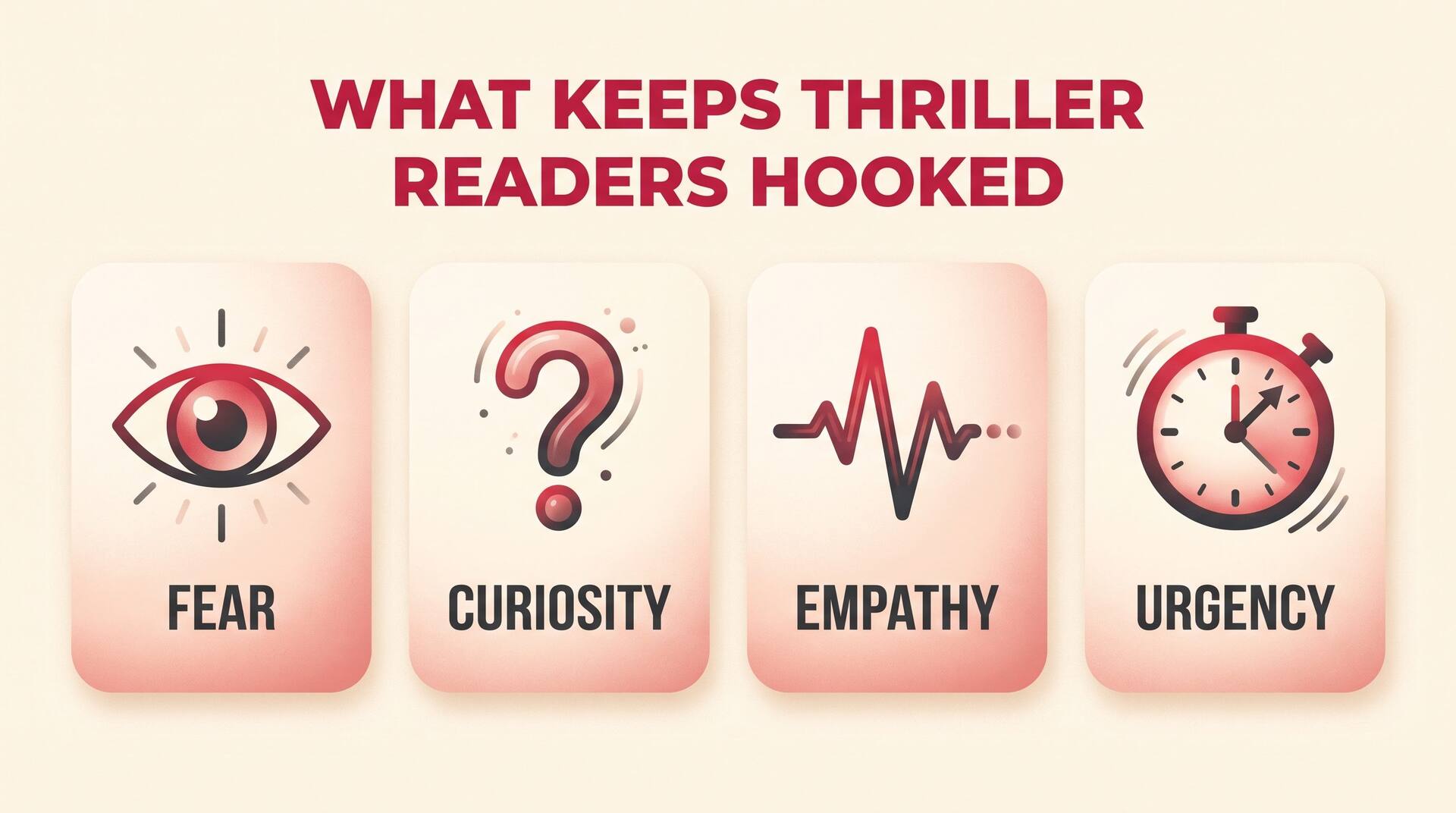
Thrillers work because they hijack the reader's nervous system. Understanding the psychology behind suspense makes you a better architect of tension.
The Threat Must Be Credible
Readers need to believe the danger is real and the consequences are irreversible. Vague threats create vague tension. A ticking bomb with a visible timer creates dread because the reader understands exactly what failure means. Specificity is the engine of fear.
Information Asymmetry Creates Dread
When the reader knows the killer is in the house but the protagonist does not, every footstep becomes a heartbeat. Hitchcock's bomb-under-the-table principle relies entirely on giving the audience knowledge the characters lack. The gap between what the reader knows and what the character knows is where suspense lives.
Empathy Multiplies Stakes
Technical danger without emotional investment creates action, not suspense. The reader must care about the person in jeopardy. Before you put your protagonist in danger, make the reader love them, understand them, or at minimum, need to know what happens to them.
Uncertainty Sustains Tension
If the reader is certain the hero will survive, suspense collapses. The best thrillers establish early that no one is safe. Kill a sympathetic character in the first act. Let the protagonist fail. Once readers understand that outcomes are genuinely uncertain, every scene carries weight.
Thriller Subgenre Explorer
Thrillers span a vast landscape from courtrooms to war rooms. Each subgenre has distinct conventions, pacing expectations, and reader demands. Knowing your subgenre helps you deliver the specific brand of tension your audience craves.
Psychological Thriller
The battleground is the mind. Unreliable narrators, gaslighting, paranoia, and the slow erosion of a character's grip on reality. The threat is often intimate—a spouse, a neighbor, a friend. The reader questions everything, including their own assumptions.
Unreliable narrators, domestic settings, slow-burn tension, major twists, character-driven suspense
Gone Girl by Gillian Flynn, The Silent Patient by Alex Michaelides, Behind Closed Doors by B.A. Paris
Readers want to be deceived. They expect at least one reality-shifting twist and a protagonist whose perspective cannot be fully trusted.
Pacing Mechanics: The Relentless Clock
Pacing in a thriller is not about speed. It is about control. You accelerate and decelerate with purpose, creating a rhythm that keeps the reader off-balance and unable to find a safe place to stop reading.
The Thriller Pacing Formula
Great thriller pacing follows a pattern: tension, escalation, brief release, higher tension. Each cycle peaks higher than the last, like a ratchet that only turns one direction. The reader gets moments to breathe, but the baseline anxiety never fully drops.
Opening Hook
Establish threat within the first chapter. A body, a disappearance, an impossible demand. The reader should understand the stakes before page 30.
Rising Pressure
Each chapter introduces a complication that makes the situation worse. New information that reframes everything. Allies who cannot be trusted. Deadlines that shrink.
False Summit
Around the midpoint, let the protagonist think they have a solution. Then destroy it. This false resolution raises stakes because the reader now knows the obvious answer does not work.
Darkest Point
Strip the protagonist of resources, allies, and hope. The reader should genuinely wonder how survival is possible. This is where you earn your climax.
Climactic Cascade
The final act is a controlled avalanche. Revelations stack. Actions have immediate consequences. Chapters shorten. Sentences tighten. The reader physically cannot stop.
The Thriller Tension Curve
Hook
Build
False Peak
Collapse
Darkest Pt
Climax
Stakes Escalation Framework
Stakes are what the protagonist stands to lose. In thrillers, stakes must escalate relentlessly. The framework below shows how to layer personal, local, and global consequences so every chapter feels more urgent than the last.
Personal Stakes
The protagonist's life, freedom, relationships, or identity. These are the most emotionally grounded stakes. A mother trying to protect her child. An agent whose cover identity is cracking. Start here because readers connect to individual human cost before anything else.
Local Stakes
The community, institution, or group surrounding the protagonist. A hospital under siege. A small town harboring a killer. A corporation covering up a lethal product. Local stakes make the danger feel systemic—the protagonist is not just saving themselves but everyone around them.
Global Stakes
Nations, populations, civilization itself. A pandemic, a nuclear threat, an AI that cannot be contained. Global stakes provide scale, but they only work if personal and local stakes anchor them. The reader cares about saving the world because they care about saving this one person first.
The Golden Rule of Escalation: Never let stakes decrease. Once a threat has been introduced, it can only get worse, get closer, or multiply. If your protagonist defuses one bomb, two more appear. If they save one hostage, the villain takes three. The ratchet turns only forward.
Six Proven Tension Techniques
These are the specific mechanical techniques that thriller writers use to generate and sustain tension across hundreds of pages.
The Ticking Clock
Impose a deadline. The bomb detonates at midnight. The trial begins Monday. The virus becomes airborne in 48 hours. A visible countdown converts abstract danger into moment-by-moment urgency. The reader counts down alongside the protagonist.
In 24 by Joel Surnow, the entire premise is a ticking clock. Each episode covers one hour, and the audience feels every minute slipping away.
The Dramatic Irony Trap
Show the reader what the protagonist cannot see. The reader watches the antagonist set a trap, then must endure the protagonist walking toward it. This is Hitchcock's bomb under the table at its purest—the reader becomes a helpless witness.
Thomas Harris uses this relentlessly in The Silence of the Lambs. The reader knows Hannibal Lecter is manipulating Clarice, and the tension comes from watching her navigate his games while partially blind to his true motives.
The Impossible Choice
Force the protagonist into a dilemma where every option has devastating consequences. Save the hostage or catch the villain. Tell the truth and endanger the mission, or lie and lose the one person they trust. Impossible choices generate tension because there is no relief—only trade-offs.
In Sophie's Choice by William Styron, the central impossible choice is so devastating that it defines the entire novel and remains unbearable decades after publication.
The Unreliable Ally
Give the protagonist a partner or ally whose loyalty is uncertain. Every piece of information they share might be true, might be a trap. The reader constantly evaluates: is this person helping or leading the protagonist to destruction?
In The Departed, every character is simultaneously an ally and a threat. The audience spends the entire film recalculating who will betray whom first.
The Shrinking Safe Space
Systematically eliminate the protagonist's places of safety. Their home is compromised. Their office is bugged. The police are corrupt. Friends are threatened. As safe spaces disappear, the protagonist—and reader—feel increasingly trapped.
In No Country for Old Men, Cormac McCarthy strips Anton Chigurh's prey of every possible refuge. Motels, hospitals, even the protagonist's own home—nowhere is safe.
The Information Cascade
Release critical information in rapid succession during climactic sequences. Short chapters. One-line paragraphs. Revelations that reframe everything the reader thought they knew. The reader's brain cannot process fast enough, creating a breathless, out-of-control sensation.
Dan Brown's chapter structure in The Da Vinci Code uses rapid cuts between storylines, each ending on a revelation, creating a cascade effect that makes the book famously unputdownable.
Creating Unforgettable Villains
A thriller is only as good as its antagonist. The villain defines the threat, sets the pace, and determines how high the stakes can climb. A weak villain produces a weak thriller regardless of how good your protagonist is.
The Mirror Villain
The most compelling villains reflect the protagonist's own qualities twisted to dark purposes. They share intelligence, determination, or skill but apply them without moral restraint. The protagonist fights not just an enemy but a version of what they could become. Hannibal Lecter mirrors Clarice's brilliance. Moriarty mirrors Holmes.
The Ideological Villain
A villain who believes they are right is more terrifying than one who knows they are wrong. Give your antagonist a philosophy, a grievance, a worldview that makes their actions feel logical from their perspective. Thanos believes he is saving the universe. The reader should understand—even while being horrified—why the villain acts.
The Competent Villain
Nothing deflates a thriller faster than a villain who makes stupid mistakes. Your antagonist should be at least as intelligent and resourceful as your protagonist, ideally more so. The reader should genuinely worry that the villain might win. Every plan the protagonist makes, the villain should anticipate or adapt to.
The Invisible Villain
Some of the best thrillers keep the antagonist offscreen for most of the story. The villain is a presence felt through their effects—bodies left behind, traps sprung, messages received. When you finally reveal them, the accumulated dread makes the encounter electric. Keyser Soze in The Usual Suspects barely exists as a character until the moment that redefines the entire film.
Writing Action Scenes That Pulse
Action scenes in thrillers are not fight choreography—they are tension released through motion. Every action scene must advance the plot, reveal character, and raise stakes simultaneously.
Short Sentences, Shorter Paragraphs
When action starts, prose contracts. Sentences drop to five words. Paragraphs become one line. White space increases. The visual rhythm of the page mimics the urgency of the moment. The reader's eye moves faster. Their breathing quickens. This is prose as a physical experience.
Sensory Overload, Then Focus
Open an action sequence with a barrage of sensory detail—the screech of tires, the smell of cordite, the flash of muzzle fire. Then narrow to a single point of focus: the protagonist's hand reaching for the door handle. The contrast between chaos and focus mirrors how the human brain processes crisis.
Cost Every Victory
If your protagonist escapes a firefight unscathed, the reader learns that action scenes are safe and stops feeling tension. Every victory should cost something: an injury, a lost ally, expended resources, revealed position. The protagonist can win the fight but must pay for it.
Geography Matters
The reader must understand the physical space of the action. Where are the exits? What is between the protagonist and the threat? What can be used as cover, as a weapon, as an escape route? Confused geography creates confused readers. A brief, clear establishment of space before the action starts makes everything that follows visceral and trackable.
Turn Your Thriller Idea Into a Manuscript
AIWriteBook helps thriller writers build airtight plots, maintain pacing across chapters, and track the complex timelines that suspense demands.
Thriller Tension Checklist
Use this interactive checklist to audit your thriller manuscript for tension, pacing, and stakes.
AI Tools for Thriller Writers
AI is an ideal collaborator for the structural demands of thriller writing, where timeline consistency, pacing rhythm, and plot logic must be airtight across hundreds of pages.
- Map complex plot timelines with multiple character threads to catch continuity errors
- Generate antagonist profiles with layered motivations and credible threat capabilities
- Test pacing rhythm by analyzing chapter length, cliffhanger placement, and tension curves
- Brainstorm escalation sequences where each complication raises stakes beyond the previous one
- Verify that planted clues, foreshadowing, and reveals are consistently placed across the manuscript
AI can build the scaffolding of a thriller—the timeline, the logic, the structural beats. But the gut-punch moments that make readers gasp aloud? Those come from your instinct for what terrifies people. Use AI as your structural engineer, not your creative director.
Start Writing Your Thriller
A thriller is a machine built to create one specific effect: the inability to stop reading. Every technique in this guide—pacing, stakes escalation, tension mechanics, villain construction—serves that single purpose. Master these fundamentals and your reader will miss their subway stop, stay up past midnight, and tell everyone they know to read your book.
Begin with the bomb under the table. Then make the conversation unbearable. That is the entire craft of thriller writing, and you now have the tools to do it.