

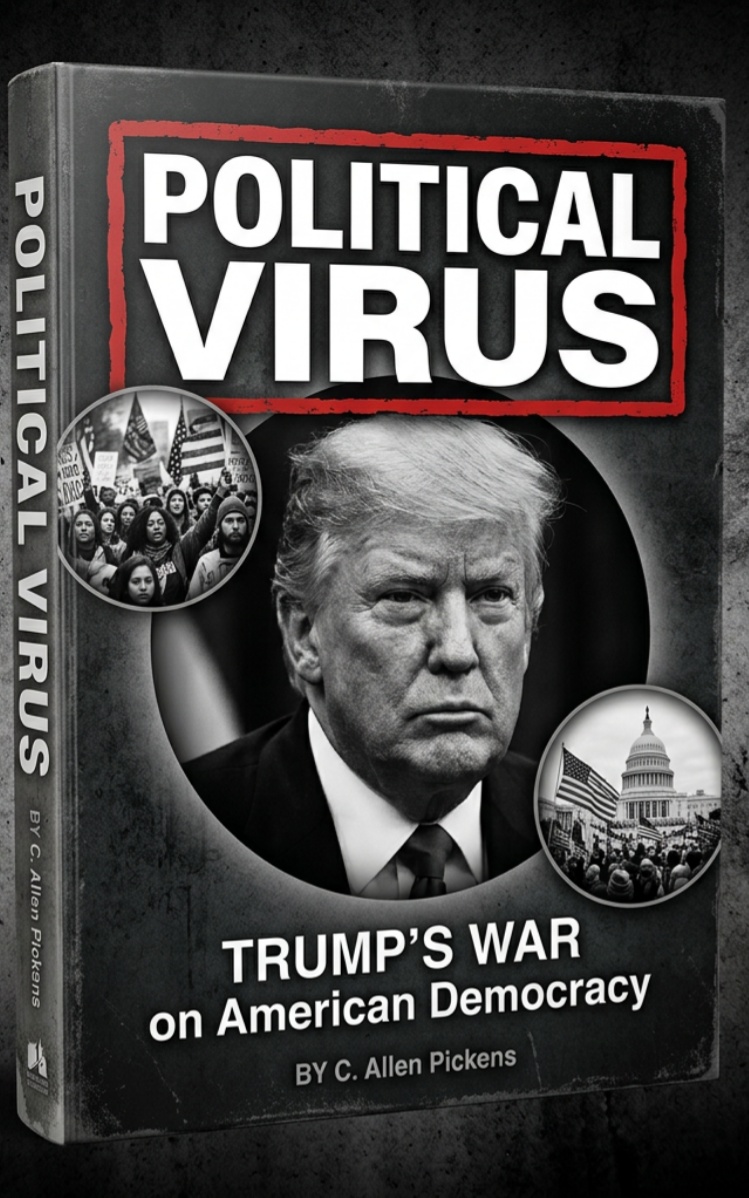
Political Virus - Trump's War On American Democracy
Trump's War On American Democracy
by C. Allen Pickens
American democracy stands at a perilous crossroads. In Political Virus, political historian C. Allen Pickens delivers a searing, meticulous critique of the systematic breakdown of democratic norms, institutional checks, and electoral integrity in modern America. From the unprecedented incitement of the January 6th Capitol insurrection to the calculated weaponization of populist media echo chambers, this book dissects how autocratic strategies have infiltrated the highest levels of governance. Pickens traces the dangerous centralization of executive authority, exposing the mechanics of voter suppression, the erosion of free press protections, and the political manipulation of federal justice. Moving beyond mere critique, he analyzes forward-looking authoritarian blueprints like Project 2025 and executive restructuring efforts that threaten civil society at its core. Uncompromising yet profoundly constructive, Political Virus offers more than a diagnosis of systemic decay—it provides a vital roadmap for civic renewal, urging citizens to embrace media literacy, local engagement, and constitutional accountability before the democratic experiment is irrevocably transformed.
- Historical Non-Fiction
- Educational & Academic
- Politics
- Government
- Political History
- American History
Attack on our most Sacred Institutions
"America will never be destroyed from the outside. If we falter and lose our freedoms, it will be because we destroyed ourselves.” - Abe Lincoln
Abraham Lincoln stood before the Young Men's Lyceum in Springfield, Illinois, in 1838 and posed a question that still echoes down the corridors of our history. He asked where an American military giant might come from to destroy us. His answer was as clear as it was chilling. "Shall we expect some transatlantic military giant to step the ocean and crush us at a blow? Never! All the armies of Europe, Asia, and Africa combined... could not by force take a drink from the Ohio or make a track on the Blue Ridge in a trial of a thousand years." Lincoln then delivered the truth we must confront today: "At what point then is the approach of danger to be expected? I answer: If it ever reach us it must spring up amongst us; it cannot come from abroad. If destruction be our lot we must ourselves be its author and finisher. As a nation of freemen we must live through all time or die by suicide."
Those words felt like a distant warning for most of my life. I grew up believing our democratic guardrails were made of reinforced steel, and that our shared reverence for the Constitution would shield us from internal ruin. But on January 6, 2021, that innocence was shattered forever. We watched in horror as American citizens attacked our own Capitol, driven by manufactured grievances and explicit lies. The danger Lincoln warned about was no longer theoretical. It was marching down Pennsylvania Avenue with gallows in tow.
The events of that cold January morning were not a spontaneous outburst of political passion. They were the calculated climax of a months-long campaign to overturn a free and fair election. Hours before the breach, thousands gathered near the White House for the "Save America" rally. The rhetoric coming from the stage was not political discourse. It was an explicit call to arms. Donald Trump Jr. warmed up the crowd by firing a shot at faint-hearted Republicans, declaring, "This isn't their Republican Party anymore! This is Donald Trump's Republican Party!" He warned lawmakers that "we're coming for you" if they failed to block the electoral certification.
Rudy Giuliani took the stage shortly after and escalated the rhetoric to a historical absurdity. "Let's have trial by combat!" he shouted to an increasingly angry crowd. And then came the President himself. For over an hour, Donald J. Trump hammered away at the legitimacy of our democratic process. He repeated debunked claims of stolen ballots and fraudulent voting machines. He directed his supporters' anger straight at the Capitol, telling them, "If you don't fight like hell, you're not going to have a country anymore." He told them to march down to the Capitol to give weak Republicans "the kind of pride and boldness that they need to take back our country."
What followed was a direct assault on the heart of our republic. The mob marched from the Ellipse to the Capitol Grounds, quickly overpowering an outmatched Capitol Police force. They smashed windows, forced open doors, and hunted through the hallways for the Vice President and the Speaker of the House. This was not a random riot. It was a coordinated attempt to stop both Houses of Congress from performing their constitutional duty of certifying the electoral votes. For the first time in our nation's history, the peaceful transfer of power was interrupted by violence, orchestrated by a sitting American president who could not accept defeat.
The Deepening Betrayal
The conspiracy to overturn the 2020 election ran far deeper than the angry mob outdoors. It had tentacles stretching into the halls of Congress and state legislatures across the country. In the weeks leading up to January 6, loyalists pressed state officials to discard certified vote totals. When those officials refused, political operatives organized unauthorized "audits" designed to cast doubt on legitimate results. They created slates of fake electors in key battleground states, trying to force a constitutional crisis that would keep the defeated president in office.
The immediate aftermath of the attack offered a brief moment when truth might have prevailed. Lawmakers on both sides of the aisle expressed genuine horror at what had occurred. Yet, that moral clarity melted away almost immediately under the heat of political cowardice. House Minority Leader Kevin McCarthy initially acknowledged that the President bore responsibility for the attack. But within weeks, McCarthy traveled to Mar-a-Lago to repair his standing with Trump. He then led the opposition against creating a bipartisan, 9/11-style commission to investigate the insurrection.
McCarthy's about-face signaled a dangerous shift in the Republican establishment. By opposing an independent investigation, party leadership chose short-term political survival over the long-term health of our republic. They normalized political violence and turned a dark day of national shame into just another partisan wedge issue. This refusal to confront the truth deepened our national polarization and sent a clear message: loyalty to one man mattered more than fidelity to the Constitution.
This systemic cowardice did not emerge overnight. It was the predictable outcome of four years of Republican leaders failing to hold Trump accountable for his continuous attack on public truth. The pattern was set on day one of his administration. White House officials forced government agencies to lie about the size of his inauguration crowd, demanding that the public disbelieve their own eyes. Year after year, establishment Republicans looked the other way as the President attacked the free press, undermined the intelligence community, and praised foreign dictators. Each uncorrected lie laid the foundation for the massive falsehood that fueled the January 6 attack.
Against this backdrop of party capitulation, small acts of institutional courage stood out. In the early morning hours of January 7, after the Capitol was cleared of invaders, Vice President Mike Pence, Speaker Nancy Pelosi, and Senate Majority Leader Mitch McConnell reconvened Congress. Working through the night among shattered glass and vandalized offices, they completed the certification of Joe Biden's election victory at 3:00 a.m. Pelosi and McConnell demonstrated that the basic mechanisms of American government could withstand physical violence, even if only by a thread.
Yet, the rot within the legislative branch remained obvious. Even after the violence and the destruction, over one hundred House representatives voted to object to the election results in key states. They chose to validate the fabrications of the mob rather than honor the certified results of their own states' voters. They traded their oath of office for political favor within a compromised party apparatus.
A few conservative leaders did refuse to participate in the lie. Senator Lisa Murkowski of Alaska spoke out forcefully, demanding that Trump resign for his role in the attack. Representative Liz Cheney of Wyoming delivered an unsparing assessment of the President's actions:
"Much more will become clear in coming days and weeks, but what we know now is enough. The President of the United States summoned this mob, assembled the mob, and lit the flame of this attack. Everything that followed was his doing. None of this would have happened without the President. The President could have immediately and forcefully intervened to stop the violence. He did not. There has never been a greater betrayal by a President of the United States of his office and his oath to the Constitution."
Cheney paid an immediate political price for her integrity. Her Republican colleagues purged her from House leadership and actively supported a primary challenger to drive her from office. Her political exile demonstrated the total control Trump maintained over the party machinery. Standing up for the rule of law had become a political death sentence within the modern GOP.
The Mechanics of Radicalization
The attack on the Capitol highlighted a disturbing failure within our national security and law enforcement agencies. Reports from the FBI and investigative journalism outlets revealed potential "inside job" assistance. Investigators looked into off-duty military personnel, police officers, and members of Congress who allegedly conducted unauthorized "reconnaissance tours" for groups of rioters the day before the attack. The thought that elected officials and sworn law enforcement officers may have aided an insurrection against their own government shows how deep the institutional rot had spread.
To understand how millions of Americans came to support an attack on their own democracy, we must examine the conspiracy theories that fueled their anger. Chief among these was QAnon—a disproven far-right movement alleging that a cabal of Satan-worshipping pedophiles runs a global sex-trafficking ring while plotting against Donald Trump. What started as obscure internet forum posts quickly evolved into a movement that federal prosecutors and law enforcement agencies formally designated as a domestic terror threat and a dangerous cult.
QAnon served as a potent political weapon, convincing believers that traditional democratic processes were inherently corrupt and that extreme actions were required to save the nation. On January 6, QAnon symbols, t-shirts, and flags were visible throughout the crowd, carried by individuals who believed they were participating in a righteous struggle against an evil deep state.
The rapid rise of this movement highlights Trump's extraordinary radicalization power. With over eighty million followers across his social media platforms, he possessed an unprecedented direct line to the American public, bypassing traditional media filters to validate baseless theories and direct his audience's anger toward specific targets. While 1990s militia radicalization relied on underground cassette tapes, printed newsletters, and secretive gun-show gatherings, today's digital ecosystem operates at light-speed with algorithmic amplification. Yet, the core psychological mechanics remain striking: both eras fed disaffected citizens a steady diet of anti-government rhetoric until they became convinced that violence was the only viable political response.
This dynamic accelerated the spread of systemic tribalism across American society. Millions of citizens began prioritizing comfortable lies over uncomfortable facts. Political identity replaced shared civic values, turning neighbors into political enemies. The hyper-partisan media ecosystem seized on this divide, monetizing rage and creating separate realities for different audiences. Within these echo chambers, loyalty to the tribe became more important than preserving democratic institutions.
This political tribalism merged with a dangerous wave of white nationalism. The January 6 attack made this alliance plain for all to see. Extremist groups like the Proud Boys and Oath Keepers marched alongside ordinary citizens, wearing anti-Semitic clothing and carrying Confederate flags through the Capitol rotundas—a sight that not even the Confederate Army achieved during the Civil War. The political leadership of the far right welcomed these elements into the mainstream, leveraging racial resentment and grievance to build a devoted political army.
The Administrative Decay
The violence of January 6 was an overt attempt to break American democracy. But the quiet erosion of institutional norms that followed over the subsequent years proved just as destructive. By 2026, during the second Trump administration, the strategy shifted from storming the gates to eroding the civil service from within. Checks and balances depend entirely on executive officials following established bureaucratic processes. When those channels are bypassed or destroyed, executive power becomes unchecked and arbitrary.
Consider the experience of a mid-level civil servant working at a federal regulatory agency during this period. For fifteen years, this career professional reviewed infrastructure permits, ensuring projects met legal standards for environmental safety and structural integrity. Under the revived administration, political appointees bypassed standard review processes entirely, instructing career staff to approve high-value contracts and permits for political donors without completing mandatory legal evaluations.
When this official raised concerns about federal compliance laws, political supervisors made their position clear: sign off on the permits or face immediate reclassification under revised executive orders, followed by termination. The message was unmistakable. Expertise, legal precedent, and public safety were secondary to executive will. These bureaucratic protocols are not redundant red tape; they are the invisible shields that protect the public from corruption and abuse of power. Dismantling them laid the direct groundwork for broader executive initiatives designed to centralize control over federal spending.
This push for administrative control took explicit shape through executive initiatives designed to dismantle the professional civil service. Chief among these was the creation of the Department of Government Efficiency, commonly referred to as DOGE. Marketed to the public as a bold effort to cut federal waste and lower taxes, DOGE acted as a mechanism to dismantle regulatory oversight and centralize executive control over federal spending.
DOGE bypassed standard congressional oversight to force sweeping, indiscriminate cuts across key federal operations. The results were immediate service disruptions, operational backlogs, and a rapid decline in public trust. By replacing career subject-matter experts with political loyalists, the department dismantled essential public services under the guise of fiscal management.
The structural damage caused by DOGE extended far beyond administrative inconvenience. The initiative disrupted over $10 billion in essential economic activity by freezing federal grants, delaying infrastructure project approvals, and stalling routine regulatory clearances. Businesses across the country faced uncertainty as long-standing administrative procedures dissolved overnight. The operational chaos destabilized critical public services, affecting several vital departments:
- Department of Education: Deep cuts to federal funding streams paralyzed public school districts, halted student loan processing systems, and eliminated oversight offices responsible for protecting students' civil rights.
- Department of Health and Human Services (HHS): Massive lay-offs of scientific researchers and policy personnel stalled public health monitoring, delayed medical approvals, and compromised safety inspections for food and pharmaceuticals.
- Social Security Administration (SSA): Staff reductions and office closures generated historic backlogs, delaying benefit payments to millions of elderly and disabled Americans who rely on those funds for daily survival.
- General Services Administration (GSA): The cancellation of long-term federal contracts left public buildings unmaintained, disrupted secure communications infrastructure, and compromised federal procurement security.
- United States Agency for International Development (USAID): The sudden suspension of foreign aid contracts weakened key diplomatic partnerships, abandoned global health programs, and opened the door for rival foreign powers to expand their influence in critical regions.
- Federal Emergency Management Agency (FEMA): Budget cuts and severe workforce reductions left emergency response teams unprepared, delaying natural disaster relief to communities facing severe weather events.
This targeted dismantling of public infrastructure was not about saving taxpayers money. It was about destroying the professional civil service so that no independent authority remained to challenge executive power. When public agencies can no longer function, citizens lose faith in the idea of self-governance altogether.
The Assault on Legal and Legislative Foundations
Alongside the destruction of the executive bureaucracy came a sustained attack on the judicial branch. The legal system relies on the public's confidence in judicial neutrality. When political leaders attack that neutrality, the rule of law collapses. Throughout his terms in office, Trump waged a continuous public campaign against federal judges who ruled against his policy agendas or legal challenges.
He publicly insulted judges, questioning their integrity based on their ethnic background or the political party of the president who appointed them. This public harassment had real-world consequences. Judges, their families, and court staff faced an unprecedented wave of threats and intimidation from political extremists. When political leaders target individual jurists, they signaled to their followers that judicial decisions were illegitimate unless they favored their political tribe.
This tactic created a chilling effect throughout the legal system. Judges were forced to evaluate high-profile political cases under the constant threat of public exposure, harassment, and violence. By eroding respect for the courts, the executive branch undermined the judiciary's ability to act as an independent check on presidential authority. A society where judicial rulings are enforced only when convenient for the executive is no longer a constitutional republic.
Simultaneously, the administration worked to undermine the legislative power of Congress, particularly its exclusive constitutional authority over federal spending. The clearest early example of this tactic occurred during the 2018–2019 government shutdown over border wall funding. When Congress explicitly refused to allocate public funds for the wall, the President initiated the longest partial government shutdown in American history, holding hundreds of thousands of federal workers hostage to his political demands.
When Congress held firm, the President bypassed the legislative branch entirely by declaring a national emergency along the southern border. He diverted billions of dollars from appropriated military construction projects to fund the wall construction. This executive maneuver bypassed the power of the purse—the foundational legislative check established by the Framers of the Constitution. By overriding congressional funding decisions through executive declarations, the administration established a dangerous precedent: a president can simply declare an emergency to spend public funds without legislative approval whenever Congress refuses to yield.
These institutional attacks alter daily life for ordinary citizens, leading professionals to self-censor and leaving public space open to authoritarian pressure.
Restoring our republic demands active local engagement and dedicated civic participation from every citizen.
- Support Independent Local Journalism: National media outlets often amplify partisan outrage for profit. Local newspapers and non-profit reporting outlets expose municipal corruption, monitor local election boards, and hold regional leaders accountable. Subscribe to local news sources and fund investigative journalism in your community.
- Attend Local Public Hearings: Democracy is defended in city hall meetings, school board assemblies, and county commission hearings. Show up to these meetings, ask hard questions of your elected officials, and demand transparency in local governance. Authoritarian movements gain ground when local institutions are left unmonitored.
- Protect and Defend Civil Service Protections: Support legislation at both state and federal levels that preserves a professional, non-partisan civil service based on merit rather than political patronage. Contact your representatives and demand an end to executive efforts that transform public servants into political loyalists.
- Participate directly in Election Administration: Sign up to serve as a non-partisan poll worker or election judge in your precinct. The integrity of our elections depends on ordinary citizens managing voting sites, counting ballots transparently, and securing public trust in the final results.
As Lincoln warned, our fate rests in our own hands. We must step forward now to reclaim our constitutional promise.
How Quickly We Forgot - Trump's 2020 Pandemic Disaster
“When historians in the future ask a really old version of me about this pandemic, I’m gonna tell them that Trump’s MAGA minions were the only ones who had no idea what was happening, while the rest of America stared into the abyss.”― Oliver Markus MalloyAuthor Oliver Markus Malloy once wrote about the collective blindness of MAGA supporters during…