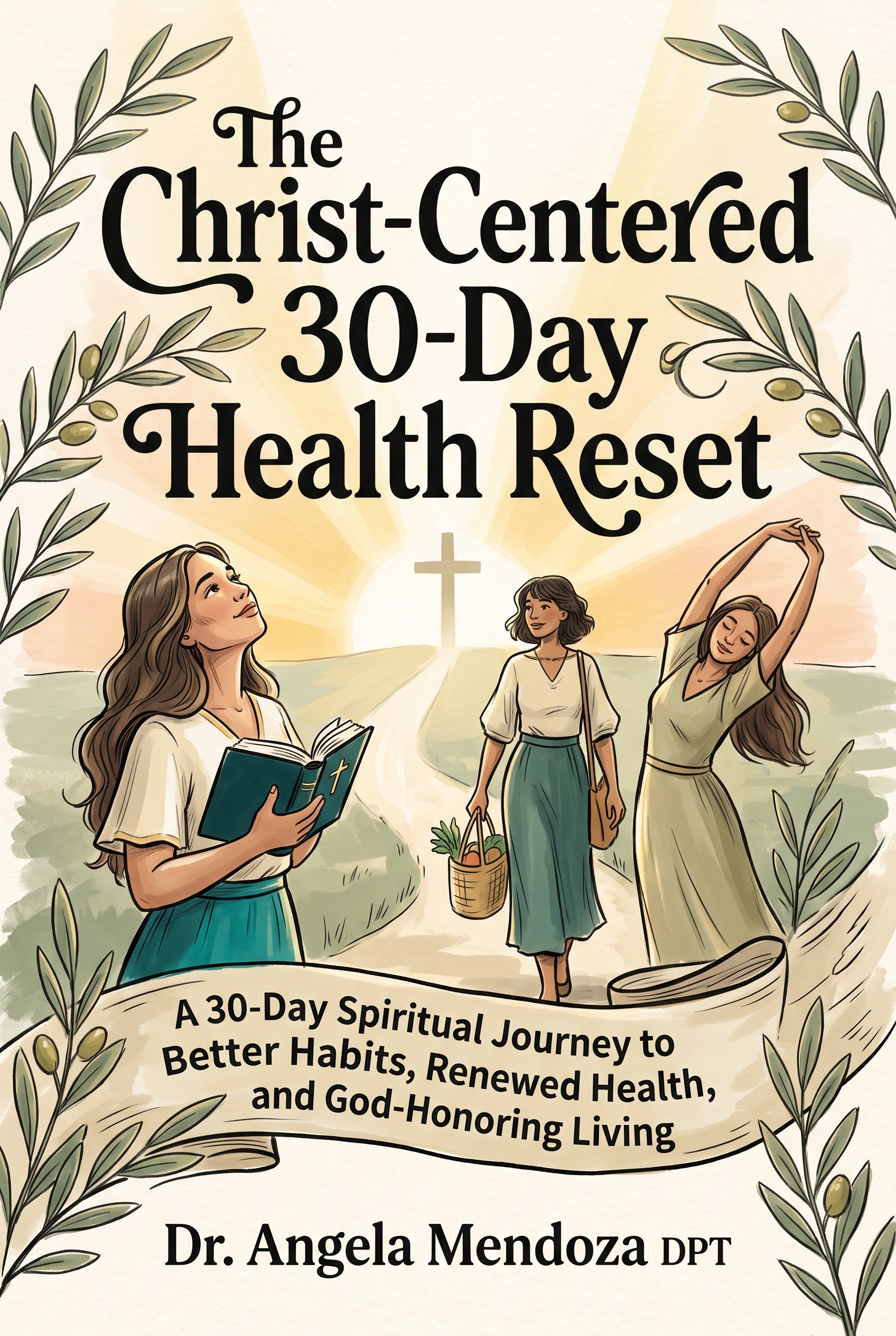
The Christ-Centered 30-Day Health Reset
A 30-Day Spiritual Journey to Better Habits, Renewed Health, and God-Honoring Living
by Angela Mendoza
Stop fighting your body and start honoring your Creator. Are you tired of the endless cycle of guilt, overwhelm, and short-lived resolutions? Secular diet culture often leaves us feeling defeated, focusing on rigid rules rather than lasting transformation. But what if health wasn't a burden to carry, but an act of worship to offer? In The Christ-Centered Health Reset, Dr. Angela Mendoza invites you on a 30-day journey to reclaim your well-being. This isn't just another fitness plan; it's a spiritual realignment. By blending evidence-based lifestyle medicine with the timeless wisdom of Scripture, Dr. Mendoza helps you build sustainable rhythms that nourish your body, mind, and soul. Over the next month, you will discover how to move away from shame and toward grace. Each day provides a manageable 'reset habit'—from mindful nutrition and functional movement to restorative sleep and mental renewal—designed to fit into your busy life. Whether you are a beginner or looking to deepen your stewardship, this guide offers the practical tools and biblical encouragement you need to thrive. Experience the peace that comes when Jesus is at the center of your health. Your journey to a stronger, more vibrant life starts here.
- Wellness & Fitness
- Religion & Spirituality
- Self-Help
- Instructional Guide
- Mindset & Motivation
- Work-Life Balance
Foundation of the Temple: Why Stewardship Matters
We often treat our physical bodies like a rented house that we can neglect without consequence, rather than a sacred home designed for a divine purpose. For years, the message from the world has been that our physical self is a project to be endlessly sculpted, measured, and judged. We are told that our worth is tied to a number on a scale or the size of a clothing label. But scripture paints a completely different picture. It invites us to view our physical existence through the lens of ownership. We do not belong to ourselves; we belong to the One who fashioned us from the dust and breathed life into our lungs.
Consider the words of 1 Corinthians 6:19-20: "Do you not know that your bodies are temples of the Holy Spirit, who is in you, whom you have received from God? You are not your own; you were bought at a price. Therefore honor God with your bodies." This is not a burden of rules and restrictions. It is a profound declaration of your high value. A temple is a place where the holy meets the ordinary, a space set apart for the presence of the Living God. When we begin to see our physical health as a matter of temple stewardship, our entire approach to wellness changes. We shift from a mindset of frantic self-correction to one of joyful preservation. We care for the vessel because we love the Creator who dwells within it.
The Sting of the Pool
I learned the hard way how painful it is to feel disconnected from this truth. I was twelve years old, standing in a sunny backyard in New York during one of our family summer visits. My cousins and I had been splashing around in the pool for hours. Jonny, my little brother, was shouting and waving his arms, demanding I throw the plastic beach ball back into the game. Wearing thick glasses in four feet of water made my aim terrible, but I tossed it anyway, eager to keep the fun going. The afternoon was filled with laughter, splashing, and the easy joy of childhood.
Then, my mom called out from the patio: "It's lunch time! Get dried up and come inside!"
There was only one ladder leading out of the pool. The other boys easily vaulted themselves over the concrete edge, dripping wet and laughing as they ran toward the house. Some of the girls hopped out just as quickly. I knew I did not have the strength or the coordination to pull my five-foot, 168-pound frame out of the water with grace. At twelve, I had learned to cope with my physical limitations by turning myself into the joke before anyone else could. I thought it would be funny to make an awkward show of my exit, to get a laugh and end the afternoon on a high note.
I pressed my chest against the rough concrete coping of the pool wall. Using every bit of strength in my arms, I shoved myself upward, balancing my torso over the ledge like a sack of flour. I used my chest as a fulcrum, swinging my left leg up and over, then dragging my right leg onto the warm concrete. I looked up, grinning, waiting for my cousins to chuckle at my clumsy display.
Instead, my uncle looked down at me. He was a man we all adored, known for his quick wit, his constant jokes, and his incredibly warm personality. But his face was serious. He looked at me and said, "That isn't funny, that is just sad. A kid shouldn't have that hard of a time to get out of a pool."
Those words felt like a physical blow. The heat of embarrassment rushed to my face, and I wanted nothing more than to disappear into the blue water behind me. The shame was paralyzing. Even though my uncle later apologized, showed me chess tricks, and did everything he could to mend my feelings, the realization of my physical vulnerability stayed with me. I was trapped in a body that could not perform basic movements, and I had no idea how to change it.
That pool incident became a metaphor for my relationship with health. For years, I felt like I was constantly struggling to pull myself over the ledge, clumsy and exhausted, while everyone else seemed to glide through life effortlessly. Perhaps you have had your own "pool moment." Maybe it was a doctor's appointment that left you feeling defeated, a pair of jeans that no longer fit, or the realization that you did not have the energy to play with your children on the living room floor. That heavy feeling of shame is not from God. Shame tells us that we are the problem. Grace tells us that we have a problem, but we also have a Savior who wants to help us resolve it.
Understanding Biblical Stewardship
To move past the shame of our physical struggles, we must understand the difference between the world's approach to fitness and the biblical model of stewardship. Secular fitness culture is built on the foundation of self-improvement. It relies on fear, comparison, and vanity to motivate action. It tells you that your body is a project to be mastered, a billboard to display your discipline and worth. The goal is always more: more muscle, less fat, faster times, and perfect meals. It is a exhausting cycle of performance and judgment that leaves very little room for grace.
In contrast, biblical stewardship is built on the foundation of relationship. It recognizes that God is the owner of our lives, and we are the managers of the resources He has loaned to us. This includes our time, our talents, our money, and yes, our physical bodies. When we steward our health, we are not trying to earn God's love or prove our worth to the world. We are simply taking care of the tool He has given us so we can carry out the work He has called us to do. Consider how these two mindsets compare:
- Secular Fitness: Driven by vanity, pride, and the fear of rejection. It focuses heavily on outward appearance and uses guilt as a primary motivator.
- Biblical Stewardship: Driven by love, gratitude, and the desire to serve. It focuses on internal health and function, relying on the Holy Spirit for strength.
- Secular Fitness: Measures success by numbers on a scale, body fat percentages, and physical measurements.
- Biblical Stewardship: Measures success by energy levels, mental clarity, physical readiness to serve, and peace of mind.
- Secular Fitness: Views rest as a failure of discipline or a sign of laziness.
- Biblical Stewardship: Views rest as a sacred gift from God, essential for recovery and spiritual renewal.
When you shift your perspective from self-improvement to stewardship, the pressure lifts. You no longer have to live up to the impossible standards of a fitness magazine. Your goal is no longer perfection; it is readiness. You are preparing your body to be an active, willing instrument for whatever plans God has for your life. Whether that means having the energy to teach Sunday school, the strength to help a neighbor move, or the mental clarity to pray with focus, stewardship ensures you are ready when the call comes.
The Science of Value-Based Motivation
This shift from secular motivation to biblical motivation is not just spiritually sound; it is also supported by modern behavioral science. Psychological research on Intrinsic Motivation reveals that people who pursue health goals for values-based reasons have much higher rates of long-term success than those who are driven by external pressures. When your primary goal is to look better for an upcoming event or to avoid social judgment, your motivation is external. This type of drive is highly unstable and usually fades when the initial excitement wears off or when life becomes stressful.
On the other hand, when your goals are rooted in your deepest personal values—such as your faith, your family, or your calling—your motivation is internal. A study published in the Journal of Behavioral Medicine found that individuals who connected their physical habits to their core life values showed significantly greater consistency over a twelve-month period compared to those who focused solely on weight loss or appearance. By anchoring your health journey in your relationship with Christ, you tap into a source of determination that does not depend on how you feel on any given morning. You are no longer exercising to pay a penalty for what you ate; you are nourishing your body to honor the One who created it.
To help you see where your current motivations lie, it is helpful to perform a simple self-assessment. Take a moment to look at the chart below and identify which column has dominated your health efforts in the past.
| External / Secular Motivations | Internal / Spiritual Motivations |
|---|---|
| Exercising out of guilt to burn off calories from a heavy meal. | Moving your body to celebrate physical ability and keep your joints healthy. |
| Restricting food strictly to hit a specific weight target on the scale. | Choosing nourishing foods to fuel your brain for work and family life. |
| Comparing your shape to images on social media and feeling inadequate. | Thanking God for the unique design of your body and its ability to heal. |
| Pushing through extreme fatigue because "no pain, no gain." | Honoring your body's need for rest as an act of trust in God's provision. |
If you find that your past attempts at wellness have been driven by the left column, do not let that discourage you. Recognizing this pattern is the first step toward lasting change. Today is the day you begin to move those goals to the right column, grounding them in the eternal truth of God's Word.
Defining Your Kingdom Why
To make this transition real, you need to define your personal Kingdom Why. This is the spiritual anchor for your health journey. It is a clear, written statement that connects your physical habits to your eternal purpose. When the alarm goes off early, or when you are tempted to choose convenience over nutrition, your Kingdom Why is the truth that will keep you steady.
To help you uncover this deeper motivation, I want you to complete a brief exercise. This is what we call a Motivation Audit. Grab a notebook or a sheet of paper and write down your answers to these three diagnostic questions:
- What has God called you to do in this season of life? Consider your roles as a parent, a spouse, a friend, a worker, or a ministry leader. Write down the specific responsibilities He has placed on your heart.
- How do your current physical habits limit your ability to answer that call? Be honest but gentle with yourself. Do you struggle with brain fog during your quiet times? Are you too exhausted to play with your kids after work? Does physical discomfort keep you from volunteering?
Once you have answered these questions, use your responses to write a single sentence that summarizes your Kingdom Why. It might look something like this: "I am steward of my health so that I have the energy to love my family well, the mental clarity to study God's word, and the physical strength to serve my community." Write this statement down on a note card and place it somewhere you will see it every day—on your bathroom mirror, your refrigerator, or your desk at work.
The Grace Journal Habit
The practical habit for today is to begin keeping a Health Grace Journal. This is not a place to count calories or record every minute of exercise. Instead, this journal is a dedicated space to track how your physical habits intersect with your spiritual growth. It is a tool to help you process your daily struggles, celebrate small victories, and keep your focus on stewardship rather than performance.
Every evening, take five minutes to open your journal and write down two things:
- One physical blessing: Write down something your body did today that you are grateful for. It could be as simple as "My legs allowed me to walk around the block," "My hands were able to cook a meal," or "I slept peacefully for seven hours."
- One act of stewardship: Record one conscious decision you made today to care for your temple. This could be drinking an extra glass of water, choosing a fruit over a sugary snack, or taking ten minutes to stretch and pray.
By keeping this journal, you train your mind to look for God's grace in your daily physical life. You begin to see that your body is not an obstacle to your spiritual life, but an essential part of it. When you feel tempted to compare yourself to others or fall back into old habits of shame, open your journal and read through your past entries. Let them remind you of how far you have come and how faithful God is to provide the strength you need.
A Prayer of Surrender
Before we take our first step together, let us bring our past struggles, our physical limitations, and our hopes for this journey before the Lord. True transformation always begins with surrender. We must lay down our old ways of thinking so that He can fill us with His truth.
Heavenly Father, I come to You today acknowledging that my body is a gift from You. Forgive me for the times I have neglected this temple, and forgive me for the times I have allowed shame and comparison to dictate how I view myself. I surrender my past failures, my physical struggles, and my deep-seated insecurities to You. I ask that You renew my mind today. Help me to see my body not as a project to be perfected for the world, but as a vessel to be cared for so I can serve You better. Give me the grace to take small, consistent steps toward health, and let Your Holy Spirit guide every choice I make. Thank You for buying me with a price and calling me Your own. I love You, and I want to honor You with my life. In Jesus' name, Amen.
Today's Small Step
To put this first day into action, I want you to take one immediate, practical step. Open your Health Grace Journal or write on a blank card one specific way that improved physical health will allow you to serve your family, friends, or community more effectively. Do not write a vague goal like "I want to be healthier." Instead, make it personal and actionable. For example: "With more energy, I will be able to play active games with my children after work without feeling exhausted." Once you have written this down, read it aloud as a declaration of your commitment to steward your body for God's glory. You are starting this journey from a place of grace, and with Christ, you have everything you need to succeed.
Heart Alignment: Preparing for the 30-Day Shift
Romans 12:1 – “Therefore, I urge you, brothers and sisters, in view of God’s mercy, to offer your bodies as a living sacrifice, holy and pleasing to God—this is your true and proper worship.” The Trap of Legalism in Health We live in a culture that loves to draw hard lines in the sand. When you sign up for a new diet plan, download a trendy fitne…