

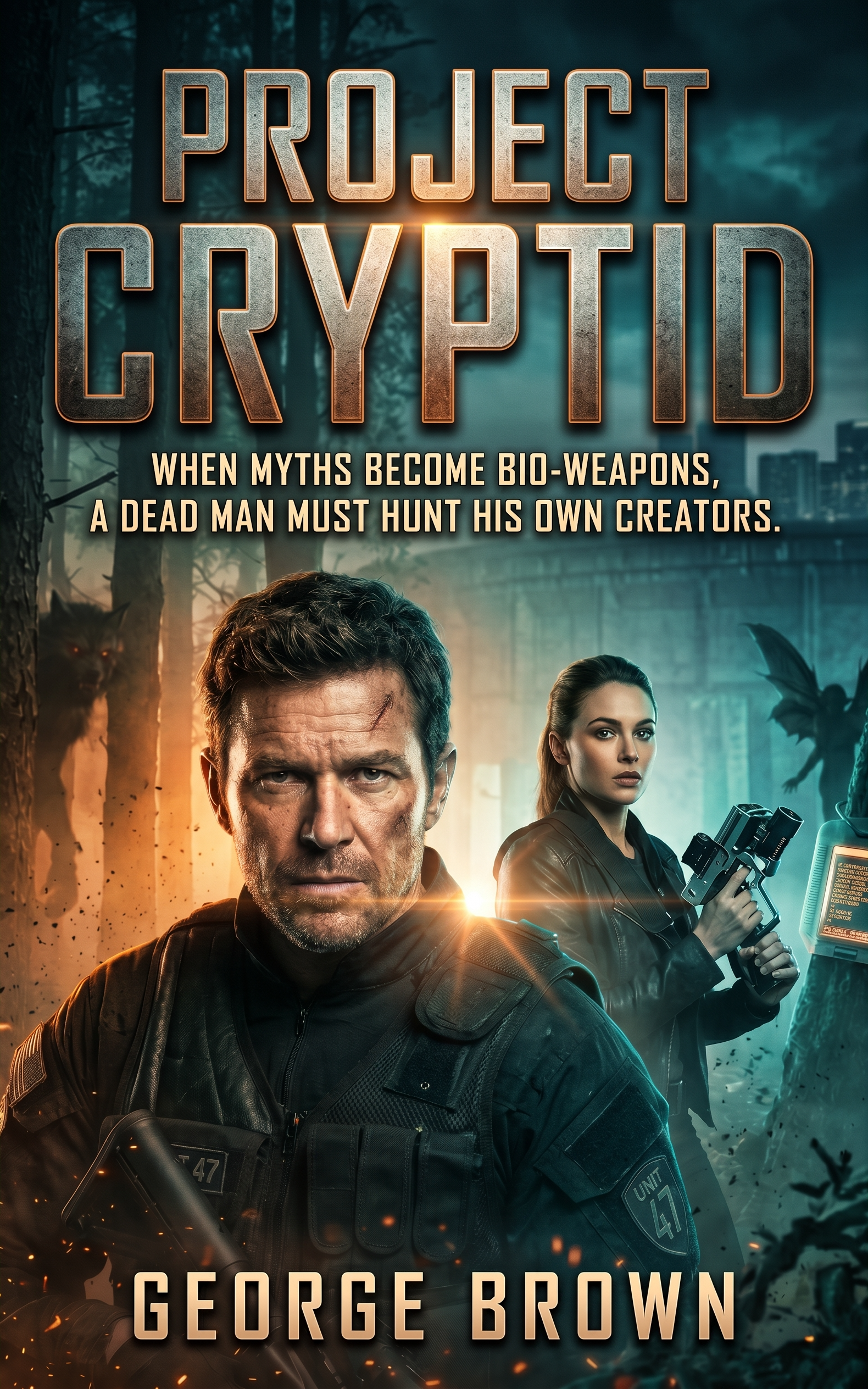
Project Cryptid
When myths become bio-weapons, a dead man must hunt his own creators.
by George Brown
Grant Sterling has been a ghost for thirty years. As a top-tier containment specialist for Unit 47, he hunts the creatures that haunt humanity’s nightmares. Alongside his partner Siobhan, a vampire tracker with a sharp edge, Grant has spent decades keeping the shadows at bay. But the rules of the hunt have changed. While investigating a series of high-tech signatures, Grant discovers a terrifying truth: the cryptids he captures aren't just being contained—they are being harvested. Director Alistair Finch is strip-mining supernatural DNA to engineer the ultimate bio-weapons. From the Fae princes of legend to the primordial void of the entity known as Hollow-Eye, no myth is safe from the Agency’s ambition. When Grant uncovers rows of his own clones in a secret laboratory, he realizes he was never just a soldier; he was always an investment. To save a world teetering on the edge of a supernatural meltdown, Grant must turn rogue. Forging an uneasy alliance between humans, vampires, and Fae, he must dismantle the shadow organization he helped build before the veil protecting humanity disintegrates forever. In the race between science and sorcery, the greatest monster of all might be the one in the mirror.
- Fantasy
- Paranormal
- Urban Fantasy
- Mythological
- Vampire
- Werewolf
Subway Predation
The smell hits you first. That is the one thing they never tell you when you sign on for a job like this. Not the danger, not the hours, not the soul-grinding weight of knowing what is actually out there in the dark. No, the thing that stays with you, the thing that burrows into the back of your throat and sets up permanent residence, is the smell. Down here in the decommissioned L-Line tunnels running beneath the east side of Manhattan, it was a particular kind of awful. Stagnant water, decades of rust, the faint chemical bite of old electrical fires, and underneath all of it, something organic and wrong. Something that had been living down here long enough to make the smell its own.
I had been crouched in the same position for the better part of two hours. My knees were past the point of complaining about it. The rifle against my shoulder was a custom build, the kind that did not exist in any procurement catalog. It fired a specialized sedative round developed by the agency's medical division, a compound designed to drop a three-hundred-pound black bear in under sixty seconds. I had used it on things that made a black bear look like a house cat. The question was always whether the dosage would hold. It usually did. Usually.
Siobhan stood three feet to my left. I say stood, but that is not quite right. She occupied the space the way a shadow occupies a wall, perfectly still, perfectly patient, her amber eyes open and catching the weak amber glow of an emergency light mounted fifty yards down the tunnel. Those eyes did not blink nearly as often as they should. That was one of the first things I noticed about her, years ago. You get used to it. Mostly.
"Northeast passage," she said, barely above a whisper. Not even a whisper, really. More like a thought she had decided to share. "The copper smell is stronger. It fed recently."
"How recently?"
"Within the hour. There is something else, though." She paused, and I had learned that her pauses meant something. Siobhan Vane did not waste silence. "Ozone. The kind you get near high-voltage lines. Or near certain biological tissue under sustained stress."
I kept my eye on the scope. "Adrenal response?"
"Possibly. Or it has been running."
Running meant it knew we were here. That was not ideal.
The mission brief had been straightforward enough on paper, which was how I knew it would be anything but. Three commuters had vanished from the Canarsie platform over a twelve-day stretch. No bodies, no blood, no security footage that showed anything useful, just the kind of absence that made transit workers file incident reports and then quietly stop talking about it. The official story was a series of accidents involving the third rail. The unofficial story, the one that landed on my desk at two in the morning, was something else entirely. Witness accounts from a maintenance crew who had gone into the tunnels to replace signal equipment described a creature roughly the size of a large dog, moving on all fours but capable of spreading what looked like membranous wings when it leaped. One of the maintenance workers had quit on the spot. The other two had convinced themselves they had seen a large bat. People are remarkably good at talking themselves out of what they actually see. That instinct is what keeps most of them sane. It is also what keeps me employed.
The agency had flagged it as a Jersey Devil variant, which was a loose classification at best. The original Jersey Devil sightings out of the Pine Barrens went back centuries, and the creature had evolved, or been driven, into something more aggressive as its habitat shrank and human population density increased. This one had moved into the subway system, and it had developed a taste for people. That combination made it my problem.
I heard it before I saw it.
The sound was a low, wet clicking, like something between a bat's echolocation and the noise a large dog makes when it is working its jaw. It came from the northeast passage, just like Siobhan had said. Then the smell rolled ahead of it, that copper and ozone combination thickening in the stale tunnel air, and I felt my gut tighten the way it always does right before contact. Not fear, exactly. More like the sensation of a wire being pulled taut.
It came out of the dark in pieces. First the eyes, pale yellow and too widely spaced, reflecting the emergency light. Then the body, dropping from what I realized was the ceiling of the tunnel where it had been clinging, landing on the tracks with a sound like wet leather slapping concrete. It was bigger than the file suggested. Bigger than most Jersey Devil variants I had worked. The leathery wings were folded tight against its shoulders, and the canine features were pronounced, a long narrow snout, heavy brow, and a jaw that looked anatomically incapable of closing all the way. But it was the hide that stopped me cold for just a half second. Even through the scope I could see it. Long, puckered lines running across its torso and flanks in deliberate patterns. Not scarring from fights. Not the random marks of a life spent in tunnels. These were surgical. Clean, precise, and numerous.
I put that thought in a box for later and pressed the trigger.
The sedative round hit it in the left shoulder with a sound like a heavy staple gun. The creature flinched, stumbled two steps sideways, and then straightened up. I watched through the scope as it reached up with one forelimb and raked at the dart site with a claw, pulling the needle free and dropping it on the tracks. Then it turned its head and looked directly at me.
"Grant." Siobhan's voice had changed. That cool, analytical tone had an edge to it now, the edge that came out when she was shifting gears from observer to predator. "The round is not holding."
"I noticed."
"Do you have a secondary load?"
"Yes. Give me four seconds."
I did not get four seconds. The creature lunged forward with a speed that did not match its size, covering twenty feet of tunnel in a single bound, its wings snapping out to stabilize it as it came. I got the rifle up but the angle was wrong, and I was already making the calculation in my head about whether I had time to roll left or right when Siobhan moved.
She crossed the distance between us in less time than it takes to blink. I have seen her move at full speed maybe a dozen times over the years, and it still does something to the back of my brain each time. Human beings are not wired to process that kind of velocity from something that looks like a person. She hit the creature from the side with enough force to redirect its trajectory completely, the two of them slamming into the tunnel wall in a tangle of limbs and wing membrane and a sound like a car accident in miniature.
What followed was not graceful. It was not the kind of coordinated takedown you see in training footage. It was brutal and close and loud, the creature raking at her with its hind claws while she locked her forearm across its throat and drove her knee into its midsection with the kind of controlled viciousness that reminded you, sharply and without any ambiguity, that Siobhan Vane was not actually on your side of the food chain. She was on her own side. She had simply decided, for reasons she had never fully explained to me, that my side was worth protecting.
I was on my feet and moving, cycling the secondary load into the rifle. The creature managed to get a wing under her and shove, and she went back two steps, which was enough for me to get a clean line. I put the second round into the base of its neck, a better site for uptake, and this time I watched it land with my own eyes instead of through a scope.
The creature staggered. The clicking sound changed pitch, going ragged and uneven. It took two more lurching steps toward me, and I held my ground, watching its legs, watching for the moment the compound finally reached the central nervous system. The third step was slower. The fourth step did not happen. It went down onto the tracks with a heavy, shuddering crash, the wings spreading wide in one last involuntary spasm before folding back against its sides. The yellow eyes stayed open, glassy and unfocused, but the breathing was steady. Sedated, not dead. That was the job. Contain, not eliminate, unless containment was impossible.
I lowered the rifle and exhaled slowly through my nose.
Siobhan was already straightening up, adjusting the collar of her coat with the precise, unhurried movements of someone who had just stepped off a curb rather than wrestled a winged predator into a tunnel wall. There were three parallel claw marks across the back of her right hand. I watched them close as I watched, the skin knitting back together with a speed that was still unsettling no matter how many times I saw it.
"You are bleeding," I said.
"I am aware," she replied. "Thank you for the update."
I slung the rifle and moved toward the downed creature, pulling a field light from my vest pocket and clicking it on. The tunnel filled with a cold white beam. Up close, the surgical scarring was even more pronounced than it had been through the scope. I crouched down and ran the light along the creature's torso, tracing the lines. They were old enough to have healed fully, months at minimum, possibly longer. The pattern was not random. The incisions had been made with intent, following the natural seam lines of the musculature in a way that suggested whoever had done this knew the animal's anatomy very well. The hide in those areas was thicker than it should have been, the tissue beneath denser, which explained why the first sedative round had not penetrated deeply enough to be effective. Someone had reinforced this animal. Someone had deliberately made it harder to put down.
"Look at this," I said.
Siobhan crouched beside me. She studied the scarring without touching it, those amber eyes moving slowly across the work. "Surgical augmentation," she said.
"That is what it looks like."
"The ozone scent. I believe it originates from these sites." She leaned closer, and I saw her nostrils flare slightly. "There is something embedded in the tissue. Metallic. Possibly conductive."
I was already pulling out my field kit. I had a pair of compact forceps and a scanning wand that could pick up electronic signatures at close range. I ran the wand along the length of the creature's left flank, and the device gave a single, steady tone. I ran it along the right side. Another tone, slightly different pitch. I worked my way up toward the head, and that was when I found it.
It was in the left ear. Small enough that you would miss it without knowing what you were looking for, a flat disc about the size of a shirt button, matte gray, seated flush against the inside of the ear canal. I got the forceps in and worked it free carefully, holding it up in the beam of the field light.
I turned it over. On the back surface, in characters small enough to require squinting, was a serial number. Below the serial number was a symbol I recognized without any difficulty whatsoever. I had seen it on equipment manifests, on containment crates, on the inside of every secure door in every facility I had ever walked through.
It was the Unit 47 agency seal.
I sat back on my heels and held the tag in my palm, staring at it. The field light hummed in my other hand. Down the tunnel, something dripped. Water, probably. The sound was very loud in the silence.
"Grant." Siobhan's voice was quiet.
"I see it."
"A tracking tag," she said. "Agency issue."
"Agency issue," I confirmed. "Series seven hardware, from the look of it. That is current production. They have not been using series seven in the field for more than eight months."
I turned the tag over again in my palm. The serial number stared back at me. Serialized tags meant this animal was in a registry somewhere. It had a file. It had a case number. It had been logged and cataloged and fitted with hardware by people who wore the same badge I wore, and then it had been here, in these tunnels, pulling commuters off platforms.
"You are running the calculation," Siobhan said.
"The one where I try to figure out how an agency-tagged specimen ends up running loose in a New York subway tunnel eating civilians."
"Yes. That calculation."
"I am running it," I said. "I do not like the answer I keep arriving at."
She did not respond to that. There was nothing to say that would make the answer better. I looked at the downed creature, at the careful surgical work along its flanks, at the reinforced hide that had shrugged off a round that would have dropped a bear. This was not an animal that had escaped from a containment unit and wandered into the subway system. This was an animal that had been modified and then placed here. The modifications were designed to make it more difficult to contain. That meant whoever released it knew that a containment team would eventually come. Whoever released it wanted to make our job harder.
I closed my fingers around the tag and slipped it into the front pocket of my vest.
"We secure the specimen and we call it in," I said. "Standard protocol."
"And the tag?"
I looked at her. "What tag?"
Those amber eyes held mine for a long moment. In the cold white light of the field lamp, her face was all sharp angles and still water. Then she gave a single, small nod. "Of course," she said. "What tag."
We worked quickly after that. I had a compact containment rig in the duffel I had staged twenty meters back in the tunnel, a collapsible frame with reinforced polymer panels and a chemical seal that would keep the creature sedated during transport. It was the kind of equipment you do not want to explain to a transit worker if someone stumbles across you during setup, so we moved with the practiced efficiency of two people who had done this kind of work in worse places under worse conditions. The Congo alone had given me enough bad-condition scenarios to last several lifetimes.
Siobhan handled the creature's head and upper body while I worked the frame around its lower half and wings. It was heavier than it looked, dense in the way that modified tissue tends to be, and the wing span complicated the geometry of the containment frame. We had it sealed and locked in under twelve minutes. I had done it faster alone before, but not with a specimen this size.
I pulled out my radio and keyed the frequency for our extraction team. Two men with a modified transit maintenance van, standard cover for moving specimens through the city. I gave them our position and told them we had a category three secured and ready for transport. The response came back clean. Fifteen minutes.
I sat on an old section of rail and looked at the sealed containment unit while we waited. The creature's breathing was visible through the polymer panel, slow and even. In sedation, with the wings folded and the jaw slack, it almost looked like something that could have been normal. Almost. The surgical scars ran in their deliberate lines across its hide, and the absence of the tag in its ear was a small empty space that felt much larger than its physical dimensions.
Siobhan stood a few feet away, facing back down the tunnel the way we had come. Watching our six. Always watching something.
"The augmentation is not crude work," she said, without turning around. "Whoever modified this animal had access to advanced tissue manipulation techniques. The kind of expertise that does not exist outside of a small number of facilities."
"I know."
"The agency has a biological research division."
"I know that too."
"I am simply noting the available facts."
"Siobhan." I looked up at the back of her platinum blonde head. "I said I know. I have been running the numbers since I pulled that tag. The numbers keep coming up the same way. I am just not ready to say it out loud yet."
She was quiet for a moment. "That is understandable," she said finally, and she meant it. That was the thing about Siobhan. She did not do false comfort. When she said something was understandable, she had actually run the calculation herself and concluded that your response was rational. It was a strange thing to find reassuring, but after enough years working alongside someone, you take reassurance in whatever form it comes.
The extraction team arrived in thirteen minutes. Two agents I knew by sight but not particularly well, Cole and Marsh, both competent and quiet in the way the best field support tended to be. They loaded the containment unit into the transit van with practiced efficiency, no questions, no lingering looks at the specimen through the polymer panel. Just the job, done cleanly. I respected that.
I climbed into the back of the van beside the containment unit while Siobhan took the front passenger seat. Cole drove. Marsh rode in the back with me, close enough to monitor the unit's vital readings on a tablet but far enough to give me space. The van smelled like diesel and industrial cleaner, and the city moved past the blacked-out windows as a series of sounds, horns and brakes and the occasional pulse of music from somewhere we were passing. Manhattan at whatever this hour was. Past midnight, heading toward two in the morning.
I reached into my vest pocket and turned the tracking tag over between my fingers in the dark. The serial number was too small to read without the field light, but I did not need to read it. I had already memorized it. That was one of those habits that had stayed with me from the Scout Sniper days, the need to commit specific details to memory before they could be taken away from you. Anything could be taken away from you in the field. What was inside your head was harder to confiscate.
The tag was real. The surgical work was real. The creature in the containment unit had been modified by someone with serious resources and serious knowledge, fitted with agency tracking hardware, and then released into a subway tunnel where it had killed at least three people. Those three people were real. The maintenance worker who had quit on the spot was real. The two workers who had convinced themselves they had seen a large bat were real, and they were alive because they had stayed in that particular corner of denial, and I hoped very much that they stayed there.
The cold in my gut was not fear. I had made a kind of peace with fear a long time ago, back in the Appalachian woods as a teenager, tracking through country where the thing you were following could just as easily turn around and follow you back. Fear was just information. What was sitting in my gut right now was something different. It was the specific, particular discomfort of a man who has been doing a job he believed in for thirty years and has just found the first solid piece of evidence that the job might not be what he thought it was.
I had worked for the agency because I believed in what the agency said it was doing. Keep the civilians safe. Keep the thin line between the world people understood and the world that would shatter their understanding intact. That was the mission. That was what I had told myself every time I came back from something that had cost me a piece of sleep or a piece of the person I used to be before the Congo. That was what I held onto.
The tag in my fingers was not compatible with that story.
The van rolled on through the city, and I sat in the dark and thought about the surgical scars and the reinforced hide and the three missing commuters from the Canarsie platform, and I let the cold in my gut settle in and get comfortable because I had a feeling it was going to be staying for a while.
Cole pulled the van over at a loading dock on the lower east side, a nondescript building that looked like a warehouse from the outside and was something else entirely below street level. A second team was waiting to take custody of the specimen and transport it to the appropriate facility for processing. I watched them wheel the containment unit away on a dolly without looking at it again. Somewhere in the building's system, a case number would be generated. A file would be opened. A specimen would be logged.
And somewhere in that same system, a serial number on a tracking tag would match an existing record, if anyone ran the check. If anyone thought to look.
I was thinking about that when Siobhan appeared at my shoulder.
"The transfer team lead wants your field report before we go," she said.
"He can want it in the morning," I said. "Tell him I am filing a written summary by oh-eight-hundred."
She relayed this with the particular tone she used when conveying information she personally found reasonable and was mildly annoyed that it required explanation. The transfer team lead apparently accepted it, because she came back thirty seconds later without further comment.
We stood on the loading dock for a moment. The city was doing its nighttime thing around us, the distant sound of traffic, a siren somewhere to the north, the smell of the river cutting through the exhaust and the concrete. Cool air for this time of year, which was fine by me. I had always done better in cool air. It kept you sharp.
"That was not a standard containment run," I said.
"No," Siobhan agreed. "It was not."
"The augmentation. The tag. The way it shrugged off the first round." I pulled out the tag and looked at it in the amber light from the loading dock. "Someone wanted this thing hard to put down. Someone wanted the containment team to work for it."
"Or to fail," she said quietly.
I looked at her sideways. "You think the intent was for the containment to fail."
"I think the modifications were designed to maximize resistance to standard containment protocols. I think the placement of the tracking tag suggests prior agency involvement. I think the location, a high-traffic civilian transit system, was chosen to generate a specific kind of pressure." She paused. "Whether the intent was for the containment team to fail or simply to suffer in the attempt, I cannot say with certainty. But the outcome either way serves a particular narrative."
"What narrative is that?"
"That the threat is escalating. That the creatures are adapting. That the agency requires more resources, more authority, more latitude to operate." She tilted her head slightly, those amber eyes catching the dock light. "It is a very old trick, Grant. Create the problem. Provide the solution."
I turned the tag over in my fingers one more time. Then I tucked it back into my vest pocket.
"Get some rest," I said. "We have a debrief in the morning."
"I do not require rest in the way you do."
"I know. I was being polite."
"Ah." She considered this. "Thank you."
I walked off the loading dock and into the cool Manhattan night, and behind me I could hear the sound of the facility's door closing with the soft, final click of a very heavy lock. The kind of sound that stays with you. I walked half a block before I stopped under a streetlight and stood there for a moment, one hand in my jacket pocket, the other hanging loose at my side, looking at nothing in particular.
I had been dead for thirty years. That was not a metaphor. Officially, on paper, in every database that the civilian world had access to, Grant Sterling had ceased to exist in his late twenties. What had replaced him was a function, a set of skills applied to a specific problem, again and again and again across three decades of tunnels and jungles and mountain ranges and decommissioned facilities at the edges of places people did not go. I had made peace with that. The work was real. The threat was real. The people I had kept safe, the ones who would never know my name or know that I had been there, were real.
But the tag in my pocket was also real. And the surgical scars on that creature were real. And the three people who had vanished from the Canarsie platform were real, and they had died not because a wild animal had found its way into the subway system through some natural migration, but because something had been engineered and released and pointed at them like a weapon.
I pulled the tag out one more time and held it in the streetlight. The agency seal was very clear. I knew what that seal meant. I had followed it for thirty years. I had trusted what it represented the way a soldier trusts the flag he serves under, not blindly, not without reservation, but with the kind of fundamental belief that gets you out of bed in the morning and back into the dark when every sensible instinct tells you to stay in the light.
The seal had been on a creature that had killed three people. The seal had been attached to a creature that had been surgically modified to resist containment. The seal had been in a situation that had no innocent explanation, and I had been running explanations for the better part of two hours now and had not found one that did not lead back to the same dark conclusion.
I closed my fingers around the tag.
Thirty years. I had given thirty years to this job, to this agency, to the mission I had been told we were all serving. I had buried colleagues. I had said nothing when orders came down that did not sit right, because I had trusted the larger picture, trusted that the people above me had information I did not have, context I was not cleared for, reasons that would make sense if I could see the whole board.
The thing in the tunnel tonight had a serial number on it. That number was in a registry. That registry was maintained by the agency I worked for. That agency had tagged and, from the evidence available, modified and released a predatory cryptid into a civilian transit system, and then sent a containment team, sent me, to go clean it up.
I was not certain of all of it yet. I was careful about certainty. Certainty got you killed in the field, because certainty made you stop looking for the thing that contradicted what you thought you knew. But the gut instinct that had kept me alive through thirty years of missions, the same instinct that had gotten me out of the Congo when it went wrong, the same instinct that had told me, years before I had any proof, that the agency was evolving into something different from what it had been when I was recruited, that instinct was not uncertain.
Something was wrong at the top. Something had been wrong for a while. And tonight, in a decommissioned tunnel under the east side of Manhattan, that something had left its signature on the inside of a dead animal's ear.
I slipped the tag back into my pocket and started walking. The streets were quiet at this hour, just the occasional cab and the distant sound of the city doing what cities do when most of the people in them are asleep. I walked three blocks before I found a payphone that still worked, one of the last few the city had not pulled, and I stood in front of it for a long moment without picking it up.
There was no one to call. That was the job. That had always been the job. You were dead to the world, and the only people who knew you existed were the people you worked with, and right now the people you worked with were the people you were not sure you could trust. That was a particular kind of alone that I had gotten very good at not thinking about directly. You looked at it sideways, the way you look at something very bright. You acknowledged it was there and you kept moving.
I kept moving.
The debrief was in eight hours. I would file the field report, standard format, specimen secured, category three, no civilian exposure during containment. I would not mention the tag in the written summary. I would not mention the surgical augmentation in any detail beyond what the evidence log required. I would wait and I would watch and I would see what the agency did with the specimen, what facility it went to, what classification it received, and whether anyone at any level of the organization seemed surprised by what we had found or whether they already knew exactly what was in that tunnel.
That was how you hunted something you could not see yet. You moved slowly. You read the ground. You paid attention to what was there and what was missing, because the absence of a thing told you as much as its presence. You had learned that in the Appalachian woods before you were old enough to drive, tracking in country where the signs were subtle and the stakes were real, and thirty years of working for a shadow agency had only deepened that particular skill.
Whatever was happening inside Unit 47, it had left tracks tonight. Small ones. Easy to miss if you were not looking, or if you had decided not to look because looking was uncomfortable. But they were there. The tag was in my pocket. The scars were on the creature's hide. The three commuters from the Canarsie platform were gone.
I was looking. I was going to keep looking.
The city moved around me as I walked, indifferent and loud and alive in the way that cities are alive at two in the morning, with a different kind of energy than the daylight hours, rawer and more honest somehow. Somewhere above the tunnels where I had spent the last two hours crouched in the dark, people were sleeping in their apartments, or arguing, or watching television, or doing any of the thousand ordinary things that ordinary people did when the world was functioning the way it was supposed to function. They did not know about the tunnels. They did not know about the creature in the containment unit. They did not know about Unit 47 or the tag or the surgical scars or the cold thing sitting in my gut that had started the moment I pulled that disc out of the animal's ear.
That was the way it was supposed to be. That was the job. Keep them in the light and keep the dark where it belonged.
I just needed to make sure I still knew which side of that line I was on.
The tag pressed against my ribs through the fabric of my vest, small and flat and specific, and I walked on through the Manhattan night with my hands in my pockets and my eyes moving the way they always moved, taking in the corners, the doorways, the spaces between things where something could be waiting. Old habit. Deep habit. The kind you do not turn off because you cannot afford to turn it off, not ever, not even when the thing you might need to be watching for has a badge that matches your own.
Especially then.
The Hive's Cold Welcome
The Hive smelled like recycled air and institutional ambition. That particular combination, cold filtered oxygen pushed through a ventilation system that had never been updated and the faint chemical undertone of server cooling units running at full capacity, was as familiar to me as anything in my life. More familiar, honestly, than most things. I…