

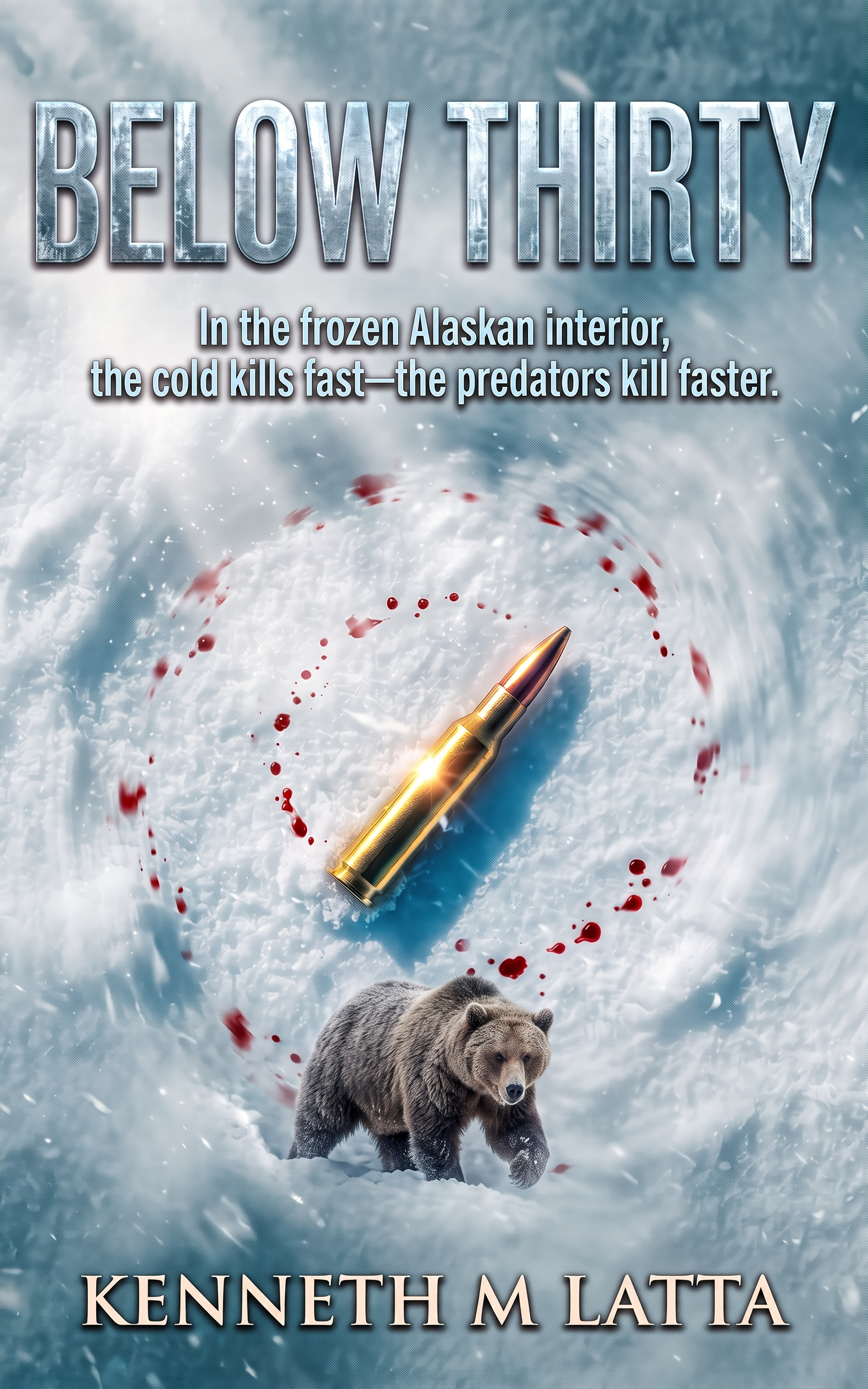
Below Thirty
In the frozen Alaskan interior, the cold kills fast—the predators kill faster.
by KENNETH M LATTA
Thirty degrees below zero is where steel shatters, breath turns to ice, and survival becomes a violent test of will. When bush pilot Kurt Bannon crash-lands his Cessna Caravan deep into the unforgiving Alaskan wilderness, surviving the impact is only the beginning. Trapped miles from civilization with cracked ribs, dwindling rations, a .44 Magnum, and a .308 rifle, Kurt must turn the wreckage of his plane into a makeshift fortress against the Arctic elements. But the sub-zero blizzard isn't the only deadly force stalking the tundra. A starving pack of wolves and an aggressive rogue grizzly bear have picked up his blood trail across the snow. As battery power drains from his emergency beacon and radio, Kurt's chances of rescue slip away by the hour. Hundreds of miles away, a desperate search team mobilizes, battling zero-visibility skies and avalanche corridors to track him down. To survive the long Arctic night, Kurt must rely on raw grit and deadly instincts before the wilderness claims him completely.
- Adventure
- Thriller
- Horror
- Survival
- Wilderness
- Survival Thriller
Impact in the Ice
The vibration came through the soles of Kurt Bannon's boots first, a fine, high-frequency shudder that bypassed the seat cushions and went straight into the marrow of his shins. He pulled back slightly on the yoke of the Cessna 208B Grand Caravan, but the airframe felt heavy, numb, and resistant. Fifteen thousand feet below, the jagged spine of the Kuskokwim Mountain Range was completely obscured by an unbroken ceiling of freezing stratus clouds, a solid slab of slate gray that had been spitting supercooled moisture across his windshield for the last forty minutes.
He leaned forward, squinting through the narrow clear patch maintained by the windshield heating elements. Milky rime ice was creeping aggressively across the leading edges of the struts, blooming like white fungus over the rivets. It had already overwhelmed the pneumatic de-ice boots. Every time he cycled the system, the rubber bladders expanded beneath the frozen rind, but the brittle ice refused to shed cleanly; instead, it built a jagged bridge over the gaps, destroying the airfoil's lift and adding hundreds of pounds of dead weight to the airframe.
"Come on, baby," Kurt muttered, his voice gravelly and dry inside his headset. "Just give me twenty more miles. Just clear the pass."
The airspeed indicator showed a steady, agonizing decay. One hundred and ten knots. One hundred and four knots. The stall warning horn gave a brief, sharp chirrup, cutting through the low drone of the Pratt & Whitney PT6A turboprop. The nose pitched down slightly as the tailplane accumulated its own deadly load of frozen crust.
Then the engine changed its pitch.
It was not the gradual sluggishness of an intake filter clogging with slush. It was a catastrophic, violent snap, followed immediately by a high-pitched metallic shriek that vibrated through the entire instrument panel. Inside the cowl, something heavy and turning at thirty thousand revolutions per minute sheared free from its mounts. A blast of superheated air, thick with the sharp stench of scorched synthetic oil and ozone, blasted through the cabin vents.
The torque gauge dropped to zero instantly. The interstage turbine temperature needle spiked violently past the red line, swinging entirely off the dial as internal sensors melted in the firestorm of disintegrating compressor blades. The nose yawed viciously to the left.
"Shit!" Kurt barked, stomping hard on the right rudder pedal to counter the asymmetric drag. The pedal kicked back against his boot with violent shuddering force. "Ignition—auto. Fuel condition lever high idle. Aux boost pump on."
His gloved hands moved in a practiced blur across the throttle quadrant and overhead switches. He slapped the starter switch into the continuous manual position, watching the digital readouts with narrowed, watering eyes. The starter motor whined, a desperate, hollow grind against a seized shaft. There was no spool-up. There was no light-off. The turbine was an expensive mass of fused, mangled alloy inside a crumpled metal housing.
The propeller feathered automatically, but the dead blade presented a flat, drag-inducing slab against the howling sub-zero slipstream. The Caravan began to drop out of the sky like an anvil.
Kurt gripped the handheld microphone with his left hand, thumbing the transmit switch hard as he banked the crippled plane toward the south, trying to point the nose away from the highest granite spires of the Kuskokwim crest.
"Mayday, Mayday, Mayday," Kurt spoke into the mic, forcing his breathing to remain slow and measured despite the cold adrenaline burning in his throat. "Fairbanks Center, this is Caravan November-Eight-Four-Six-Uniform. Total engine failure. Structural icing. Uncontrolled descent out of one-four thousand. Last known grid is sixty-two degrees, forty-one minutes North, one-hundred fifty-six degrees, twenty minutes West. Heading two-one-zero into the drainage. I am going down."
Static crackled through his headset, a chaotic wash of solar interference and mountain blockage. Through the hiss, a faint, clipped voice emerged, fragmented and distant.
"November-Eight-Four-Six... Fairbanks... radar contact lost... repeat your..."
"Eight-Four-Six-Uniform is in the soup," Kurt snapped back, his eyes locked on the altimeter as the long needle spun counterclockwise in a dizzying blur. "Ten thousand feet. Descent rate twenty-two hundred feet per minute. No restart. I am dead stick. Tell them I went into the timber south of the ridge."
The radio crackled once more, then dissolved into a deafening wall of white noise as a violent mountain downdraft caught the aircraft by the tail. The vertical speed indicator pegged itself against the bottom stop. The floor dropped out from beneath his boots, lifting him momentarily against the tight nylon webbing of his four-point harness.
"Aviate, navigate, communicate," Kurt said aloud, repeating the old bush pilot mantra through clenched teeth. "Airspeed eighty-five. Trim for best glide. Keep the wings level. Don't stall. Do not stall."
The Caravan plunged through the belly of the cloud deck at six thousand feet. The gray vapor tore away abruptly, revealing a terrifying world of stark black and blinding white. Towering granite ridges loomed on both sides, their sheer, snow-dusted walls rising like the battlements of a frozen fortress. Directly ahead, a narrow, boulder-strewn canyon sliced through the lower foothills, choked with thick stands of black spruce and willow brush buried beneath feet of fresh snow.
Wind shear hammered the left wing, rolling the heavy plane forty degrees into the canyon wall. Kurt hauled back on the yoke, muscle and tendon straining against the aerodynamic pressure on the iced-over ailerons. The controls felt like they were set in half-cured cement. He kicked the right rudder with all the strength in his leg, leveling the wings just as the first spruce tops appeared beneath the nose, rushing upward with terrifying speed.
"Brace," he whispered. "Pick an alley. Keep the nose up."
The aircraft struck the timberline at ninety miles per hour.
The first impact was a deafening, percussive crack as the fixed landing gear clipped a fifty-foot spruce. The trunk snapped like a matchstick, sending the heavy nose pitching downward. Kurt hauled the yoke into his chest, trying to pancake the fuselage into the deep snow instead of plowing nose-first into the granite boulders lining the creek bed below.
Branches whipped across the windshield, scoring deep white scratches across the Plexiglas before the right wing slammed directly into a dense cluster of mature timber. The impact sounded like an artillery shell detonating inside a steel drum. The entire right wing sheared completely away at the root, tearing loose with a horrendous screech of ripping sheet metal, hydraulic lines, and severed control cables.
The sudden loss of the wing flipped the Caravan onto its right flank. Tons of cargo—plastic crates, wooden pallets, steel drums, and survival gear—broke free from the aft tie-downs, hurtling forward against the cargo barrier netting with a deafening roar. The plane cartwheeled down the steep slope of the ravine, carving a hundred-yard trench through the dense timber, throwing blinding roostertails of powdery snow, splintered spruce, and pulverized needles into the freezing air.
The nose struck a massive, submerged granite boulder. The engine cowling crushed backward into the firewall like an accordion. The front windshield imploded in an explosive shower of razor-sharp, crystalline shards that slashed across Kurt's face and chest. His head snapped forward violently, his forehead slamming into the metal rim of the glare shield before the shoulder harness locked hard, biting deep into his collarbones with enough force to crack bone.
The fuselage bounced once, rolled onto its belly, and slid fifty yards across the icy crust of the frozen creek bed before wedging itself solidly between two massive chunks of granite. Then, the grinding roar of tearing aluminum died away.
Silence settled over the ravine.
It was not a gentle quiet; it was the heavy, suffocating silence of an Arctic wilderness that had just crushed an intruder and was now waiting for the heat to bleed out of him. The only sound was the faint, rhythmic ticking of cooling metal, the hiss of hydraulic fluid vaporizing against hot exhaust manifolds, and the distant, hollow moan of the sub-zero wind threading through the jagged mountain spires above.
Inside the mangled cockpit, snow was already drifting through the shattered windshield frame, settling in soft, powdery layers across the broken dials, the severed wires, and Kurt's motionless body.
A drop of dark, warm blood fell from the bridge of his nose, landing with a soft hiss on the cracked glass of the attitude indicator. Kurt gasped, a sharp, ragged inhalation that felt like a handful of broken glass being dragged through his chest. His eyes flickered open, though the world was a blurred, spinning tunnel of gray and crimson.
The taste of copper and bile filled his mouth. He coughed, and the convulsion sent a white-hot spike of agony through his left ribcage that instantly robbed him of breath. A low, guttural groan escaped his lips, his breath frosting thickly in the sub-zero draft that was already pouring through the ruined flight deck.
"Check... check yourself," he whispered, the words slurred and barely audible above the wind. "One thing at a time. Breathe."
He blinked against the stinging cold, forcing his pupils to focus on the wreckage. The instrument panel was twisted inward toward him, the control column bent at an unnatural forty-five-degree angle. Wires hung down like disemboweled guts, spitting occasional, dying blue sparks near the melted circuit breaker panel. The smell of aviation fuel was faint, carried away by the stiff breeze, but the bitter stench of burnt synthetic oil clung to everything.
Kurt reached up with a trembling right hand, his fingers stiff inside his heavy leather glove, and touched his forehead. The skin was split open along his hairline, bleeding freely, the warm liquid already freezing into dark, sticky rime along his eyebrows. He wiped it away with the back of his sleeve, gritting his teeth as he tested his neck and spine. No sharp paralysis. His neck moved, though every muscle screamed with severe whiplash.
He moved down to his torso. When he pressed gently against his left lower ribs, the bone ends shifted with a sickening, wet crunch beneath his Carhartt arctic parka. The pain made his vision gray out around the edges, his forehead slumping forward against the steering yoke until the nausea passed.
"At least three cracked," he muttered, fighting to keep his voice steady against the creeping panic. "Maybe fractured. No sucking chest wound. Keep moving."
He reached down to release the four-point harness buckle. His fingers found the center rotary release, but the mechanism was jammed, packed with snow and distorted by the sheer force of the impact. He drew a deep breath, braced his right heel against the floorboard, and slammed his fist down onto the release lever. The buckle finally popped free with a dull mechanical click.
The sudden release dropped his weight forward into the mangled footwell. A sharp, tearing sensation ripped through his left thigh. Kurt cried out, his voice raw, as he realized a jagged section of the lower rudder pedal bracket had punched through his insulated snow pants during the crash, slicing deeply into the outer quadricep.
He pulled himself up by the steel tubing of the overhead frame, his teeth bared in an involuntary snarl. He reached down and ripped the fabric away from the wound. Dark venous blood was soaking rapidly into the gray thermal lining, pooling against the cold vinyl of the seat cushion. The tear was a wide, jagged trough split to raw meat, steaming faintly as the sub-zero air bit into the open flesh.
"Pressure," he commanded himself, his voice dropping into the harsh, clipped cadence he used when an engine went sour over the ice. "Direct pressure. Stop the bleed before the cold gets it."
He dragged a spare wool watch cap from his coat pocket and jammed it hard against the laceration, leaning his full body weight into his palms. The agony was sickening, pulsing in rhythm with his hammering heart, but he held the cap down until the initial, heavy gush slowed to a sluggish ooze. The freezing air, already dropping well below zero inside the cabin, was beginning to congeal the blood, forming thick, black crusts around the edges of the torn wool.
Kurt looked past the shattered windshield. The right wing was gone entirely, sheared off clean at the fuselage attachment points. Through the gap in the cabin wall, he could see the torn path of the crash stretching back up the mountainside. Cargo was scattered for two hundred yards along the snow-covered scree: crushed cardboard ration boxes, shattered wooden crates, and twisted sheets of corrugated aluminum. High on the ridge, a dense plume of black smoke was rising into the gray sky where the severed fuel tank had ruptured against the timber.
The left wing remained partially attached to the fuselage, but it was twisted upward at a grotesque angle, its fuel tank weeping blue aviation gas onto the snowbank below.
"You're on your own, Bannon," he muttered through clenched teeth. "Nobody's coming. Move."
He tried to move his left leg, dragging the heel across the crumpled floorboards. The muscle fired with a jagged spasm, but the femur was intact. He could stand, provided he kept the weight off the torn quad. He leaned back against the remains of the pilot seat, closing his eyes for three slow, measured breaths to let his pulse settle.
The temperature was dropping fast. The sun was nothing more than a pale, ghostly smudge behind the thickening storm clouds to the west, and the sub-zero chill was already penetrating the thick layers of his arctic parka. The sweat that had soaked his thermal shirt during the frantic descent was turning icy, clinging to his spine like a wet shroud.
If he stayed in the seat, hypothermia would settle into his blood within an hour. The shock would dull the pain, the numbness would feel like relief, and he would simply fall asleep in the crushed cockpit and never wake up.
"Move," Kurt growled, his knuckles white as he seized the cabin frame above his head. "Get the hell out of the seat."
With a desperate, ragged heave, he pulled himself out of the crushed footwell. His cracked ribs grated together, sending a blinding wave of nausea through his stomach, but he forced his good right leg under his center of gravity and shoved. He tumbled out of the pilot seat, collapsing heavily into the narrow aisle of the main cargo compartment among the shifted boxes and tangled tie-down straps.
He lay on the cold aluminum floor for a long moment, his cheek pressed against the rough non-skid surface, his breath puffing in rhythmic white clouds against the frosted metal. Above him, through the torn seams of the ceiling, the Alaskan sky was turning the color of bruised iron. The wind began to pick up, howling with a low, predatory whistle across the jagged edges of the torn fuselage.
Kurt reached into his tactical chest rig, his trembling fingers wrapping around the cold, checkered rubber grips of his .44 Magnum revolver. He thumbed the cylinder release, checked the six heavy hollow-point rounds nestled in the chambers, and snapped the cylinder back into place with a solid, metallic click.
"One problem at a time," he said to the empty cabin. "Stop the bleeding. Find the gear. Build a fire."
He dragged himself toward the aft cargo door, his boots kicking through the drifted snow that had begun to bury the floor of the wreck.
Salvage and Scars
The metal floor of the cargo bay felt like an iron slab pulled straight from a freezer. Kurt pulled himself forward on his elbows, dragging his deadened left leg over scattered tools, severed aluminum stringers, and split plywood crates. The air inside the broken fuselage had dropped past twenty below zero, sharp enough to scorch the lining of his …