

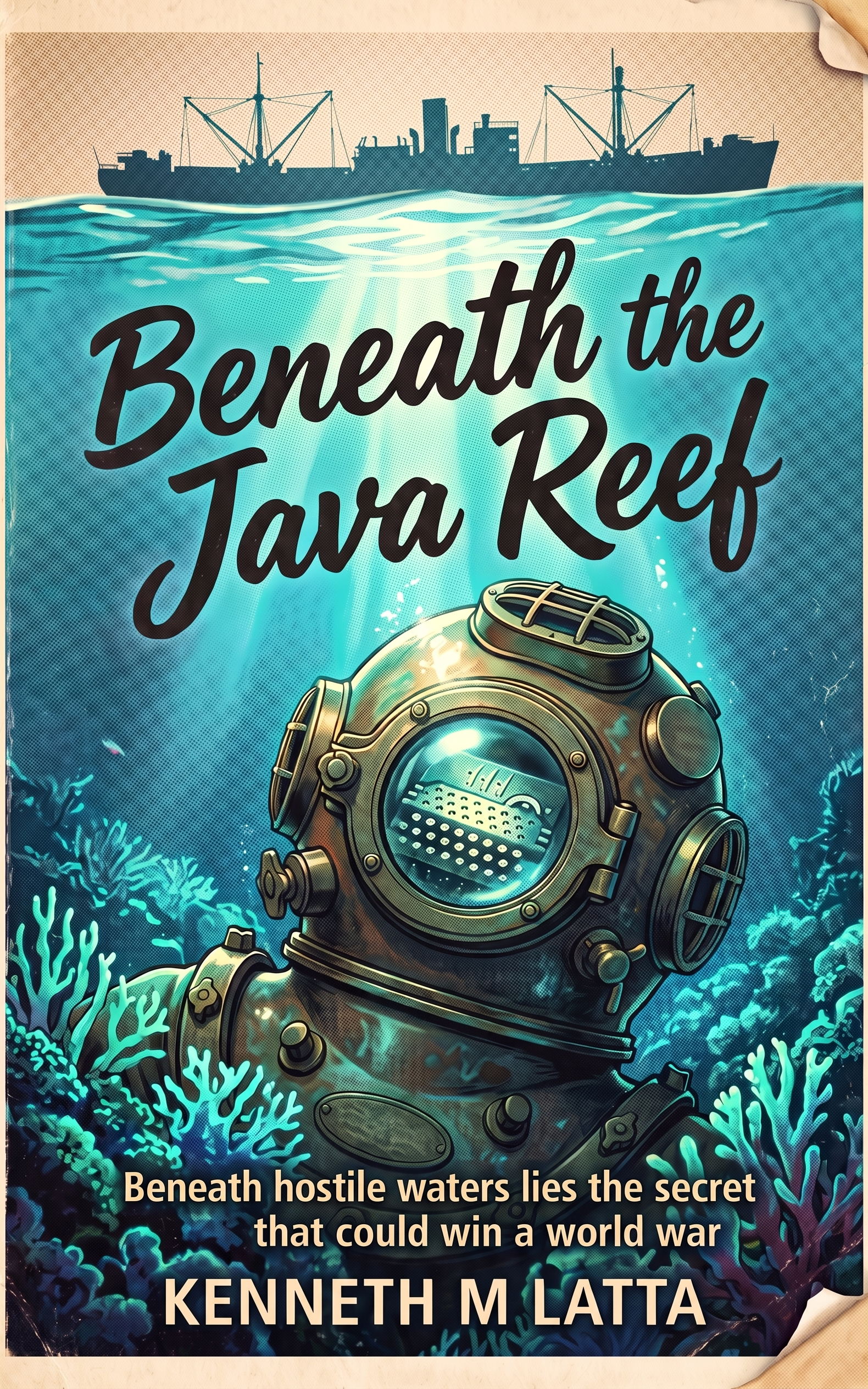
Beneath the Java Reef
Beneath hostile waters lies the secret that could win a world war
by KENNETH M LATTA
Java Sea, 1942. When an Allied cargo ship is torpedoed and dragged into the abyss, it takes vital naval cipher machines down into the reef. Merchant Marine officer Gordon Bancroft and four battered survivors wash ashore on a razor-sharp coral atoll, only to discover it is occupied by an enemy garrison commanded by the ruthless Vincent Sallis. Sallis knows the wreck holds the key to Allied naval intelligence, and he will exterminate every survivor to claim it. Hidden inside a submerged sea cave, Bancroft's crew repairs an obsolete diving suit and makeshift compressor. Forty feet below the surface, Bancroft braves crushing nitrogen narcosis, razor coral surges, and patrolling sharks to retrieve the codebooks before enemy combat swimmers reach the flooded compartments. With their motor launch barely seaworthy and time running out, Bancroft and his men must wage a desperate, two-front war—one in the sunlit terror of the occupied island, and the other in the suffocating darkness of the deep. Failure means the collapse of Allied codes across the Pacific. Survival means plunging back into the black.
- Historical Fiction
- Thriller
- Adventure
- World War 2
- Survival Thriller
- Sea Adventure
Shelter in the Coral
The coral tore at Gordon Bancroft's palms as he hauled himself out of the last curling wave, and for a moment he could not tell if the salt in his mouth was seawater or blood. He collapsed face-down on the shelf, chest heaving, the reef's jagged teeth biting through what remained of his khaki shirt. His right shoulder throbbed in time with his pulse, a deep grinding ache where a sliver of shrapnel had opened him from collarbone to rib during the second pass of the dive-bombers. He pressed his left hand against the wound and felt the wet heat of it soak through his fingers, mixing with the diesel sheen that coated his skin like a second, oily hide.
He made himself breathe. In through the nose, out through the mouth, four counts each, the way he'd drilled into frightened able seamen a hundred times on the Atlantic run. It steadied nothing, not really, but it gave his hands something to do besides shake.
"Bancroft." Harold Fletcher's voice came low and hoarse from somewhere behind him, half-swallowed by the surf. "Don't lie there. Tide's still coming up the shelf and it'll drag you back out before you know it."
Gordon got his knees under him and looked up. Fletcher stood knee-deep in the froth, one hand locked on the gunwale of their battered motor launch, the other braced against a limestone outcrop slick with weed. Behind him, Jonathan Brookes hauled on a length of frayed line looped around his fist, his bare feet finding purchase on the coral even as it opened new cuts across his soles. The launch groaned with each swell, its hull staved in along the port quarter, one plank sprung loose like a broken rib.
"Get an arm under it," Brookes said, not looking up. His voice had the flat, unhurried patience of a man who had already decided panic wouldn't fix anything. "She's taking water faster than she's shedding it. We lose her here, we lose the launch and every tool in her."
Gordon staggered upright and waded back into the surf. The saltwater found his wound like a lit match and he bit down against the sound that wanted to come out of him. Together the three of them walked the launch across the last stretch of reef, timing their steps to the surge, until the coral gave way to a black slot in the tidal bluff, a crack barely wide enough for the hull to pass, hidden beneath an overhang of limestone furred with old guano and creeper roots.
Inside, the cave opened wider than its mouth promised, a low vault of stone that dripped somewhere in the dark and smelled of brine, bat dung, and cold rock. Gordon's eyes adjusted slowly. A small fire burned near the back wall, no bigger than a man's two fists, its smoke thinning to nothing against the ceiling. Alfred Ockenden crouched over it, feeding it splinters of driftwood one at a time, his weathered face lit orange from below.
"Keep her small," Ockenden said without turning around, in that rasping voice that always sounded like it had been dragged over gravel. "Smoke goes up and spreads thin against the rock before it ever reaches that crack topside. Any bigger and you'll paint a signal for every lookout on this reef."
Near him, Frederick Wainwright sat with his back against the stone, both hands wrapped in strips torn from someone's shirt, the fabric already gone dark with seep. He looked up as Gordon came in, his pale eyes too wide, too bright.
"The switchboard," Frederick said, before anyone asked. His voice shook on the first word and steadied on the rest, the way it always seemed to when the fear caught up faster than his composure. "It arced right in front of me. I didn't even hear it go, just felt it, like someone opened an oven door on my hands."
"Let me see," Gordon said, kneeling beside him despite the fire climbing his own shoulder. He carefully peeled back the soaked cloth, feeling the sharp heat radiating off raw, weeping flesh across both palms and up Frederick's forearms—blistered shallow rather than charred deep, agonizing but not crippling. "You'll keep your hands. Wrap them back up and keep them still."
"Small mercies," Brookes muttered, dragging the launch the last few feet onto a shelf of dry rock above the waterline. He straightened, pressed both palms into the small of his back, and surveyed the wreck of a boat with the flat, assessing stare of a man pricing a repair job he already knew he couldn't afford. "Port strake's stove in good. Engine's flooded to the manifold. We'll be lucky if she runs again this side of a proper yard, and I don't see one of those handy."
"You'll make her run," Gordon said. It wasn't a question, and Brookes didn't answer it as one.
"I'll try," he said instead, which from Brookes was close enough to a promise.
Gordon lowered himself against the cave wall, letting the cold stone take some of the weight off his legs, and finally looked around at what they had. Not much. A ditty bag Fletcher had kept lashed to his belt through the whole swim, its contents a jackknife, a half-spool of tarred twine, three tins of bully beef swollen tight from the water, and a fid for splicing rope that was no good to anyone now except as a weapon. Ockenden had come ashore with nothing but the clothes on his back and an old habit of surviving worse than this. Frederick's hands were too burned to carry anything.
Five men. One stove boat. No fresh water they'd found yet, and a wound in his shoulder that was already starting to throb with the particular deep heat that meant infection, not just pain.
And forty feet down, two miles off this reef, the freighter Cardwell was resting somewhere on the bottom of the Java Sea with a locked strongroom full of naval cipher machines that half the war in this ocean depended on nobody ever finding.
"Bancroft." Fletcher's voice again, quieter now, edged with something careful. He'd found a narrow fissure in the cave's outer wall, no wider than a porthole, and stood pressed against it with one eye to the gap, filtered daylight striping his face. "You'll want to see this."
Gordon pushed himself up, ignoring the way the cave tilted for a half-second before it steadied, and crossed to the crack. He put his eye where Fletcher's had been.
Through the narrow slot he could see a wedge of the lagoon, turquoise shallows giving way to the deeper blue of the pass, and cutting through that blue with slow, deliberate purpose was a gray patrol boat flying an unfamiliar ensign, its bow wave folding white against the calm water. A man stood on the forward deck, uniform crisp and dry despite the heat, binoculars raised and sweeping the mangrove line with the patience of someone who expected to find exactly what he was looking for eventually, and had all the time in the world to wait for it.
"That's not a routine sweep," Gordon said quietly. "That's a man who already knows something's down here."
"Aye." Fletcher's jaw was tight. "And look at the flag on the northern point, past that stand of casuarina. I clocked it coming in, before we found this cave. There's a garrison up there already. Watchtower, wire, the lot. This isn't empty ground we've washed up on. It's their ground, and we're squatting on the edge of it."
The words landed harder than the shrapnel had. Gordon had assumed, without ever quite saying it to himself, that the atoll was neutral rock, empty and indifferent, a place to catch their breath before working out how to reach friendly water. Instead they'd swum straight into the shadow of an enemy post, close enough that a single careless fire, a single voice raised too loud, could bring that gray boat and everyone aboard it down on top of them within the hour.
"How far's the garrison from us," Brookes asked, coming up beside them, "as the crow flies?"
"Mile, mile and a half," Fletcher said. "Not far enough."
Ockenden had left the fire and crouched now at the mouth of the cave, one gnarled hand testing the color of the water where it lapped the rock. He said nothing for a long moment, reading something in the swell that the rest of them couldn't see.
"There's your bigger trouble," he said finally, and nodded toward the tide line, a pale ring of dead coral and bleached weed a good three feet above where the water sat now. "Spring tide's building. New moon's two nights off, maybe three. When it comes in full, this whole shelf goes under, cave mouth and all. Water'll be up past where that boat's sitting now."
"You're saying we drown in our own hiding hole," Brookes said.
"I'm saying the sea doesn't care what flag's flying on that patrol boat," Ockenden said, his rasp flattening into something colder. "It'll take this whole reef under in a few days whether you're ready for it or not. You want to argue with a spring tide, go on. I've buried men who tried."
Gordon let that settle. Behind him, Frederick had gone completely still against the stone, but Gordon's own thoughts were already racing ahead into the dark—picturing the black swell filling this vault inch by inch, saltwater climbing his chest until the rock met the surface, leaving no way out except straight into the patrol boat's guns in the lagoon.
"We'll need higher ground for the launch before the surge builds," Gordon said. "And fresh water, wherever we can find it, before we're all too weak to look. But first." He turned back to the crack, to the gray hull sliding across the pass, unhurried, methodical, a man who clearly believed his patience would outlast whatever was hiding from him. "First we need to know what that ship's doing here, and why it's already looking."
"You think they know about the cargo," Fletcher said.
"I think a coastal garrison doesn't post a commander like that on a rock this small unless someone told them there's a reason to." Gordon's shoulder pulsed, insistent, and he pressed his palm harder against it, feeling the wet warmth answer back. "The Cardwell wasn't just running rice and spare engine parts. There were two crates bolted into the strongroom aft of the bridge, sealed, armed guard rotation the whole run up from Fremantle. Naval cipher machines. If those machines are salvageable, and someone with authority to spend fuel on this reef already suspects it, then we're not just hiding from a patrol anymore. We're racing it."
The cave was quiet except for the fire's small hiss and the distant slap of surf against rock. Frederick's breath had gone thin and fast, but he didn't say anything, just watched Gordon with the wide, waiting eyes of a man who needed someone else to have a plan before he could believe there was one.
"You think she's still down there whole," Brookes said. "Two miles out, that's deep water. Abyssal, near enough."
"That's what I thought," Gordon said, and something in his own voice surprised him, a thread of certainty he hadn't earned yet but felt anyway, low in his gut, the way he sometimes felt weather changing before the sky showed it. "But we didn't drift two miles to get here. Current pulled us in fast, faster than open water should. I marked our heading against the sun before we lost sight of the smoke." He looked at Ockenden. "You've worked these reef systems longer than any of us. Tell me if I'm wrong. A ship going down that close to a barrier reef like this one, hit the way she was hit, listing before she went under."
Ockenden's sunken eyes narrowed, calculating in a way that had nothing to do with fear and everything to do with decades of reading water the rest of them would never learn to read. "She wouldn't have made the drop-off," he said slowly. "Not with a hole in her side and a list already started. These barrier reefs run out shallow a good way before the shelf falls off proper. If she went down close to where you make her, she's sitting on the reef flat itself. Forty feet, maybe less at low water. Not the abyss. Not anywhere near it."
Nobody spoke for a moment. Gordon felt the shape of it settle over all of them at once, the terrible, narrow hope of it.
"Then she's reachable," Gordon said.
"Reachable ain't the same as safe," Ockenden said, and there was no comfort in his voice, only the flat truth of a man who'd spent his whole life under water that didn't forgive mistakes. "You'll want gear we don't have, air we can't make, and a tide that's already turning against you. And that's before you count the boat sitting out there in the pass with a commander who looks like he's got nowhere better to be."
"I know what we don't have," Gordon said. He looked around the cave once more, at Frederick's ruined hands, at Brookes crouched beside the stove-in launch already running his fingers along the split plank like he was diagnosing a wound, at Fletcher standing sentinel by the crack with his eye still on the gray hull sliding through the lagoon. Five men, one boat, a shoulder that burned worse with every beat of his heart, and somewhere below the surf, within reach, the one thing that could not be allowed to end up in enemy hands. "We'll find what we need. We don't have a choice left that doesn't end the same way."
Outside, faint and carried on the wind through the narrow crack in the rock, came the low mechanical throb of the patrol boat's engine, unhurried, drawing no closer and no farther away.
The Sunken Hull
Alfred Ockenden woke them before the light had fully broken, moving through the cave on bare feet with the silence of a man who had spent forty years learning not to be heard by things that mattered. He touched Gordon's good shoulder and jerked his chin toward the crack in the rock. "Tide's low as she'll get till noon," he rasped. "You want to see…