

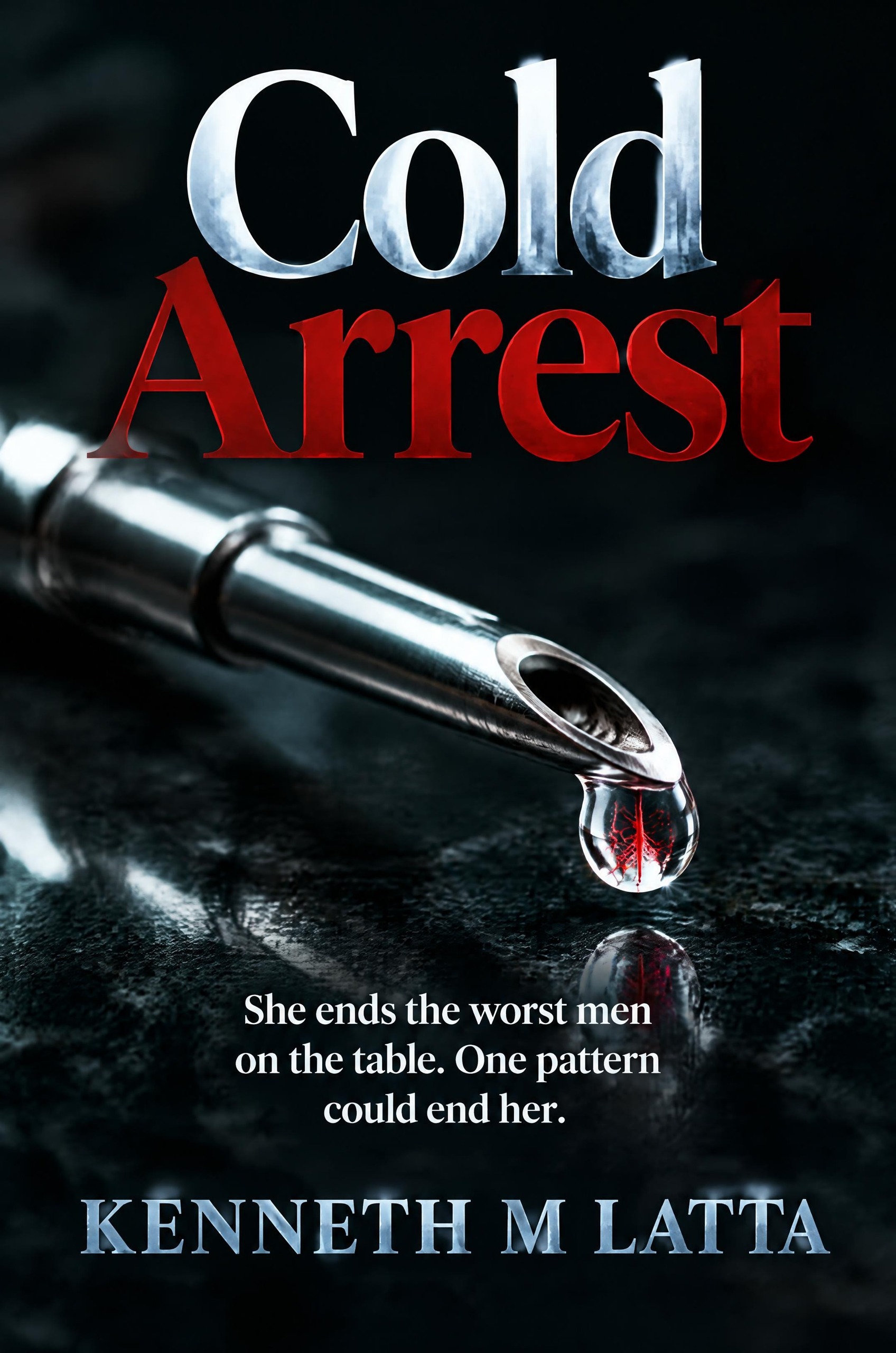
Cold Arrest
She ends the worst men on the table. One pattern could end her.
by KENNETH M LATTA
Dr. Christine Lennox is the star of St. Martin Metropolitan Medical Center: unmatched in the chest, ice-cold under the lights. Certain male patients never leave her table. Their deaths look like ordinary post-op heart failure. Review boards sign off. Families get condolences and a closed chart. Homicide Detective Victor Dane is not looking for a surgeon. He is following a neighboring precinct’s paper trail when a cluster of mortalities refuses to behave like chance. County pathologist Harrison West finds micro-vascular collapse that should not exist. Inside the OR, scrub nurse Janet Hobbs sees tiny procedural discrepancies and risks everything to get records out. Lennox does not panic. She uses hospital brass, political cover, and Commander Graham Elliot’s fear of a lost endowment to bury the case. Victor keeps digging toward a biochemical delivery through modified bypass cannulas—and a single microscopic piece of proof. As she preps her last case and a clean exit into philanthropy, the operating room becomes a crime scene. Cold Arrest is a forensic cat-and-mouse medical thriller about who we trust with the knife.
- Mystery
- Thriller
- Crime Fiction
- Horror
- Medical Mystery
- Cat & Mouse
A Clean Incision
The overhead surgical lamps in Operating Room 4 cast a stark circle of luminescence across the sterile field. Within that disc of white light lay the opened thoracic cavity of Raymond Finch, his sternum separated by a stainless steel retractor, revealing the slow, heavy heave of a heart burdened by three-vessel disease. Beyond the blue disposable drapes, the rest of the world ceased to exist. Monitors pulsed in green and amber along the periphery. The heart-lung machine hummed with the rhythmic, wet cadence of mechanical displacement, processing Finch's dark venous blood, stripping it of carbon dioxide, and pushing oxygenated crimson back into his femoral artery.
Dr. Christine Lennox extended her right gloved hand without glancing up from the wound. Her knuckles were steady, her shoulders lowered into an unyielding posture of absolute command.
"Graft scissors," Christine said. Her voice carried the clean, metallic edge of a sharpened blade, cutting effortlessly beneath the ambient drone of the scrub room ventilators.
Beside her, Janet Hobbs laid the curved Metzenbaum scissors into Christine's open palm with an immediate, tactile snap. Metal clicked cleanly against wet latex. Janet's free hand remained poised over the instrument tray, index finger tracing the next clamp in sequence, matching the rhythm of the sternal retractors and the mechanical intake of the suction tip without looking away from the exposed mediastinum.
Christine trimmed the distal end of the saphenous vein segment with millimeter precision. Her fingers moved through the surgical field with total economy. Underneath the clinical composure, her thoughts remained entirely cold and detached. Raymond Finch was fifty-four years old, heavily built, and possessed the dense, leathery subcutaneous fat of an unrepentant drinker. To the municipal board, he was a vital general contractor who secured contracts for transit lines and civic plazas. To the quiet records buried in county precincts across the river, he was a brute who had broken the orbital sockets and cracked the ribs of two separate domestic partners until both lay comatose on cold linoleum, escaping prison time through bought alibis and aggressive legal threats.
A man who strikes until the bone yields, Christine thought, seating the vein against the left anterior descending artery. A parasitic organism convinced of its own permanence.
She did not feel anger. Anger was an unruly biological spike, a surge of catecholamines that compromised vascular control and disrupted fine motor skills. Instead, she viewed the operation as an overdue technical adjustment. Finch had arrived on her table because his coronary arteries were choked with calcium and lipid plaques, the inevitable physical toll of a life lived through gluttony and unbridled rage. She was merely curating the outcome.
"Seven-zero Prolene," Christine instructed, not lifting her eyes from the magnification loupes fixed to the bridge of her nose.
Janet handed the hair-thin suture to Christine's needle driver. "Suture loaded, Doctor."
"Anastomosis proceeding," Christine murmured, acknowledging the circulator nurse who logged each landmark into the electronic chart across the room. "The arteriotomy is clear. Perfusion pressures are stable at sixty-five millimeters of mercury."
Behind the clear plastic barrier at the head of the table, the perfusionist nodded, his eyes scanning the console that regulated Finch's suspended life. "Cardiopulmonary flow is steady at four point two liters, Dr. Lennox. Blood gas is balanced. Myocardial temperature remains at twelve degrees Celsius."
"Thank you, Paul," Christine said mildly. She threw her knots with practiced elegance, tying off the delicate vascular joins. Each movement was fluid, effortless, and mathematically sound. She had performed this exact operation over twelve hundred times in her career. She knew the tensile strength of the human aorta, the precise resistance of calcified intima, and the subtle friction of synthetic thread biting into tissue. She could feel the fragile architecture of the man's mortality through the tips of her surgical gloves.
Janet leaned forward slightly, holding the suction tip near the junction to clear any seepage of blood. Her knuckles were white against the suction wand. Janet was usually silent, but today her dark eyes tracked Christine's hands with an intense, unblinking concentration.
"Keep the suction steady, Janet," Christine remarked, her tone conversational and devoid of malice. "Fluid pooling obscures the distal heel. Precision requires an unobstructed field."
"Yes, Doctor. Understood," Janet said quickly, pulling the suction cannula back a fraction of an inch to clear the line of sight.
Christine tied the final knot, clipped the suture ends, and inspected the three finished bypass grafts. The saphenous vein bridges and the internal mammary artery were positioned flawlessly. There was no leaking at the suture margins. Anatomically, the reconstruction was a masterwork. Anyone examining the physical integrity of the vessel bridges would conclude that Raymond Finch had received the finest cardiovascular intervention modern medicine could provide.
"Grafts are secured," Christine declared to the room. "Let us prepare to de-air the root and remove the aortic cross-clamp. Prepare to re-warm the patient and initiate the final cardioplegic flush."
"Rewarming initiated," Paul confirmed from the perfusion rig. "Water bath up to thirty-six degrees. Delivering warm blood cardioplegia in thirty seconds."
Christine shifted her weight slightly. Her left hand rested naturally against the transparent tubing of the cardioplegic infusion line running from the secondary infusion manifold. Concealed beneath the cuff of her sterile blue gown, gripped between her thumb and forefinger, was a flat, medical-grade micro-injector no larger than a matchstick. It contained two-tenths of a milliliter of an ultra-concentrated, engineered barium-potassium organometallic adduct.
The compound possessed no smell, no color, and left no broad chemical trace. It was designed to slip through standard blood panels, mimicking the catastrophic calcium-overload cascades that occurred during sudden, uncontrolled ischemic-reperfusion injury.
"Re-warm flush flowing," Paul announced, turning the three-way stopcock on his console.
Christine positioned her palm over the auxiliary injection port along the sterile bridge. It was a standard motion, one she frequently used to verify the pressure compliance of the tubing by tactile feel. With an imperceptible contraction of her thumb, the needle of the micro-injector breached the self-sealing rubber membrane of the infusion line. The piston depressed. Two-tenths of a milliliter slid into the stream of warm, oxygen-rich blood, swept away instantly by the flow into Raymond Finch's coronary sinus.
She withdrew the micro-injector smoothly, allowing it to slide into the deep, sterile fold of her gown's sleeve pocket. The entire action had taken less than two seconds.
Janet, standing eighteen inches away, blinked. She adjusted her grip on the retractor. Her eyes darted from Christine's hands down to the tubing, then back to the surgeon's covered face. A quiet tension tightened Janet's brow beneath her scrub cap. She opened her mouth as if to ask a question, but closed it immediately, swallowed, and stared back down into the open chest.
Christine felt a faint thrill of disdain. Suspicion was meaningless without clinical proof, and Janet had nothing more than an uneasy glance.
"Release the aortic cross-clamp," Christine ordered evenly.
The surgical clamp was unbolted from the great vessel. Finch's systemic circulation re-engaged. Blood surged through the aorta, flooding the freshly placed bypass conduits. Within seconds, the cold, still cardiac tissue began to pink. The muscle stirred, sluggish at first, shivering under the reintroduction of metabolic energy, then organized itself into a slow, rhythmic mechanical contraction.
"We have spontaneous rhythm," Paul called out, his voice relaxed. "Sinus bradycardia, forty-two beats per minute. Gaining rate."
"Pacing wires are not required yet," Christine noted, checking the monitor. "Allow the myocardial tissue to re-perfuse naturally. Janet, let us have warm saline for irrigation."
Janet turned, her motions slightly stiff, and retrieved the stainless bowl. "Warm irrigation, Doctor."
Christine poured the saline over the cardiac surface, washing away residual coagulated blood into the suction drain. The heart beat steadily, its rate climbing to sixty, then sixty-eight beats per minute. The arterial line tracing on the high monitor painted crisp, peaked systolic curves. Across the sterile curtain, the anesthesiologist adjusted the ventilator settings, clearly preparing for an uneventful closure.
Twelve minutes, Christine counted internally. The lipid compound requires twelve minutes of normothermic circulation to saturate the sarcoplasmic reticulum.
She used the time to inspect the pericardial cavity, chatting occasionally with the team about routine administrative scheduling for the coming Thursday. She spoke with measured ease, her voice low and soothing. To any outside observer, this was an ordinary afternoon ending with a textbook surgical victory. Finch's heart continued to contract, pumping blood through newly opened passages, an engine running on borrowed time.
At precisely eleven minutes and forty seconds following clamp release, the rhythm tracing on the overhead display flickered.
A single premature ventricular contraction disrupted the line. Then a second. Then a cluster of three.
"Dr. Lennox," the anesthesiologist remarked, leaning forward. "We have sudden PVCs. Widening QRS complexes."
Christine kept her eyes fixed on the beating muscle. "Administer one hundred milligrams of lidocaine intravenously. Verify electrolytes."
"Lidocaine going in," the anesthesiologist said.
The drug had no effect. Within the chest, the coordinated contraction of the ventricles dissolved into an irregular, convulsive tremor. The cardiac muscle lost its unified pump function, writhing like a nest of trapped serpents beneath the bright lights. The crisp waveforms on the monitor flattened into the jagged, chaotic saw-tooth pattern of coarse ventricular fibrillation.
"Patient is in V-fib," Paul said, his voice rising in alarm. "Pressure is crashing. Mean arterial pressure down to thirty."
"Internal paddles," Christine commanded, her voice dropping into a register of icy, unhurried authority. "Charge to twenty joules."
Janet moved with urgent mechanical efficiency, retrieving the sterile internal defibrillator paddles from the side table and presenting them. Her hands were rigid. "Paddles ready. Charged to twenty."
Christine took the spoons and pressed them firmly against the quivering muscle of Finch's heart, one on the anterior wall, one behind the apex. "Clear."
The team stepped back from the stainless steel table. Christine pressed the discharge buttons on the handles. Finch's torso jerked as the current tore through his chest. The monitor registered the jolt, but the jagged lines immediately returned, degenerating into fine, chaotic static.
"No conversion," the anesthesiologist called out. "Still in fibrillation. Epinephrine one milligram IV push. Amiodarone three hundred."
"Charge to thirty joules," Christine said calmly. "Re-applying paddles."
She placed the paddles again. She discharged the current. The myocardium twitched under the electricity, but the fine micro-vascular collapse within the deep tissue had already finished its work. The intracellular potassium gradient had ruptured entirely, locking the cellular membranes into an irreversible state of electrical refractory arrest. The heart could no longer generate an organized contraction. It was drowning in its own cellular debris.
For the next eighteen minutes, the theater devolved into the controlled frenzy of an unsuccessful resuscitation. Epinephrine was pushed. Atropine followed. Christine performed open-heart cardiac massage with steady, mechanical compressions of her fingers, rhythmically squeezing the dead muscle while the anesthesiologist squeezed the ventilation bag. She allowed the protocol to run its full, exhausting course. She let the team exhaust every vial, every standard countermeasure, every joule of electricity the equipment could safely deliver.
Janet stood motionless at the tray, her dark eyes wide behind her plastic eye shield, watching Christine's rhythmic hands compress the ruined heart. Janet's breathing was shallow. She knew what failure looked like, but she had never seen an arrest drop so sheer and unprovoked.
Finally, the monitor flattened into a continuous, unbroken horizontal tone. Fine fibrillation had faded into complete, unresponsive asystole.
Christine stopped compressing. She lifted her hands from the chest cavity and allowed the muscle to settle. She looked up at the wall clock, its red digital seconds continuing their indifferent march.
"There is no cardiac response," Christine said. Her voice was flat, carrying the calm finality of a judge reading a verdict. "Pupils are fixed and dilated. We have exceeded maximum resuscitation limits. Time of death: six forty-two PM."
A tired silence settled over the operating room. The anesthesiologist reached up and muted the flatline alarm, leaving only the hum of the air handlers. Paul began the methodical process of powering down the bypass circuit, disconnecting the plastic reservoirs that held Finch's cooled, unneeded blood.
"A tragic outcome," Christine said smoothly, looking across the table at her scrub nurse. "A sudden, refractory reperfusion injury. His coronary micro-vasculature was simply too brittle to tolerate physiological re-oxygenation. It happens in these severe multi-vessel cases. The myocardium was structurally spent before he ever arrived on our table."
Janet did not answer right away. She kept her eyes on the surgical field, staring at the perfectly placed bypass grafts that sat pristine and useless across the dead heart. "Yes, Doctor," she finally managed, her voice thin.
"Janet, help me discard the sterile field," Christine directed. "The family will need to be informed, and the mortality documentation must be precise."
Christine untied her gown at the neck, rolled the contaminated blue fabric inward with seamless grace, and stepped backward away from the operating table. She stripped off her gloves, dropping them directly into the red hazardous waste bin, revealing pale, impeccably scrubbed hands that showed not the slightest tremor.
She walked through the double swinging doors into the surgical scrub bay. The stainless steel sinks gleamed under the fluorescent fixtures. The harsh smell of povidone-iodine and chlorhexidine hung in the cool air. Christine pressed the foot pedal, letting cold water run over her wrists, watching the faint residue of latex powder wash down the stainless drain.
Janet entered a moment later, carrying the sealed container of sharps and used instrumentation. She moved with a hesitant, guarded slowness, avoiding Christine's gaze as she set the metal tray onto the processing counter.
"You seemed distracted during the de-airing phase, Janet," Christine said quietly, her back turned to the nurse as she dried her hands with a lint-free towel.
Janet stopped. She kept her back straight, but her fingers twitched against her scrub pants. "It was just... the arrest happened very fast, Dr. Lennox. He had good tone coming off bypass. The rhythm looked stable."
Christine turned around slowly. Her slate-gray eyes fixed upon Janet with an unblinking, analytical intensity. She tilted her head slightly, her posture erect and commanding. The scrub bay felt small, the sound of the running faucet loud between them.
"Cardiology is full of rapid de-compensations," Christine said, her voice dropping into a clipped, measured cadence. "Ischemic tissue is treacherous. A vessel that appears patent on the surface can harbor micro-vascular spasms deep within the capillary beds. We cannot control cellular fragility, Janet. We can only provide standard surgical care. You have been in theater long enough to know that bad vessels inevitably fail."
"I know," Janet whispered. "Of course, Doctor."
"File the post-operative report under acute reperfusion failure and refractory cardiac arrest," Christine instructed, her tone brooking no argument. "Make sure the bypass cannula logs are filed with the administrative office before you leave tonight. I will handle the primary surgical summary myself."
Janet nodded once. "I'll file them."
Christine smiled, a faint, precise movement of her lips that carried no warmth whatsoever. "Get some rest, Janet. We have an aortic valve replacement scheduled for seven o'clock tomorrow morning. I require your full focus."
Christine turned and walked down the scrub corridor, her footsteps clicking with steady, rhythmic confidence against the polished tile floor. She did not feel tired. At the junction where the hall met the sterile core, she unpinned her paper mask, tossed it into the linen hamper, and paused under the recessed fluorescent strip to examine her fingertips, turning them once in the pale glare to check for any stray speck of red beneath the nails.
The Bell Curve
The fluorescent tubes in the bullpen flickered with a faint, persistent hum that Victor Dane had stopped hearing five years ago. His desk stood near the southern bank of windows, where the radiator hissed wet steam against panes coated in autumn grime. Around him, the Homicide Division operated in its usual mid-morning rhythm: phones ringing unansw…