

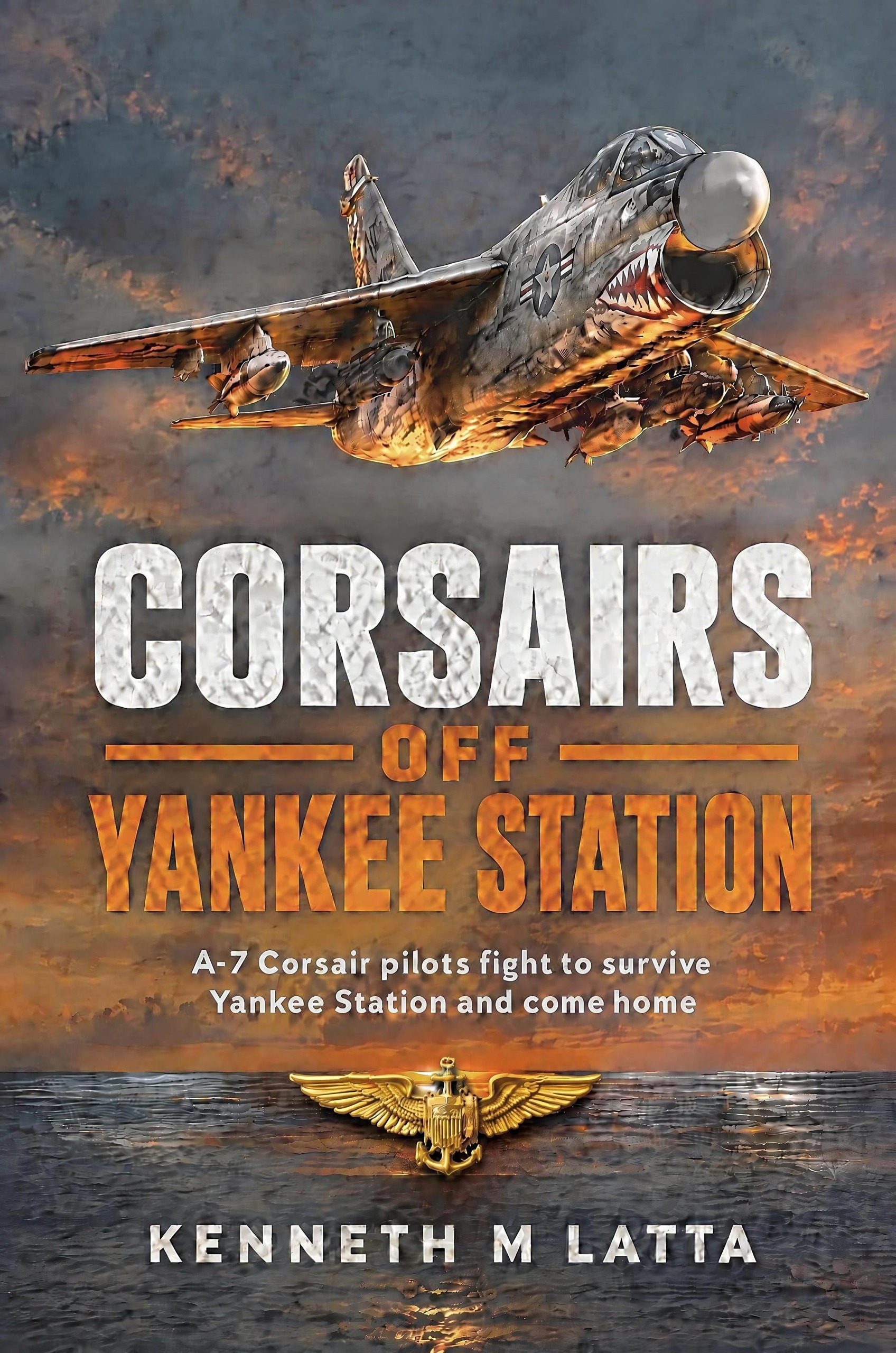
Corsairs off Yankee Station
A-7 Corsair pilots fight to survive Yankee Station and come home
The Gulf of Tonkin does not forgive a late pull-out or a missed radio call. Lieutenant Commander Ken MacIntyre flies the A-7 Corsair II off USS Coral Sea, leading a strike division whose only real mission is to bring every man back aboard. His wingman, Lieutenant Roger Vane, can put a bomb on a rail cut but cannot stop his hands from shaking when the tracers rise. Commander Arthur Sterling argues with admirals who want night launches through monsoon squalls. On the blacked-out flight deck, Senior Chief Paul Garcetti keeps steam catapults alive while jets come back holed and hungry for another turn. When a strike on a railroad hub goes wrong, Vane stares too long at the target and an SA-2 climbs. MacIntyre rolls into the missile to save him. Sortie quotas climb. Losses climb. The campaign drives toward a massive Alpha strike on the Thanh Hoa rail net under radar-guided flak. Corsairs off Yankee Station is a taut, closely observed novel of carrier aviation in Vietnam: the grit of the deck, the politics of target lists, and the bond between men who live one trap, one cat shot, one SAM at a time.
- Non-Fiction
- Historical Fiction
- Thriller
- War & Military
- History
- Cold War
Turn into the Wind
The vibration began deep in the ship’s keel before the bridge announced the turn. Lieutenant Commander Ken MacIntyre felt the hull shudder through the soles of his flight boots, forty thousand tons of steel banking slowly into the prevailing easterly swell of the Gulf of Tonkin. Overhead, the ventilation ducts hissed against the damp, tropical morning. The USS Coral Sea was coming around into thirty knots of natural wind, bringing the flight deck alive for the first strike of the day.
In Ready Room Two, Commander Arthur Sterling stood before the lighted tactical board, his grease pencil poised against the plexiglass map of North Vietnam. The room smelled of stale coffee, damp canvas, and cooling air-conditioning that barely held the morning heat at bay. Sterling’s graying hair was cut tight to his scalp, his broad shoulders squared against the low bulkhead. He waited until the red rotation light stopped swinging overhead before he spoke.
"Target is the classification yard south of Vinh," Sterling said, tapping the black grease-pencil circle. "Task Force Seventy-Seven wants the rolling stock interdicted before it reaches the southern supply depots. Intel dropped a fresh reconnaissance packet thirty minutes ago. The North Vietnamese have ringed the perimeter with newly emplaced 37mm batteries, radar-laid and manned by seasoned gunners. We also have confirmation of mobile Soviet-built radar vans deployed along the coastal ingress route. If you stay on your run too long, they will paint you before you clear the hills."
Sterling passed the mimeographed target sheets down the row of tiered vinyl chairs. He looked directly at MacIntyre, then let his slate-gray eyes settle briefly on Lieutenant Roger Vane.
"We fly the mission assigned by Task Force Seventy-Seven, gentlemen, but we fly it smart," Sterling continued, his voice low and firm. "Check your ordnance switches and bring those airframes back. Vane, keep your scan outside the cockpit. Do not bury your nose in the sight. Lead will set the release profile, and you come off the target in his wake. No second passes."
MacIntyre took his flight packet and studied the approach vectors. The target was hemmed in by river bluffs, offering poor egress options if the weather went sour. Beside him, Vane was writing grease-pencil notes directly onto his kneeboard. The young aviator’s handwriting was jerky, his sandy blond hair damp with sweat that had already soaked through the neckband of his flight suit.
"You set on the fuel numbers, Roger?" MacIntyre asked.
"Set, boss," Vane replied. His voice was higher than usual, cracking slightly around the edges. He forced a thin smile, repeatedly twisting the bayonet connector of his anti-g suit hose until the brass detent clicked home.
"Expect the deck at three thousand," MacIntyre said calmly. "We come underneath, lay the sticks down in single-drop ripple, and break hard for the water. Follow my belly. Don't look back to see the dust."
They walked the narrow passageway toward the flight deck access hatch. The transition was immediate: the roar of Allison TF41 turbofans slammed through their hearing protection, and the thick, humid air of the Gulf hit them like a wet woolen blanket. Exhaust fumes and the sharp, hot stench of boiled grease from the catapult machinery drifted across the non-skid deck.
Senior Chief Paul Garcetti was already down in the gut of the waist, working near the track of catapult one. The flight deck was a controlled storm of colored jerseys, but Garcetti dominated his sector with raw physical presence. He was broad, his muscular forearms black with grease and stained with salt. He shoved a young crewman back toward the deck edge, pointing a gloved fist at the shuttle gear.
"Clear that bridle!" Garcetti bellowed, his voice cutting through the mechanical howl of the jet engines. "Watch your step on the track, kid, this catapult will tear your leg off before you feel the snap! Give 'em the weight board! Clear that deck!"
Steam hissed from the shuttle trough in thick white plumes, drifting over the rough, oil-stained steel. Garcetti wiped his brow with the back of his wrist, leaving a smear of dark lubricant across his forehead, and signaled the deck crew to bring the first aircraft into the blocks.
MacIntyre climbed the boarding ladder of his A-7A Corsair II, Bureau Number 401. The jet sat low and squat, heavy with Mark 82 five-hundred-pound bombs slung along its wing pylons. The plane captain helped him strap into the ejection seat, hauling the shoulder harnesses down hard until the nylon bit into MacIntyre's collarbones. MacIntyre connected his oxygen mask, hooked up the survival radio lead, and checked the weapon release panel. He ran through the blind cockpit drill he had practiced hundreds of times to keep his mind steady: gloved fingers finding the master arm guard, clicking the heads-up display rheostat up three notches, thumbing the cold, knurled cylinder of the fuel dump valve where bare metal showed through worn paint.
He turned his head to the right. Catapult two held Vane’s Corsair. The young pilot was struggling to seat his oxygen mask, his fingers repeatedly slipping off the knurled bayonet latch before forcing the prong home against the gray rubber seal. Vane rubbed his dark visor with a forearm, his shoulders locked rigid beneath the straps.
MacIntyre caught Vane’s eyes through the canopy glass. Slowly, deliberately, MacIntyre raised two fingers in a steady salute, followed by a flat palm pressed horizontally against his own visor—the universal signal to breathe, level out, and hold the scan. Vane paused. Under the tight green nylon of his torso harness, his rapid chest rises slowed, easing out into long, measured exhalations that misted and cleared against his visor. He blinked, nodded once, and settled his hands firmly on the canopy rail.
Down on the deck, the yellow-shirted flight director taxied MacIntyre’s Corsair forward until the nose gear dropped into the catapult shuttle. The holdback fitting locked into place with a sharp metallic clack. The jet groaned as the deck crew hooked up the launch bridle. The wind whipped salt spray across the nose cone, thirty-two knots over the deck as the carrier cut into the ocean swell.
Garcetti moved forward, checking the nose gear tension bar himself. He slapped the fuselage with his open hand, stepped clear into the catwalk, and looked toward the catapult officer. The weight board showed the gross launch weight. Garcetti pumped his arm, confirming the steam accumulator pressure setting while keeping a wary eye on the aging valve seals.
MacIntyre ran the throttle forward. The Corsair vibrated violently as the turbofan screamed to military power. The fuel flow gauge spiked, the turbine gas temperature held within limits, and the engine instruments showed solid green. MacIntyre checked the control surfaces, cycling the stick in a complete box—ailerons left, ailerons right, elevators full deflection. He looked left, braced his helmet back against the headrest, and dropped his hand to the canopy grab handle, snapping a rigid salute to the catapult officer.
Garcetti watched the cat officer drop to one knee and touch the deck, slashing his right arm forward toward the bow. The deck crewman pushed the fire button.
The stroke fired with a metallic sledgehammer hit that snapped MacIntyre's head back. Four g's slammed him against the armor plate, pinning his breath in his chest and driving his eyeballs into their sockets. Two hundred feet of non-skid vanished under the intake in a flat blur, the carrier's rounded bow dropped away, and suddenly the Corsair hung thirty feet above open water, settling briefly until the wings caught cushion air off the swells.
"Lead is airborne," he said into the mask.
Behind him, catapult two fired. A massive cloud of white steam vented across the forward deck as Vane’s Corsair was hurled into the sky. The second jet dropped toward the whitecaps before its wings found lift, banking cleanly to the right to clear the carrier’s turn. Within ninety seconds, Vane tucked his nose up and slid into position on MacIntyre’s right wing, maintaining combat spread as the two aircraft climbed through three thousand feet, turning their noses westward toward the coast.
Feet Dry
The brown surf line slipped behind them, and the Gulf gave way to the flat, pale greens of the coastal lowlands. Lieutenant Commander Ken MacIntyre leveled his Corsair off at two thousand feet, tucking the flight under a ragged ceiling of gray stratus. Down low, the air lost the cold smooth bite of the open sea. It grew thick and turbulent, bumping…