

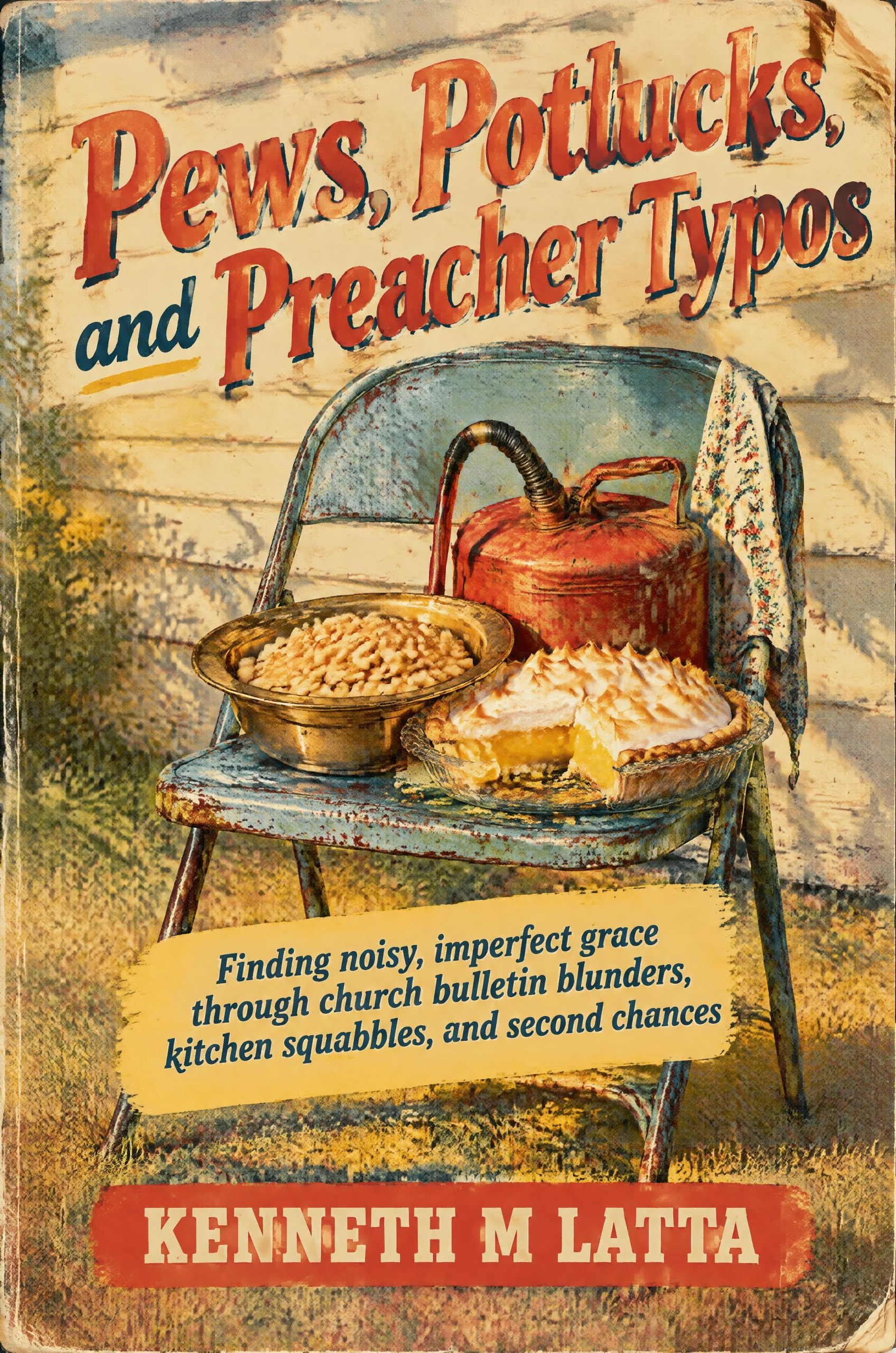
Pews, Potlucks, and Preacher Typos
Finding noisy, imperfect grace through church bulletin blunders, kitchen squabbles, and second chances
by KENNETH M LATTA
Welcome to Mount Gilead Church, where sanctification happens one minor catastrophe at a time. Between jammed copiers churning out inadvertently scandalous bulletins, a temperamental basement furnace that groans like a dying beast, and passing poultry trucks scrambling the outdoor marquee letters, the pastor of this small Southern flock has his hands full. Add matriarch Granny Horton patrolling the potluck line to enforce strict mayonnaise doctrines, and simply getting through Sunday morning service feels like a miracle. When town outcast Bunco Potts gets caught siphoning gas in the gravel parking lot, righteous outrage threatens to derail the fellowship. But instead of calling the sheriff, Mount Gilead chooses an unconventional, messy path of hospitality. Handed a ladder, a plate of yeast rolls, and honest work alongside folks wrestling with their own quiet heartaches, Bunco discovers that forgiveness does not always arrive quietly in clean pews. Pews, Potlucks, and Preacher Typos is a charming, tenderhearted, and riotously funny portrait of community life that shows redemption is best served with plenty of grace and warm homemade pie.
- Literary Fiction
- Southern Fiction
- Small Town Drama
The Copier Eats Sunday
I cleared my throat the way a man does when he already suspects the paper in his hand is going to betray him. Late spring light came through the stained glass and laid a gold stripe across the second pew, which was as close as Mount Gilead ever came to looking solemn before the first hymn. I smiled at the folks I had shepherded for twenty-two years and said, "Now, friends, if you would turn to the hymn listed in this morning's bulletin."
They did. A rustle went down the rows like a field of corn in a small wind. Then a quieter rustle, the kind that means people have read something they were not supposed to read in church. I looked down at page two. The title had lost a letter. What should have been a sacred song now sat there looking like a grocery-store scandal. I felt my clip-on tie shift. My glasses slid. I pushed them up and tried to keep my face pastoral.
Imogene Medlock, still clutching a bottle of correction fluid as if it might yet rewrite history, waved from the organ bench. She mouth-whispered, fast and frantic, that nobody should look at page three. I did not look at page three. Half the congregation did. Somebody in the back made a sound that might have been a cough if a cough could blush.
Granny Horton sat in the alto section like a small, blue-haired fortress. She sniffed once, a sound that could have stopped a mule. Then she opened her mouth and led the first verse, anyway, daring anyone to snicker. The altos followed her because that is what altos do when Granny Horton decides the hymn will be sung with dignity even if the bulletin has gone to seed. I joined in a beat late, praying the Lord would hear the tune and not the typesetting.
We made it through. I moved into the prayer, the one I had practiced in the office with my eyes shut, hoping gravity would hold. Midway through the amen meant to settle the room, the furnace groaned. It sounded like a hog with opinions. Clifton Lowery, lanky in the back pew, reached over and whacked the thermostat with two knuckles, the way a man taps a mule that already knows better. The groan faded into a sulk. I finished the prayer with my ears hot and my clip-on sitting crooked.
After the benediction I followed Imogene to the church office. The old copier had jammed on fifty more copies of the same blooper, a black tongue of paper hanging out like it had tried to confess and got stuck. Toner dusted the tray. Imogene's cropped curls were standing a little extra from the static, and her reading glasses were shoved up into her hair. "Oh goodness me," she said, "don't look at page three yet, nobody looks at page three." She said it even though we were already looking at a pile of page twos that had done enough damage for one Sabbath.
I pinched the tip of my clip-on tie with a dry paper towel, hoping for a dignified dab, but the black powder immediately liquefied against the polyester. When I tried rubbing it out, the thumb-sized smudge bloomed into the shape of a scorched pork chop across my sternum. Each swipe only pressed the soot deeper into the pale yellow weave until my fingers were tipped black and my pastoral authority looked like it had survived a chimney fire. Gravity, I have learned, does not survive office machines.
Granny Horton marched in with a casserole pan held at inspection height. "If the paper is a mess," she said, sweet as tea and twice as sharp, "at least the ham will be perfect." She set the pan on the side table as if the Lord Himself had requested a status report on pork. I told her I believed her, because a preacher may doubt the reliability of human nature, but a wise man never doubts Granny Horton when it comes to ham.
Edna Fitzhugh dropped by with leftover nursery wafers in a plastic bag, her orthotic sneakers squeaking on the linoleum. She took one look at the jammed copier, at my tie, at Imogene's correction fluid, and laughed until her bifocals bounced on their beaded chain. "Mercy me," she said, "sugar-pie, that bulletin has more personality than half the deacons." She offered me a wafer. I took it. It tasted like glue and Sunday school, which is to say it tasted honest.
Clifton stuck his head long enough to say the furnace had decided to behave for the fellowship hour, which in Clifton-speak meant he had threatened it with a wrench and a verse of Scripture. Then he was gone toward the kitchen, because a man who keeps a church standing also knows when ham is about to be sliced.
I walked out to the lot because a pastor cannot hide in toner forever. The air smelled like grass and hot asphalt. Over by Deacon Miller's pickup, Bunco Potts stood hunched with his shoulders curled inward against the world, squinting under stringy, unwashed bangs plastered to his temple. He had spent his twenty-nine years sliding toward the edges of this county, drifting into exile one skipped Sunday and bad turn at a time, wearing the same salt-stiffened flannel shirt that never seemed entirely dry. In his left hand, half-tucked into an oversized coat pocket, a clear length of siphon hose caught the noon glare. He froze when gravel crunched under my soles, quickly angling his body toward the gravel and pretending to nudge a lost washer with the toe of a cracked work boot, though tailpipes in this lot had learned to dread him more than any man since Job.
"Bunco," I called, easy as I could make it, "come on inside before the potato salad vanishes. There is a plate with your name on it if you can find a fork."
He grunted something that might have been thanks if thanks had a rasp. He coiled the hose without looking at me and followed at a distance, like a man who expects the door to close. I held it open anyway.
Inside, the fellowship hall kitchen was already doing what it does: plates clinking, sweet tea sweating, Granny Horton directing traffic with a serving spoon. Imogene had given up on the copier and was washing her hands as if ink were original sin. Edna set the wafers next to a bowl of punch and told a child not to run, which the child did not hear because children never do. Clifton leaned on the doorframe and watched the thermostat like it owed him money.
I ate standing up, the way a preacher eats when he is still half in the pulpit. The ham was, as promised, perfect, salty and warm against the cold crunch of Granny's chow-chow. I chewed slowly, balancing my paper plate on the edge of the counter while the din of clattering forks and neighborly talk washed around me.
When the last dish was scraped, I carried the ruined bulletins back to the office. The bottom drawer on the left of my desk has a masking tape label I put there years ago, curled at the corners, in fading blue ballpoint. It just says Scratch / Backside Clean. I slid the whole stack in, toner and all, and shut it. Next week will not be quieter. The copier will jam. The furnace will comment. Somebody will lose a letter, and somebody else will sing anyway.
I wiped my tie again, which did nothing, and walked back toward the hall where the ham was already becoming leftovers and leftovers were becoming fellowship. Bunco sat at the end of a table with a paper plate and his shoulders up around his ears. I did not mention nickels or hoses. I poured him more tea and set the pitcher down between us.
Imogene passed me in the hallway with her binder hugged to her chest. "Page three was the announcements," she said, almost to herself. "The covered-dish list. I spelled casserole with one s too many and it looked like a medical condition." I told her I had not looked. She did not believe me, but she smiled anyway, which is how we survive Saturdays that bleed into Sundays.
Granny Horton declared the kitchen closed with the authority of a woman who has closed kitchens since 1974. Edna collected wafer crumbs. Clifton reset the thermostat one last time and said, without looking at me, that the sign out front would need letters Thursday, weather permitting. I said weather rarely permits. He said that was about right.
I locked the office, left the bottom drawer shut, and stood a minute in the quiet sanctuary. The hymn boards still showed the numbers we had sung, and though the numbers had been correct, the paper certainly had not. I sat on the front pew and let my glasses slide, and I laughed once, private, the kind of laugh a pastor is allowed if nobody is taking minutes.
Then I went home with toner on my tie and ham on my breath and a drawer full of paper that should never have been printed, which is, I have come to believe, a fair description of most weeks at Mount Gilead.
Letters on the Highway
Wednesday night supper at Mount Gilead has always been a kind of unofficial theology, the sort you practice with a paper plate and a folding chair instead of a hymnal. Folks drifted into the fellowship hall carrying covered dishes the way pilgrims carry relics, and the long serving tables already looked like a county fair had parked itself indoors.…