

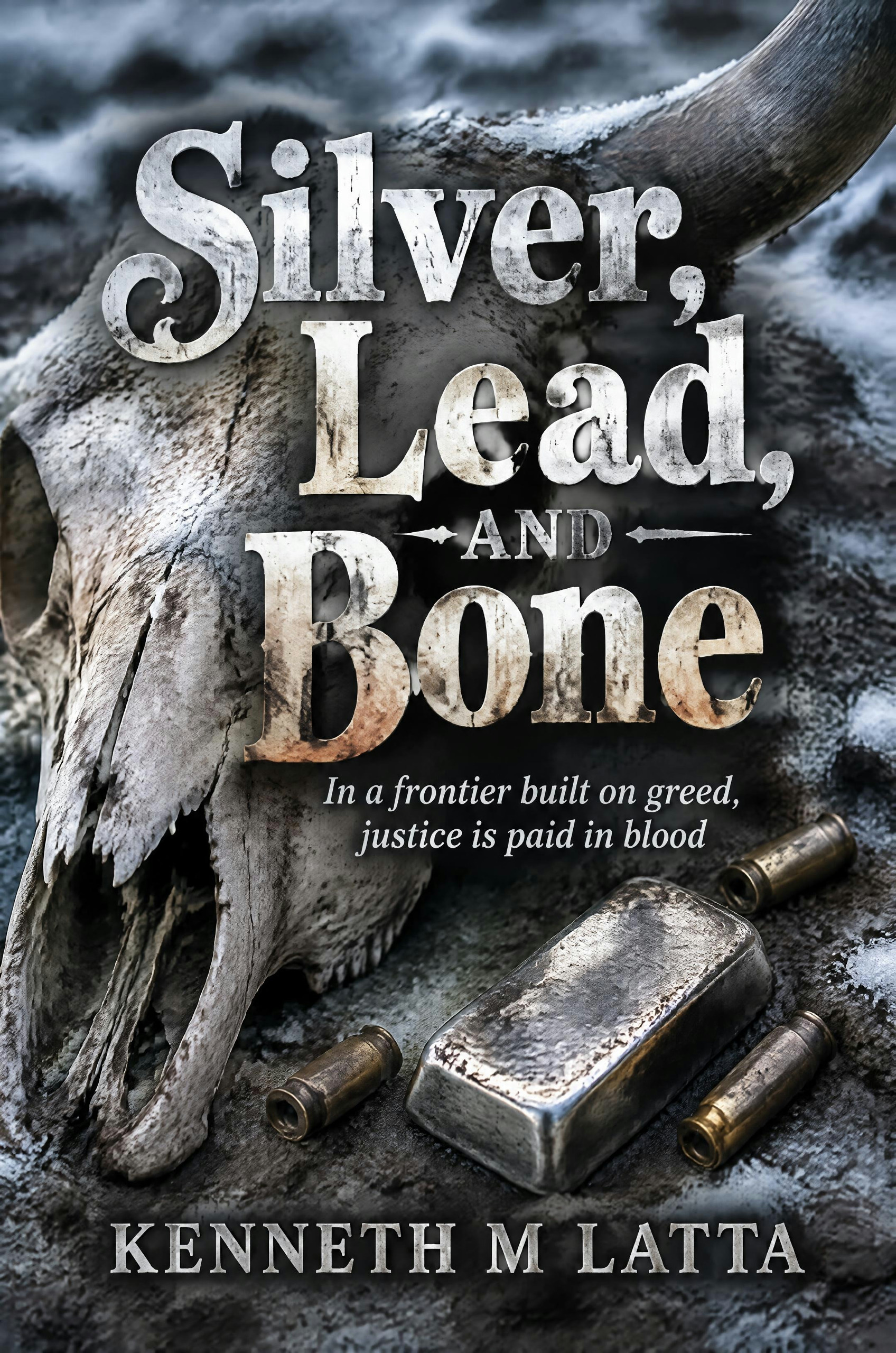
Silver, Lead, and Bone
In a frontier built on greed, justice is paid in blood
by KENNETH M LATTA
Winter 1880. In the boomtown of Oakhaven, silver brings fortune to a ruthless few and unmarked graves to everyone else. When cholera strikes the squalid mining camps and municipal corruption rots the settlement from within, veteran Marshal Henry Puckett fights an uphill battle to keep the peace. Then cold-blooded outlaw Benjamin Blythe stages a bloody jailbreak. Leaving slaughtered guards in his wake, Blythe vanishes into the blizzard-swept badlands to recover a buried fortune in bullion and slaughter those who put him in irons. Pursued by Marshal Puckett and a hardened plains scout, the manhunt cuts across treacherous mountain terrain and bullet-riddled cattle ranges. Back in town, a courageous saloon keeper and an embattled clinic doctor uncover a sinister conspiracy: a powerful syndicate is poisoning the water supply to crush independent homesteaders. Caught between treacherous frontier terrain, ambush by outlaws, and venomous civic treason, Puckett must wage an all-out war before Oakhaven collapses into ruin. Silver, Lead, and Bone is a gritty, relentless Western epic of vengeance, survival, and the raw price of frontier justice.
- Western
- Historical Fiction
- Crime Fiction
- cattle
- Lawman
- Gunslinger
Frost on the Jailhouse Eaves
The stamp mills started before first light, a low hammering that rolled down from the Rawlings works and shook the frost off the jailhouse eaves. Marshal Henry Puckett stood on the stone step with a tin cup of coffee gone cold in his glove and watched the street take shape. Mud, ruts, a wagon chain rattling somewhere toward the creek. Breath rose off the backs of dray horses in white sheets. Oakhaven was waking the way it always did in November: loud, hungry, and already half sick.
He drank anyway. The coffee tasted of tin and last night's grounds, settling like grit in the back of his throat. His collarbone pulled where the old lead had scarred over against the bone, stiff and aching in the freeze. He rolled the shoulder once, set the tin cup on the stone sill, and reached for the heavy iron ring at his belt.
Inside, the cell block held its own weather. It was a drafty pit of iron, damp stone, and a box stove that had burned down to gray ash hours ago. Benjamin Blythe sat on the wooden bunk with his back against the limestone wall, his ankles crossed as if the iron uprights were nothing more than a hotel railing. He wore a tailored wool coat that had gathered grease at the cuffs, but his pale amber eyes were sharp, catching the gray light from the high clerestory grating. They found the younger man first.
"Morning, Deputy," Blythe said. The southern drawl was soft enough to pass for manners in a parlor. "You sleep any, or did you keep one eye on me all night like a good boy?"
Young Henry stood at the far end of the corridor, his back braced against the heavy pine timber of the outer doorframe. His Winchester rested across his sheepskin vest, both hands resting loose on the walnut stock. Sandy hair stuck out under his hat, and his jaw had the raw look of a boy who had tried to scrape his whiskers off with a dull razor before dawn. He was twenty and trying hard not to look it.
"I slept fine," the boy said.
"Sure you did." Blythe smiled without showing much tooth. His thin mustache curved over dry lips. "This town's law is a padlock and a prayer. You feel that, don't you? How thin it sits between this floor and the hole under it."
The marshal came through the heavy oak door, his canvas duster brushing the jamb. He did not look at Blythe. He looked at the locks. His thumb pressed into the first hasp, testing the spring. He gave the crossbar a solid jerk, then another. Each piece of iron answered with a dry, heavy clack that echoed off the wet limestone.
"Let him talk," the marshal said, his voice a low rasp from years of alkali dust. "Words don't open steel." He stopped before the center cell and let his slate-gray eyes settle on the outlaw. "You sit quiet. Your friends in the hills can freeze for all I care."
Blythe's smile widened just a fraction. He shifted his boots on the straw, the silver tips catching a sliver of dawn. "Friends get lonely, Marshal. Lonely men do loud work."
The marshal turned his back on the cage. He looked at his nephew, measuring the tightness in the young man's shoulders, the way the boy's knuckles showed white against the lever of the carbine. "You check these bars every hour. Not when you remember. Every hour. You take the iron rod from behind the stove and you strike each upright. If a pin sounds dead or a weld looks wrong, you holler. Don't play at being clever with him. He ain't here to make you a story."
"Yes, sir," Young Henry said. He shifted his weight, his boots scraping dry grit on the planks. "I know the routine."
"Knowing ain't doing. Watch his hands. Don't look at his eyes."
The marshal turned toward the front office, took his hat from the peg, and seated it low over his brow. The leather sweatband was stiff with cold. He unhooked his sheepskin-lined coat from behind the door, pulled it over his shoulders, and stepped out onto the boardwalk.
The November wind had a razor in it, cutting down the gulch from the high peaks. The air carried the sulfurous stench of slag heaps mixed with the greasy stench of fried lard and open cesspools. Down the length of Main Street, the mud had frozen into jagged ridges that threatened to snap a mule's fetlock. A freight wagon loaded with iron timbers groaned past, its chains clanking rhythmically as the driver cursed his six-mule team into the ruts.
Across the road, a miner stumbled out of a canvas-topped tent that served as an unbonded boardinghouse. The man was hollow-cheeked, his skin the color of tallow, and he wore a pair of trousers patched with flour sacking. He doubled over by the ditch, his chest heaving with a deep, rattling cough that ended in a wet retch. When he pulled his hand from his mouth, a dark splatter of lung-blood hit the gray frost. He wiped his chin with his sleeve, looked up at Puckett with glazed, feverish eyes, and shuffled toward the Rawlings shaft without a word.
Puckett watched the man go. The cholera had started down by the creek where the shanties drained into the wash, but the mountain fever and the bad lungs were everywhere. Men came here to tear wealth out of the rock, and the camp ground them into gravel before they could spend an ounce of it.
He stepped down into the frozen muck, his heavy boots breaking through the crust. The boardwalks on the north side of the street were already awake with the kind of business that never slept. The Golden Spur had its lamps lit behind frosted panes, the tinny racket of an upright piano bleeding through the clapboards. A dance-hall girl in a moth-eaten rabbit cape stood on the landing, emptying a bucket of dirty water into the gutter. She nodded to the marshal, her painted mouth tight against the wind, and ducked back inside to escape the draft.
Puckett paused beneath the overhang of the assay office. The town was moving, but two figures caught his eye. They stood fifty yards down, half-sheltered beneath the sagging awning of an empty dry-goods store. Both men wore long slickers despite the lack of rain, collars turned up against the wind, hats pulled low. They were not looking at the wagons, nor were they heading for the boardinghouses or the mines. Their eyes were fixed straight on the thick limestone front of the jailhouse.
One of them was tall, leaning against a cedar support post with his hands buried deep in his pockets. The other was broader, shifting his weight from boot to boot on the frost. They were watching the small, barred windows where the morning smoke had begun to trickle from the tin pipe.
Puckett stepped off the boardwalk, cutting an angle through the ruts. The Colt on his hip banged lightly against his thigh. He did not draw it, but his right hand dropped naturally near the horn grip. His left shoulder gave a familiar throb, the scar tissue tightening like a cinch.
Before he had crossed half the distance, the broader man caught sight of the star pinned to Puckett’s vest. He nudged his companion with an elbow. Without a word or a backward glance, both men turned, stepped down into the mud, and vanished down the dark, narrow alley that separated the dry-goods store from the assay office.
Puckett did not chase them. Running in frozen muck was a fool's errand, and a man who ran showed his hand before the cards were dealt. He walked with a steady, measured stride to the mouth of the alley. It was empty. The ground back there was churned with old frozen manure and trash, offering no clear boot prints among the debris. The passage opened out toward the lower creek bottoms, where dozens of miners lived in sod huts and canvas shelters.
He stood at the alley mouth for a minute, letting his eyes sweep the shadows, then turned back toward the jailhouse. His boots crunched on the frost as he climbed the steps.
Inside, the stove was beginning to draw, the smell of birch smoke pushing back the damp chill of the cells. Young Henry was standing at the corner desk, his Winchester leaning against the wood while he whittled a cedar splinter with his pocketknife.
"Put the knife away," Puckett said, closing the heavy door behind him and dropping the drop-latch.
The boy looked up, caught by the tone, and slid the blade into his pocket. "Something out there, Uncle Henry?"
"Marshal," Puckett corrected him, his voice flat. "When you're wearing that tin, it's Marshal. Take your coat and go down to Miller's livery. Walk through the stalls. Don't ask questions, just count the mounts. Look for horses that came in late, rode hard, and got put away wet. Count every saddle in the tack room that ain't got a local brand on the leather."
Young Henry picked up his rifle, checking the brass receiver out of habit. "You think Blythe's boys are in town?"
"I think two men were watching this stone while you were carving shavings," Puckett said. "Go down the rear boardwalk. Keep your eyes off your boots. If you see two slickers with high collars, you don't draw and you don't challenge. You come back here and tell me."
The boy drew a quick, sharp breath that hitched in his collar, his chest swelling hard against the wool of his shirt with the kind of jittery blood that got green drovers trampled in a river crossing. "I can handle myself if they start something."
"They won't start nothing with a boy holding a carbine unless they mean to put a hole through his lungs," Puckett said, his slate eyes leveling on his nephew until the boy looked away. "You walk, you count, you come back. Move."
The deputy nodded, pulled his woolen hat down tight, and went out the back door, slipping into the cold alley with quick, silent steps.
From the cell block, a low, dry chuckle drifted through the iron bars. Blythe had moved to the front of his cell. His fingers, long and clean compared to the rest of the camp, rested lightly around the cold round uprights. He had tilted his head back, watching Puckett through the heavy inner grating.
"You sent the boy on an errand, Henry," Blythe drawled. "That's good. Keep him away from the hard timber. Hate to see a pretty boy like that get his face laid open. He looks just like your brother did before the fever took him in Missouri."
Puckett walked slowly to the cell door. He stopped six inches from the iron. "You talk too much for a man facing a hemp collar in Prescott."
"Prescott is a hundred and forty miles of snow and bad rock," Blythe said softly. His amber eyes did not blink. "A man can die of a lot of things between here and there. Cold. Apoplexy. Stiff neck. Sometimes a wagon wheel just comes off on a ridge, and the whole box goes down into the scrub."
"The wagon won't lose a wheel," Puckett said.
"You got a lot of faith in iron, Marshal. Always did. You think because you mixed the lime and hauled the rock that this house is going to hold. But this camp ain't built on stone. It's built on grease. Cora Rawlings owns the dirt under your boots, and she pays the men who bring the timber down. You think she cares if I swing?"
"I don't care what Mrs. Rawlings thinks about you," Puckett said. "I care about the three men you put in the dirt outside the stage office."
Blythe's smile vanished, leaving his jaw hard and sharp. "They shouldn't have reached for their leather. A clerk with an oath is a fool with a gun. Same as your boy."
"He ain't a fool," Puckett said. "He just hasn't seen enough blood to know what it smells like when it sits in the dirt for two days."
He turned his back on Blythe's cold stare and walked back to the heavy oak desk in the outer room. He pulled the chair out, the legs groaning against the floorboards, and sat down. From the bottom drawer, he drew out the leather-bound ledger, thick and dog-eared, with corners worn down to the gray pasteboard. He dipped an iron pen into the inkpot and entered the date in a heavy, deliberate hand: November 18, 1880.
He wrote out the night's charges: one drunkard locked in the lean-to till dawn; an altercation between two teamsters over a mule harness, settled with a cracked rib; two vagrants ordered out of the creek bottom. Simple, ugly, routine business. The business of keeping a collection of angry, shivering men from burning their own roofs down over their heads.
The back door opened with a sudden scrape of wood. Young Henry slipped back into the office, his breath coming in short puffs of steam. Frost clung to the sandy hair around his ears. He set the Winchester against the desk with a sharp click and unbuttoned his vest.
"Well?" Puckett asked without looking up from the ink.
"Livery's got five new mounts in the rear stalls," the boy said, dropping his voice to a low murmur. "Rode hard. Sweat's dried crusty on their flanks, and their legs are caked in that red mud from the creek crossing five miles north. Miller wasn't there. Just an old Mexican boy sweeping the runway. He said two men came in an hour before dawn, left the stock, and took off on foot toward the saloons."
"Did you see the slickers?"
"No," Young Henry said. He looked toward the cell door, his face pale despite the cold. "I checked the boardwalks on the way back. Checked the assay porch. Gone. Both of them. It's like they just melted into the crowd coming down from the shift change."
Puckett closed the ledger with a quiet thud. He laid the pen across the groove in the wood and reached for the bottle of sweet oil and the flannel rag sitting beside the inkpot. He unholstered his Colt Single Action Army, checked the loading gate, and laid the heavy piece of steel flat on the blotter. He slid the cylinder out, the clicks of the ratchet sharp and clean in the quiet room.
"They didn't melt," Puckett said, his voice level. "They went where men go when they don't want to be seen. Into the cribs or down into the lower tents where nobody asks who a man is as long as his silver's heavy."
"Should we turn out the council?" the boy asked, his hands twitching on his belt. "Get some of the storekeepers deputized? If Blythe's men are gathering, they won't wait till noon. They'll hit us while the shift's changing at the mills, when all that stamp iron is drowning out the noise."
Puckett dipped the corner of the rag into the oil and began wiping down the cylinder, each chamber getting a slow, circular turn of the cloth. He felt the old lead in his shoulder, that dull, permanent reminder of a boy who had thought courage was something you showed off by shouting in the middle of a street.
"The council don't fight," Puckett said. "The council calculates. You ask them for men, and Cora Rawlings will have three lawyers telling you that Blythe is just a traveler until he shoots somebody else. We don't deputize clerks. A clerk with a gun gets killed, and then you have to bury him and listen to his sister cry."
He slipped the cylinder back into the frame and drove the pin home. The iron gave a satisfying, solid snap. He looked up at the boy, his slate-gray eyes pinning the deputy against the wall.
"You think that star makes you bigger than the man you're standing against," Puckett said. "It don't. That piece of tin just means you promised not to run when things get loud. The oath ain't a story in a nickel book, Henry. It ain't about standing tall while the band plays. It's iron. It's sitting in the cold, smelling sick men and horse piss, and holding a door because nobody else will."
Young Henry swallowed. The boy’s jaw tightened, and he looked down at the floor, where the gray frost had melted into small pools of greasy water around his boot heels. "I ain't going to run, Marshal."
"Good," Puckett said. He slid the Colt back into the leather at his hip, the worn holster creaking softly under the movement. "Because when Blythe's boys come, they won't come to talk about the law. They'll come to kill the lock and kill the men holding the key. You remember that rod. You check those bars every hour."
From the darkness of the cell block, Blythe's voice came one more time, dry and mocking, drifting over the smell of cold iron and lamp oil.
"Every hour, Deputy," Blythe murmured. "Make sure you count 'em twice. Daylight don't last long in this valley."
Puckett didn't answer. He stood, turned the lamp down just enough to save the kerosene, and walked back to the stone sill to look out at the grey, shivering camp. The stamp mills kept their rhythm, a steady, iron heartbeat shaking the mountain, while Oakhaven moved through the frozen mud toward whatever blood the day was going to cost.
Silver on the Ledger
The sun sat behind a shelf of lead-colored cloud by the time Marshal Henry Puckett crossed the gulch toward the lower quarter. The midday whistle had blown at the Rawlings works twenty minutes earlier, a long, tearing blast that left the mules twitching their ears along the teamster lines. Men were sitting along the boardwalks with lard buckets bet…