

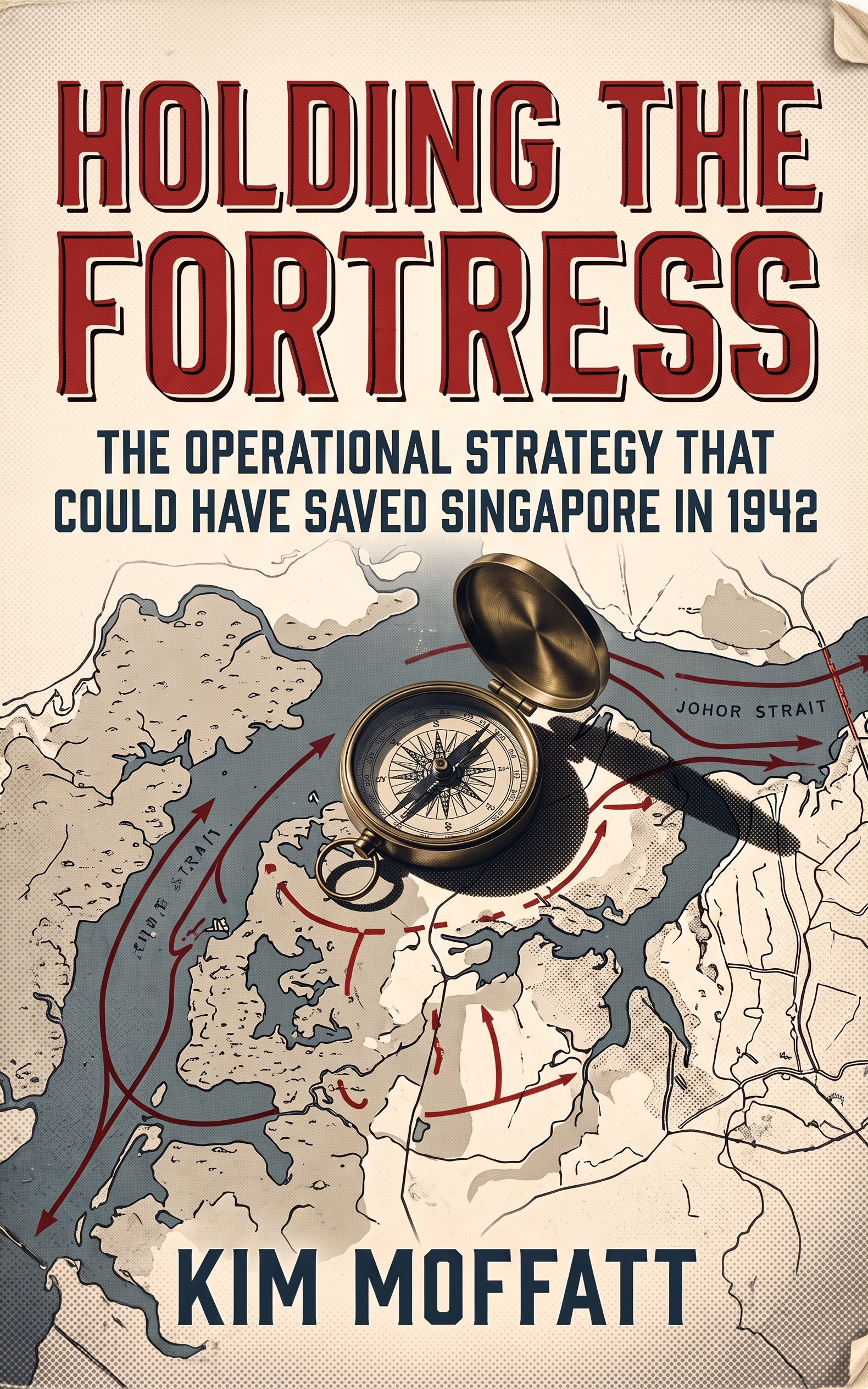
Holding the Fortress
The Operational Strategy That Could Have Saved Singapore in 1942
by Kim Moffatt
The catastrophic fall of Singapore in February 1942 has long been remembered as an inevitable disaster—a fortress doomed by Japanese superiority, inadequate defences and the famous story of great guns pointing the wrong way. But what if Singapore could have been saved? In Holding the Fortress, military historian Kim Moffatt challenges one of the most enduring assumptions of the Second World War and asks a provocative question: Did Singapore fall because it was impossible to defend—or because it was defended the wrong way? In this groundbreaking, meticulously researched counterfactual analysis, Kim Moffatt dismantles the myths of the Malayan campaign. By rigorously assessing authentic ordnance returns, troop dispositions, water supply logistics, and tactical terrain realities, Moffatt demonstrates that Malaya Command possessed the raw combat power necessary to repel General Yamashita’s assault. Rather than committing to a paper-thin cordon defence along a seventy-mile coastline, a doctrine centred on defence in depth, pre-registered massed artillery fires across the Johor Strait, and a concentrated mobile reserve could have shattered the Japanese bridgeheads before they expanded inland. Could different decisions have prevented Britain's greatest surrender? Could Yamashita's famous victory have become his first major defeat? Could the fortress have held? Holding the Fortress invites you to reconsider everything you thought you knew about Singapore in 1942. Holding the Fortress provides a gripping reassessment of command decisions, operational doctrine, and missed opportunities, presenting an alternative reality that would have fundamentally derailed the Japanese offensive timetable across the Pacific. History tells us what happened. Strategy asks whether it had to happen.
- Historical Non-Fiction
- Military History
- War & Conflict
- Asian History
- Historical Events
The Fallacy of the Inevitable Fall
On 15 February 1942, Lieutenant-General Arthur Percival walked to the Ford Motor Factory at Bukit Timah and signed away the largest capitulation in British military history. Some 130,000 men went into Japanese captivity, a great many of whom would not survive the ordeal that followed. Winston Churchill later called it the "worst disaster" and the "largest capitulation" in British history, and for eighty years that judgement has calcified into something close to historical law. The fall of Singapore is treated not as an event that might have unfolded differently, but as an outcome written into the ledger the moment Japanese troops came ashore at Kota Bharu on 8 December 1941. This chapter argues that the ledger was never closed. It was abandoned.
The purpose of this book is not to rehabilitate Percival's reputation through wishful thinking, nor to pretend that Singapore's defenders enjoyed some hidden advantage that history has simply failed to notice. The purpose is narrower and more demanding: to show, through the actual troop numbers, the actual stockpiles, and the actual terrain, that Malaya Command possessed the raw material to defeat Yamashita's 25th Army on the island itself, and that this outcome was lost not on the battlefield but in the planning room. The tragedy of Singapore was not that Britain lacked the tools. It was that the men holding those tools had already convinced themselves the job could not be done.
The Weight of Received Wisdom
Ask most readers of the Second World War why Singapore fell, and the answer arrives quickly and with confidence: the guns faced the wrong way. This is the single most repeated fact about the battle, and it happens to be almost entirely false. The fixed coastal batteries at Singapore, contrary to the popular image, were capable of traversing to fire inland, and several did exactly that during the final week of fighting. The real explanation for the defeat is less tidy and less quotable, which is precisely why it has been buried under decades of simplification.
The standard historiography runs along a familiar track. Imperial Japan achieved surprise at Pearl Harbor and along the Malayan coast simultaneously. The Royal Navy's Force Z, built around the battleship HMS Prince of Wales and the battlecruiser HMS Repulse, sailed north on 8 December 1941 without air cover and was sunk two days later off the coast of Kuantan by Japanese land-based bombers. With that loss, so the argument goes, Britain's entire strategic concept for the Far East collapsed. Singapore had been built as a naval base, not a land fortress, and the assumption underpinning the whole imperial defence scheme, that a battle fleet would arrive from home waters to relieve any siege, evaporated the moment those two ships went under. From there, the narrative treats the subsequent seventy days of fighting down the Malayan Peninsula as a formality, a mopping-up operation in reverse, with Percival's army retreating from the Thai border to the Johor-Singapore Causeway like a man walking backwards along a plank.
There is truth in this account, but it is a partial truth dressed up as the whole story. The sinking of Force Z was a catastrophe for British naval prestige and it did remove any prospect of contesting the sea lanes around Malaya. It did not, however, determine the outcome of the land battle for Singapore Island itself. Naval power was irrelevant to the question of whether 85,000 Allied combatants, dug in behind water obstacles with artillery, could stop a Japanese force of roughly 35,000 frontline troops from crossing the Johor Strait and driving south. That question was decided by generalship, not by battleships, and it is on the ground, not in the sea lanes, that this book fixes its attention.
The retreat down Malaya itself deserves a moment's scrutiny, because the mythology of inevitability draws much of its power from the speed of that collapse. Japanese forces under Yamashita advanced roughly 1,100 kilometres in fifty-five days, using bicycle infantry, light tanks, and an aggressive willingness to infiltrate jungle terrain that British and Indian units had been trained to treat as impassable. It was a masterclass in operational tempo. But speed down a peninsula is not the same problem as forcing a defended water crossing against a concentrated enemy holding interior lines, and treating the two as continuous phases of the same inevitable defeat is exactly the kind of lazy historical shorthand this book sets out to dismantle.
The Numbers Behind the Myth
By the final week of January 1942, the last Allied formations had crossed the Causeway, and on 31 January 1942 Royal Engineers blew a seventy-foot gap in it, severing Singapore Island from the Malayan mainland. What remained on the island was not a beaten remnant scraping together a token defence. It was a substantial army.
Malaya Command's total strength on the island stood at approximately 85,000 men, drawn from British, Indian, Australian, and Malay units, supported by fixed defences, a functioning logistics base, and artillery in quantities that Yamashita himself later admitted surprised him. Facing this force were roughly 35,000 Japanese frontline combat troops of the 25th Army, organised into three divisions, the 5th, the 18th, and the Imperial Guards, with limited reserves and a supply chain stretched across the length of the peninsula they had just conquered. On paper, the numerical ratio favoured the defenders by more than two to one.
This is not a controversial statistic buried in obscure regimental histories. It is the accepted order of battle, and it sits at the heart of the puzzle this book investigates. An army with more than double the manpower of its attacker, fighting from prepared positions across a water obstacle, supported by heavy artillery and holding interior lines with short supply routes, does not simply lose because the enemy is more aggressive. Armies with those advantages lose when command decisions squander them, and that is precisely what happened in the weeks before the Japanese assault crossed the Johor Strait on the night of 8 February 1942.
The artillery picture reinforces the point. Singapore's garrison fielded several hundred guns of varying calibre, including fixed coastal defence pieces capable of firing high-explosive shells inland, as well as substantial field and medium artillery brought back from the mainland retreat. Ammunition stocks, while not infinite, were sufficient to support a determined defence, particularly if fire had been concentrated against known assembly areas and likely crossing points rather than dispersed thinly along seventy miles of coastline. Water supply, often cited as a decisive factor in the final surrender, remained largely intact throughout the fighting; the reservoirs at MacRitchie, Peirce, and Woodleigh were never fully lost to Japanese control before the capitulation, and the water crisis that influenced Percival's decision to surrender was as much a product of damaged pipes and panic as of any irreversible physical shortage.
None of this is to suggest the defenders enjoyed an easy task. Many units on the island were exhausted, under-trained reinforcements who had arrived within days of the final assault, thrown into the line with little acclimatisation and less coordination. The Indian Army formations in particular had suffered heavily during the mainland campaign and absorbed replacement drafts that had barely handled a rifle. But an army's quality is not fixed at the moment of its arrival. It is shaped by how its commanders organise, position, and employ it, and this is where the historical record turns from a story about material shortage into a story about command failure.
A Command Paralysed
Arthur Percival was not a stupid man, nor a coward, nor indifferent to the fate of his soldiers. He was, by most accounts, a conscientious and hardworking officer who had genuinely studied the Malayan defence problem for years before the war began, having served in the region during the 1930s and having authored assessments warning of exactly the kind of Japanese assault that eventually occurred. The tragedy of his command is not that he was unaware of the danger. It is that awareness curdled into fatalism, and fatalism produced a defensive doctrine built to manage defeat rather than achieve victory.
The plan Percival adopted for the defence of Singapore Island has become known to history as the "cordon defence," and its logic reveals the depth of the institutional paralysis that had settled over Malaya Command by early February 1942. Rather than concentrating his forces against the sector of coastline where a landing was most likely, the north-western shore facing the Japanese-held mangroves of Johor, Percival distributed his three main formations along the entire perimeter of the island. The Australian 8th Division under Major-General Gordon Bennett held the north-west, a sector of roughly ten miles that intelligence assessments correctly identified as the probable point of attack. The remainder of the coastline, including sectors far less likely to see a major assault, absorbed comparable or greater troop density, spreading combat power thinly across a seventy-mile perimeter as if every mile of coast carried equal risk.
This was not simple incompetence. It reflected a specific and, in retrospect, disastrous theory of the battle. Percival and his senior staff feared that if they concentrated too heavily against the north-west, the Japanese might simply shift their assault elsewhere, landing against a weakened sector and achieving surprise. This fear was not irrational in the abstract, but it produced a defence with no weight anywhere, a perimeter thin enough that a determined assault at any single point could punch through, because nowhere along that seventy miles did the defenders hold enough depth or reserve strength to seal a breach once it occurred.
The deeper problem, however, was psychological rather than technical. Malaya Command's senior officers had internalised the mainland retreat as proof that the Japanese soldier was simply superior, that his infiltration tactics could not be countered, and that any attempt to hold a forward position invited encirclement and collapse. This belief, understandable after fifty-five days of retreat, hardened into something closer to institutional despair by the time the fight reached the island itself. Commanders planned for the failure of their own defence almost as thoroughly as they planned for its success, and a defensive scheme designed around the expectation of failure tends, unsurprisingly, to produce failure.
The consequence of this mindset showed up in force allocation. Percival kept only a modest reserve, and what reserve existed was neither concentrated nor positioned for rapid intervention against the most probable landing zone. Compare this with Yamashita's approach on the attacking side: the Japanese commander concentrated his three divisions against a narrow front, accepted the risk of committing almost his entire force to the initial assault, and planned to exploit a breakthrough with speed and aggression before the defenders could react. Yamashita later confided to associates that his own supply position was precarious, that his artillery ammunition was limited, and that a determined counterattack in the first days of the landing might well have destroyed his bridgehead before it could be reinforced. This is not a speculative claim invented for the purposes of counterfactual history. It is Yamashita's own postwar assessment of how thin his margin for victory actually was.
Here lies the cause-and-effect chain that runs through the entire Singapore disaster. The belief that Singapore was already strategically doomed, a belief rooted in the loss of naval supremacy and the trauma of the mainland retreat, produced a defeatist command culture. That defeatism produced passive, dispersed planning rather than an active doctrine designed to concentrate strength against the enemy's actual point of vulnerability. And that passive planning, in turn, produced the systematic underutilisation of an army that, on paper, held every material advantage needed to win.
An Alternative Was Available
The counterfactual proposition at the centre of this book is not an exercise in fantasy. It is built from options that were genuinely available to Malaya Command in early February 1942, using formations, weapons, and terrain that actually existed on the island, employed according to principles of warfare that British and Australian officers of the period would have recognised from their own training manuals.
The alternative doctrine rests on four connected elements.
- Concentration of the strongest available formations against the north-western coastline, the sector correctly identified by intelligence as the likely crossing zone facing the Japanese assembly areas in Johor, rather than distributing force evenly across the entire island perimeter.
- Defence in depth behind the immediate coastline, covering the approach routes toward Tengah Airfield, Bukit Panjang, and Bukit Timah, so that a Japanese breakthrough on the beach would run into successive prepared positions rather than open ground leading directly to the island's interior and its vital stores.
- Pre-registered, massed artillery fire directed against the most probable Japanese assembly areas and crossing points on the Johor shore itself, using the substantial gun strength available on the island to strike the enemy before and during his crossing, rather than reserving fire for targets that had already reached the beach.
- Retention of a powerful, centrally located mobile reserve, held back from the beach perimeter entirely and committed only once a genuine main effort had been identified, ready to strike an established Japanese bridgehead before it could be reinforced or allowed to expand inland.
None of these ideas were exotic or untested in 1942. Defence in depth had already been articulated in British Army doctrine following the lessons of the First World War, when static linear defence had repeatedly proven vulnerable to concentrated breakthrough. The principle of holding a mobile reserve for immediate counterattack rather than committing every unit to a fixed perimeter was standard teaching at the Staff College. What Singapore lacked was not the doctrine itself, but the will to apply it against an enemy that had, through sheer momentum, convinced its opponents that orthodox principles no longer applied to them.
Under this alternative posture, the Japanese assault on the night of 8 February, launched by the 5th and 18th Divisions across the Johor Strait against the Australian sector, would have faced a fundamentally different tactical problem. Rather than landing against a thinly held beach with minimal defensive depth behind it, the assault craft would have crossed water already registered by massed artillery observation, absorbing casualties during the crossing itself rather than only after reaching the shore. Any Japanese troops who did establish a beachhead would have found themselves not facing open country toward Tengah and Bukit Timah, but a series of prepared positions designed to slow and canalise their advance while the defending command identified the true weight and direction of the main assault. And within hours, rather than days, a concentrated mobile reserve, positioned centrally rather than dispersed across the island, could have been committed against the bridgehead while it remained isolated, under-supplied, and still absorbing its first waves of reinforcement across a contested strait.
Testing the Counterfactual
It is one thing to assert that an alternative doctrine existed. It is another to test that assertion against the actual sequence of events, and this book does so through detailed tactical wargaming that reconstructs the Japanese assault under both the historical dispersed-cordon posture and the proposed concentrated defence-in-depth posture.
The historical record of the Sarimbun and Kranji sectors provides the baseline. On the night of 8 February, the Australian 22nd Brigade, spread thinly along its assigned frontage with minimal depth, faced the initial assault waves of the Japanese 5th and 18th Divisions. Artillery support existed but had not been systematically pre-registered against the most probable assembly and crossing points on the Johor shore, meaning much of the defensive fire arrived reactively rather than as a planned barrage timed to catch Japanese troops during their most vulnerable moment, while massed in boats or forming up on the mudflats before departure. Communication breakdowns, worsened by damaged telephone lines and the general confusion of night fighting, meant that requests for reinforcement and artillery support were delayed at exactly the moment speed mattered most. By dawn on 9 February, Japanese forces had secured a foothold that Malaya Command's dispersed and poorly coordinated response proved unable to eliminate, and from that foothold the entire remaining campaign flowed with grim inevitability toward Tengah, Bukit Panjang, and ultimately the surrender at the Ford Factory.
The wargamed alternative scenario alters the preconditions rather than inventing new resources. It assumes the same troop numbers, the same artillery inventory, and the same terrain, but applies them according to the four principles outlined above. Massed and pre-registered artillery fire, directed against the Johor shore assembly areas identified by aerial reconnaissance and patrol reports in the days before the assault, inflicts substantially heavier casualties on Japanese troops during the vulnerable window of embarkation and the strait crossing itself. Defence in depth behind the immediate coastline means that any Japanese troops reaching the shore encounter successive defended lines rather than a clear run toward the island's interior, buying critical hours for the defending command to correctly identify the main Japanese effort. And a mobile reserve, held centrally rather than dispersed, becomes available for a concentrated counterattack against the Kranji-Sarimbun bridgehead within the first twenty-four hours, striking Japanese troops before they can bring across their limited stock of artillery ammunition, before follow-up waves can reinforce the initial lodgement, and before the psychological momentum of the assault can translate into a genuine breakout.
The wargamed outcome does not suggest a bloodless or effortless victory. Japanese infantry of 1942 were skilled, aggressive, and willing to accept heavy casualties to achieve their objectives, and any reconstruction that pretends otherwise would be dishonest. What the wargame does suggest is that the historical Japanese margin for success was thin enough, and Yamashita's own logistics precarious enough, that a defence organised around concentration, depth, and immediate counterattack stood a genuine chance of destroying the initial lodgement before it could be exploited. Yamashita's own admission that his ammunition supply would not have sustained a prolonged fight against determined resistance is the single most important piece of evidence supporting this conclusion. He won because his opponent allowed him the time and space to consolidate. He would not necessarily have won against an opponent who denied him both.
Why the Myth Matters
It would be easy to treat this argument as an academic curiosity, a pleasant exercise in reshuffling the pieces of a battle that ended eighty years ago with an outcome that cannot now be changed. That would be a mistake, and it would miss the reason this book exists.
The myth of Singapore's inevitable fall has done real damage to how military history is taught and understood, because it collapses a complex failure of command into a simple story about material weakness. That story is comforting in a way, because it removes responsibility from the individuals who made specific, identifiable decisions and places it instead on abstract forces, imperial overstretch, naval neglect, the unstoppable momentum of a rising Asian power. It is far more comfortable to say Singapore was always going to fall than to say Singapore fell because a specific set of officers, working with genuinely sufficient resources, chose passive dispersion over concentrated, aggressive defence.
The two lessons that emerge from this reassessment deserve to be stated plainly, because they carry weight well beyond the particular case of Singapore in 1942. The first is that strategic setbacks must never be confused with operational impossibility. The loss of Force Z and the collapse of the mainland campaign were genuine strategic disasters, but they did not render the defence of the island itself impossible; they merely made it harder, and harder is not the same as hopeless. The second is that local numerical superiority, properly concentrated and decisively commanded, can still produce victory even after a string of prior defeats. Malaya Command held more than double Yamashita's frontline strength on 8 February 1942. That advantage was real. It was squandered, not absent.
The chapters that follow will pursue this argument through the specific evidence: the exact composition of forces on both sides, the terrain of the north-western coastline and its implications for defensive planning, the artillery inventories and ammunition stocks available to the defenders, and a sector-by-sector reconstruction of how a concentrated defence in depth might have unfolded against Yamashita's historical assault plan. None of this is offered as a comfortable revision designed to spare British military reputation. It is offered because getting the history right matters, and because the men who died in the camps that followed the surrender deserve an account of their defeat that does not simply shrug and call it fate.
Balance of Forces: The Material Reality of 1942
By the first week of February 1942, the ordnance depots on Singapore Island held more artillery pieces, more anti-tank guns, and more small arms ammunition than most accounts of the battle have ever cared to mention. This is not a footnote buried in a regimental war diary. It is the plain arithmetic of the garrison, and it sits uncomfortably agains…