

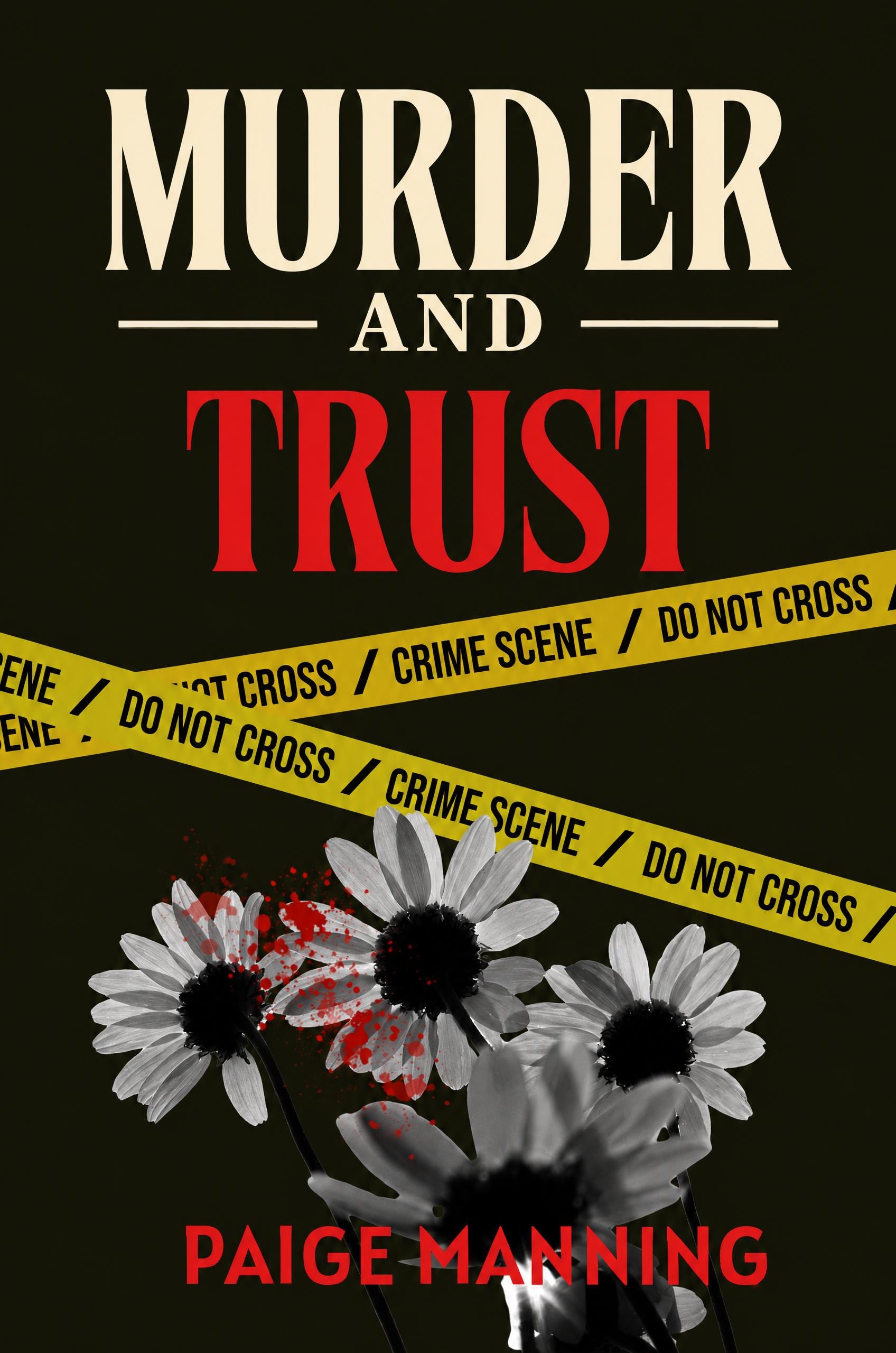
MURDER AND TRUST
Two detectives. One secret. A killer who knew all along.
Detective Emily Bennett follows the rules. Detective Shawn Mitchell used to follow them with her—until their off-duty relationship was discovered and their partnership was formally severed. Now they work separate cases under the cold scrutiny of a captain who would love an excuse to fire them both. Emily catches a fresh homicide: a prominent businessman found strangled in his locked study with a single word carved into his desk. LIAR. The ligature work is too precise for a crime of passion. Shawn is still working the Timber Ridge serial follow-up, chasing loose threads in a closed case, when he finds three unaccounted weekends in the killer's confession. Three weekends that line up with disappearances in neighboring counties. Then Emily discovers the word LIAR appears in that same confession—a detail the department never released to the public. The case she helped close was never fully closed at all. Exchanging information means risking exposure. Staying silent means letting a killer walk. And veteran detective Roy Cassidy is watching them both, documenting every procedural violation with the satisfaction of a man who has been waiting thirty years for exactly this moment. What Emily and Shawn don't know yet is that Cassidy isn't protecting department protocol. He's protecting himself.
- Mystery
- Romantic Suspense
- Thriller
- Police Procedural
- Serial Killer Mystery
- Small Town Thriller
The Word on the Desk
The cabin is cold when I wake. Not the sharp cold of winter—this is September, and the mornings still carry the last warmth of summer in the soil—but the particular chill of a space that was never meant to hold two people overnight. Shawn's furnace kicks on with a low rumble that vibrates through the floorboards, and the sound is so familiar now that I don't startle at it anymore. I used to. The first time I stayed here, every click and groan of the old structure pulled me out of sleep like an alarm I hadn't set, and Shawn lay beside me with one arm thrown across my waist and his breathing even, and I lay awake cataloging every sound the cabin made until dawn grayed the windows and I could pretend I'd slept.
This morning I sleep until the alarm. That's the thing I notice. That I sleep until the alarm, and when it goes off at five-forty, I reach for my phone with the muscle memory of someone who has done this enough times that the unfamiliar has become routine.
Shawn is already up. The space beside me is empty and cooling, and the smell of coffee drifts through from the kitchen with the particular richness of the dark roast he buys from the place on Third Street that grinds the beans while you wait. I pull on yesterday's shirt and follow the smell.
"You're out of creamer," I say.
He turns from the stove—eggs, two pans, one for his scrambled and one for my over-easy because he remembers things like that, catalogues them the way I catalogue evidence, files them away in whatever mental system he uses that is nothing like my index cards and somehow arrives at the same conclusions. His hair is still damp from the shower and his five-o'clock shadow is already darkening toward the stubble that will be full by midday, and when he sees me in the doorway he smiles with the particular ease of someone who has decided not to make a production of being happy.
"You're out of creamer every time you're here," he says. "I don't use it."
"So buy it for me."
"I did. You finished it last week."
I pour my coffee black and lean against the counter. The kitchen is small—everything in this cabin is small, built in the seventies by someone who wanted a hunting retreat and got a mortgage instead—but Shawn has kept it clean in the way that matters. No dishes in the sink. No mail piled on the table. The only clutter is a stack of case files on the chair by the door, and even those are squared, aligned, arranged with a precision that surprises people who mistake his casual manner for carelessness.
"Separate cars," I say. It's not a question.
"Separate cars," he agrees. "I'll take the long way in. Give you fifteen minutes."
This is how we do it now. The calculus of separation. The arithmetic of not being seen arriving at the same place at the same time, of not parking in adjacent spots, of not walking through the department doors within ten minutes of each other because Roy Cassidy times these things—Shawn is sure of it, and I have learned not to dismiss Shawn's certainties. The man has made a hobby of our destruction, and hobbies are things people pursue with the dedication of love.
I shower in water that never quite gets hot enough—the cabin's plumbing is a negotiation between desire and capacity—and I dress in the dark slacks and button-down I brought over on Friday and left hanging in Shawn's closet next to his leather jacket and the one suit he owns that still fits. My blazer is on the hook by the door. My notebook is in my bag. My gun is on the nightstand where I left it, and I holster it with the same motion I have made ten thousand times, and the weight of it against my ribs is the only constant I have ever been able to count on.
The drive into Crestfall takes twenty-two minutes from Shawn's cabin. I have timed it. On the mornings I leave from his place, I add seven minutes to my normal commute, and I spend those seven minutes in the car with the radio off and the window cracked, and I let the cold air pull the sleep from my eyes while I run through the day's expected tasks in the particular order they will need to be completed. It's a ritual. I know it's a ritual. I don't examine what it's compensating for.
The department parking lot is half-full when I arrive. Montoya's truck is in its usual spot. Reynolds's sedan is two spaces down. Shawn's Jeep is not here yet—he'll be somewhere on the county road, taking the long way, giving me my fifteen minutes—and the absence of it is a small relief I don't let myself feel for more than a second. Cassidy's cruiser is parked by the south entrance with its nose pointed out toward the street, and that means he's already inside, already watching, already cataloging the morning's arrivals in whatever ledger he keeps in his head.
The conference room door sticks. I shoulder through it and the hinge protests with a low metal groan that turns every head at the long table. Fifteen faces. Maybe more. Chairs filled, patrol officers lining the back wall, the air thick with coffee and the particular staleness of government-issue carpet that's absorbed too many mornings just like this one. The fluorescent light overhead flickers once and holds, painting the room in that sickly yellow-white that makes everyone look slightly ill.
I'm late. Not officially—no clock on the wall, no one checking watches—but late enough that the weight of the room's attention settles across my shoulders the moment I step inside. Shawn is already here. Of course he is. He must have taken the shortcut after all, or driven faster than I did, or simply decided that fifteen minutes was too much buffer and cut it to ten. He's leaning against the far wall with his arms crossed, jacket on, and his eyes find mine across the crowded room with the easy precision of a man who has been waiting and decided not to make a show of it.
Captain Marlowe stands at the head of the table. Her silver hair is cropped in its usual severe line, her charcoal blazer pressed into creases sharp enough to cut, and her pale gray eyes sweep the room with the cold efficiency of someone who has already counted every person present and noted every person absent. She does not look at me when I enter. She does not need to. The slight pause in her briefing—half a beat, no more—is acknowledgment enough that she has registered my arrival and filed it under the category of things she will address later or never.
"As I was saying," she continues, and her voice is flat, deliberate, ruler-straight. "The Timber Ridge follow-up requires continued investigation. Detective Mitchell will lead that effort. He will report directly to me."
Shawn does not react. His expression stays neutral, his arms stay crossed, and if I didn't know him—if I hadn't spent the morning in his kitchen with his coffee and his eggs and his particular way of not making a production of anything—I would think he was bored. But I do know him. I see the slight tension in his jaw, the way his eyes have stopped scanning the room and fixed on the captain with an attention that is too complete to be casual.
"Detective Bennett." Captain Marlowe's gaze shifts to me. "The Oakes homicide is yours. Fresh scene, fresh investigation, no connection to any other active case. You will report to Lieutenant Chen."
No connection. She says it like a door closing. Like the possibility has been considered and dismissed and sealed into a file that no one in this room is authorized to open. I nod once. The motion is small—professional, noncommittal—and I take my position against the wall near the door because every chair is taken and I prefer to stand anyway.
The briefing continues. Assignments are distributed. Patrol rotations are confirmed. The Timber Ridge follow-up is described in terms so general they could apply to any investigation in any jurisdiction, and the Oakes homicide is presented as a straightforward crime scene with a straightforward victim and a straightforward path to resolution that will require nothing more than competent police work and timely paperwork. Captain Marlowe does not believe this. I can tell by the way she delivers the words—too flat, too final, the particular cadence of someone who is describing the world as she wants it to be rather than as it is.
Roy Cassidy is watching from the back wall. His uniform is immaculate—creases pressed, brass polished, shoes mirror-shined—and his square jaw is set in its habitual clench, and his pale blue eyes move between Shawn and me with the slow deliberation of someone who is counting the seconds between our glances and drawing conclusions from the intervals. He does not speak during the briefing. He never speaks during briefings. His presence is its own statement, and the statement is: I am watching. I am always watching. I am waiting for you to make the mistake I know you will make.
The briefing ends. Chairs scrape. Voices rise in the particular murmur of people transitioning from listening to doing, and the room empties in a slow drift of uniforms and coffee cups and the shuffle of papers being gathered into folders. Shawn leaves first—deliberate, I think, a small concession to the arithmetic of not walking out together—and I wait thirty seconds before following, and the thirty seconds feel longer than the twenty-two-minute drive from the cabin felt, and I hate that I am counting seconds at all.
The bullpen is already humming when I reach my desk. Phones ring. Keyboards click. Someone's radio crackles with a dispatch call about a traffic stop on Mill Road. The coffee pot in the corner gurgles through its final cycle. Normal sounds. The sounds of a department doing what departments do, and I sit at my desk with my notebook open and my pen uncapped and the Oakes file spread across my blotter in the particular arrangement I use to absorb a new case: crime scene photos on the left, initial responding officer's report on the right, victim's basic information centered above the keyboard where I can reference it without turning my head.
Andrew Oakes. Fifty-eight. Local businessman. Found by a neighbor on the floor of his locked study. Ligature marks on wrists and ankles. The word LIAR carved into his desk.
The word LIAR.
I read the responding officer's report twice. The first time for the facts. The second time for the gaps, the pauses, the details that are present but unexplained. The neighbor—a Margaret Chenoweth, sixty-four, widow, lived two houses down—had a key to the front door but not to the study. She let herself in when Oakes didn't answer his phone for two days. She found the study door locked from the inside and called the department. The patrol officers forced the door and found the body.
Locked from the inside. Ligature marks. A carved word.
I close the file and drive to the scene.
The Oakes residence is on Sycamore Lane, a street of old houses with deep porches and mature trees and the particular quiet of a neighborhood where nothing bad is supposed to happen. The house is white clapboard with black shutters and a front door that has been repainted recently enough that the brush strokes are still visible in the right light. A patrol car is parked at the curb. Lena Ortiz is standing on the front porch with her dark braid tucked precisely under her cap and her uniform pressed into lines that would satisfy Roy Cassidy's exacting standards, and when she sees me pull up she raises one hand in a small wave that is both greeting and warning.
"The widow's inside," she says when I reach the porch. Her voice is crisp and economical, every syllable placed where it belongs. "She's been cooperative. Too cooperative, maybe. I can't decide."
"What does she do with her hands?"
Lena considers this. "Touches her wedding ring. Every time someone mentions his schedule or his work habits or anything that might require her to account for where he was and when. She touches the ring like she's checking it's still there."
"She's nervous."
"She's something."
Judith Oakes receives me in the front parlor. The room is decorated in the particular style of someone who has money but no interest in appearing trendy—dark furniture, heavy drapes, a piano in the corner that looks like it has not been played in years. She is tall and angular, her silver-white hair styled in a smooth controlled bob, her mourning clothes well-cut and clearly expensive, and her posture is so erect that it must have been trained into her in girlhood and maintained ever since. Her hands are in her lap. Her wedding ring catches the light from the window, and her fingers touch it once, twice, a third time before she speaks.
"Detective. Please sit."
I sit. The chair is upholstered in a floral pattern that is probably older than I am, and the springs creak under my weight with the particular complaint of furniture that is not accustomed to being used.
"Tell me about your husband's routines," I say.
"Andrew was a creature of habit." Her voice is measured and precise, the enunciation of someone who learned early that how you speak matters as much as what you say. "He left for the office at seven-fifteen every morning. He returned at six. On Tuesdays he had a standing dinner with clients—he didn't say which clients, and I didn't ask. On Thursdays he worked late. The study was his private space. I did not have a key."
She says this last part with no change in tone, no hesitation, no acknowledgment that a wife of thirty-two years not having a key to her husband's study is unusual. Her hands touch the ring again.
"Did that bother you?"
"I told myself it was his work matters. Nothing that concerned me." She pauses. The pause stretches. The heating system clicks on somewhere in the walls, and the sound is so small and so specific that I can track its path through the ductwork and into the silence between us. "I told myself that for thirty-two years."
The study is at the back of the house. The door has been forced—the jamb is splintered where the patrol officers broke through, and yellow crime scene tape marks the threshold. Inside, the room is wood-paneled and windowless, lit by a single overhead fixture that casts shadows into every corner. The desk is a heavy oak piece, old and solid, and the word carved into its surface is deep enough to have bitten through the varnish and into the grain beneath.
LIAR.
Four letters. Jagged edges. Carved with something sharp but not surgical—the lines are too rough for a scalpel, too deliberate for a random act of vandalism. Someone wanted this word here. Someone wanted it seen.
Iris Reed is already working the scene. Her sleeves are rolled to her elbows, her dark hair flecked with silver and tied back in its usual neat knot, and she looks up when I enter with the calm focus of someone who has been concentrating hard and is not finished concentrating.
"The body has been transported," she says. "I've done the preliminary. The ligature marks are circumferential—wrists and ankles, both. The binding material left fibers. Cotton rope, three-eighths inch, commercially available. Nothing exotic."
"Time of death?"
"Between forty-eight and seventy-two hours ago. I'll narrow it once I've run the labs. The carving on the desk was done postmortem. The angle of the cuts suggests the killer was standing at the desk, not sitting. Right-handed, based on the stroke direction."
She pauses. Her dark eyes hold steady on mine, and the fine lines around her mouth deepen in the particular way they do when she is about to say something she would prefer not to be the first one to say.
"The word," she says. "LIAR. It's in Whitmore's confession, isn't it?"
I don't answer. I don't need to. Iris Reed has been doing this work longer than I have been a detective, and she knows what she knows.
"It wasn't released to the public," she continues. "That detail was held back. Standard procedure—something only the killer would know. And now it's carved into a dead man's desk."
"Yes."
"That's either a copycat with inside information or an accomplice we missed."
"Yes."
She nods once. The motion is small and precise, the gesture of someone who has delivered difficult information before and will deliver it again. "I'll have the full report on your desk by this afternoon."
I photograph the desk. Fourteen shots. Different angles, different lighting, the macro lens for the fiber deposits along the carved edges and the wide lens for the room's layout. My hands are steady. My breathing is even. The cold realization that has been forming since I read the word in the responding officer's report settles into my chest like something solid and permanent, and I pack it away into the compartment where I keep the things I cannot afford to feel while I am working.
The drive to the morgue takes twelve minutes. The county facility is a low brick building on the east side of town, and the parking lot is empty except for Iris's sedan and the coroner's van. Inside, the air is cold and smells of formalin and the particular cleanliness of spaces designed to contain things that would contaminate anywhere else.
Andrew Oakes is on the table. The ligature marks circle his wrists and ankles in precise bands—too precise, Iris is right, the work of someone who has done this before or studied how it should be done. The skin beneath the rope is abraded in a pattern that suggests struggle, but not much. Not enough. He was restrained quickly or he was incapacitated first.
"The tox screen will take a few days," Iris says. "But I found this."
She points to a small mark on the left side of his neck. A puncture wound. Almost invisible beneath the ligature bruising, but there—clean, precise, the entry point of a needle.
"Someone sedated him before they tied him up," she says. "That's why there's not more struggle. He was already unconscious."
"Which means the killer came prepared."
"Which means the killer came with a plan."
I stand in the cold room with the body of a man who was sedated and bound and carved into a message, and the word on his desk matches a detail from a confession that was never made public, and the only person who should know that detail is sitting in a maximum-security prison two hundred miles away.
I call Shawn from my car.
The phone rings twice. He picks up on the third ring, and the silence on his end of the line is the particular silence of someone who has been waiting for a call he did not want to receive.
"The word on the desk," I say. My voice is clipped to its essential components. "It's LIAR. It's the same word from Whitmore's confession. The detail we never released."
The silence stretches. I can hear him breathing. I can hear the background noise of whatever room he is in—the low murmur of voices, the click of a keyboard, the particular hum of the department's ancient heating system.
"That's not possible," he says finally.
"It's on the desk. I photographed it. Iris confirmed it."
"Whitmore is in prison. He's been in prison for six months. He doesn't have access to victims or carving implements or—"
"I know."
The silence comes back. This time it holds longer, and in it I can feel the shape of everything we are not saying: that the case we closed was never fully closed, that someone else was involved, that the connection between the Oakes homicide and the Timber Ridge investigation is not a coincidence and not a copycat and not something Captain Marlowe can file away under the category of things she will address later or never.
"What do you need?" Shawn asks.
"The full Whitmore file. The parts that didn't make it into the official record. His phone logs. His visitor list. Anyone who's been to see him in the last six months."
"That's your case now."
"It's both our cases. They just don't know it yet."
The line goes quiet for three heartbeats. Four. Five. Then Shawn exhales, and the sound is rough and tired and carries the particular weight of someone who has just made a decision he knows he cannot take back.
"I'll get you what I can," he says. "But Emily—Cassidy is watching. He's been asking questions about the morning briefings. About who talks to who. About how long we're in the same room together. He's building something."
"Let him build. He doesn't have the word on the desk."
"No," Shawn says. "But he has patience. And he has time. And he has thirty years of knowing exactly where to look for the cracks in a story."
I end the call and sit in the parking lot with the engine idling and the heater pushing lukewarm air through the vents, and I think about the word carved into Andrew Oakes's desk and the ligature marks on his wrists and the puncture wound on his neck and the particular arithmetic of a case that has produced one body and one set of initials and nothing that would survive a transfer briefing to a state team that will arrive with its own theories and its own methodology and its own particular brand of institutional confidence.
The case is already colliding with Shawn's. The separation Captain Marlowe mandated is already breaking down. Roy Cassidy is watching. And somewhere in Crestfall, someone who knows a detail that was never supposed to leave a sealed confession file has sedated a man and bound him and carved a word into his desk.
I put the car in gear and drive back to the department. The notebook is on the seat beside me. The pen cap is between my teeth. And the seventy-two hours since Andrew Oakes died divides itself into hours, then minutes, then the particular arithmetic of a case that is going to get worse before it gets better—if it gets better at all.
Three Unaccounted Weekends
The Timber Ridge file covers my desk in three uneven stacks. Case summaries. Witness statements. The confession Dale Whitmore signed eighteen months ago in a room that smelled of stale coffee and the particular exhaustion of a man who had stopped pretending he was innocent. I've read the confession seven times since the trial ended. I've read it th…