

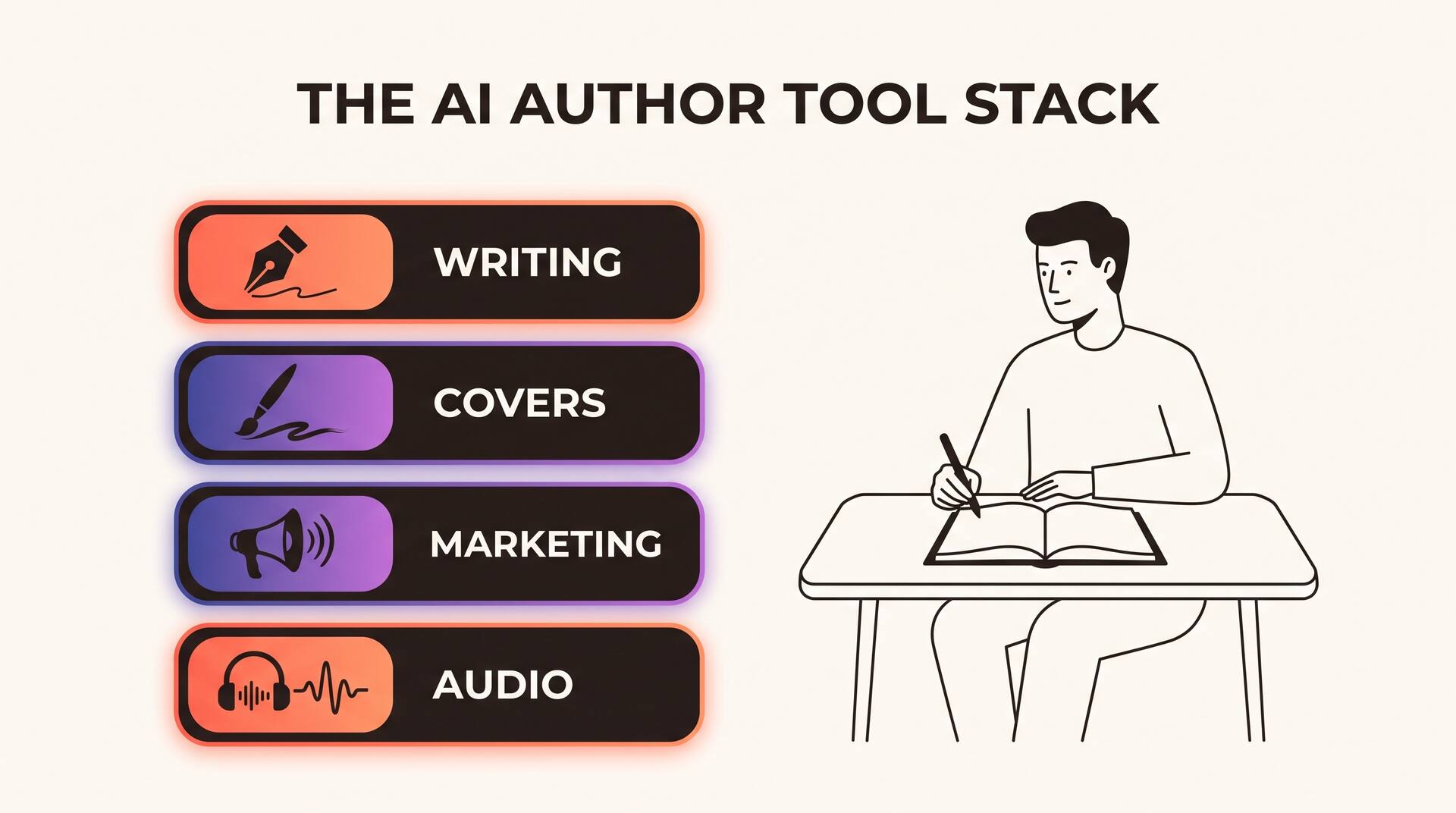
A self-published author working with the right AI stack can now produce a book that competes on quality with traditionally published titles, reach readers without a PR team, and build a backlist without a warehouse. The tools exist. The challenge is knowing which ones actually earn their place in a lean workflow and which ones add complexity without adding value.
This is a walkthrough of the AI tool stack worth building for the full author journey: from the first draft to the finished audiobook, from launch to long-term discoverability.
Writing and Drafting: Where the Stack Starts
The writing stage is where most authors start experimenting with AI, and where the gap between useful tools and overhyped ones is widest.
General-purpose AI assistants like Claude and ChatGPT are genuinely useful for brainstorming, outlining, and working through structural problems. They are less useful for drafting long-form fiction or non-fiction at scale, because they have no persistent memory of what you have already written. Every new session starts from zero, which means you become the continuity engine, copying context into every prompt, catching contradictions manually, and assembling the manuscript by hand.
Dedicated book writing tools solve this by keeping the entire project in context: outline, characters, tone, and prior chapters. They draft chapter by chapter against that structure, which is what makes a full manuscript coherent rather than a collection of disconnected chunks. For non-fiction, this matters for argument consistency. For fiction, it matters for character continuity and plot logic.
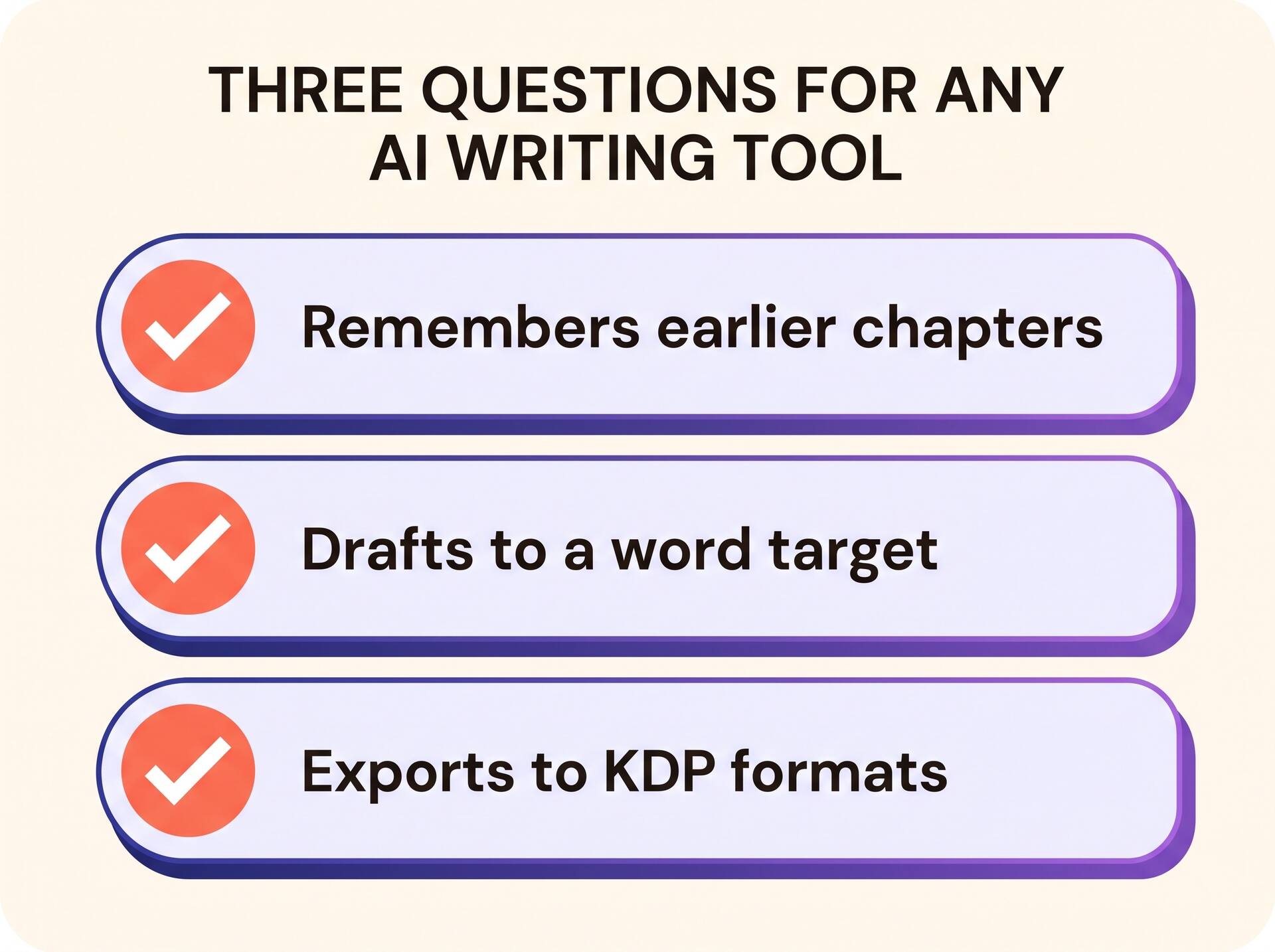
When evaluating any AI writing tool, the questions worth asking are: does it remember what happened in earlier chapters, does it draft to a specific word target per chapter, and can it export directly to formats Amazon KDP accepts? Those three capabilities determine whether the tool saves time or creates more work.
For authors looking to explore the full range of AI writing tools available, AI Plaza's Writing and Content category is a useful starting point, each listing includes a breakdown of features, ideal users, and pricing so you can compare options without opening a dozen product pages.
Once a stack grows past two or three tools, the handoffs between them cost more time than the drafting does. Authors who write on a schedule increasingly automate those handoffs with ai agent workflows, so an approved chapter moves to the editing pass and the metadata step on its own instead of waiting for someone to copy files between apps. A schedule maker can also help authors organize writing sessions and keep those recurring tasks on track. If you are still deciding which agent to hand those handoffs to, an AI agent store lets you browse what exists by task before you commit to one.
Cover Design: The Half-Second Decision
Readers decide whether to click on a book in roughly half a second. The cover is doing most of that work, and it is doing it against a backdrop of professionally designed competition.
AI cover generation tools have improved significantly, and for certain genres, particularly non-fiction and literary fiction, they can produce covers that hold up well. The critical constraint is that AI-generated covers need to match genre conventions precisely. Romance readers, thriller readers, and fantasy readers all have specific visual expectations, and a cover that looks technically good but reads as the wrong genre will hurt more than a weak cover would.
The most practical approach for most indie authors is to use AI tools for concept exploration and initial versions, then evaluate honestly whether the result is competitive with the top sellers in your category. For genres with strong visual conventions and high competition, working with a human designer is often the better investment even if it costs more upfront.
Formatting is the less glamorous but equally important half of this stage. Amazon KDP requires specific file formats, trim sizes, and bleed settings for both ebooks and print. Getting these wrong means rejection or visible formatting errors in the finished product. Tools that handle export natively, producing print-ready PDFs and EPUBs directly from the manuscript, remove a significant source of friction and error.
The Design category on AI Plaza covers the tools relevant to this stage, from AI image generation to layout and design automation, with enough detail to make a real comparison before committing to any of them.
Marketing: From Launch Day to Long-Term Discoverability
Most authors underestimate marketing and overestimate launch day. A single launch spike rarely translates into sustainable sales. What builds a backlist is consistent discoverability over time: the right keywords in your metadata, email subscribers who buy new releases, and a presence in the places where readers discover books. AI in digital marketing can help with all three, but each one requires a different approach.
For metadata optimization, AI tools that analyze Amazon search behavior and suggest backend keywords are genuinely valuable. The difference between ranking for the right keywords and ranking for the wrong ones can determine whether a book finds its audience organically or disappears into the catalog. This is an area where spending an hour with the right tool upfront pays off across the entire life of the book.
For email marketing, the challenge for most indie authors is not finding subscribers, it is converting them consistently. AI-powered email tools that can draft launch sequences, re-engagement campaigns, and announcement emails in your established voice are useful here, especially for authors managing multiple pen names or a large backlist.
For social and content marketing, the volume of content required to maintain a presence across multiple platforms is genuinely difficult to sustain without help. AI tools that draft posts, repurpose existing content, and suggest formats based on what performs in a given genre community can help close the gap between what you know you should be doing and what you actually have time to do. For a new release, you can turn your blurb into a video ad for TikTok or Instagram in a few minutes, which is often faster than adapting the same content manually for each platform.
For authors promoting books through short-form content, an image to video ai free unlimited tool can also turn covers, illustrations, or promotional graphics into reusable video clips for social media.
The Marketing category on AI Plaza breaks down the relevant tools by function, so you can identify what you actually need rather than subscribing to a general-purpose platform that does everything at average quality.
Audio: The Format Most Indie Authors Skip
Audiobooks are the fastest-growing format in publishing and the most consistently underserved by indie authors. The traditional barrier was cost: a professional narrator for a full-length book runs between $200 and $500 per finished hour, which makes audiobook production a significant upfront investment that only pays off at scale.
AI narration tools have changed the economics of this substantially. The quality gap between AI narration and professional narration has narrowed to the point where it is negligible for non-fiction and acceptable for many fiction genres, particularly when the narration style matches the tone of the work. For authors with a backlist, converting existing titles to audio format has become a realistic option rather than an aspirational one.
The workflow for AI narration typically involves uploading the manuscript, selecting a voice that fits the work, and generating the audio chapter by chapter. The output requires review for mispronunciations and pacing, but the editing time is substantially less than the recording time for a human narrator.
Some dedicated book writing tools now include narration generation as part of their output options, which keeps the entire production workflow in a single place. For authors who want to evaluate narration tools separately, looking for options that allow fine-tuning of pacing and emphasis is worth the extra time, since those controls are what determine whether the final product sounds like a reading or a performance.
Building the Stack
The right AI stack for a self-published author is not the one with the most tools. It is the one that removes the right friction at each stage without adding coordination overhead.
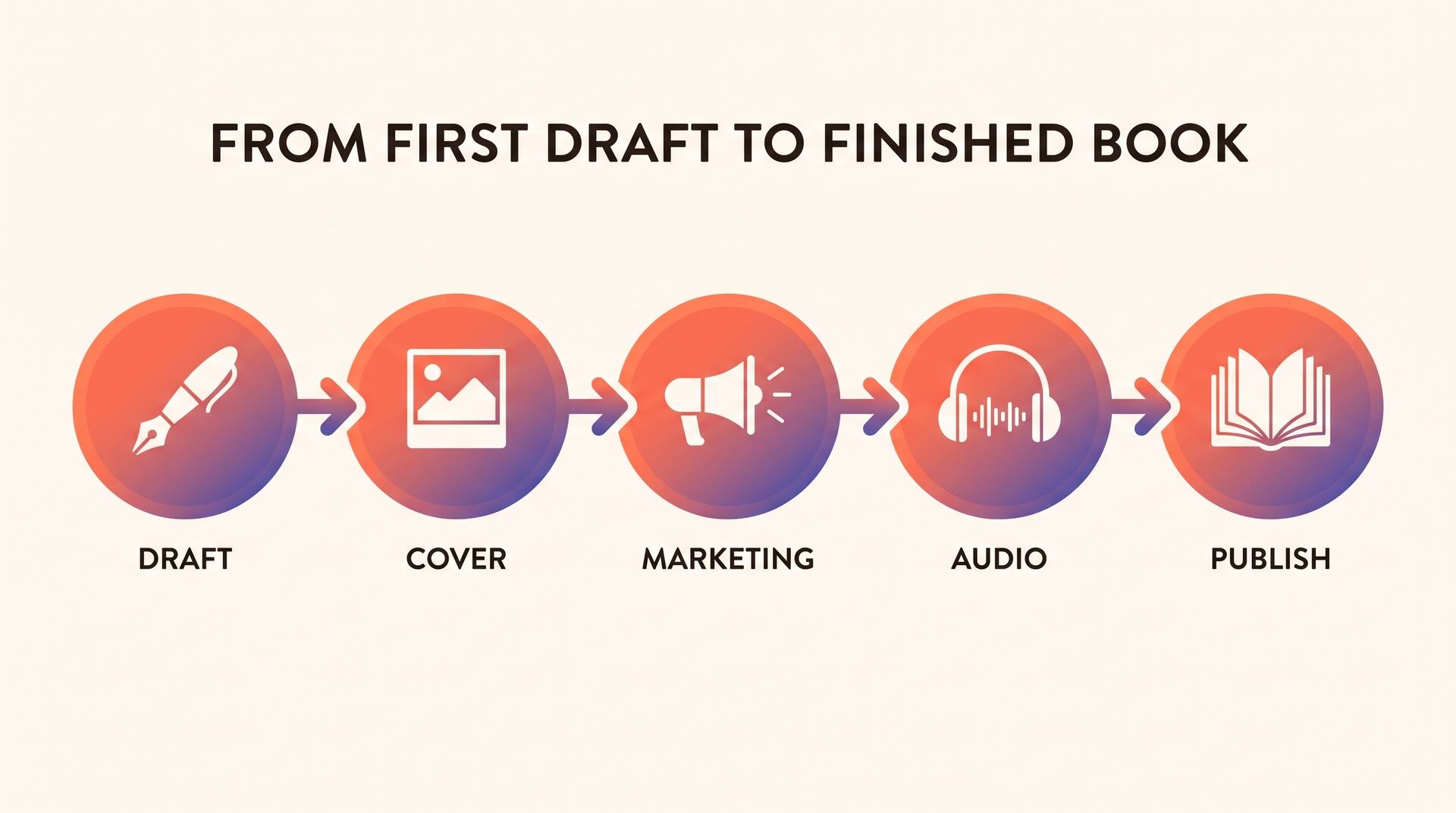
A practical starting configuration covers drafting continuity, cover generation with honest quality assessment, keyword research before any metadata is finalized, and at least one marketing channel with AI assistance. Audio is worth adding once the writing workflow is stable, because the cost of not having it compounds over time as your catalog grows.
One part of the stack that rarely gets mentioned is the author website itself. Plenty of authors run their own site on a small server rather than a hosted page builder, and that means occasionally logging in to it to restore a backup, move files, or restart something that stopped. On macOS that job needs a terminal client, and a comparison of the current options is collected in this guide to the best SSH Client Mac tools, which is worth reading before you need one at short notice.
The AI tool landscape for authors is still developing, and the best options in any category will change as the technology improves. Keeping a short list of tools that are actually in use and revisiting that list annually is a more sustainable approach than trying to optimize everything at once.
For authors who want to keep track of how the tool landscape is evolving, AI Plaza is updated regularly with new additions across all the categories relevant to the author workflow, with enough detail on each tool to make a real comparison before committing time or money.