


Here is the uncomfortable truth about self-publishing: Amazon lists over 12 million Kindle titles. Your book is competing with all of them for attention, and the algorithm does not care how good your prose is. It cares about clicks, sales velocity, and relevance signals. The authors who sell consistently are not necessarily the best writers. They are the ones who understand how discoverability works and build systems around it. This guide breaks down every phase of book marketing into concrete actions you can start today, whether your budget is $0 or $5,000.
What You Will Learn
Pre-Launch Marketing: Build Buzz Before You Publish
The biggest mistake self-published authors make is treating launch day as the start of marketing. Your marketing should begin 60 to 90 days before publication. Every sale in your first week matters disproportionately because Amazon's algorithm heavily weights initial sales velocity when deciding which books to recommend.
Build an ARC Team
An Advance Reader Copy team is your secret weapon. Recruit 20 to 50 readers who get your book free before launch in exchange for honest reviews on day one. Find ARC readers in Facebook groups for your genre, on StoryOrigin or BookFunnel, or from your existing email list. The goal is 15 to 25 reviews within the first 48 hours of launch. Amazon's algorithm treats early reviews as a strong credibility signal, and books with fewer than 10 reviews convert browsers to buyers at dramatically lower rates.
Cover Reveal Campaign
Your cover is your single most important marketing asset. Plan a cover reveal 4 to 6 weeks before launch. Share it on social media, in genre-specific groups, and on your email list. Ask your ARC team to share it on their own channels. A strong cover reveal generates anticipation and gives you content to post about when you have nothing else to promote yet. Professional covers in your genre typically cost $200 to $500 and pay for themselves many times over.
Set Up Pre-Orders
Pre-orders on Amazon count toward your first-day sales, which supercharges your launch. Set your pre-order live 2 to 4 weeks before launch. Every pre-order sale gets credited to launch day, which means your book can debut higher in the charts than if those same sales trickled in over the first week. Use this window to drive traffic from your email list and social media to the pre-order page.
Warm Your Email List
If you have an email list, begin warming it 3 weeks before launch. Send a behind-the-scenes email about your writing process. Follow up with a cover reveal. Then send a pre-order announcement. Do not just blast a buy link on launch day to a list that has not heard from you in months. Engagement rates drop dramatically when subscribers are cold, and email providers may route your launch email to spam if your recent open rates are low.
Launch Week: Your Most Important 7 Days
Your first week determines whether Amazon's algorithm picks up your book or buries it. The goal is concentrated sales velocity. You want as many sales as possible in the shortest window possible, because the algorithm interprets a spike as a signal that your book is trending and worth recommending to more readers.
The 7-Day Launch Plan
Follow this day-by-day framework to maximize your launch impact. Every action is designed to create concentrated sales velocity that triggers Amazon's recommendation algorithm.
Day 1: The Big Push
Email your full list with a direct link to buy. Post on every social channel. Ask your ARC team to post their reviews. This is not the day for subtlety. Tell everyone you know that your book is live and ask them to buy it today, not tomorrow.
Day 2-3: Social Proof Wave
Share screenshots of your first reviews. Repost reader reactions. Create quote graphics from positive feedback, or turn a favorite line into something shareable with a meme creator. The goal is to show momentum, because momentum attracts more buyers. People want to read what others are already excited about.
Day 3-4: Activate Your Network
Reach out personally to friends, family, and author colleagues. Ask them to buy and leave a review. Personal asks convert at 10x the rate of broadcast posts. Send individual messages, not group blasts.
Day 4-5: Run a Promotion
Consider a 24-hour Kindle Countdown Deal or a temporary price drop to $0.99 to spike downloads. Volume matters more than revenue this week. More downloads mean more also-bought connections, more reviews, and a higher chart position.
Day 5-6: Cross-Promotion
Partner with authors in your genre for newsletter swaps or social media shoutouts. Their readers are pre-qualified for your book. One mention to a 5,000-person genre-specific email list can drive more sales than a post to your own 500 general followers.
Day 7: Assess and Adjust
Check your sales rank, review count, and read-through rate. Decide whether to continue pushing organic promotion or shift budget to paid advertising. If your rank is climbing, keep the momentum. If it has plateaued, it is time to invest in Amazon Ads.
Amazon Advertising Fundamentals
Amazon Ads are the most efficient paid marketing channel for self-published authors because they reach people who are already shopping for books. Unlike social media ads, you are not interrupting someone. You are appearing next to books they are actively considering buying. Here are the four concepts you need to understand before spending a dollar.
Sponsored Products vs. Lockscreen Ads
Sponsored Products appear in search results and on product pages. They are the workhorses of book advertising. Lockscreen Ads appear on Kindle devices and Fire tablets. Start with Sponsored Products because they have clearer intent signals and are easier to optimize. Move to Lockscreen Ads once you have profitable Sponsored Products campaigns.
Keyword Targeting
Target keywords that readers actually search for: genre names, tropes, comparable author names, and book titles in your category. Start with exact match for precision, then expand to broad match once you know which terms convert. Bid conservatively at first. A $0.25 to $0.50 starting bid lets you gather data without burning through your budget.
ACOS: The Number That Matters
Advertising Cost of Sale is your ad spend divided by ad revenue. If you spend $10 and earn $30 in book sales, your ACOS is 33%. For a $4.99 ebook with a 70% royalty, you earn about $3.50 per sale. An ACOS under 70% means you are profitable on the front end. But even a higher ACOS can be profitable if readers go on to buy your other books.
The Read-Through Factor
If you have a series, your true advertising ROI includes revenue from subsequent books. A reader who buys book one at a loss but goes on to buy books two, three, and four is extremely profitable. Calculate your read-through revenue before deciding whether a campaign is working. Many successful series authors run ads at a loss on book one because the lifetime value of a reader justifies it.
Pro Tip: Start with a daily budget of $5 to $10 and run ads for at least 14 days before making optimization decisions. Amazon's algorithm needs time to learn which impressions convert. Turning off campaigns after 3 days because they have not produced sales yet is the most common mistake new advertisers make.
Social Media Strategy for Authors
Social media works for authors, but not the way most people use it. Posting buy my book three times a day will grow your follower count in the wrong direction. The authors who build real audiences on social media follow the 80/20 rule: 80% value and entertainment, 20% promotion. If keeping a steady stream of value-first posts alongside promotional ones feels like too much on top of writing, a social media post generator can help draft and format that 80% mix so posting doesn't compete with your writing time. Others hand the posting calendar and the paid campaigns to a social media marketing agency and keep only the parts that need their own voice, such as replies and behind-the-scenes posts. Here is how each platform works for book marketing.
Amazon Ads
Amazon Ads remain the highest-converting paid channel for self-published authors because they target readers with purchase intent. Your ad appears when someone is already browsing books in your genre. No other platform offers that level of buyer intent.
Best for: Direct sales, series read-through, backlist visibility
Optimization: Check metrics weekly, adjust bids bi-weekly
Target competitor ASINs and category-specific keywords. Use auto campaigns to discover converting keywords, then move winners to manual campaigns with higher bids.
Finish Your Book and Start Marketing
The sooner your book is done, the sooner you can implement these strategies. AIWriteBook helps you write, outline, and polish your manuscript so you can focus on what comes next.
Email List Building from Scratch
Every successful self-published author will tell you the same thing: start your email list before you publish your first book. Even if you only have 50 subscribers on launch day, those 50 people are worth more than 5,000 social media followers because they opted in to hear from you and they will actually see your messages.
Create a Reader Magnet
A reader magnet is a free piece of content that readers get in exchange for their email address. The best reader magnets are short stories, novellas, or bonus chapters set in the same world as your published books. They should be genuinely good, not throwaway content. If your reader magnet disappoints, subscribers will ignore your future emails.
Example: A romance author offers a free prequel novella showing how the couple's parents met. It hooks readers into the series world and makes them want to buy book one.
Use BookFunnel or StoryOrigin
These platforms make delivering reader magnets painless. They handle file delivery to every e-reader format, collect email addresses, and integrate with your email service provider. They also run group promotions where multiple authors in a genre cross-promote their reader magnets, exposing you to new audiences for free.
Example: Join a group promotion with 20 other fantasy authors. Each author promotes the landing page to their list. You gain 100 to 300 new subscribers who specifically chose your book from the lineup.
Put Signup Links Everywhere
Add your reader magnet link to the back matter of every book, your social media bios, your Amazon author page, your website, and your email signature. Nobody can click a URL in a paperback, so run that signup page through Vecteezy's QR code generator and print the code next to the link. Every reader who finishes your book and enjoys it is a potential subscriber. The back-of-book signup link is consistently the highest-converting placement for author email lists.
Example: A thriller author adds a page after the epilogue that says: Want a free Jack Reeves short story? Get the prequel at [link]. This single page converts 5 to 8% of readers into subscribers.
Write Emails People Want to Open
The authors with the best email metrics treat their newsletters like a conversation, not a billboard. Share what you are reading, what you are working on, behind-the-scenes glimpses of your process, and personal stories. When you do promote a book, it feels natural because your subscribers already feel connected to you.
Example: A monthly newsletter with three sections: what the author read this month (2 sentences each), a writing update (what stage the next book is at), and a personal story or photo. Promotional emails are sent separately and only during launches.
If you would rather pay to fill the list than wait for it to grow, Facebook lead ads let a reader hand over an email address without ever leaving the app, which converts far better than sending cold traffic to a landing page. Send those subscribers into the same welcome sequence as your organic signups so the reader magnet still does its job.
Long-Term Visibility and Backlist Strategy
Launch marketing gets the spike. Long-term strategy builds the career. The authors earning a living from self-publishing are not the ones with one viral launch. They are the ones with 5, 10, or 20 books that all sell steadily because each book drives readers to the others.
Write the Next Book
Your next book is your best marketing tool. Every new release brings existing readers back and introduces your backlist to new readers through also-bought algorithms. Authors who publish 3 to 4 books per year grow their income exponentially because each book markets all the others. Focus on writing speed and consistency above all other marketing tactics.
Optimize Your Backlist
Revisit your older titles every 6 months. Update covers that look dated. Refresh descriptions with stronger hooks. Adjust categories and keywords based on what is currently trending. A backlist book with an updated cover and new keywords can see a 200 to 400% increase in daily sales with zero additional writing.
Build Author Relationships
The self-publishing community is remarkably collaborative. Newsletter swaps, anthology projects, shared Facebook ads, and co-promotions with authors at your level can double your reach overnight. Find 5 to 10 authors in your genre who write at a similar quality level and have similar list sizes. These become your marketing partners for every future launch. If your genre circle is still thin, communities like WebSEO.Club, where bloggers connect for collaboration, are a practical place to find someone who will host a guest post or trade a mention.
Diversify Your Income Streams
Do not rely solely on Amazon. Publish wide on Kobo, Apple Books, Barnes and Noble, and Google Play. Consider print-on-demand through IngramSpark for bookstore distribution. Explore audiobook production through ACX or Findaway Voices. Each platform reaches readers who may never shop on Amazon, and diversification protects you from any single platform changing its terms.
One channel most authors leave alone for years is selling straight from their own store, where the margin is whole and the reader's email is yours rather than the retailer's. If you go that way, the mobile side is where the sales actually happen, and a Shopify mobile app builder turns an existing store into an app your regular readers keep on their phone, which matters most for a series where the same people come back for every new release.
Realistic Budget Allocation
You do not need thousands of dollars to market a book effectively, but you do need to spend strategically. Here is how to allocate your marketing budget based on three common scenarios. The key principle: invest in the assets that sell books for months or years, not in one-time promotions that produce a single spike.
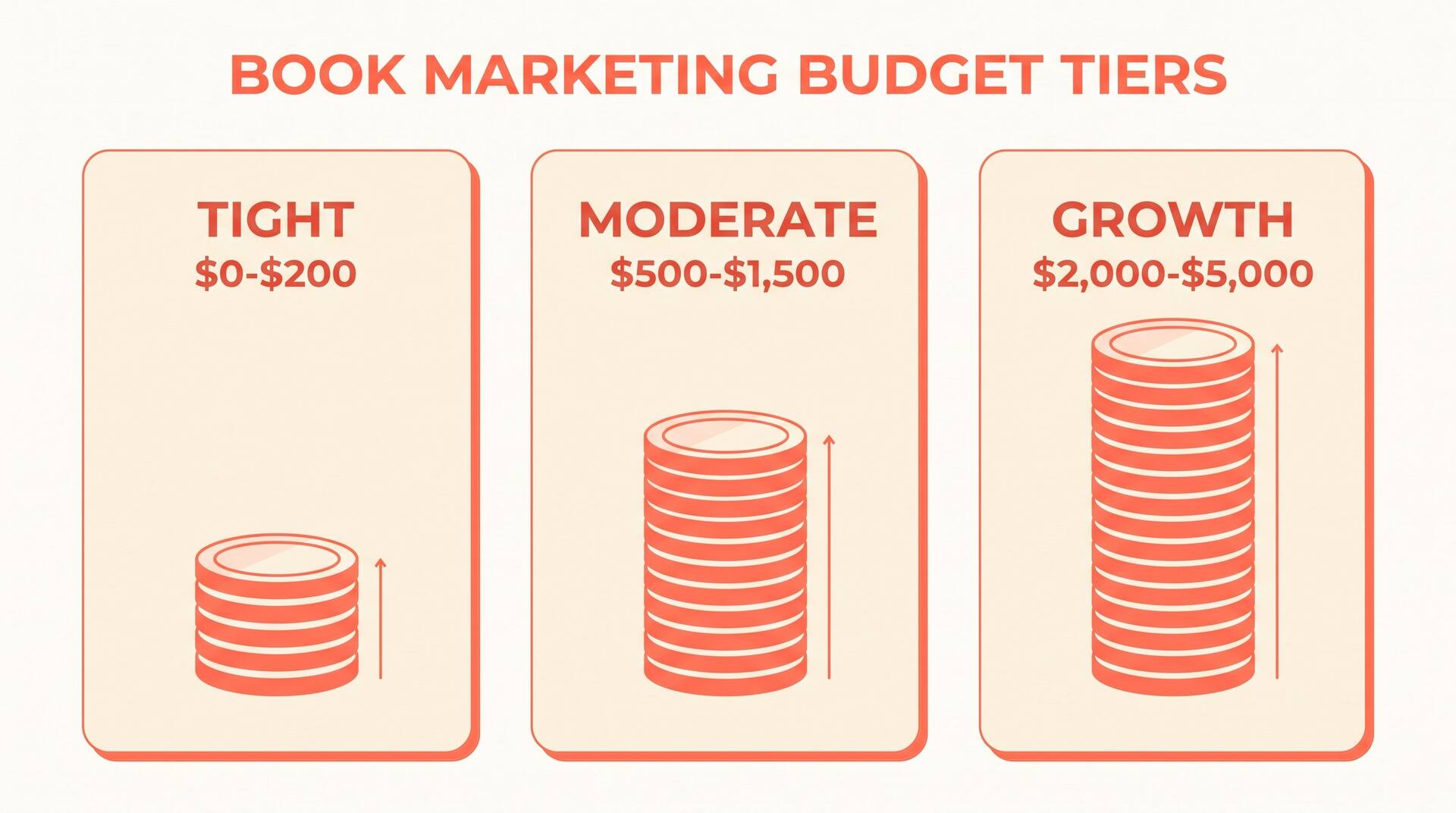
Tight Budget: $0 to $200
Focus entirely on organic strategies. Build an ARC team through free platforms. Create a reader magnet and start your email list. Post consistently on one social media platform. Use free cross-promotion opportunities through BookFunnel group promos. Request reviews from book bloggers in your genre. This budget works but requires more time investment.
Recommended: $100 for professional cover, $50 for email service, $50 for BookFunnel
Moderate Budget: $500 to $1,500
Invest in a professional cover and basic Amazon Ads. Run a BookBub Featured Deal if you can get one. Add newsletter swap promotions with paid services like BookSweeps or FreeBooksy. This budget lets you test paid advertising while maintaining organic efforts. Allocate roughly 40% to cover, 40% to ads, and 20% to promotional services.
Recommended: $400 cover, $600 Amazon Ads (first 2 months), $300 promo services
Growth Budget: $2,000 to $5,000
At this level you can run sustained Amazon Ad campaigns, invest in a professional website, hire a virtual assistant for social media, and book multiple promotional slots. Consider Facebook Ads targeting readers of comparable authors. Fund audiobook production to open a new market. This budget should generate positive ROI within 3 to 6 months if your book has strong read-through.
Recommended: $500 cover, $2,000 Amazon Ads, $1,000 promos, $500 audiobook, $500 misc
Budget Rule of Thumb: Never spend more on marketing a single book than you can recoup from that book plus its series within 6 months. Track every dollar and calculate your cost per acquisition. If you are spending $5 to acquire a reader who generates $3.50 in royalties and does not buy your other books, that campaign needs to be paused or optimized.
Marketing Launch Checklist
Use this interactive checklist to track your progress. Complete these tasks before and during your launch week for maximum impact.
Marketing Timeline Visualization
Here is how your marketing efforts should flow from pre-launch through sustained growth. Each phase builds on the previous one.
90 to 30 Days Before Launch
Foundation Building
Create your reader magnet and start collecting email subscribers. Commission your cover. Begin posting on social media about your writing journey. Recruit ARC readers. Set up your author website and Amazon Author Central page.
30 Days to Launch Day
Pre-Launch Momentum
Do your cover reveal. Open pre-orders. Distribute ARC copies. Schedule your launch week emails. Prepare Amazon Ad campaigns in draft mode. Arrange cross-promotions with other authors. Ramp up social media posting frequency.
Launch Week
Maximum Push
Execute your 7-day launch plan. Send all scheduled emails. Activate Amazon Ads. Post daily on social media. Share reviews as they come in. Reach out personally to friends and network. Run a Kindle Countdown Deal on day 4 or 5 if sales slow.
Month 2 and Beyond
Sustained Growth
Optimize Amazon Ads based on data. Continue building your email list. Start writing the next book. Run monthly newsletter swaps. Apply for BookBub Featured Deals. Revisit your keywords and categories quarterly. Shift focus to long-term backlist building.
How AI Can Accelerate Your Marketing
AI tools can dramatically reduce the time you spend on marketing tasks, freeing you to focus on writing and strategy. Here is where AI adds the most value for self-published authors:
- Generate and test multiple book description variations to find the highest-converting version
- Draft social media content calendars with post ideas tailored to your genre and audience
- Research and identify profitable keywords for Amazon Ads and book metadata
- Write email sequences for your launch, including subject line variations for A/B testing
- Analyze competitor books to understand what is working in your market right now
For nonfiction authors, a chapter can become the starting point for a workshop, webinar, or book-launch talk. Julius's AI presentation maker turns your outline, notes, or manuscript excerpt into an editable slide deck. Refine the slides in chat, then export to PowerPoint or Google Slides.
AIWriteBook can help you write your book faster so you can get to the marketing phase sooner. The best marketing strategy is a great book followed quickly by the next one.
The Bottom Line
Book marketing for self-published authors is not about going viral or spending thousands on ads. It is about building systems that consistently put your book in front of the right readers. Start with an ARC team and an email list. Launch with concentrated velocity. Learn Amazon Ads gradually. Build relationships with other authors. And above all, keep writing, because your next book is always your most powerful marketing tool.
The authors who succeed in self-publishing are not the ones who found a secret marketing hack. They are the ones who showed up consistently, treated their publishing career like a business, and invested their time and money where the data told them it mattered most.