

Amazon Ads (formerly AMS — Amazon Marketing Services) is the most direct way to put your book in front of readers who are actively searching for something to read. Unlike social media advertising where you interrupt someone scrolling through cat videos, Amazon Ads reach people who are already on Amazon looking for their next book. That intent-based targeting is what makes Amazon Ads the single most effective paid marketing channel for indie authors. In 2026, authors who run even basic Amazon Ad campaigns sell 2-5x more copies than those who rely on organic discovery alone. This guide walks you through everything from your first campaign to advanced optimization strategies.
Why Amazon Ads Matter for Authors
Amazon's algorithm favors books that sell consistently. When your ads generate sales, those sales boost your organic ranking, which generates more organic sales, which improves your ranking further. This flywheel effect means that a well-managed ad campaign doesn't just generate direct sales — it lifts your entire book's visibility on the platform. Even spending $5-10 per day can create meaningful momentum.
Table of Contents
1. How Amazon Ads Work for Books
Amazon Ads operate on a pay-per-click (PPC) model. You only pay when someone clicks your ad — impressions are free. Your ad appears on search results pages, product detail pages, and Kindle device screens depending on the campaign type you choose.
The Auction System
Every time a reader searches on Amazon or views a book page, an instant auction runs among all advertisers targeting that keyword or product. You set a maximum bid (the most you're willing to pay per click), and Amazon's algorithm determines which ads to show based on bid amount, ad relevance, and expected click-through rate. You never pay more than your bid, and often pay less — you pay just one cent more than the next highest bidder.
Where Your Ads Appear
Sponsored Products ads show in search results (marked 'Sponsored') and on competitor book pages under 'Products related to this item.' Sponsored Brands ads appear as banner ads at the top of search results with your author logo and up to three books. Lock Screen ads display on Kindle e-readers and Fire tablets when the device is in sleep mode — these are image-based and great for brand awareness.
The Click-to-Sale Journey
A reader sees your ad, clicks it (you pay for the click), lands on your book's product page, and decides whether to buy. Your conversion rate depends entirely on the quality of your book page — cover, description, reviews, and price. This is why optimizing your book listing before running ads is critical. Sending paid traffic to a poorly optimized listing is like pouring water into a leaky bucket.
Attribution Window
Amazon attributes a sale to your ad if the reader purchases within 14 days of clicking. This matters because many readers click, add to their wishlist, and buy days later. Your dashboard may show low immediate conversions that improve significantly over time. Always wait at least two weeks before judging a campaign's performance.
2. Campaign Types Explained
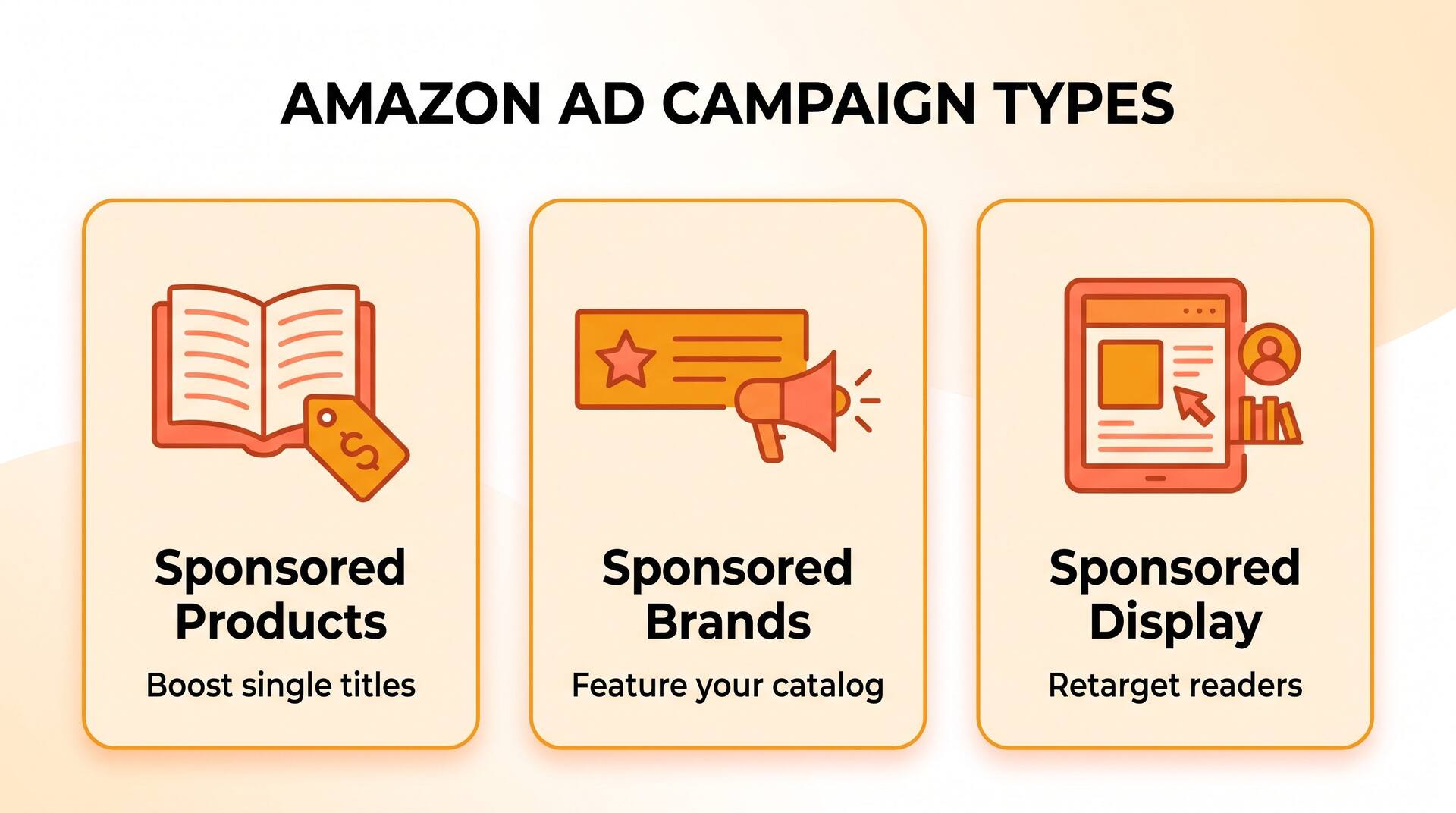
Amazon offers three campaign types for book advertisers. Each serves a different purpose, and most successful authors run all three simultaneously.
Sponsored Products
The workhorse of book advertising. These ads promote individual book listings and appear in search results and on product pages. They look like regular search results with a small 'Sponsored' label. Sponsored Products drive the most direct sales and should be where you spend 60-70% of your ad budget. They support both automatic and manual targeting.
Campaign Type Comparison
| Feature | Sponsored Products |
|---|---|
| Placement | Search results, product pages |
| Targeting | Keywords + Products |
| Avg CPC | $0.20 – $0.75 |
| Conversion Rate | Highest |
3. Keyword Research for Book Ads
Keywords are the foundation of profitable Amazon Ads. The right keywords connect your book with readers who want exactly what you've written. The wrong keywords burn through your budget showing your romance novel to people searching for tax preparation guides.
Automatic Campaigns: Let Amazon Find Keywords
Start every new book with an automatic targeting campaign. Amazon's algorithm tests your ad against thousands of keywords and products, showing it where it thinks your book is relevant. Run this for 2-4 weeks with a $5/day budget. Then download the Search Term Report to see exactly which search terms generated clicks and sales. These real-data keywords become the foundation of your manual campaigns.
Manual Campaigns: Take Control
Create manual keyword campaigns using the best performers from your automatic campaign plus your own research. Organize keywords into tight ad groups — group similar keywords together so you can set appropriate bids for each group. A keyword like 'fantasy romance books' should be in a different ad group than 'epic fantasy series' because reader intent and competition levels differ.
Keyword Match Types
Your ad shows for searches that include your keyword in any order, plus related terms. 'Fantasy romance' triggers for 'best fantasy romance books,' 'romance with fantasy elements,' and similar variations. Use for discovery — finding new keywords you haven't thought of.
Your ad shows when the search contains your exact keyword phrase in order, with possible words before or after. 'Fantasy romance' triggers for 'best fantasy romance' but not 'romance fantasy.' A good balance of reach and precision.
Your ad shows only when someone searches for your exact keyword or very close variations. 'Fantasy romance' triggers only for 'fantasy romance' and 'fantasy romances.' Highest conversion rates but lowest reach. Use for your proven top performers.
Product Targeting
Target specific books (ASINs) to show your ad on their product pages. This is incredibly powerful for book advertising. Target books that are comparable to yours — same genre, similar themes, similar audience. If you write cozy mysteries, target the top 50 cozy mystery bestsellers. Readers browsing those books are your ideal audience. You can also target entire categories, though this is broader and typically less efficient.
4. Bidding Strategies That Work
Your bid strategy determines how much you pay per click and how aggressively Amazon pursues ad placements for you. Getting this right is the difference between profitable campaigns and money pits.
Dynamic Bids — Down Only
Amazon lowers your bid in real time when it predicts a click is less likely to convert. Your bid never goes above your set maximum. This is the safest strategy for beginners — it protects you from overspending on low-quality placements. Start here and keep this as your default for most campaigns.
Dynamic Bids — Up and Down
Amazon raises your bid by up to 100% when it thinks a click is likely to convert, and lowers it when conversion probability is low. This can increase your reach on high-value placements but also increases your average cost per click. Use this only for proven campaigns with established conversion data — never for new campaigns where Amazon has no data to work with.
Fixed Bids
Amazon uses your exact bid for all auctions regardless of conversion probability. This gives you the most impressions for your budget since Amazon doesn't reduce bids on any placement. Useful when you want maximum visibility (like during a book launch) and are willing to accept lower efficiency in exchange for more eyeballs.
Starting Bid Recommendations
| Genre | Bid Range |
|---|---|
| Romance / Thriller | $0.25 – $0.50 |
| Sci-Fi / Fantasy | $0.20 – $0.45 |
| Nonfiction / Self-Help | $0.30 – $0.65 |
| Children's / YA | $0.15 – $0.35 |
Tip: Start at the low end of these ranges. If you're getting fewer than 1,000 impressions per day, increase your bid by $0.05 every few days until you find the sweet spot where you get consistent impressions without overpaying.
5. Budget Management & Daily Spend
Your advertising budget should align with your goals and your book's profitability. Spending too little means no data to optimize. Spending too much before optimizing means wasting money. Here's how to find the right balance.
Start with $10-20/day total across all campaigns. Run one automatic Sponsored Products campaign ($5-10/day) and one manual keyword campaign ($5-10/day) using keywords from your KDP research. The goal here is not profitability — it's data collection. You need at least 1,000 clicks before you have statistically meaningful data on what works.
Download your search term reports weekly. Add converting search terms as exact match keywords in your manual campaigns. Negate (block) search terms that generate clicks but no sales. Gradually shift budget from automatic campaigns to manual campaigns as you identify winners. Your daily spend should stabilize around $10-15/day with improving efficiency.
Once you have profitable campaigns, scale by increasing budgets on winners and pausing losers. A good rule: never increase a campaign budget by more than 20-30% at once — large jumps can destabilize Amazon's algorithm. If a campaign is profitable at $10/day, move to $12-13/day, evaluate for a week, then increase again. Scale gradually to $30-50/day for a single book, or higher for series with strong read-through.
Monthly Budget Guide
| Level | Budget |
|---|---|
| Beginner (1 book) | $150 – $300/month |
| Intermediate (2-5 books) | $300 – $750/month |
| Advanced (5+ books) | $750 – $2,000+/month |
Tip: Never spend more on ads than you can afford to lose for three months. Amazon Ads require patience — most campaigns need 4-8 weeks of data before they become consistently profitable. Treat your early ad spend as an investment in market research.
Create Ad-Ready Books with AI
AIWriteBook helps you write compelling books that convert when readers land on your page. From engaging descriptions to well-structured manuscripts — give your Amazon Ads the best possible landing page.
6. Optimization & Key Metrics
Running ads without optimization is like driving with your eyes closed. The authors who profit from Amazon Ads check their metrics weekly and make data-driven adjustments. Here are the numbers that matter.
ACoS (Advertising Cost of Sales)
The percentage of your ad-attributed revenue that you spent on advertising. If you spent $10 on ads and earned $50 in sales, your ACoS is 20%. Lower is better. For a $4.99 eBook at 70% royalty (earning ~$3.35 per sale), your break-even ACoS is approximately 67%. Anything below that means your ads are directly profitable.
Click-Through Rate (CTR)
The percentage of impressions that result in clicks. A healthy CTR for book ads is 0.3-0.8%. Below 0.2% means your cover or targeting needs work — your ad is being shown but readers aren't interested enough to click. Above 1% is excellent and usually indicates strong cover-to-keyword alignment.
Conversion Rate (CVR)
The percentage of clicks that result in a purchase. A good conversion rate for book ads is 10-25%. Below 5% means your product page isn't converting — check your description, reviews, and price. Above 25% is exceptional and means your targeting is very precise.
Cost Per Click (CPC)
The average amount you pay per click. For most book genres, CPCs range from $0.15 to $0.75. If your CPC is higher than $0.50 and your book is priced under $5, profitability becomes very difficult. Lower CPCs through better targeting and negative keywords.
Weekly Optimization Checklist
Tip: Set a recurring calendar reminder for weekly optimization. Fifteen minutes of optimization per week is enough for most authors. The key is consistency — small weekly adjustments compound into significant performance improvements over months.
7. ROI Tracking & Profitability
Amazon's ad dashboard shows you direct ad-attributed sales, but that's only part of the picture. Understanding your true return on investment requires looking at the full revenue picture.
Direct ROI
Calculate your break-even ACoS first: (Royalty per sale / Book price) x 100. For a $4.99 eBook at 70% royalty with ~$0.15 delivery cost, you earn $3.34 per sale. Break-even ACoS = ($3.34 / $4.99) x 100 = 67%. Any campaign running below 67% ACoS is directly profitable. For a $14.99 paperback earning $3.50 royalty, break-even ACoS is only 23% — which is why paperback-only advertising is harder to make profitable.
Series Read-Through Value
If you write series, your true value per reader is much higher than a single book sale. If your three-book series has 60% read-through from book 1 to book 2, and 50% from book 2 to book 3, each book 1 reader is worth: $3.34 + (0.60 x $3.34) + (0.60 x 0.50 x $3.34) = $3.34 + $2.00 + $1.00 = $6.34. This means you can tolerate a much higher ACoS on book 1 ads because you're acquiring a reader for the entire series.
Kindle Unlimited Pages Read
If your book is in KDP Select, you earn from page reads in addition to direct sales. Amazon's dashboard doesn't attribute KU page reads to specific ad campaigns, but you can track the correlation by comparing your daily ad spend to your daily KENP (Kindle Edition Normalized Pages) reads. Many authors find that 30-50% of their ad-driven readers come through KU rather than purchasing, effectively doubling their ad ROI.
Organic Ranking Halo
Ad-driven sales boost your organic ranking. Higher ranking means more organic visibility, which means more unpaid sales. This 'halo effect' is hard to measure precisely, but most experienced advertisers estimate that for every ad-attributed sale, they generate 0.5-1 additional organic sale. This means your true ROI is 50-100% higher than what the ad dashboard shows.
When to Scale and When to Stop
Scale a campaign when: ACoS is consistently below your break-even threshold, the campaign is spending its full daily budget, and you have at least two weeks of stable data. Pause a campaign when: ACoS is consistently above break-even after four weeks of optimization, you've negated all non-converting keywords and CPC is still too high, or the campaign generates fewer than 100 impressions per day (your bids or targeting are too narrow).
Your Amazon Ads Action Plan
Amazon Ads are not a magic bullet, but they are the closest thing to a predictable, scalable book marketing channel that exists today. The authors who succeed with ads treat them as a long-term investment: they start small, collect data, optimize weekly, and scale what works. Your first month will be a learning experience, not a profit center — and that's exactly how it should be.
Start with one Sponsored Products automatic campaign at $5/day. Let it run for two weeks. Download your search term report. Build manual campaigns from the data. Optimize weekly. Scale winners. Pause losers. Within three months, you'll have a clear picture of your book's advertising economics. Within six months, most authors who follow this process have profitable, self-sustaining ad campaigns that generate consistent sales around the clock.