


Ask ten writers what the climax is and you get ten versions of "the most exciting part." That definition is why so many climaxes fail. Excitement is a symptom. A car chase is exciting and settles nothing. A two-minute conversation in a kitchen can be the climax of a 400-page novel if the right thing is decided in it.
This guide gives you a test you can run on your own manuscript in about five minutes, the placement ranges you can check against books already on your shelf, six real climaxes broken down to their working parts, and the four ways climaxes fail — with what to do about each one.
Three conditions a climax has to meet
A scene is the climax when all three of these are true at once. Two out of three produces the flat ending readers describe as "it just sort of ended."
1. The protagonist decides and acts
Not reacts. Decides. The scene has to contain a choice only this character could make, made under pressure, with the option to refuse still visibly open. If you can rewrite the scene with the protagonist unconscious and the outcome stays the same, you do not have a climax — you have an event the protagonist attended.
Counter-example: in H.G. Wells's The War of the Worlds, the Martians are killed by earthly bacteria while the narrator is hiding in a ruin. Wells meant it — the book is an argument about human insignificance, and the narrator's helplessness is the point. It works because the novel never promised that a man would win. Yours probably did.
2. The central question gets answered
Every book raises one question loudly enough that a reader could state it out loud by chapter three. Will she get out? Will he forgive his father? Is the town worth saving? The climax has to answer that exact question — yes or no — not a nearby one. The answer may be devastating; it may not be the one the reader wanted. It cannot be missing.
Counter-example: a manuscript that spends 300 pages asking whether a daughter can trust her mother, then climaxes with the mother's illness resolving. The illness was the plot. The trust was the question. Curing one does not answer the other, and the reader feels the switch even if they cannot name it.
3. The cost is actually paid
A decision with no price is a preference. Whatever the protagonist chooses, the thing they had to give up has to be visible on the page — the relationship, the belief, the safety, the version of themselves they were before. Readers judge the weight of an ending almost entirely by what it cost.
Counter-example: the climax where the hero defeats the villain, keeps the love interest, keeps the job, keeps the moral high ground, and loses nothing but time. It reads as a wish rather than a story, because nothing was ever genuinely at stake.
Where the climax actually falls
There is no universal percentage, and anyone quoting one to two decimal places is guessing. But the ranges below are consistent enough that you can verify them yourself: pick five books off your shelf in the same genre, find the scene where the protagonist makes the irreversible choice, and divide the page number by the total.
| Genre or format | Climax lands around | Why the shape differs |
|---|---|---|
| Thriller / suspense | 90–95% | Tension is the product. Readers want the answer as late as possible and almost no wind-down afterwards. |
| Category romance | 85–92% | The climax is the emotional risk, not the plot event, and the pages after it exist to prove the couple's decision holds. |
| Epic fantasy | 75–88% | Multiple threads have to be landed and a world has to be resettled, so the denouement is genuinely long rather than padded. |
| Literary fiction | 70–90% | The decisive moment is often quiet and early, with the remaining pages showing what living with it looks like. |
| Middle grade | 85–95% | Young readers need the payoff close to the end and a short, warm landing rather than an extended aftermath. |
Typical climax placement by genre, expressed as a share of total length
The useful takeaway is not a number to hit. It is that the space after your climax has a job, and the job differs by genre. If you write epic fantasy and your book ends four pages after the confrontation, threads are being abandoned rather than resolved. If you write a thriller and forty pages remain, your reader has already put the book down.
Six climaxes, taken apart
For each one: the question the book had been asking, and the decision that answered it.
The Great Gatsby
Question: can Gatsby buy his way back into the past? Decision: he takes the blame for Myrtle's death and keeps his vigil outside Daisy's house — choosing the illusion over the evidence, and paying with his life.
Nineteen Eighty-Four
Question: can a private self survive the state? Decision: in Room 101 Winston begs them to do it to Julia instead. The answer is no, and the cost is the only thing he had left.
Pride and Prejudice
Question: can Elizabeth trust her own judgment? Decision: she refuses Lady Catherine's demand to renounce Darcy — asserting the judgment she once got badly wrong, in public, with no guarantee it will be rewarded.
The Hunger Games
Question: can Katniss survive without becoming what the Capitol wants? Decision: she offers the nightlock berries. She wins by making the arena's rules unusable, and pays by becoming a target the Capitol cannot ignore.
Harry Potter and the Deathly Hallows
Question: is Harry willing to be what the prophecy says he is? Decision: he walks into the forest to die, unarmed and alone. The decision is the climax; the duel afterwards is confirmation.
To Kill a Mockingbird
Question: will Maycomb's decency survive contact with its prejudice? Decision: Atticus makes the defense anyway, knowing the verdict, and the jury convicts. The children pay the cost of learning what their town is.
Reversal is a change by which the action veers round to its opposite, subject always to our rule of probability or necessity.
Two and a half thousand years later the constraint still holds: the turn has to feel inevitable in hindsight and impossible to predict in advance.
Why climaxes fail — and what fixes them
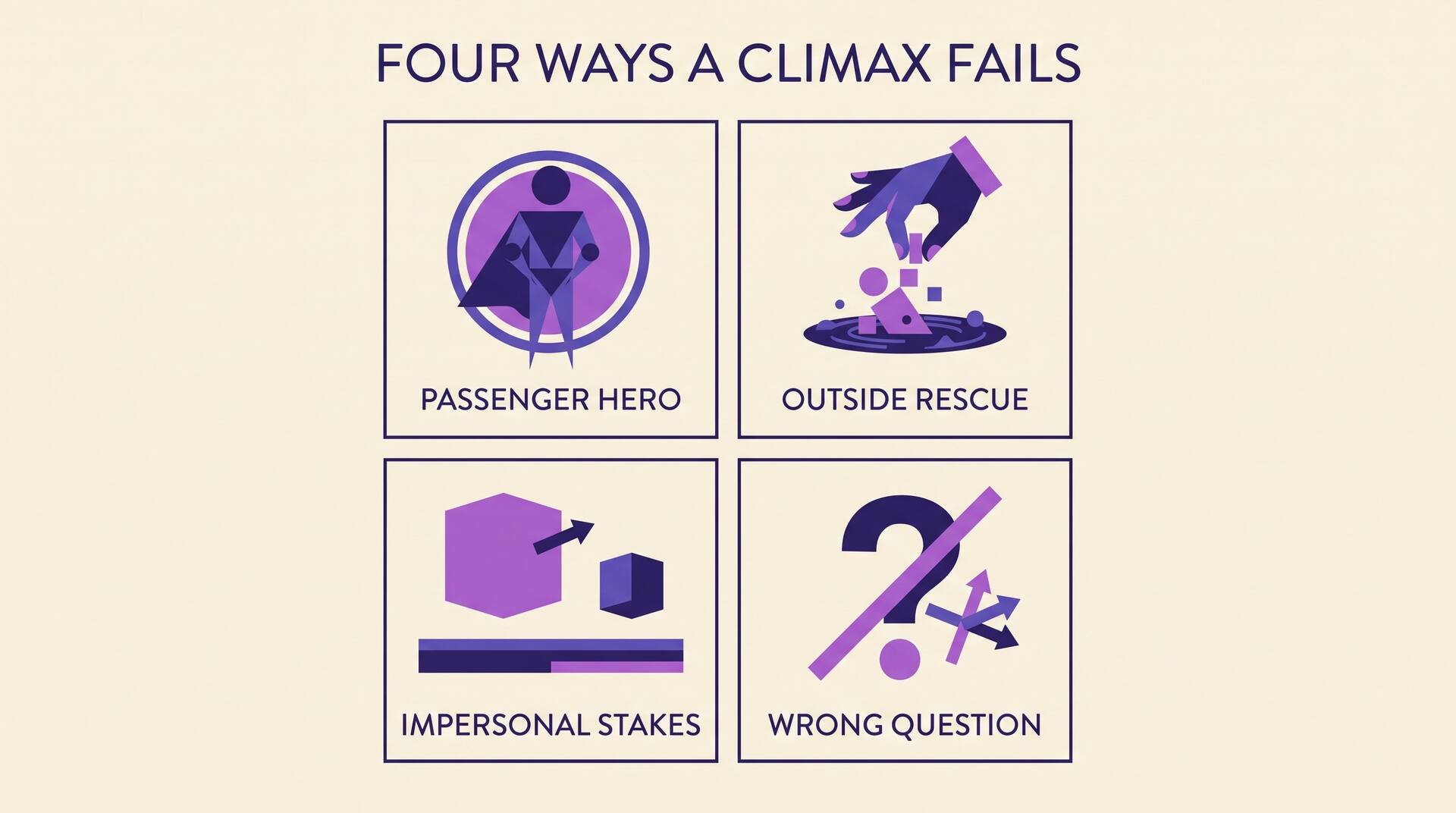
The protagonist is a passenger
Two other characters fight, argue, or negotiate while your lead watches, is restrained, or arrives late. The scene has energy and no meaning.
Fix: give the protagonist the one piece of agency nobody else has — information, access, or the authority to say no — and structure the scene so the outcome hinges on whether they use it.
Rescue arrives from outside
A previously unmentioned ally, a lucky coincidence, or an authority figure resolves the problem. Readers forgive a lot, but they never forgive being told the protagonist's struggle did not matter.
Fix: if the rescue has to happen, plant it early enough that the reader half-expects it, and make the protagonist's earlier choice the reason help arrives.
This failure has a name and a long history — read the full breakdown of deus ex machina before you decide your version is the exception.
The stakes were never personal
The world ends, the company collapses, the town floods — and none of it costs this specific character anything they named as precious. Scale is not stakes.
Fix: go back to the first act and give your protagonist one concrete, small, losable thing. The climax then threatens that thing, and the global stakes get their weight from it.
The ending answers a different question
The book asked whether he could forgive his father; the ending delivers a courtroom win. The reader gets a resolution and still feels cheated, because the thing they were following was quietly dropped.
Fix: write your central question on one line and pin it above the desk. If the climax scene does not contain a yes or a no to that exact sentence, the scene is not finished.
Climax, falling action, resolution
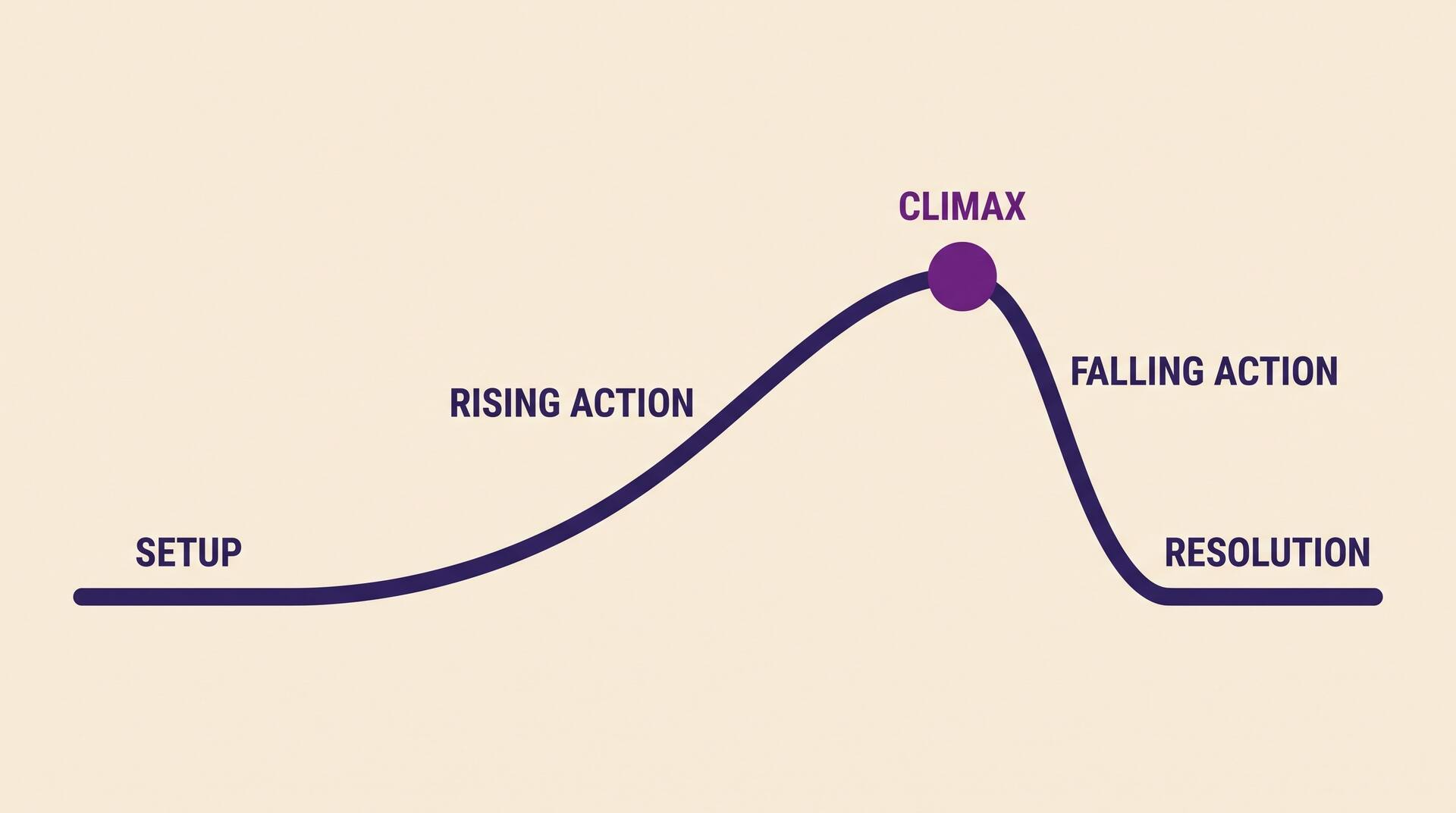
These three get used interchangeably and they are not the same thing. The climax is the decision and its immediate consequence. The falling action is the chain of effects that decision sets off — who reacts, what breaks, what gets repaired. The resolution is the new normal: the reader seeing what life looks like now that the question has an answer.
The common mistake is to fuse the last two into a single summary paragraph. The falling action is where a reader's emotion actually gets discharged; cutting it makes an ending feel abrupt even when everything is technically resolved.
If those three stages are still blurry in your outline, the plot diagram guide maps them against the rising action visually, and the three-act structure breakdown shows where each one falls inside the acts.
Working out your climax before you draft it
Climax problems are almost always outline problems that survived into the draft. Fixing them at 60,000 words means rewriting a third of a book; fixing them in an outline means changing three lines.
If you are stuck on what the irreversible choice should be, the free plot twist generator is useful for exactly this — feed it your setup and it proposes reversals you can test against the three conditions above. Most will be wrong for your book. The one that makes you say "that would cost her everything" is the one to keep.
Inside AIWriteBook, the outline builder writes a chapter-by-chapter plan where each chapter carries its own plot points and twists, all of it editable. That matters here for one practical reason: you can see the whole arc as a list and check whether the decisive chapter sits where your genre expects it, before a single scene is written. Chapters are drafted with Gemini or Grok once the shape is right.
For the scene itself, the scene builder helps you block out who is present, what each of them wants, and what the room costs the protagonist — the details that turn a decision into a scene rather than a summary.
Common questions
Run the test on your own draft
Open your climax chapter and check the three conditions. Does the protagonist decide, with refusal still on the table? Does the scene answer the exact question the book has been asking? Is the price visible on the page? If any answer is no, you have found the reason the ending felt thin — and you have found it while it is still cheap to fix.
Structure work rarely stays in one place, so if you are building a book from scratch rather than repairing one, the complete guide to writing a book covers the stages around this one: premise, outline, drafting, and what to do when the middle sags.