

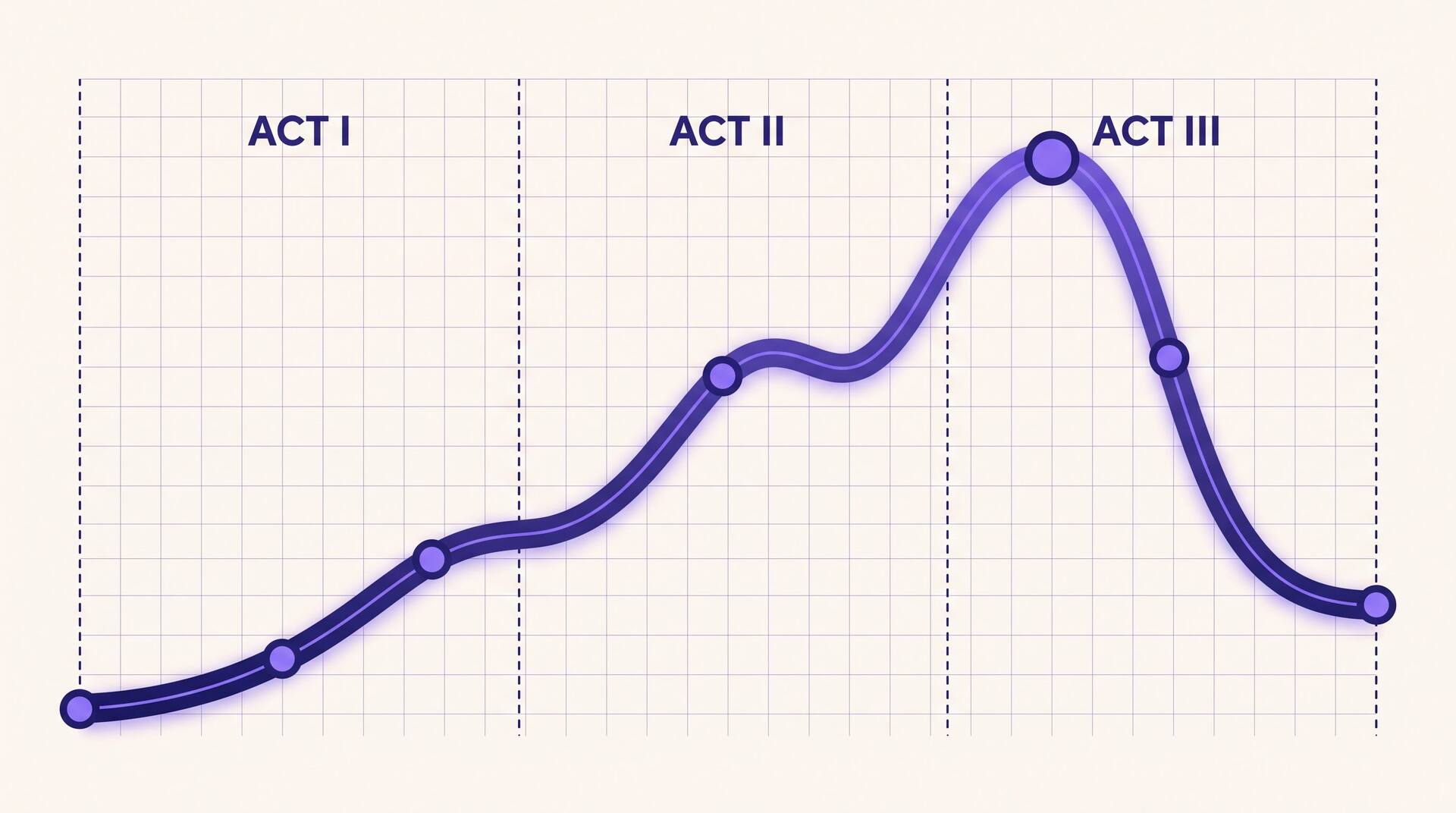
The beat map at a glance
The three-act structure divides a story into roughly 25% setup, 50% confrontation, and 25% resolution. Those proportions are not arbitrary — they place the reader's biggest questions and answers at the moments a story feels most satisfying. The percentages below are targets, not laws, but they are a reliable diagnostic: if your turning points land far from these marks, something is usually off.
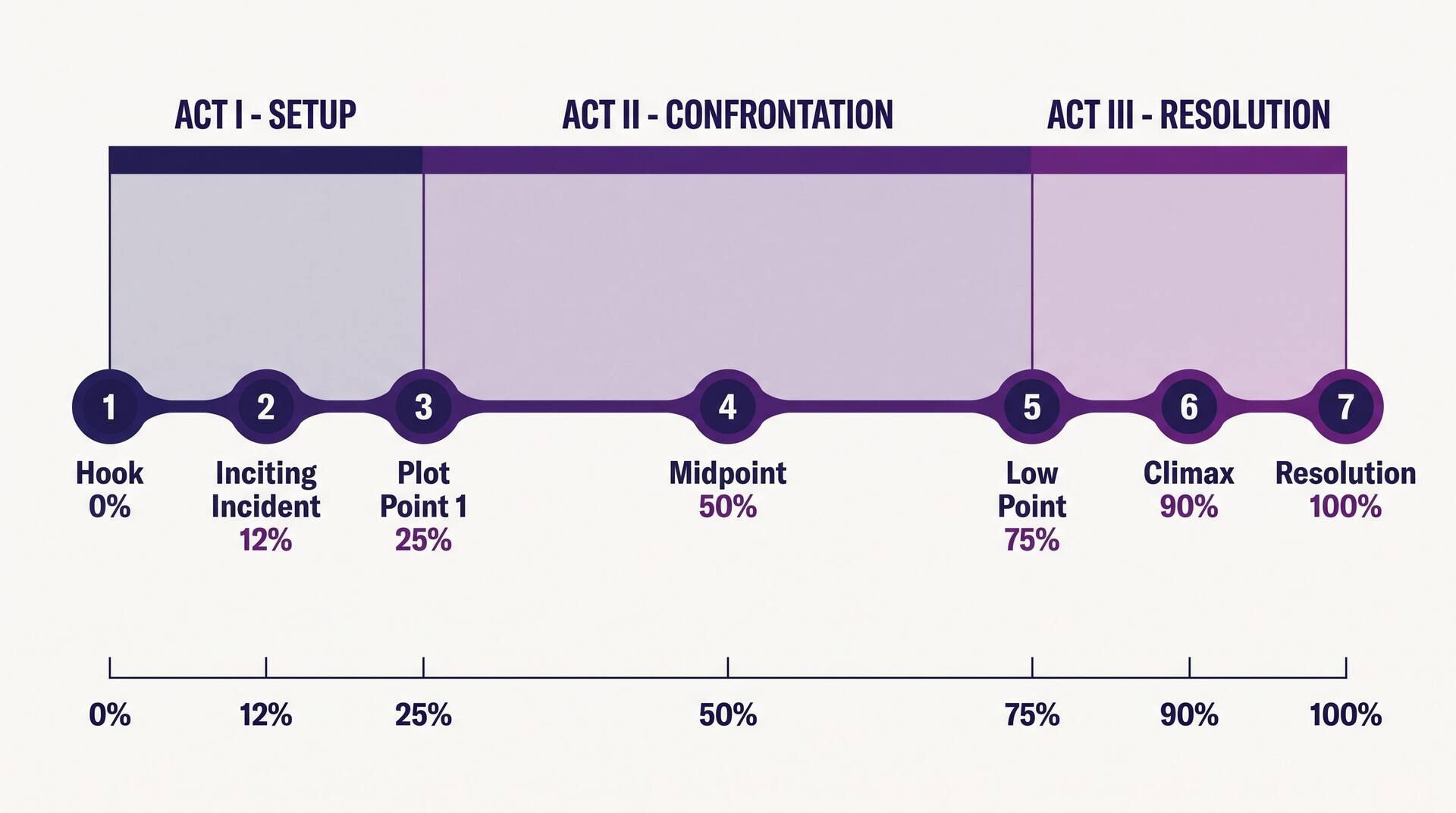
| Beat | Position | Word count | What happens |
|---|---|---|---|
| Hook | 0-3% | Page 1 | Open on a character in motion, in a world the reader wants to keep reading about. |
| Inciting incident | ~12% | ~10,000 | The event that knocks the status quo off balance and starts the real story. |
| First plot point | ~25% | ~20,000 | The protagonist commits, crosses a threshold, and Act I ends. No going back. |
| Midpoint | 50% | ~40,000 | A reversal that reframes the goal — a false victory, a false defeat, or a revelation. |
| Low point | ~75% | ~60,000 | All is lost. The protagonist's plan collapses and Act II ends at its darkest. |
| Climax | ~90% | ~72,000 | The final confrontation that answers the story's central question for good. |
| Resolution | 95-100% | ~76,000+ | The new normal. Loose ends close and the changed character shows the cost of the journey. |
Word counts assume a typical 80,000-word novel. Scale them to your own length — the percentages are what travel.
What each act is actually for
Acts are not just chunks of runtime — each has a distinct job. Switch between them to see what work belongs where.
Act I - Setup (0-25%)
Act I earns the reader's investment. You establish who the protagonist is, what they want, and the world's rules — then break the status quo with the inciting incident around the 12% mark. The act ends at the first plot point: the hero makes an irreversible choice that launches the central conflict. The most common Act I mistake is stalling: a whole chapter of ordinary life before anything happens. Get the inciting incident onto the page early, then let the first plot point slam the door on the old world.
Key beats: hook, character and world setup, inciting incident (~12%), first plot point (~25%).
The beat map in famous stories
The proportions hold across genres. Here is where the turning points land in three very different, widely-studied stories.
The Hunger Games
- Inciting incident: Prim's name is drawn at the reaping and Katniss volunteers to take her place.
- First plot point: Katniss enters the arena — the old life is gone, survival is the only goal.
- Midpoint: the alliance with Rue and the rule change allowing two victors reframe the game from pure survival to something like hope.
- Low point: Rue's death and Peeta's grave wound strip that hope away.
- Climax: the poison-berry standoff forces the Capitol to blink — Katniss wins on her own terms.
Pride and Prejudice
- Inciting incident: the Meryton ball, where Darcy snubs Elizabeth and first impressions harden.
- First plot point: Wickham's arrival and Darcy's meddling lock Elizabeth's prejudice into place.
- Midpoint: Darcy's first proposal — rejected — and the letter that reframes everything Elizabeth believed.
- Low point: Lydia elopes with Wickham, threatening the family's reputation and any future with Darcy.
- Climax: Darcy quietly resolves the scandal; the second proposal is accepted.
Star Wars: A New Hope
- Inciting incident: Luke finds Leia's message hidden in R2-D2.
- First plot point: his aunt and uncle are killed; Luke leaves Tatooine and commits to the fight.
- Midpoint: the daring rescue of Leia aboard the Death Star raises the stakes from escape to rebellion.
- Low point: Obi-Wan falls to Vader before Luke's eyes.
- Climax: the trench run — Luke trusts the Force and destroys the Death Star.
Notice the pattern: the midpoint always turns the story, and the low point always precedes the climax. If you want to see how these beats trace the same rising-and-falling arc that Freytag's pyramid and the hero's journey circle describe, the plot diagram guide maps all three side by side.
The two failure modes that sink most drafts
When a manuscript feels broken, it is almost always one of these — and both are structural, not stylistic.
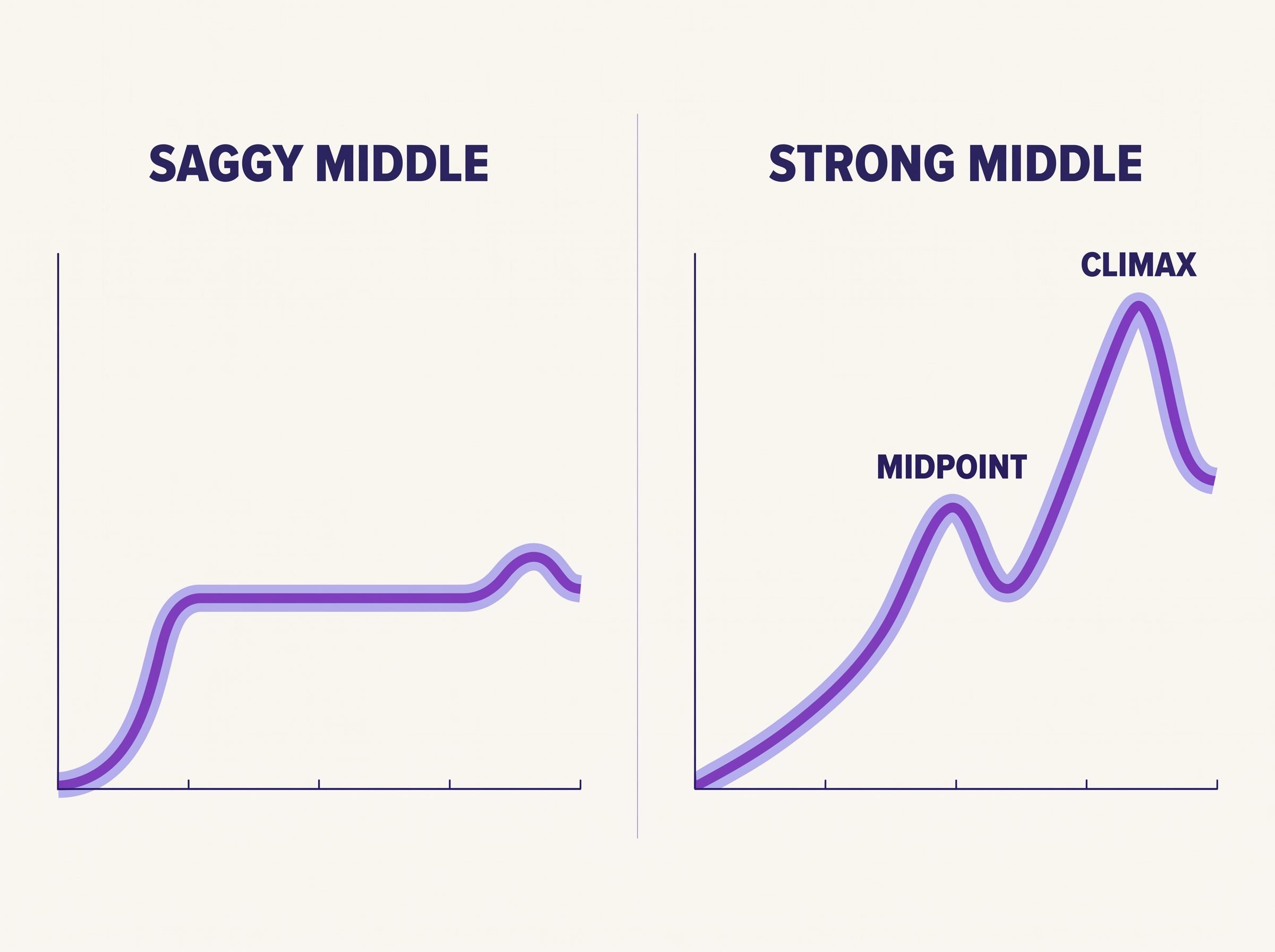
The saggy middle
Act II runs on for tens of thousands of words with no clear direction — scenes happen, but stakes stay flat and the reader drifts.
Install a true midpoint reversal at 50% and pinch points on either side. Every scene in Act II should either raise the stakes or narrow the protagonist's options. If a scene does neither, cut it.
The rushed Act III
The climax arrives out of nowhere, resolved by a lucky break or a skill the hero never showed, and the ending feels unearned.
Plant the climax's tools in Act II — the ally, the object, the lesson. Give the low point room to breathe so the recovery means something. A satisfying climax is a promise the earlier acts already made.
A third, quieter killer is the late inciting incident — burning through Act I on backstory before the story starts. If your inciting incident lands past the 15% mark, the opening is probably too slow.
Turn the beat map into an actual outline
Knowing where the midpoint should land is one thing; filling 50 chapters with beats that hit those marks is another. When you draft a book in AIWriteBook, the outline step builds a chapter-by-chapter plan that follows a chosen structure — laying out plot points, events, and locations for each chapter, with a toggle for how strictly it holds to the shape. You can regenerate or edit any chapter's outline before a word of prose is written, so the three-act skeleton is locked in before you draft.
Want a quick standalone version first? The free outline generator turns a premise into a structured chapter list in seconds — a fast way to pressure-test your act breaks before committing.
When three-act is the wrong tool
The three-act structure is a default, not a mandate. It rewards stories driven by a central external conflict. Some stories are not — and forcing them into three acts flattens what makes them work.
Literary and character studies
When the real movement is internal — a shift in perception rather than a won battle — rigid plot points can feel mechanical. Interiority, not turning points, carries the book.
Episodic and picaresque stories
Road novels, linked short-story collections, and slice-of-life work are built from self-contained episodes rather than one escalating throughline. A single climax would betray the form.
Kishotenketsu
This four-act East Asian structure — introduction, development, twist, reconciliation — needs no central conflict at all. The 'twist' (ten) recontextualizes what came before rather than resolving a fight. It suits gentle, contemplative stories that three-act tension would ruin.
If your story resists three acts, that is useful information, not failure. Try the hero's journey for myth and transformation arcs, or study the broader map of story shapes before you commit.
Three-act structure FAQ
Not necessarily. Acts are units of dramatic structure, not table-of-contents divisions. A single act can span many chapters, and your Part One / Part Two labels may or may not line up with the act breaks. Structure is about where the turning points land, not how you split the pages.
The classic split is roughly 25% Act I, 50% Act II, and 25% Act III. In an 80,000-word novel that is about 20,000 / 40,000 / 20,000 words. Treat these as targets — a diagnostic to check your pacing — rather than exact quotas.
The inciting incident (~12%) disrupts the status quo and raises the story's question. The first plot point (~25%) is where the protagonist makes an irreversible choice to engage with that question, ending Act I. The inciting incident happens to the hero; the first plot point is a decision the hero makes.
Yes. Many screenwriters split Act II in two at the midpoint, giving a four-part feel, and Shakespearean drama uses five acts. Kishotenketsu uses four acts with no central conflict. Three acts is the most common teaching model because it maps cleanly onto setup, confrontation, and resolution — but it is one option among several.
It helps, but discovery writers often find the structure in revision instead. Even pantsers benefit from checking a finished draft against the beat map: if the midpoint drifts or the low point is missing, the map shows you exactly where to dig. Outlining tools can generate a structured act-by-act plan to start from if you prefer to build the skeleton first.
Use the map, then trust the story
The three-act structure works because it mirrors how readers experience tension: a promise, a long complication, and a payoff. The percentages give you a diagnostic — a way to find the scene that is one chapter too early or the climax that arrives with nothing behind it. But the map is a servant, not a master. Once your turning points land where they should, stop measuring and follow the characters.
If you are building your first full manuscript, the broader how-to-write-a-book guide walks through everything around the structure — idea, characters, drafting, and publishing — so the beat map fits into a finished book.