

What's inside
There is a comforting myth in self-publishing that the hard work ends when you hit publish. In reality, that's where the business starts. Amazon will happily host a book that sells two copies a year, and it will host a book that pays a mortgage, with exactly the same upload flow. The difference is never the upload — it's the decisions made before and after it: format, price, niche, royalty tier, and whether you understand how Amazon counts your money.
Why most KDP books make $0
The failure pattern is consistent, and almost none of it is about writing quality. Books die for structural reasons that are fixable before you ever publish.
Priced by emotion, not by tier
Authors price a book at $0.99 to 'get sales' or $14.99 because 'it took a year to write.' Both leave money on the table. Amazon's 70% royalty rate only exists in a specific price window — outside it, you silently drop to 35%.
Invisible in search
A book in a category with no demand, or buried under thousands of rivals, gets no organic visibility. No visibility means no sales, regardless of how good the prose is.
One book, no series
A single title has no read-through. Profitable self-publishers earn most of their money from readers who finish book one and immediately buy book two, three, and four.
Published, then abandoned
The book goes live, the author waits for sales that never come, and gives up. Nothing was wrong with the launch except that there wasn't one.
Every one of these is a decision, not bad luck. The rest of this guide walks through the decisions that separate a $0 book from a profitable one — starting with the number that actually lands in your account: the royalty.
Calculate your royalty per sale
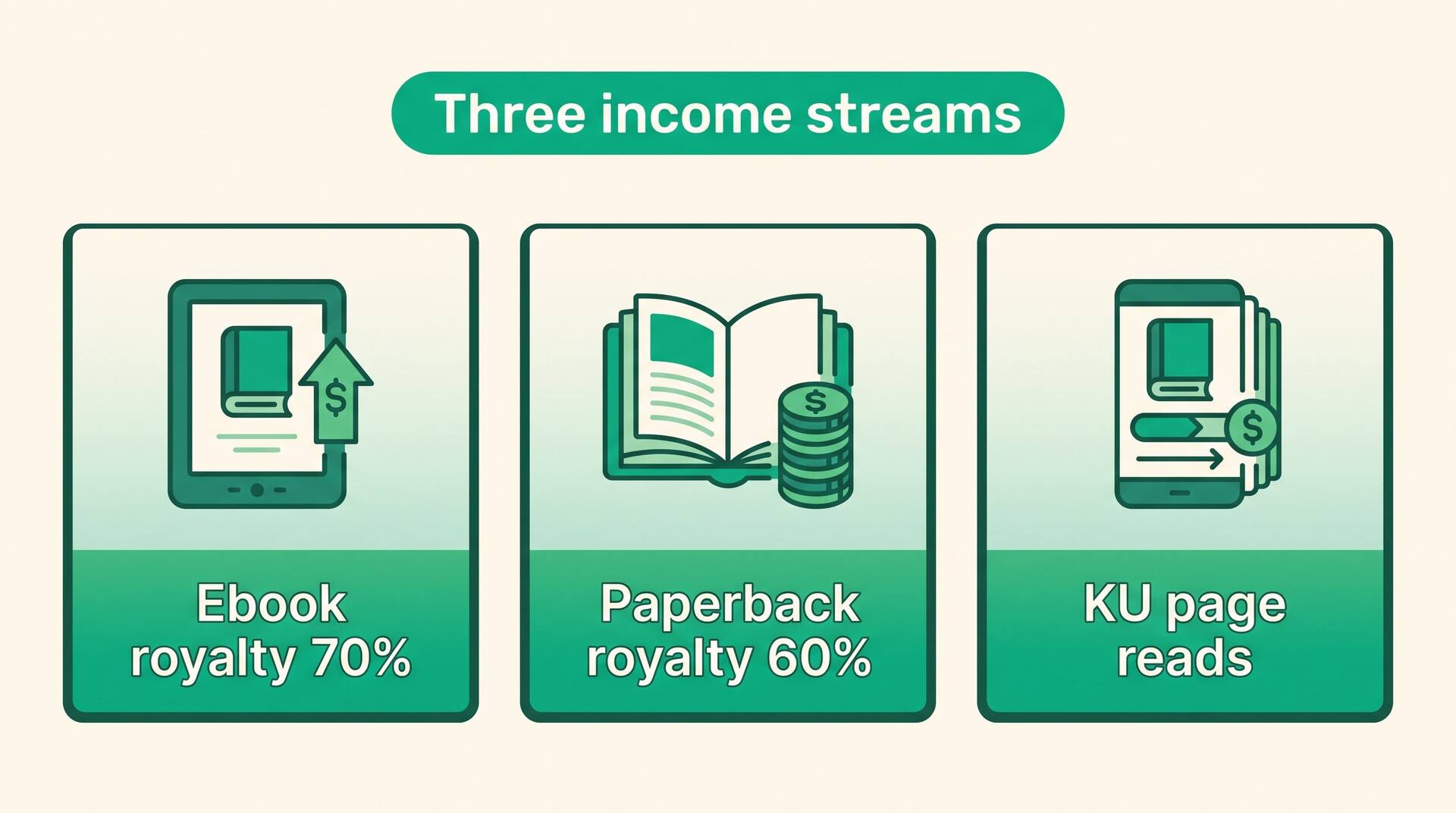
Your cover price is not your income. Amazon takes its cut, subtracts delivery or printing costs, and pays you the remainder. Before you price anything, you need to see the real number. Switch between formats and adjust the inputs — the result updates live.
Royalty per sale
$3.43
Monthly earnings
$343
Annual earnings
$4,120
The 70% tier subtracts a small delivery fee based on file size — a few cents for most books. We estimate it here; your dashboard shows the exact figure.
These are planning estimates. Amazon's exact delivery fees, print costs, and KENP rate change over time and by marketplace — always confirm against your KDP dashboard.
Want exact numbers for your specific book and marketplace? Try the free KDP royalty calculator
Pricing for profit, not vanity
Once you can see the royalty, pricing becomes a strategy instead of a guess. Three rules cover almost every situation.
Live inside the 70% window
For ebooks, $2.99 to $9.99 is the only range where Amazon pays 70%. A $2.99 ebook nets roughly $2.04; a $9.99 ebook nets about $6.99. A $1.99 ebook only pays 35% — about $0.70. Pricing low to 'compete' often earns less per sale than pricing higher.
Match price to length and genre
Nonfiction and how-to readers tolerate $6.99–$9.99 because they're buying a result. Genre fiction usually sells best at $3.99–$5.99. A 25,000-word novella priced like a 120,000-word epic will simply not convert.
Use paperback as the anchor
List a paperback at $12.99–$16.99 next to your ebook. Even if few people buy print, the higher 'compare at' price makes the ebook feel like a deal — a quiet conversion boost that costs you nothing.
Worked example: the same book, two prices
A 300-page nonfiction ebook priced at $2.99 nets about $2.04 per sale. The same book at $7.99 nets about $5.59 — and in this category, the higher price rarely cuts unit sales enough to matter. At 100 sales a month, that's $204 versus $559: a $4,260 difference over a year from one pricing decision.
KDP Select & Kindle Unlimited math
KDP Select enrolls your ebook in Kindle Unlimited and grants promotional tools, in exchange for 90 days of Amazon exclusivity (no selling that ebook anywhere else). Whether it pays depends entirely on your genre.
When Select wins
Bingeable genres — romance, thriller, fantasy, cozy mystery — thrive in Kindle Unlimited. Subscribers read voraciously and pay you per page. A 300-page book read in full earns roughly $1.35 in page reads, and an engaged KU reader may devour your whole series in a week.
When Select hurts
Nonfiction, reference, and slow-burn literary titles often earn more from full-price sales across every store (Apple Books, Kobo, Google Play) than from page reads. Exclusivity locks you out of those markets for no gain.
The practical move
Enroll new fiction in Select for the first 90 days to ride the Kindle Unlimited algorithm and stack reviews, then reassess. Keep nonfiction wide unless your data says otherwise. You can compare per-page earnings against wide sales right inside your dashboard before renewing. KDP Select: Pros and Cons.
Picking a niche that pays
A profitable niche is the intersection of real demand and beatable competition. You want readers who are actively buying, in a category you can rank in.
Demand: are people buying?
Look at the best-seller ranks of the top books in a category. If the #1 book sits around a 5,000–50,000 overall rank, the category has steady daily sales. If the top book is ranked in the millions, nobody's buying there.
Competition: can you break in?
Now check the depth. If breaking into the top 20 requires outselling polished books with thousands of reviews, that's a hard niche for a debut. A category where the top 20 includes thin, dated, or poorly-formatted books is an opening.
Profitability: does the price hold?
Some niches sell well but only at $0.99. A great niche has demand, weak competition, and a price floor your readers accept — a low-content puzzle book at $6.99 can out-earn a novel that took ten times longer to write.
You don't have to eyeball this. Our free niche and category research tools surface demand and competition signals so you can validate an idea before you write a word. Picking a niche that pays · KDP Keyword Research
Ad math for new authors
Amazon Ads can turn a stalled book into a steady earner — or quietly drain your wallet. The whole game comes down to one ratio: are you earning more from a click than you're paying for it?
Know your breakeven ACOS
ACOS (Advertising Cost of Sale) is ad spend divided by ad revenue. If your $4.99 ebook nets $3.49 in royalty, you break even when ad cost equals $3.49 per sale — an ACOS of 70%. Below that, you profit; above it, you pay to be read.
A simple breakeven view
| Royalty per sale | Sales per 10 clicks | Max profitable cost per click |
|---|---|---|
| $2.00 | 1 | $0.20 |
| $3.50 | 1 | $0.35 |
| $3.50 | 2 | $0.70 |
Higher royalty and higher conversion both raise the bid you can afford. This is why pricing and a strong book description matter before you ever run an ad — they change the math underneath it.
Start small, let data accumulate for two weeks, kill keywords with spend and no sales, and pour budget into the few that convert. For series, you can afford to lose money on book one's ads if read-through pays it back across the rest. Amazon Ads for Books.
Series economics: where the money is
The single biggest lever in self-publishing income isn't price or ads — it's read-through. A reader who buys book one of a five-book series is worth five times a reader who buys a standalone.
Make book one a doorway
Price book one low, or even free through select promotions, to remove all friction. Its job isn't to earn — it's to deliver readers to books two through five at full price.
Compound the royalty
If 60% of readers continue to each next book, 1,000 readers of book one become roughly 600, 360, and 216 buyers down the line. At $4.99 each, that one cohort earns far more than four unrelated standalones ever could.
Write to a finishable plan
Series stall when the author burns out mid-way. Planning the arc and outlining every book up front — something AIWriteBook can generate in minutes — keeps momentum so the read-through machine actually has books to sell.
A realistic 12-month income picture
Honest expectations protect you from quitting too early or spending too much. Most authors who keep going follow a recognizable curve.
Publish and learn
Get one to two books live, nail metadata and categories, and gather your first reviews. Income is usually small — often under $100 a month. This phase is about data, not profit.
Find what works
Double down on the niche and format that sold, start modest ads, and add titles to build a series. Many authors reach a few hundred dollars a month here as a catalog forms.
Compound
With three to five titles, read-through and ads start compounding. A focused author with a tight niche and a series can realistically be earning a meaningful monthly side income — and a few break through to far more.
The authors who make real money are rarely the best writers. They're the ones who treated publishing as a business, shipped consistently, and let a catalog do the compounding. The fastest way to get through the early phases is to produce more good books, faster — which is exactly the bottleneck AI writing removes.
Where AI changes the equation
Every strategy here rewards having more books: more read-through, more ad surface, more categories ranked, more shots at a winner. The old constraint was that each book took months. AIWriteBook compresses outlining and drafting from months to days — generating a full structured manuscript you then edit and make your own — so you can build the catalog the math depends on while it's still your voice on the page.
Frequently asked questions
Publish like it's a business
Making money on Amazon isn't a secret formula — it's a stack of small, correct decisions: price inside the 70% window, choose Kindle Unlimited only where it pays, pick a niche with real demand, run ads that clear breakeven, and build a series so read-through compounds. None of it requires luck. All of it requires more good books than most people are willing to write.
That's the real bottleneck, and it's the one worth solving first. Map your whole plan against the full Amazon KDP guide, then start producing the catalog the math rewards.