

Free AI Short Poem Generator
Give it a subject, choose a form and a mood, and get three original poems you can edit, share, or save as an image.

Which poem form should you pick?
Each form sets different rules, and the rules shape what the poem can do.
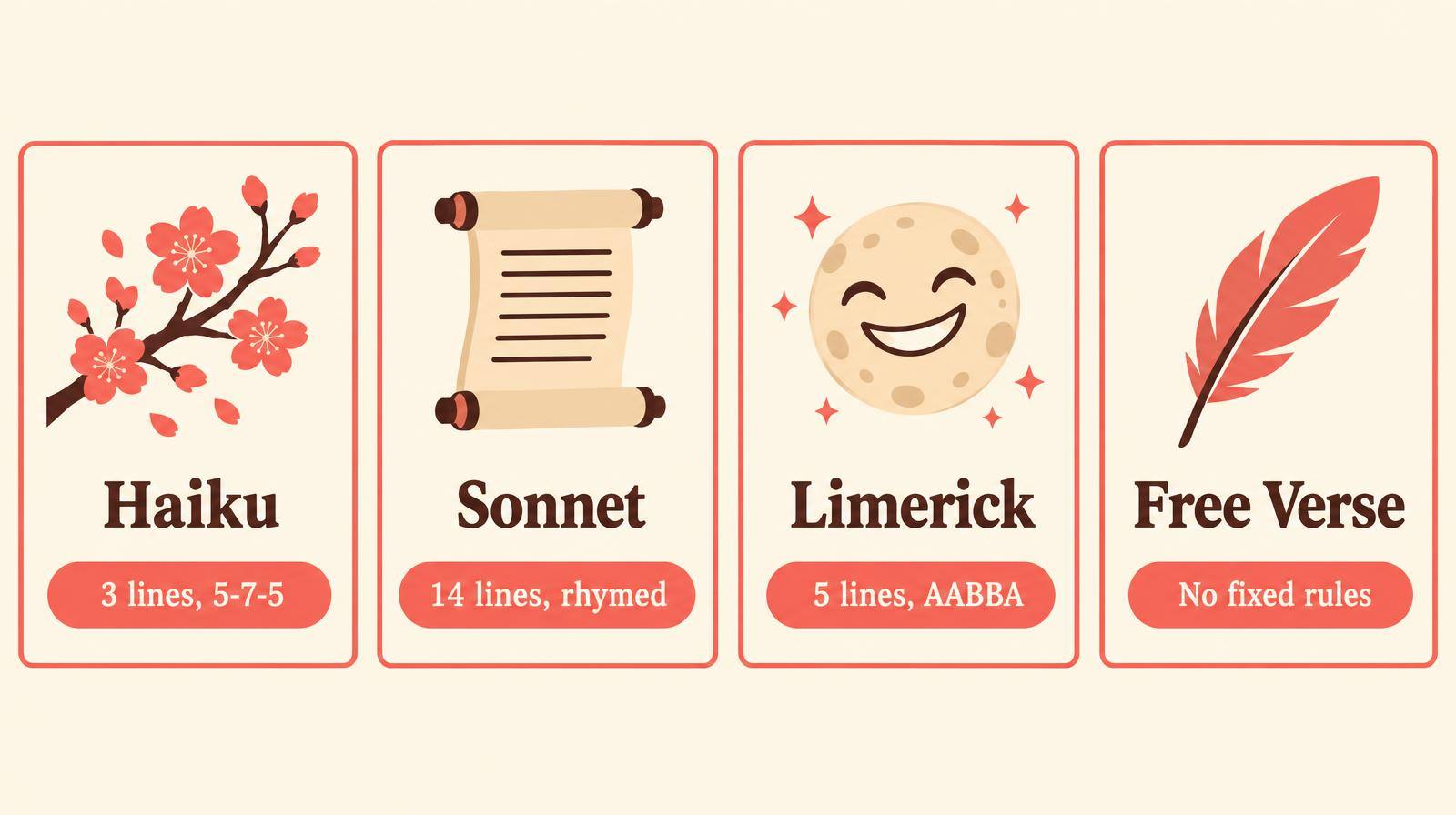
Pick haiku when you want one sharp moment, like a frozen pond or the first coffee of the day. A sonnet gives you room to argue with yourself, and the turn near the end is where the feeling lands. Limericks are for jokes, birthday cards, and anything that needs a bounce. Free verse is the safe choice when the subject matters more than the music. You can also try acrostic for names, or ode when you want to praise something ordinary.

How the AI poem generator works
You bring the subject. The tool handles meter, rhyme and line breaks, and you keep the final say.
Name your subject
Be specific. 'My dog waiting at the window' gives better poems than 'love'. Names, places and small details all end up in the lines. Stuck for a subject? Grab a writing prompt first.
Choose form, mood and length
Pick from eight forms, from haiku to ballad. Add a mood if you want one, then choose short, medium or long. Fixed forms like the sonnet and limerick keep their own line count.
Edit, share or save
You get three different takes on the same subject. Change any line with the pencil, share it, or save it as an image for a card or a post. When you have enough of them, turn them into a poetry book.
What people write with it
Most people want a poem for a reason: a card, a caption, a page in a collection, or practice.
Cards and special days
Birthdays, weddings, anniversaries, a farewell at work. Put the person's name and one true detail in the subject and you get something that sounds like them, not like a greeting card.

Poets building a collection
Use it to get past a blank page. Generate drafts on a theme, keep the lines that ring true and rewrite the rest in your own voice. Then publish the collection on Amazon.

Students and teachers
See how the same subject reads as a haiku, a sonnet and a limerick side by side. It is a quick way to show what form does, and to spot devices like alliteration in action.

Frequently asked questions
Yes. You can generate poems without an account. Each run writes three poems, and you can run it again as often as the daily free limit allows.
Free verse, haiku, sonnet, limerick, rhyming quatrains, acrostic, ballad and ode. The generator follows each form's rules, such as 5-7-5 syllables for haiku and 14 lines for a sonnet.
Yes, the poems are yours to use in cards, posts, books or class. If you publish them, edit them into your own voice first. Readers notice the difference, and so will you.
Give concrete details. A smell, a color, a name or a place gives the AI images to work with. Vague subjects like 'life' or 'happiness' get vague poems back.
Yes. Switch the site language and the generator writes in that language, including rhyme and line breaks that suit it.
Related tools & guides
Keep going with more free tools and in-depth guides
Writing Prompt Generator
Find a subject when you have nothing to write about yet.
AI Poetry Book Generator
Turn a theme into a full poetry collection.
How to Publish a Poetry Book on Amazon
Formatting, categories and pricing for poetry on KDP.
Alliteration Examples
One sound device that makes lines stick.
Lyrical Writing Style
Bring the music of poetry into prose.
Ready to write your full book?
Transform your ideas into complete books with AI-powered writing, cover design, and publishing tools.