

What lyrical prose actually is
Lyrical prose is fiction written with the tools of poetry — rhythm, sound, imagery, and figurative compression — while still doing the ordinary work of prose: moving a story forward.
The word gives it away. "Lyric" comes from the lyre, the instrument Greek poets played while they sang. Lyrical writing keeps that musical instinct but pours it into sentences rather than stanzas. It cares how a line lands on the ear, how one clause leans into the next, how a paragraph breathes. When you catch yourself rereading a sentence just to feel its shape again, you have found lyrical prose.
The critical thing it is not: decoration for its own sake. Music that carries no meaning is purple prose — adjectives stacked like a wedding cake, metaphors that collapse under their own weight, a narrator so in love with the sound of their voice that the story stops. The difference between lyrical and purple is not intensity; it is whether the sound is doing a job. In lyrical prose, the rhythm mirrors the feeling, the image delivers information, and the beauty is load-bearing. In purple prose, it is furniture.
Lyrical vs poetic vs literary: three words people blur together
These labels overlap, which is why they get used interchangeably and wrongly. They answer different questions. Lyrical describes the texture of the sentences; poetic borrows specific devices; literary describes ambition and audience. A book can be one, two, or all three.
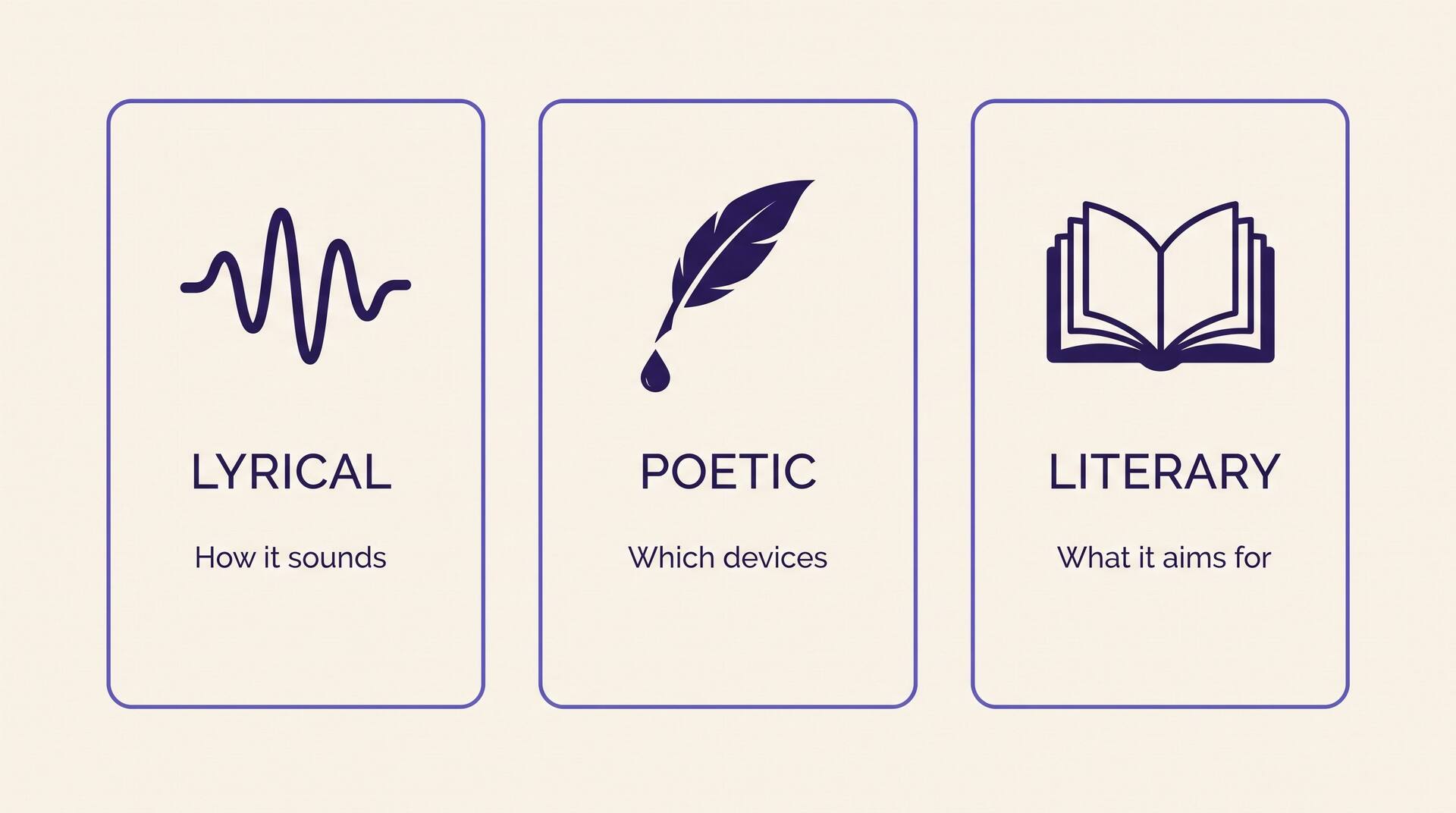
Lyrical
How does it sound?
A quality of the prose itself — musical rhythm, deliberate sound, sensory imagery. You feel it line by line. Sara Gruen and Delia Owens write lyrically inside commercial fiction; the sentences sing without demanding a literature degree.
Poetic
Which devices does it use?
Prose that reaches directly for poetry's toolkit: metaphor, meter, line-like fragments, symbol, and compression. Every lyrical passage is a little poetic, but "poetic" points at the specific devices, not the overall feel.
Literary
What is it trying to do?
A marketing and ambition category, not a sound. Literary fiction prizes character, theme, and language over plot mechanics. Plenty of literary novels are written in plain, spare prose — Hemingway, Rachel Cusk — so literary does not mean lyrical at all.
The practical takeaway: you can write a lyrical thriller, a spare literary novel, and a poetic children's book. Pick the texture on purpose, not by default. If you are still building the underlying craft, our beginner-facing walkthrough of the elements every scene needs sits alongside this one in the how-to-write-a-book library.
The five techniques that actually produce lyrical prose
Lyrical writing is not a mood you summon; it is a set of decisions you can name and practice. Here are the five that do the real work — each with a flat line and its lyrical rewrite, so you can hear the mechanism instead of just reading about it. Tap a technique to see the before and after.
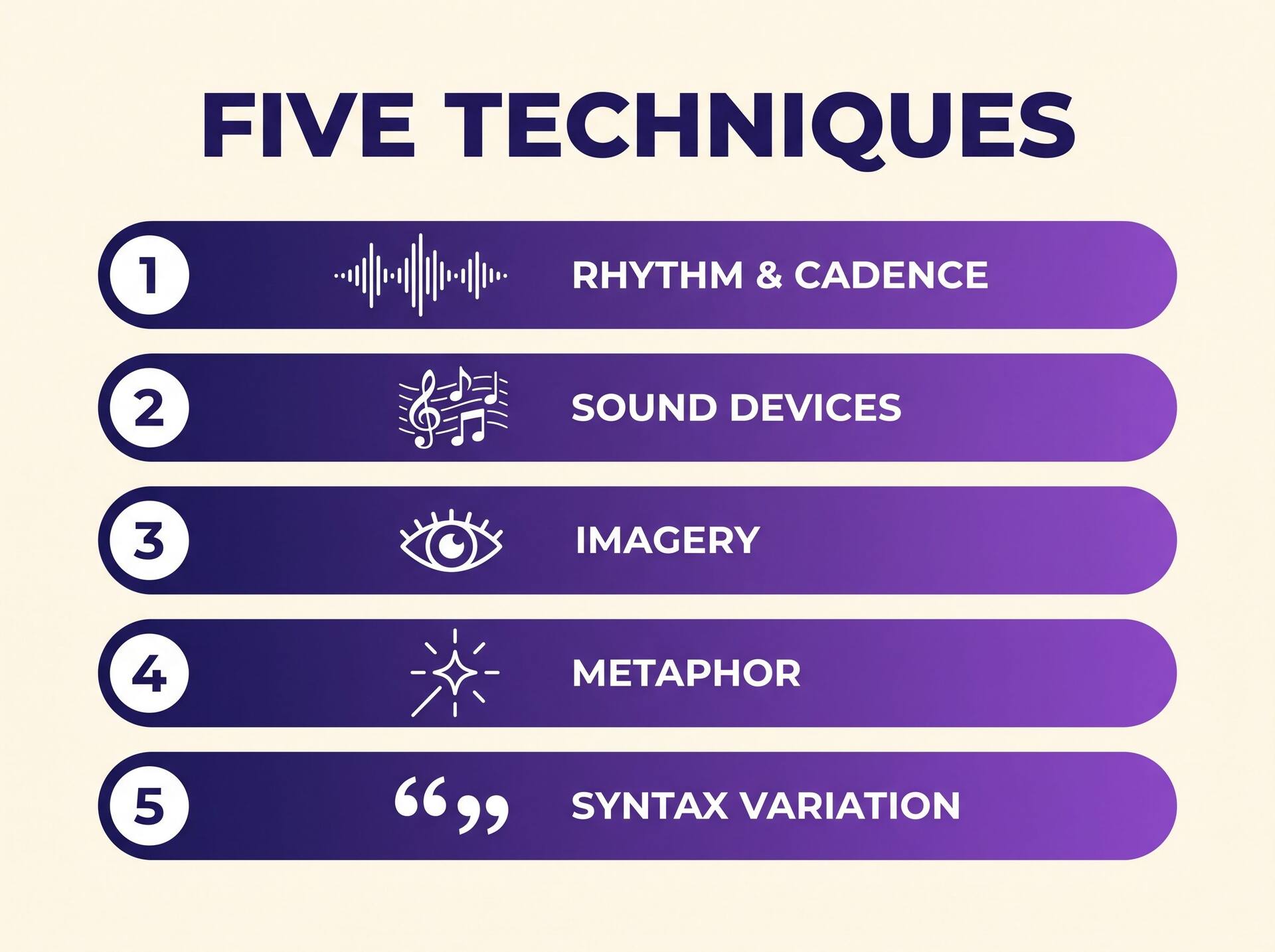
Sentence rhythm and cadence
The single most important lever. Vary sentence length so the prose has a heartbeat — a run of short sentences builds tension, then one long sentence releases it in a single breath. Read everything aloud; your ear catches what your eye forgives.
Flat
She walked into the room. It was empty. She felt sad and alone.
Lyrical
She walked into the empty room, and the silence met her the way water meets a stone dropped into it — closing over, smoothing out, as if she had never come in at all.
Sound devices
Assonance, consonance, alliteration, and sibilance let sentences chime. Used lightly they are invisible and irresistible; overused they turn into tongue twisters. Our roundup of alliteration examples shows how to dose the effect without tipping into gimmick.
Concrete sensory imagery
Abstraction kills lyricism. Replace "she was nervous" with what nervousness does to the body and the world around it. Our full guide to imagery in writing goes deeper, but the rule is simple: lyrical prose reports through the senses — sight, sound, smell, texture, taste — because specificity is what the ear and the imagination both reward.
Fresh, controlled metaphor
One precise metaphor outperforms three vague ones. Lyrical writers earn their figurative language by keeping it fresh and unmixed — never "a sea of fire raining down." Our deep dive on metaphor examples covers the difference between an image that illuminates and one that just decorates.
Syntax variation and repetition
Anaphora (repeating an opening phrase), sentence fragments used on purpose, and inverted word order give prose its musical structure. Repetition is not a mistake when it is deliberate — it is a refrain. The trick is control: a fragment lands only when the sentences around it are whole.
Examples from the masters
The fastest way to internalize lyrical prose is to read it slowly and notice the machinery. Four writers, four distinct approaches to the same instrument.
What is the meaning of life? That was all — a simple question; one that tended to close in on one with years. The great revelation had never come. The great revelation perhaps never did come.
Woolf builds music from repetition and rhythm rather than ornament. "The great revelation" returns like a refrain; the sentences lengthen and contract to mimic a mind circling a thought it cannot land. This is cadence doing emotional work — technique 1 and 5 together.
So we beat on, boats against the current, borne back ceaselessly into the past.
The most quoted closing line in American fiction earns it through sound. Listen to the b-sounds — beat, boats, borne, back — and the way "borne back ceaselessly" slows the sentence to a tide's drag. One controlled metaphor, one perfect cadence, no wasted word.
124 was spiteful. Full of a baby's venom.
Morrison shows lyricism does not mean long. Two fragments, blunt and strange, that give a house a temperament and a nursery a threat. Her lyricism is incantatory and often clipped — proof that rhythm, not sentence length, is the real engine.
She has grown older. And he loves her more now than he loved her when he understood her better.
Ondaatje, a poet before he was a novelist, works by juxtaposition — placing plain statements beside images until they strike a chord. The lyricism here is in the restraint and the turn, the way the second sentence quietly undoes the certainty of the first.
Quoted briefly for study and commentary.
Genre suitability: when to turn the music up
This is where most advice fails genre novelists. Lyrical density is not a virtue you apply everywhere — it is a dial. Turn it too high in a thriller and the pace dies; leave it at zero in literary fiction and the prose goes grey. The skill is matching the dial to the genre, then breaking your own rule at exactly the right moment.
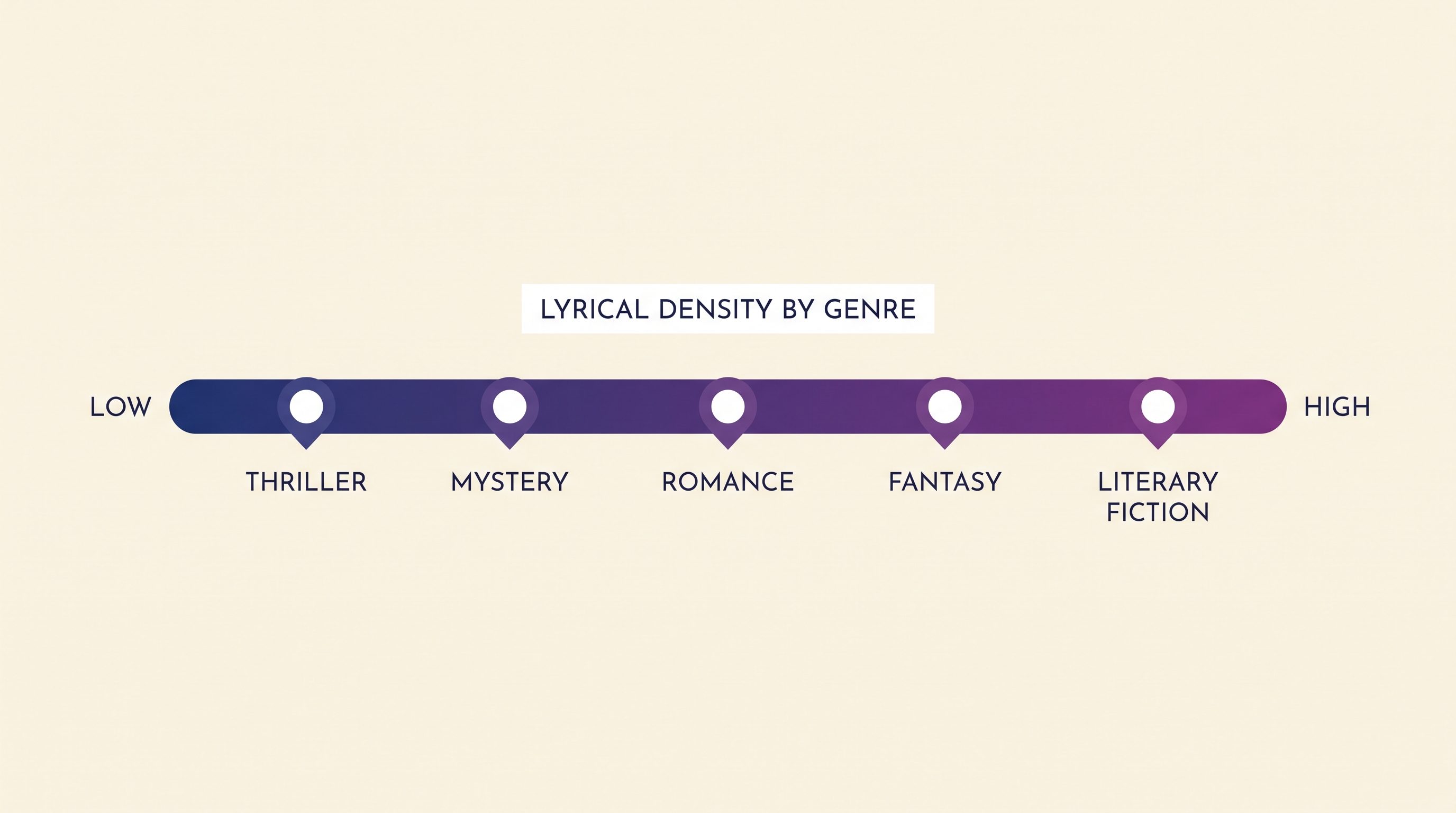
Where lyrical prose thrives
- Literary and upmarket fiction — language is part of the point
- Literary fantasy and magical realism — the prose sells the wonder
- Coming-of-age and historical fiction — memory rewards a musical voice
- Character-driven romance at emotional peaks
Where to keep the dial low
- Thrillers and action — velocity beats beauty; a slow sentence stalls a chase
- Cozy mystery and commercial plots — clarity and momentum first
- Middle-grade and most YA action — young readers want forward motion
- Hard science fiction procedure — precision over lyricism in the mechanics
The counter-intuitive rule: even in the fastest genres, a single lyrical beat lands hardest precisely because the prose around it is lean. Save your most musical sentence for the turn — the death, the reveal, the kiss — and let the plainness before it be the silence that makes the note ring. If you are still shaping the larger scaffolding those beats hang on, our guide to three-act structure covers where the emotional peaks actually fall.
Five exercises to train the ear
You cannot think your way to lyrical prose; you drill it until the ear takes over. Check these off as you work through them — each targets one of the five techniques.
Where AI actually helps with lyrical style — and where it doesn't
Be honest about the limit first: a distinctive lyrical voice is the one thing AI cannot hand you whole. Rhythm that means something comes from your ear and your revisions. What AI is genuinely good at is being a fast sparring partner — generating five ways to phrase a line so you can hear which cadence fits, or flattening a passage you have overwritten so you can rebuild it with intent.
When a draft reads mechanically even — every sentence the same length, the same shape — that evenness is itself the tell of unrevised writing, human or machine. Our free AI text humanizer is built to break exactly that flatness: paste a robotic paragraph and it varies the rhythm and phrasing so you have something with a pulse to edit. For quick single-line alternatives, the paraphrasing tool gives you three or four rewrites of a stubborn sentence in a click. Treat both as options to choose from, never as the final ear.
Inside AIWriteBook, the deeper help is voice fidelity. Import a manuscript and the writing-style feature learns your cadence and keeps drafting new chapters in it, so a series stays consistent instead of drifting into generic AI smoothness. And the chapter AI chat proposes line edits with an accept-or-reject diff for every change — so when it suggests a more lyrical phrasing, you keep the ones that sound like you and throw out the ones that don't. The taste stays yours; the tool just makes more of it, faster.
Frequently asked questions
Purple prose is overwriting — ornament stacked past the point of meaning, where the language calls attention to itself and the story stalls. Lyrical prose uses the same tools but keeps them load-bearing: the rhythm mirrors the feeling and the image delivers information. The test is simple — if you can cut a beautiful sentence and lose nothing but the beauty, it was purple.
Yes, in measured doses. Authors like Delia Owens and Sara Gruen write lyrically inside commercial fiction. The key is reserving density for emotional peaks and keeping action lean, so a single musical sentence lands hard against plain prose rather than drowning the pace.
No, but reading poetry trains the ear faster than anything else. You do not need formal scansion; you need to notice why a line sounds good and be able to reproduce the effect. A basic feel for stressed and unstressed syllables helps you control cadence on purpose instead of by luck.
Treat lyrical density as a dial, not a default. Write action and plot in clear, lean prose, then turn the music up only at turning points — the reveal, the loss, the decision. The contrast is the point: lean prose makes the lyrical beat ring, and constant lyricism makes every beat blur.
AI can imitate lyrical patterns and generate options for a line, which is useful for breaking flat, mechanically even writing. What it cannot do is supply a distinctive voice — that still comes from your ear and your revision. Use it to propose phrasings and vary rhythm, then choose and rewrite so the music is yours.
The bottom line on lyrical style
Lyrical writing is not a gift a few authors are born with; it is five learnable techniques — rhythm, sound, imagery, metaphor, and syntax — applied with taste and, above all, with an ear tuned by reading aloud. The masters differ wildly in how they use the instrument, from Woolf's long circling sentences to Morrison's two-word fragments, but they share the same discipline: every musical choice earns its place.
And style is only powerful when it serves a story worth telling. Once your ear is trained, the next job is fitting that voice to structure, character, and genre.