

Kindle Unlimited (KU) represents the single largest revenue stream for many indie authors on Amazon. With millions of subscribers paying $11.99/month for unlimited reading, KU authors earn from a shared global fund based on pages read — not books sold. In 2025, the KDP Select Global Fund exceeded $500 million, and top KU authors consistently earn six figures annually from page reads alone. But succeeding in KU requires a different mindset than traditional eBook sales. This guide breaks down exactly how to approach enrollment, optimize for page reads, build a series catalog, market effectively within the KU ecosystem, and set realistic revenue expectations.
KU Landscape in 2026
Amazon continues to refine how KENP (Kindle Edition Normalized Pages) are calculated and how the global fund is distributed. The per-page rate has stabilized around $0.004–$0.0045 in recent months. This guide reflects the latest payout data and enrollment terms as of early 2026.
Table of Contents
1. How Kindle Unlimited Works
Before optimizing for KU, you need to understand the mechanics. KU is not a traditional sales channel — it is a subscription lending library where authors earn per page read, not per book borrowed.
The Subscriber Model
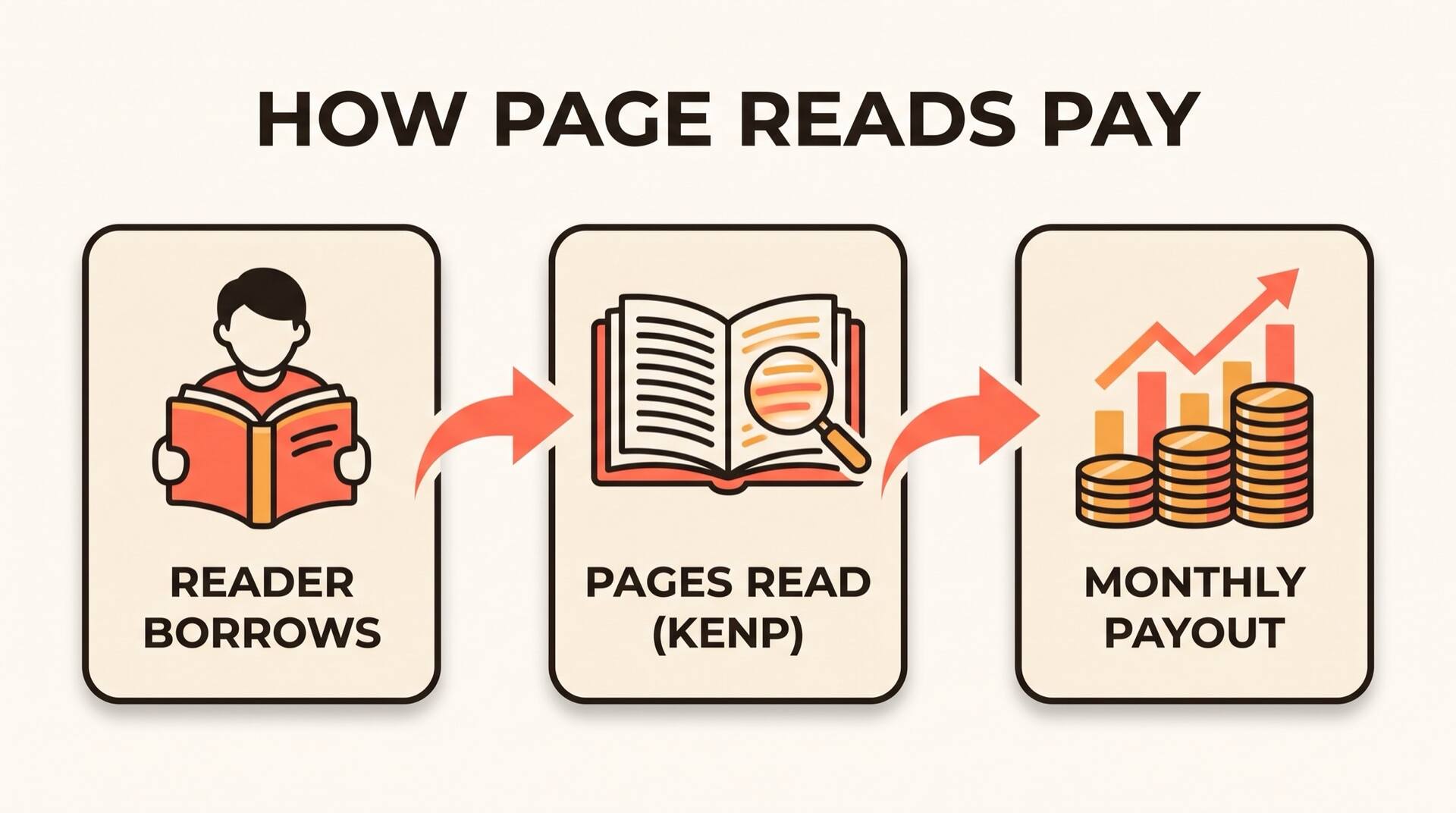
Readers pay $11.99/month for unlimited access to millions of titles enrolled in KDP Select. When a subscriber borrows your book and reads it, you earn from the KDP Select Global Fund. The more pages they read, the more you earn. A book must be read past 10% to count as a borrow.
KENP: Normalized Page Count
Amazon converts your book into Kindle Edition Normalized Pages (KENP) to standardize page counts across different formatting and font sizes. A typical 60,000-word novel equals roughly 400–450 KENP. Your KENP count appears in your KDP dashboard after enrollment.
The Global Fund & Per-Page Rate
Each month, Amazon allocates a pool of money (the Global Fund) to pay KU authors. Your share is proportional to the total KENP read across all KU books. The per-page rate fluctuates monthly but has averaged $0.004–$0.0045 per KENP read. A full read-through of a 450 KENP book earns roughly $1.80–$2.00.
90-Day Enrollment Periods
KDP Select enrollment lasts 90 days and auto-renews unless you opt out before the period ends. During enrollment, your eBook must be exclusive to Amazon — you cannot sell or distribute it on any other platform, including your own website. Print editions are not affected by this exclusivity requirement.
2. The Enrollment Decision: Exclusivity vs. Wide Distribution
The biggest strategic choice in KU is whether to enroll at all. KDP Select requires Amazon exclusivity for your eBook, which means giving up sales on Apple Books, Kobo, Barnes & Noble, Google Play, and other platforms. Here is how to think about it.
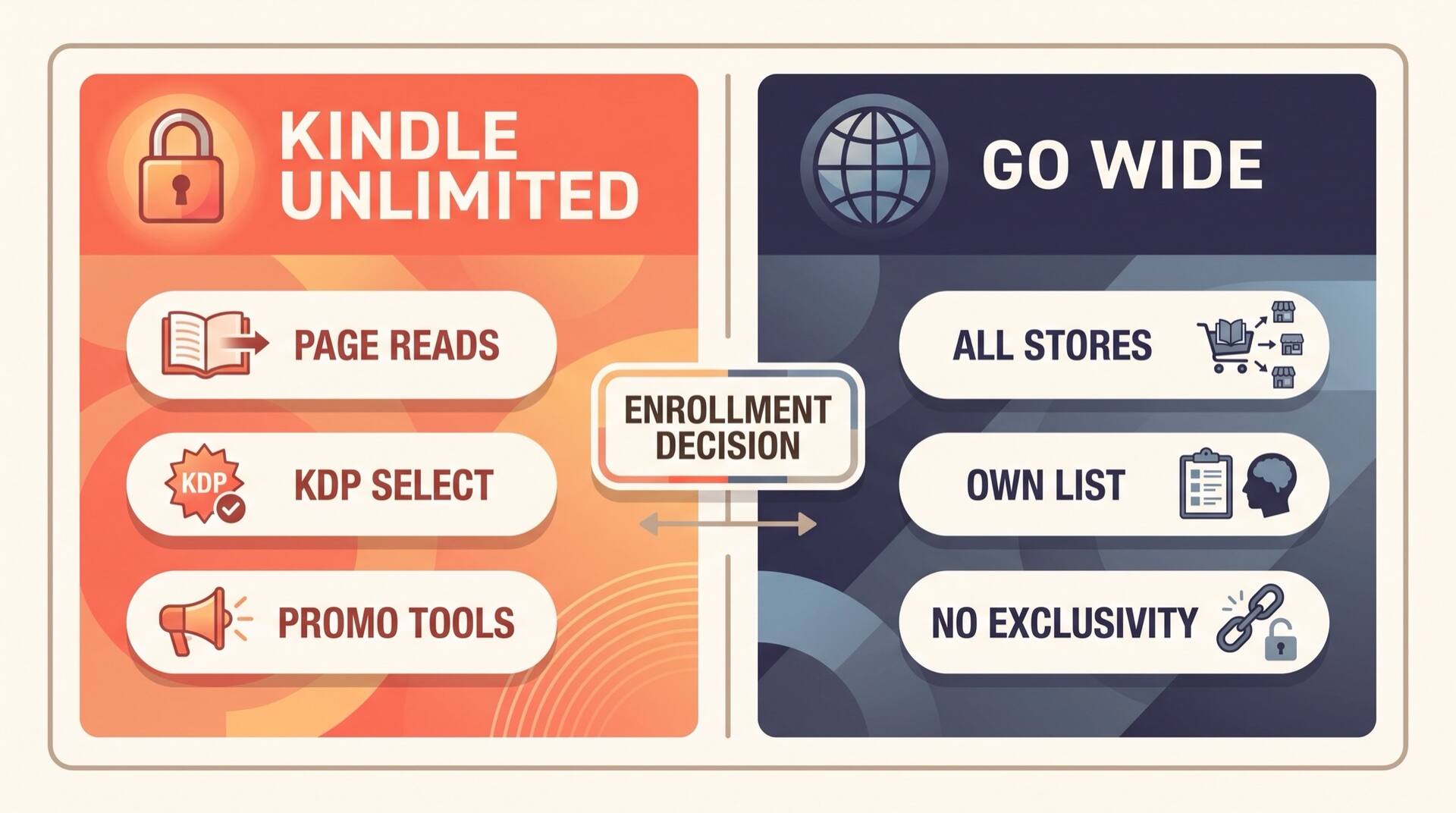
KDP Select (Kindle Unlimited)
Amazon-exclusive, page read income + sales
- Access to millions of KU subscribers who prefer borrowing over buying
- KU borrows boost your Amazon ranking alongside regular sales
- Kindle Countdown Deals and Free Book promotions (KDP Select exclusives)
- Page read income often exceeds what you would earn from eBook sales alone
- Higher visibility in Amazon's recommendation algorithm for KU-enrolled titles
Best for: romance, thriller, sci-fi, LitRPG, and other high-volume genre fiction where Amazon dominates the market
| Feature | KDP Select (KU) | Wide Distribution |
|---|---|---|
| Platform availability | Amazon only | All retailers |
| Subscription income | KU page reads | Kobo Plus, Scribd (limited) |
| Promotional tools | Countdown Deals, Free Days | Price matching, retailer promos |
| Ranking boost | Borrows count toward rank | Sales only |
| Enrollment period | 90 days, auto-renews | No commitment |
Strategy: Many successful authors use a hybrid approach — enroll new releases in KDP Select for the first 1–2 periods to leverage the ranking boost, then go wide after the initial momentum fades. Others keep their series starters in KU permanently while distributing standalones wide.
3. Page Read Optimization
In KU, your revenue depends on how many pages readers actually finish — not just how many people borrow your book. Optimizing for read-through (the percentage of your book that borrowers complete) is the most important lever you have.
Write Compelling Opening Chapters
KU readers browse heavily and abandon books quickly. Your first three chapters need to hook readers immediately. Start with action, conflict, or a compelling question. Avoid slow worldbuilding prologues or lengthy character introductions. If a reader drops your book at 5%, you earn almost nothing.
Optimize Your Book Length
Longer books earn more per full read-through. A 90,000-word novel (roughly 600 KENP) earns about $2.40–$2.70 per complete read — significantly more than a 40,000-word novella at $1.10–$1.20. However, padding your book with filler destroys read-through rates. The sweet spot for genre fiction in KU is 60,000–90,000 words — long enough to maximize KENP but tight enough to keep readers engaged.
Use Strong Chapter Endings
End every chapter on a hook — a cliffhanger, a revelation, an unresolved question. KU readers often read in short sessions (commute, lunch break, before bed). If a chapter ending gives them a natural stopping point with no tension, they may never come back. Make every chapter ending pull them into the next one.
Include Back Matter That Drives Series Reads
After your story ends, include a compelling preview of the next book in your series (first 2–3 chapters). This counts toward your current book's KENP and creates a seamless transition to the next title. Also include your "Also By" list with direct links. In KU, back matter is not just marketing — it is revenue.
Format for Readability
Short paragraphs, generous white space, clear scene breaks, and readable fonts all reduce reader fatigue. KU readers consume books rapidly — if your formatting feels dense or hard to read on a Kindle screen, they will move on. Use scene break markers, avoid walls of text, and keep your paragraphs under 4–5 sentences.
KENP Revenue Quick Reference
At the current per-page rate of approximately $0.0042 per KENP read, here is what a full read-through earns:
$1.26
300 KENP (short novel / novella)
$1.89
450 KENP (standard novel)
$2.52
600 KENP (longer novel)
4. Series Strategy in KU
Series are the engine of KU income. A single standalone novel can perform well, but a completed series with strong read-through multiplies your earnings dramatically. A reader who finishes book one and reads through a five-book series at 450 KENP each generates roughly $9.50 in page read revenue — compared to $1.89 from a single title.
Rapid Release Strategy
Write and schedule 3–5 books before launching the first one. Release them 2–4 weeks apart to maintain algorithmic momentum. Amazon's recommendation engine favors authors with recent releases, and readers who finish book one will immediately find book two available. This is the single most effective KU growth strategy.
Free or Discounted Series Starters
Use KDP Select's Free Book promotion or Kindle Countdown Deal to make book one free or $0.99. You sacrifice revenue on the first book to acquire readers who will read through the entire series in KU. A free first book that drives 500 borrows with 60% series read-through is far more profitable than a $4.99 book one with 50 sales.
Ideal Series Length and Format
For KU, 3–7 book series perform best. Trilogies work well but longer series (5–7 books) maximize total KENP. Each book should be relatively self-contained with a satisfying arc while building toward a larger series conclusion. Avoid open-ended series with no planned endpoint — reader fatigue sets in after book 7–8.
Cross-Promotion Between Series
When a reader finishes your series, immediately offer them the start of your next one. Include a preview chapter and a direct link in the back matter. Your best audience for your next series is readers who just finished your last one. Build a web of interconnected series that feed readers from one to the next.
Pro Tip: Track your series read-through rate in your KDP dashboard by comparing KENP read on book one vs. subsequent books. If read-through drops sharply between books 2 and 3, there is likely a pacing or story issue in book 2 that is losing readers.
Write Your KU Series with AI
AIWriteBook helps you plan, outline, and write books built for KU, from series bibles to chapter-by-chapter drafts. Build your catalog without sacrificing quality.
5. Marketing for KU Authors
Marketing in KU is different from marketing regular eBook sales. Your goal is not just to get someone to buy — it is to get them to start reading and keep reading. That difference is what separates smart marketing from plain spending: the same ad budget that looks wasteful on a sales-only view can be clearly profitable once page reads are counted. Here are the most effective strategies specific to KU authors.
Amazon Ads (Sponsored Products)
Amazon Ads are the primary paid marketing channel for KU authors. Target competitor titles and genre keywords with Sponsored Product ads. KU borrows triggered by your ads count toward your ACOS calculation, so factor in estimated page read revenue when evaluating ad performance. Many KU authors run ads profitably at what looks like a high ACOS because the page read income covers the gap.
Leverage KDP Select Promotions
Every 90-day enrollment period gives you 5 Free Days and one Kindle Countdown Deal. Use Free Days on series starters to drive massive borrow volume. Stack your free promo with newsletter features (BookBub, Freebooksy, Robin Reads) for maximum visibility. Countdown Deals work better for standalones or later books in a series.
Build a Reader Mailing List
Include a reader magnet (free short story, bonus chapter, or prequel novella) in the back of every book with a link to sign up for your mailing list. Your email list is the only marketing channel you fully control. Announce new releases to your list first — those initial borrows and reads spike your ranking and trigger Amazon's recommendation algorithm.
Social Media and Reader Communities
Engage in genre-specific communities on Facebook, Reddit, TikTok (BookTok), and Goodreads. KU readers are voracious and actively seek recommendations. Participating genuinely in these communities — not just promoting — builds organic word-of-mouth that drives consistent borrows over time.
Track and Adjust with Data
Monitor your KDP dashboard daily during launch periods. Watch your KENP read trends, borrow-to-read-through ratio, and page-read velocity. If borrows are high but KENP read per borrow is low, your opening chapters may not be hooking readers. If KENP per borrow is strong but total borrows are low, you have a discoverability problem — increase ad spend or run a promo.
6. Revenue Expectations & Realistic Numbers
KU income varies enormously based on genre, catalog size, marketing spend, and read-through rates. Here are realistic scenarios based on current per-page rates (approximately $0.0042/KENP) to help you set expectations.
| Scenario | Monthly KENP Read |
|---|---|
| Single novel, minimal marketing | 10,000–30,000 |
| 3-book series with ads | 100,000–300,000 |
| 5+ book catalog, active marketing | 500,000–1,500,000 |
| Prolific author (10+ books), strong brand | 2,000,000+ |
These numbers represent page read income only. Most KU authors also earn from direct eBook and paperback sales, which can add 20–50% to total revenue. The key takeaway: KU rewards catalog depth and series read-through far more than individual title performance. Authors who treat KU as a long-term catalog-building strategy consistently outperform those chasing single-title hits.
KU Launch Readiness Checklist
Before enrolling your book in KDP Select, make sure you have covered these essentials:
Build Your KU Strategy for the Long Term
Kindle Unlimited is not a get-rich-quick scheme. It is a platform that rewards consistent publishing, series depth, reader engagement, and smart marketing. The authors who earn the most from KU are those who treat it as a career-building strategy — releasing regularly, optimizing read-through, building a mailing list, and reinvesting in ads that compound over time.
Whether you go all-in on KU or use it strategically for select titles, understanding how page reads, KENP, and the global fund work gives you a real advantage. Start with one well-crafted book, track your data, and scale from there.