


The definition
Author's perspective is the position a writer takes toward their subject — the set of beliefs, assumptions, experiences, and values that color how they present material. Every choice an author makes, from which facts to include to which character to make sympathetic, reflects this underlying stance. Readers absorb it even when they can't name it.
In nonfiction, perspective shows up as the argument the author is building and the worldview behind it: an economist and a historian will write very different books about the same decade. Who you're writing for shapes it too. In fiction, it is subtler — it lives in which events the story dwells on, whose suffering matters, and what the narrative treats as just or absurd.
Crucially, perspective is the author's, not the narrator's. A first-person narrator can be naive, biased, or flat-out lying, while the author standing behind them holds a clear-eyed view the reader is invited to see past the narrator to reach. Keeping that gap in mind is the key to reading — and writing — perspective well.
In one sentence
Author's perspective is the worldview behind the words: the values and attitudes that decide what a writer shows you, how they frame it, and what they want you to feel about it.
Perspective vs point of view vs voice
These three terms get used interchangeably, but they answer different questions. Keeping them separate makes both analysis and writing far cleaner.
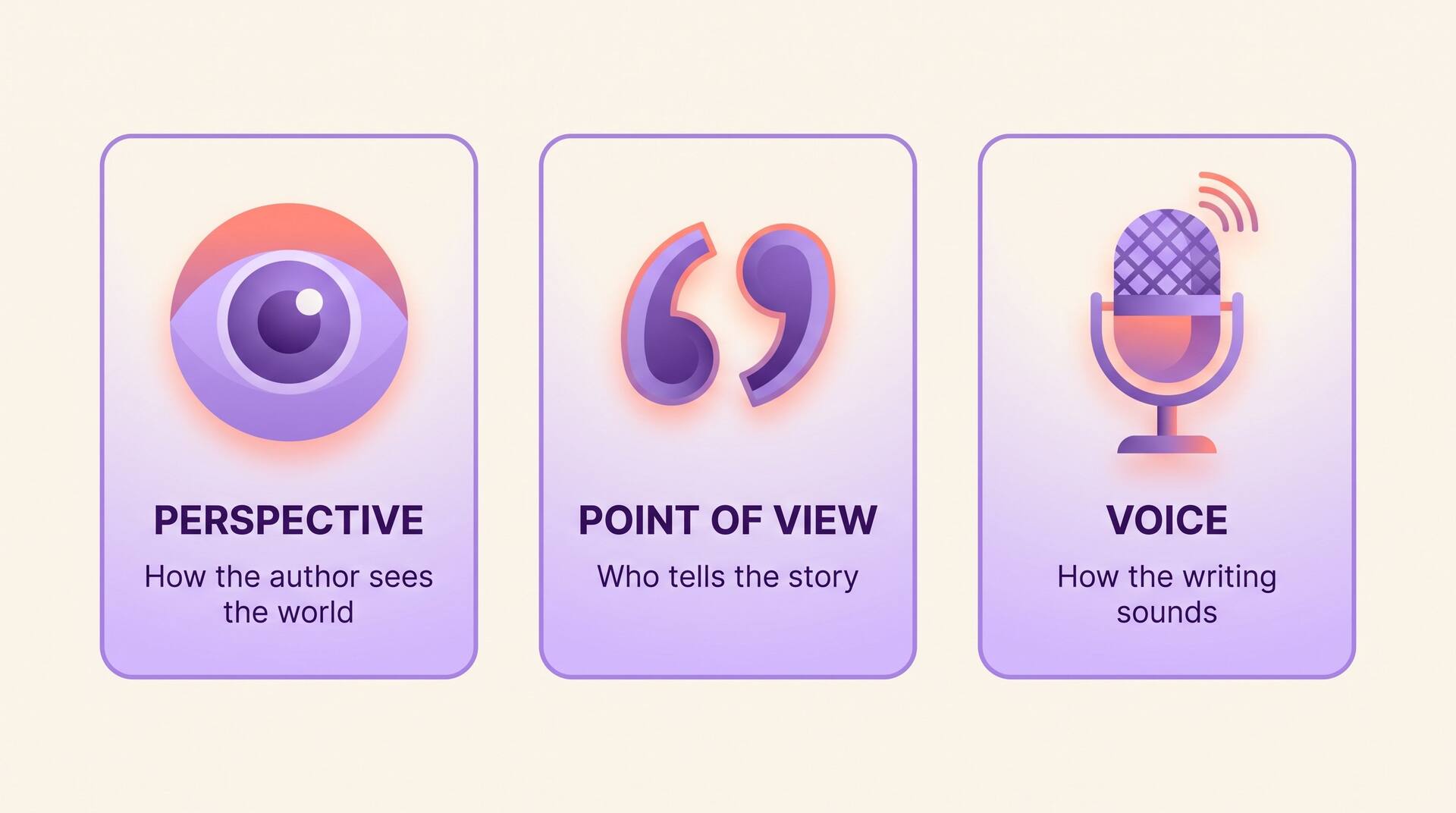
Perspective
What does the author believe?
The worldview, values, and attitude behind the text. It is the lens that decides what matters and how it is judged. Perspective can stay constant across a whole book — or a whole career.
Point of view
Who is telling the story?
The grammatical and structural choice: first person, second person, third-person limited, or omniscient. POV is a technical position; an author can switch it between books or even chapters without changing their perspective.
Voice
How does it sound?
The distinctive style — diction, rhythm, humor, sentence shape — that makes a writer recognizable. Voice is the texture of the prose; perspective is the conviction underneath it.
A quick test: change the narrator from 'I' to 'she' and you have changed point of view. Rewrite the same scene with wit instead of dread and you have changed voice. Decide the whole event was admirable rather than tragic, and you have changed perspective.
How to identify perspective in a text
Perspective is rarely stated outright. You infer it from patterns in the choices an author makes. Work through these questions on any passage and the lens comes into focus.
Notice what is emphasized and what is skipped
What does the text linger on, and what does it rush past or omit entirely? Emphasis reveals what the author considers important; omissions reveal what they take for granted or dismiss.
Track the loaded language
Word choice carries judgment. 'Freedom fighter' versus 'rebel', 'thrifty' versus 'cheap'. The connotations an author reaches for expose their attitude toward the subject.
Ask whose side the text is on
Which characters or positions are rendered with sympathy and depth, and which are flattened or mocked? The distribution of empathy is a direct readout of perspective.
Find the implied conclusion
Where is the text steering you? Even when no thesis is stated, the selection and framing of material points toward a takeaway. Name that takeaway and you have named the perspective.
Examples from real books
Perspective is easiest to grasp through cases. Open each example to see the author's lens at work.
Nick Carraway narrates in first person, but Fitzgerald's perspective sits above Nick's. The novel's lingering attention on hollow wealth, the romanticizing then puncturing of the American Dream, and the quiet contempt for the Buchanans' carelessness all signal an author critical of the very glamour his narrator is dazzled by. The perspective is the author's judgment; the point of view is Nick's limited account.
Developing your own perspective
A distinct perspective is what separates memorable writing from competent writing. It cannot be faked, but it can be cultivated — you can even take a flat passage and rewrite it in your own voice to hear your stance come through.
Know what you actually believe
Before you write about a subject, get clear on your own stance toward it. What do you find unjust, absurd, beautiful, or overlooked? Vague writing usually traces back to a writer who has not decided what they think.
Let conviction guide selection
You can't include everything, so let your perspective choose. Foreground what matters to your argument or theme and cut what dilutes it. Selection is where perspective becomes visible.
Be consistent, not preachy
A strong perspective shapes the whole work quietly; it does not lecture in every paragraph. Trust framing, emphasis, and detail to carry your stance so readers feel it rather than being told it.
Separate your view from your narrator's
Especially in fiction, decide deliberately where you agree with your narrator and where you don't. The gap between an unreliable narrator and the author's clear perspective is one of fiction's most powerful tools.
Author's perspective: frequently asked questions
It is the writer's attitude and worldview toward their subject — the lens that decides what they show you, how they frame it, and what they want you to think or feel. It is the set of values behind every choice in the text.
Write from a point of view that's yours
Author's perspective is the worldview behind the words — distinct from point of view, which is how the story is told, and from voice, which is how the prose sounds. Once you can separate the three, you read more sharply and write with more intent: you choose what to emphasize, you frame it on purpose, and you let your conviction shape the work without lecturing.
The writers we remember are the ones whose perspective is unmistakable. Decide what you believe about your subject, then let every choice serve that lens. For more craft fundamentals like this, see our complete guide on how to write a book. complete guide on how to write a book