


The definition
The intended audience is the particular reader, or group of readers, a writer has in mind while creating a work. It is the answer to the question 'who is this for?' — and it is rarely 'everyone'. The more precisely you can describe that reader, the more decisions the writing makes for you.
Intended audience covers more than age or gender. It includes what readers already know about the subject, why they are reading, what they care about, the genres and authors they already love, and the tone they expect. A cookbook for beginners and one for trained chefs cover the same craft but are written for two entirely different people. The same split runs through every trade: a hotel owner who spends part of each month comparing hotel linens wholesale suppliers will read a hospitality book for procurement detail, while a guest reads about the same hotels for atmosphere.
There is also a distinction worth holding: the intended audience is who you are writing for, while the actual audience is who ends up reading. It pairs closely with the author's perspective — who is telling the story shapes who it is for. Writing with a clear intended reader does not exclude others — it simply gives the work a center of gravity, which paradoxically makes it resonate more widely.
In one sentence
Your intended audience is the specific reader you are writing for — and naming them turns vague choices about tone, vocabulary, and content into clear ones.
Why audience matters
Every meaningful choice in a manuscript depends on who will read it. Define the reader and these decisions resolve themselves; leave them undefined and the writing drifts. The starkest version of this sits outside publishing: teams writing federal bids draft inside government contracting software that keeps the evaluator's scoring sheet beside the text, because there the reader is a known person with a checklist and any sentence that answers nothing on it scores zero.
Vocabulary and assumed knowledge
Audience decides what you can take for granted. A book for specialists can use jargon and skip the basics; one for newcomers must define terms and build from the ground up. Get this wrong and you either patronize or bewilder.
Tone and register
Playful, authoritative, intimate, academic — the right register is a function of who is reading and why. The same advice reads as warm encouragement to one audience and as condescension to another.
What to include and cut
Knowing your reader tells you which examples will land, which objections to address, and which tangents to drop. Audience is the editor that decides what earns its place.
Genre expectations
Readers come with conventions. A romance audience expects an emotionally satisfying ending; a thriller audience expects escalating stakes. Meeting — or knowingly subverting — those expectations starts with knowing who holds them.
Identifying your audience
Work through this checklist for your project. Tap each item as you answer it — the clearer your picture, the easier every later decision becomes. If you are still choosing what to write, our book idea generator can suggest concepts aimed at a specific kind of reader.
If you can describe your reader this specifically, you can write a sentence and instantly know whether it is for them. That instinct is what audience awareness buys you.
Demographic vs psychographic
Audiences are defined on two axes. Most writers stop at the first; the second is where the useful detail lives.
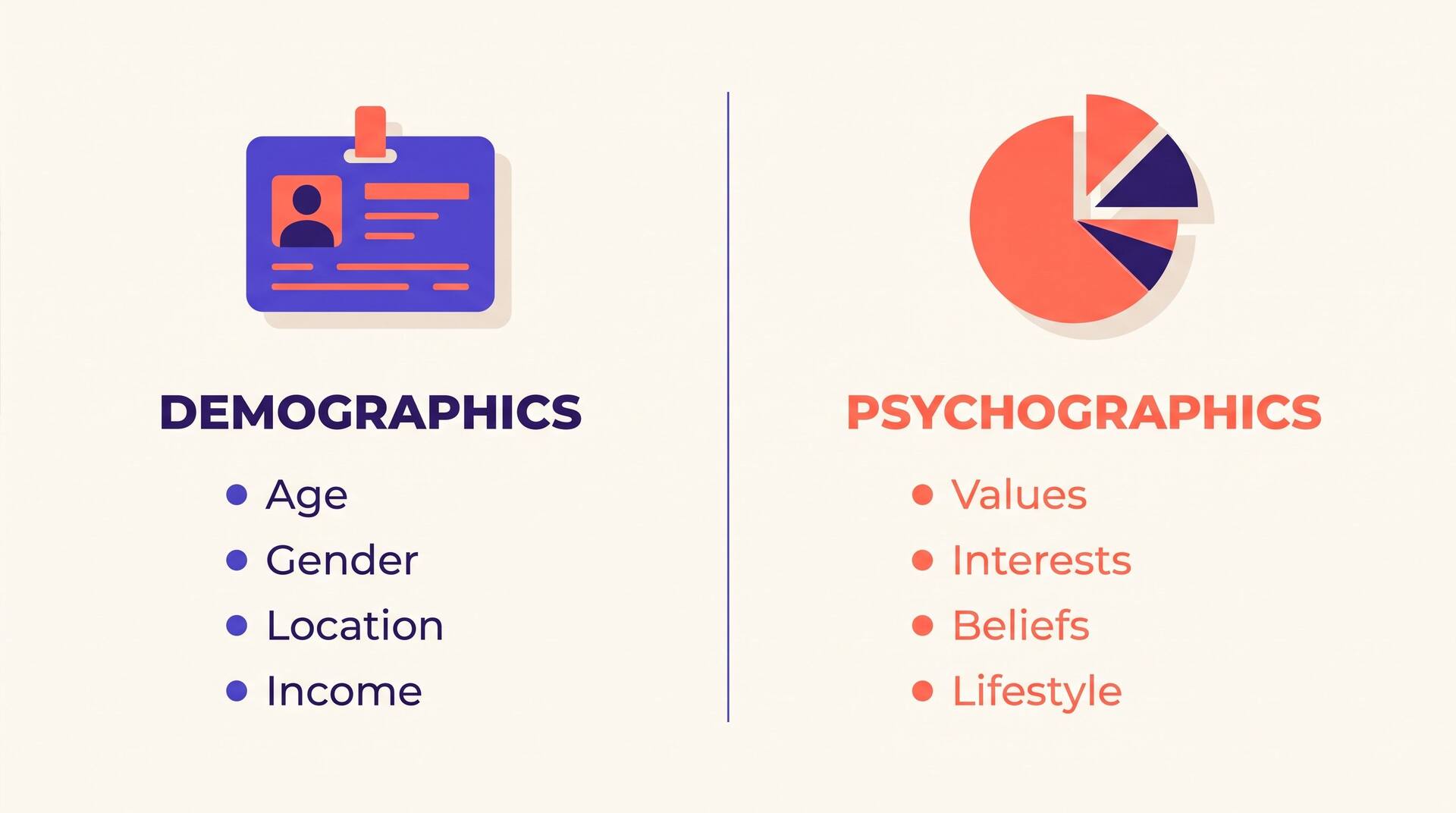
Demographic
Who they are
The measurable surface: age, gender, location, education, income, profession. Useful for a rough sketch and for marketing, but it tells you little about what a reader actually wants on the page.
Examples: women aged 25–40, college-educated parents, retirees, small-business owners.
Psychographic
What drives them
The inner life: values, motivations, fears, aspirations, habits, and tastes. This is what determines whether your book speaks to them. Two readers with identical demographics can want completely different books.
Examples: ambitious but burned out, craves cozy escapism, distrusts hype, reads to feel understood.
Write to the psychographic and the demographic mostly takes care of itself. A reader who is 'overwhelmed and wants a clear plan' is a sharper target than 'adults aged 30–50'.
Examples by genre
Intended audience looks different in every category. Here is how a clear reader profile shapes books across genres. The same profile also shapes your book description, the first place a reader checks whether a book is written for them.
Readers want emotional payoff and a satisfying relationship arc. The intended audience expects genre promises kept — and a clear sense of heat level and tropes — so the writing signals them early and delivers on them.
There are two audiences at once: the child who hears the story and the adult who buys and reads it aloud. Vocabulary, length, and rhythm serve the child; theme and reassurance reassure the parent. Our guide to writing a children's book works through both readers in detail.
The reader has a specific problem and wants a credible path out of it. The intended audience defines the starting point — beginner or experienced — and the tone, whether tough-love or gentle.
Readers value language, ambiguity, and theme over fast plot. The intended audience tolerates — even seeks — complexity, which licenses a slower build and a more demanding style.
Adjusting voice and content
Once you know your reader, you tune the writing to them. These are the levers that turn audience awareness into pages.
1. Calibrate vocabulary to their knowledge
Define what they won't know; skip what they will. Match the technical level to the reader so the prose neither talks down nor leaves them behind.
2. Choose examples they recognize
Reach for references, analogies, and scenarios from your reader's world. An example that lands for one audience falls flat for another; pick the ones that feel like home to yours.
3. Set the tone they trust
Decide on warmth, authority, or wit based on what your reader responds to, and hold it consistently. Tone is how a reader decides whether the book is 'for them'.
4. Meet their format expectations
Chapter length, structure, and pacing should fit how your audience reads — short, scannable sections for busy readers; immersive chapters for those who settle in for hours.
Intended audience: frequently asked questions
It is the specific group of readers a piece of writing is created for — the people whose knowledge, interests, and expectations shape the vocabulary, tone, content, and structure. It answers the question 'who is this for?'
Write for someone, not everyone
Intended audience is the reader you are writing for, and naming them is one of the highest-leverage moves in the craft. Once you can picture that person — what they know, why they are reading, and what they want — your choices about vocabulary, tone, examples, and structure stop being guesses and start being answers.
Define your reader first, then let every page serve them; the wider audience tends to follow a book that knows exactly who it is for. For more foundational craft like this, see our complete guide on how to write a book. complete guide on how to write a book