


What a dynamic character is
A dynamic character is a character who undergoes a significant internal change over the course of the story. The change is not about circumstances — getting richer, moving cities, surviving a war. It is about who they are inside: their values, their self-understanding, their emotional capacity, the thing they believe about the world.
The keyword is internal. A character can have wild external adventures and still be static if they end the story believing exactly what they believed at the start. A character can barely leave one room and be deeply dynamic if that room is where they finally face a truth about themselves.
Dynamic characters are almost always protagonists, because the protagonist's transformation is usually what the story is about. But any character can be dynamic — a mentor, a rival, a love interest — as long as the story moves something inside them.
The three marks of a dynamic character
- They change internally — beliefs, values, or self-knowledge, not just situation
- The change is earned through the events of the plot, not announced
- Who they are at the end would have been impossible for them at the start
Dynamic vs static vs round vs flat
Two different axes get tangled together constantly. Dynamic and static measure change. Round and flat measure depth. A character has one value on each axis — they are independent.
Dynamic
Transforms internally across the story. Ebenezer Scrooge ends as a generous man; he began as a miser. The arc is the point.
Static
Stays internally consistent. Sherlock Holmes is brilliant and detached in story one and story fifty. Static is not a flaw — series heroes are often static by design.
Round
Complex, contradictory, fully realized. Has competing desires and a believable inner life, whether or not they change.
Flat
Built from one or two traits. Useful for minor roles and comic relief. Flat does not mean badly written — it means efficiently written.
The powerful combination for a protagonist is round and dynamic: a complex person who genuinely changes. The most common supporting type is flat and static. A static-but-round character — think a steady mentor with real depth who simply does not need to change — is one of the most underused tools in fiction.
15+ dynamic character examples
The fastest way to internalize the dynamic arc is to see it. Each example below names the starting state, the ending state, and the shift between them — the three things every arc needs.
Ebenezer Scrooge — A Christmas Carol
Miserly and isolated → generous and connected. The clearest redemption arc in English literature; the three spirits are just the mechanism that forces the change.
Elizabeth Bennet — Pride and Prejudice
Quick to judge and proud of her judgment → humbled and self-aware. Her arc is literally the title; she learns her first impressions were prejudice.
Fitzwilliam Darcy — Pride and Prejudice
Proud and socially contemptuous → humbled and openly tender. A rare second dynamic lead, his change mirrors Elizabeth's from the other side.
Neville Longbottom — Harry Potter
Timid, forgetful, overlooked → brave leader of the resistance. A slow-burn arc across seven books that pays off in a single defiant moment.
Huckleberry Finn — The Adventures of Huckleberry Finn
Accepts his society's view of slavery → rejects it and chooses his conscience. His decision to 'go to hell' rather than betray Jim is the arc's hinge.
Michael Corleone — The Godfather
Reluctant outsider who wants no part of the family business → ruthless don. A tragic dynamic arc: he changes for the worse, and the change is total.
Woody — Toy Story
Jealous and possessive of Andy's attention → secure and generous toward Buzz. Proof that dynamic arcs drive the best animated films, not just literary novels.
Katniss Everdeen — The Hunger Games
Survival-focused and politically detached → reluctant symbol and active revolutionary. Her arc is the widening of what she is willing to fight for.
How a character arc actually works
A dynamic character is the result of a character arc. The arc has a reliable shape — once you see the four parts, you can build one deliberately. Pair that arc with a clear character archetype and you have both the underlying pattern and the change that moves it.
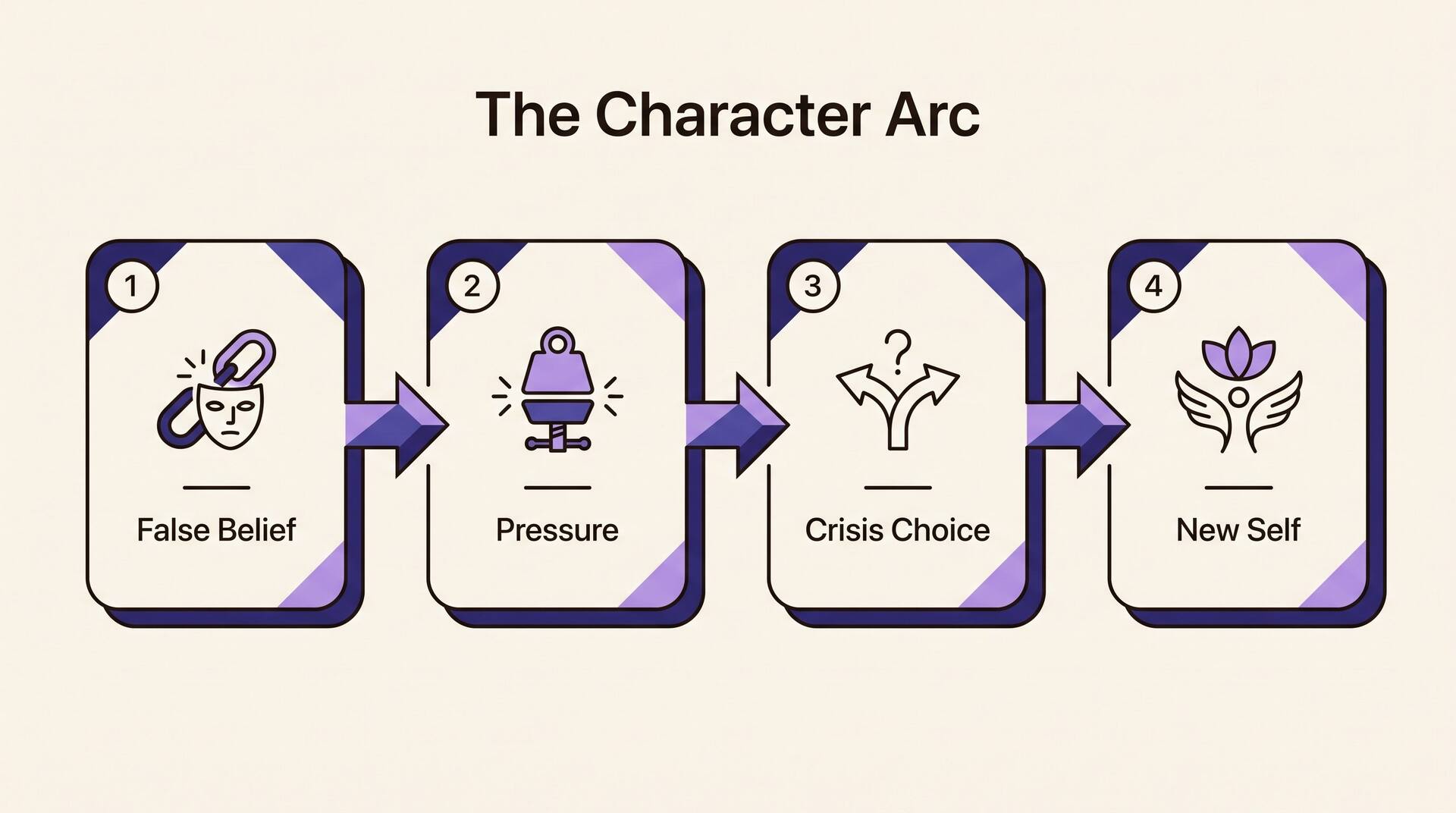
The flaw or false belief
Every arc starts with something the character gets wrong: a fear, a lie they believe about themselves, a value that no longer serves them. Scrooge believes money is worth more than people. This is the gap the story will close.
The pressure
The plot exists to attack the false belief. Events make the old way of being increasingly costly and uncomfortable. The character resists at first — change is painful, and a believable character does not give in easily.
The crisis choice
At the low point, the character faces a decision that forces them to either cling to the old belief or abandon it. Huck choosing to protect Jim, knowing his society says it damns him, is the crisis choice. This moment is the arc.
The new equilibrium
After the choice, the character acts from the new belief and the story shows the result. We see the changed person live — Scrooge buying the turkey — so the transformation feels real rather than asserted.
How to write believable change
Readers reject change that feels unearned. These are the techniques that make a transformation land.
Show the old self vividly first
You cannot feel a change you never saw the start of. Spend real pages establishing the flaw in action before you begin dismantling it.
Make change cost something
Growth that is free is not believable. The character should have to give up something they value — a relationship, a self-image, a comfortable lie — to become who they end up as.
Move in steps, with backsliding
Real people do not change in one scene. Let the character take a step forward, then retreat under pressure, before the final commitment. The backslide is what makes the arc feel human.
Tie the change to a choice, not an event
A character who changes because something happened to them is passive. A character who changes because they decided is dynamic. Put the transformation inside an action the character takes.
Prove it in the climax
The climax should be a problem the old self could not have solved. The character wins — or loses — specifically because of who they have become. That is how you demonstrate change instead of claiming it.
Common mistakes to avoid
Most failed arcs fail in one of these predictable ways.
The overnight transformation
The character is selfish for 90% of the book, then becomes selfless in a single scene with no buildup. Change needs accumulating pressure, not a switch flip.
Change without cost
The character grows but gives up nothing and struggles with nothing. Readers sense the easiness and stop believing.
Mistaking plot for arc
A lot happens to the character, but nothing inside them moves. Big external events plus an unchanged interior equals a static character in disguise.
Forcing an arc onto a static role
Not every character should change. A series detective or a steady mentor often works better static. Giving them a forced arc weakens the structure.
Using AI to track character growth
Arcs are easy to lose across a long manuscript — the character drifts, or the change happens off the page. You can also think about building ai agents that are well suited to the bookkeeping side of arc-building. Our free character creator builds a profile with a built-in arc so the change is planned from the first chapter.
- Map a character's beliefs in chapter one against chapter thirty and flag whether a real shift is on the page.
- Generate the four arc beats — flaw, pressure, crisis choice, new equilibrium — from your premise so you have a spine before drafting.
- Audit a draft for the 'overnight transformation' problem by checking whether the change is built across scenes or dropped in at the end.
- Suggest where a backslide or moment of doubt would make a too-smooth arc feel more human.
- Track every supporting character so you know which are dynamic and which are static by design — and whether that mix is intentional.
AI is excellent at tracking and structuring arcs. The specific flaw, the cost of change, and the perspective and voice of the transformation are still yours to write.
Dynamic characters: frequently asked questions
A dynamic character is one who changes on the inside over the course of a story — their beliefs, values, or understanding of themselves are different at the end than at the beginning. Ebenezer Scrooge going from miser to generous is the classic example.
Building your own dynamic character
Start with the flaw, not the transformation. Decide what your character gets wrong about themselves or the world on page one, then build a plot whose whole job is to attack that belief until the character has to choose. Show the old self clearly, make the change cost something real, and prove the new self in a climax the old self could never have survived.
Do that, and your reader will close the book remembering not what happened, but who your character became. For the full path from premise to finished manuscript, see our complete how to write a book guide. complete how to write a book guide