


What this guide covers
Yes — but "without KDP" means picking who lists the book for you
Amazon doesn't require you to use KDP. It requires a valid product listing. You can create that listing through a print distributor like IngramSpark, by becoming a third-party seller in Seller Central, through an aggregator that pushes your file to the Kindle store, or through a wholesale program where Amazon buys copies from you. Each one trades a little royalty or convenience for something you want — wider distribution, an owned ISBN, hardcover options, or control over your own stock.
Why some authors deliberately skip KDP
KDP is free and fast, so leaving it on the table is a real decision. These are the reasons authors usually do it.
They want their own ISBN
KDP will assign a free ISBN, but Amazon is then listed as the imprint. Buying your own ISBN through IngramSpark or your national agency makes you the publisher of record across every store, not just Amazon.
They want bookstore and library reach
A book that only exists inside KDP is hard for physical bookstores and libraries to order. Listing through Ingram's catalog makes the same title orderable by stores worldwide while still appearing on Amazon.
They want hardcover and specialty formats
IngramSpark has long offered case-laminate and cloth hardcovers, dust jackets, and trim sizes KDP doesn't print. Authors chasing a gift-quality edition often distribute that format outside KDP.
They sell their own printed stock
Authors who print a run themselves — for events, signed copies, or bundles — use a Seller Central offer so they can fulfill orders directly and keep the margin instead of paying per-copy print costs.
Every way onto Amazon, side by side
Pick a route to see how it actually behaves. "Reach" means how the book shows up to an Amazon shopper; "control" means how much say you have over price, stock, and edition.
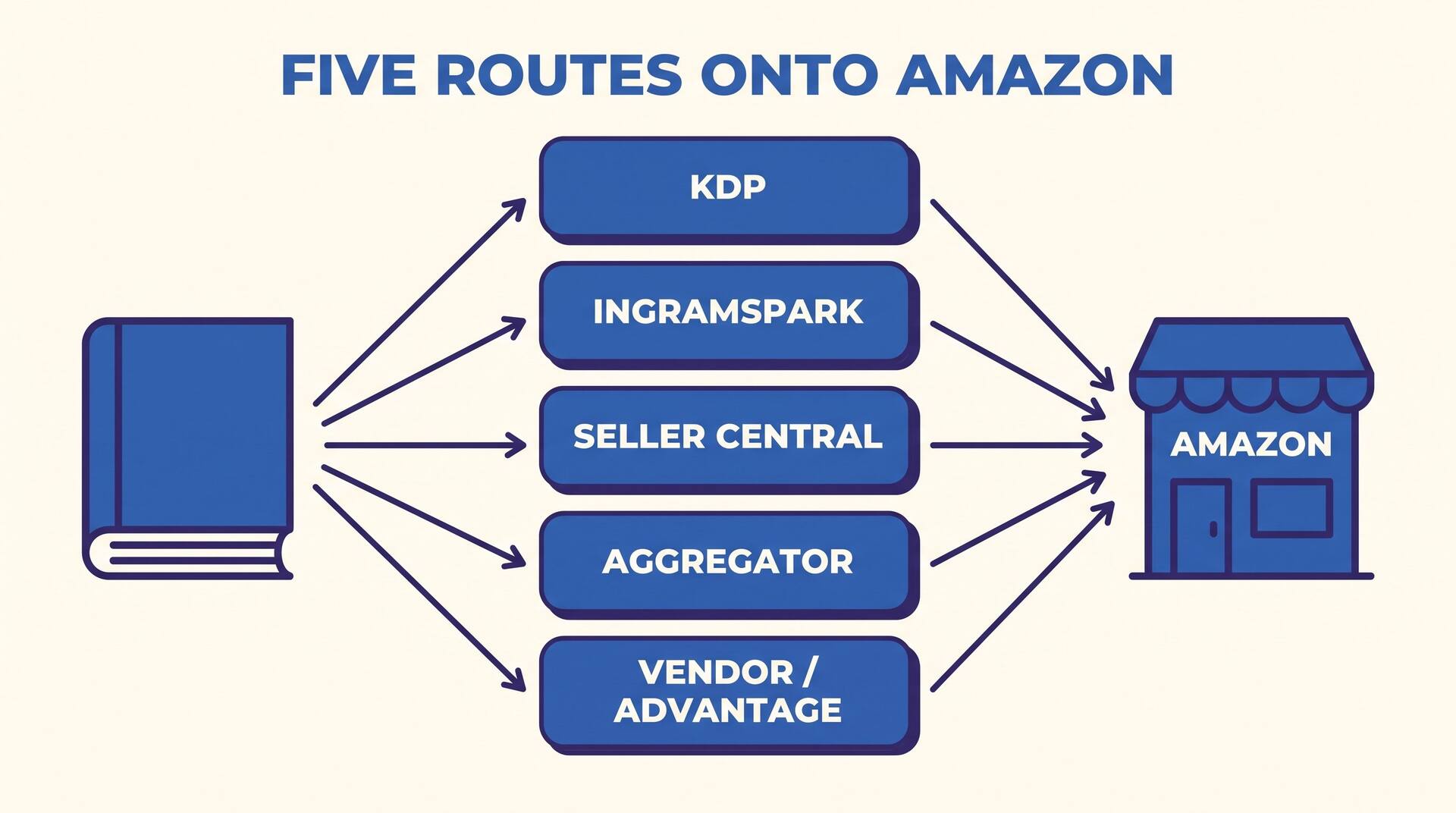
KDP
- Setup
- Free; upload ebook and print files directly to Amazon
- What you keep
- 70% or 35% on ebooks; ~60% minus print cost on paperback
- Reach on Amazon
- Native Kindle listing, fast indexing, eligible for Kindle Unlimited
- Control
- High on Amazon, but the listing lives inside Amazon's ecosystem
- Best for
- The default for most indies who mainly sell on Amazon
Included here as the baseline to compare the others against — it's the route you're choosing whether or not to use.
The IngramSpark route, step by step
This is the path most people mean when they ask about selling on Amazon without KDP. You publish through Ingram, and the title flows into Amazon's catalog as a standard print listing.
Get your own ISBN
Buy an ISBN (or use one IngramSpark provides). Owning it makes you the publisher of record and lets the same edition live on Amazon, in stores, and in library systems.
Upload print-ready files
IngramSpark wants a properly formatted interior PDF and a full cover with bleed and the correct spine width. A clean, professionally laid-out file is what keeps the printed copy from looking self-made.
Set your wholesale discount and returns
Choose the discount retailers earn (often 40% to satisfy Amazon and bookstores) and whether you accept returns. This single setting decides both your royalty and how willing stores are to stock you.
Enable global distribution
Turn on Amazon and the wider trade channels. Within days to a couple of weeks the title appears on Amazon, fulfilled from Ingram's print network rather than from KDP.
Heads up: if you also list the same paperback on KDP, the two can collide on one product page. Most authors print one format through KDP and a different one (often hardcover) through IngramSpark to keep things clean.
Selling through Amazon Seller Central
Seller Central turns you into a third-party merchant. Instead of asking Amazon to print and ship your book, you list physical copies you already own and either ship them yourself or send a batch into Fulfillment by Amazon.
It is the only route here where you pocket the full retail price minus fees, because there is no per-copy print cost baked in — you paid for the print run up front. That math works when you bought copies cheaply in bulk or want to sell signed and special editions. It also makes you a small ecommerce operation rather than a publisher, so the same things that lift any product listing apply here — clear titles, real keywords, and the kind of ecommerce SEO services that get a page found in the first place.
Attach your offer to the existing ISBN, or create a fresh listing if the book isn't on Amazon yet.
Choose self-fulfillment for low volume, or FBA for Prime eligibility and hands-off shipping.
You set the price, so you can run signed-copy and bundle pricing the main listing can't.
You also own returns, customer questions, and stock-outs — this is a small business, not a passive listing.
Aggregators and wholesale programs
Aggregators promise one upload that reaches many stores. The catch for Amazon specifically is that they don't all cover it.
Ebook aggregators
Some, like PublishDrive and BookBaby, do deliver ebooks to the Kindle store. Others, including Draft2Digital, deliberately leave Amazon to you and distribute everywhere else, expecting you to use KDP for Kindle.
Print aggregators
Print distribution from an aggregator almost always runs through Ingram, which means your paperback lands on Amazon the same way the direct IngramSpark route does — just with a middle layer taking a cut.
Wholesale (Vendor / Advantage)
In a wholesale program Amazon buys stock from you and resells it as a first-party item. Vendor Central is invite-only, and the open consignment programs have been wound down in most markets, so few new authors can use this.
Before you pay an aggregator, confirm in writing whether your ebook will actually reach Amazon. If it won't, you're paying a fee for everywhere-but-the-biggest-store.
What skipping KDP does to your royalties
Every alternative route costs something. Here is the honest trade-off, format by format.
| KDP ebook | 70% in the $2.99–$9.99 band (or 35% outside it) | Locked to Amazon's terms; free ISBN names Amazon as the publisher |
|---|---|---|
| KDP paperback | ~60% of list minus Amazon's per-copy print cost | Limited trim and binding options; no real bookstore reach |
| IngramSpark print | List minus your wholesale discount minus print cost — often less per Amazon sale than KDP | You trade margin on Amazon for an owned ISBN and wide distribution |
| Seller Central | Full retail minus referral and fulfillment fees | You front the print run and run it like a small shop |
Before you lock in a list price, run the numbers: our free royalty calculator shows what each route actually pays out per copy so the wholesale-discount trade-off stops being a guess.
Rule of thumb: for ebooks, KDP almost always pays more on Amazon sales. For print, the question is whether the reach and the owned ISBN are worth a few dollars less per Amazon copy.
Every route needs the same thing: a finished, print-ready book
IngramSpark, Seller Central, and KDP all reject a sloppy file. AIWriteBook drafts the manuscript, formats the interior, generates a cover, and exports the print-ready PDF and EPUB you upload to whichever route you pick.
When KDP is still the smart choice
Skipping KDP is right for some books and wrong for plenty of others. Be honest about which one you have.
You mainly sell on Amazon — KDP's royalties and indexing are hard to beat there.
You want Kindle Unlimited — it's KDP-exclusive, and for many genre readers it's where the volume is.
You want zero upfront cost and the fastest path to a live listing.
You're new and want to validate the book before investing in an ISBN and a print run.
The sharpest setup for many authors isn't either-or: use KDP for the Kindle ebook and the Amazon paperback, and add IngramSpark for hardcover and bookstore reach. You skip KDP only where it genuinely can't serve the book.
Common mistakes when going around KDP
Listing the same paperback on both KDP and Ingram
Two sources for one format can fight over the product page and confuse availability. Split formats between the two instead of duplicating one.
Assuming an aggregator reaches Amazon
Several don't push ebooks to Kindle at all. Verify coverage before you pay, or you'll be invisible on the biggest store.
Setting a wholesale discount too low for Amazon
If your IngramSpark discount is below what Amazon expects, the book can show as unavailable or ship slowly. Match the channel's norm.
Uploading a manuscript that isn't print-ready
Non-KDP routes are stricter about bleed, margins, and spine width. A file that squeaked past KDP can get rejected by IngramSpark.
Frequently asked questions
So, what should you actually do?
You can absolutely sell self-published books on Amazon without KDP — through IngramSpark, Seller Central, certain aggregators, or a wholesale deal. None of them is free in the way KDP is; each buys you a specific advantage, whether that's an owned ISBN, hardcover printing, bookstore reach, or full control of your own stock.
For most authors the answer is a blend: lean on KDP where it's strongest and reach past it only where the book genuinely needs more. Decide based on the edition you're building and the readers you're chasing, not on a blanket rule.
For the full picture of publishing and selling on Amazon, see our complete Amazon KDP guide.