

On this page
Use KDP to sell on Amazon and IngramSpark to reach everywhere else — bookstores, libraries, and international wholesalers. KDP gives you the best royalty on Amazon and a free ISBN. IngramSpark gives you the catalog that physical retailers actually order from, plus richer formats. They are complementary, not interchangeable.
If you only ever sell on Amazon and nowhere else, KDP alone is enough. The moment you want a bookstore or library to stock you, IngramSpark enters the picture.
KDP vs IngramSpark at a glance
The fastest way to see the difference is line by line. This is the comparison the rest of the article unpacks.
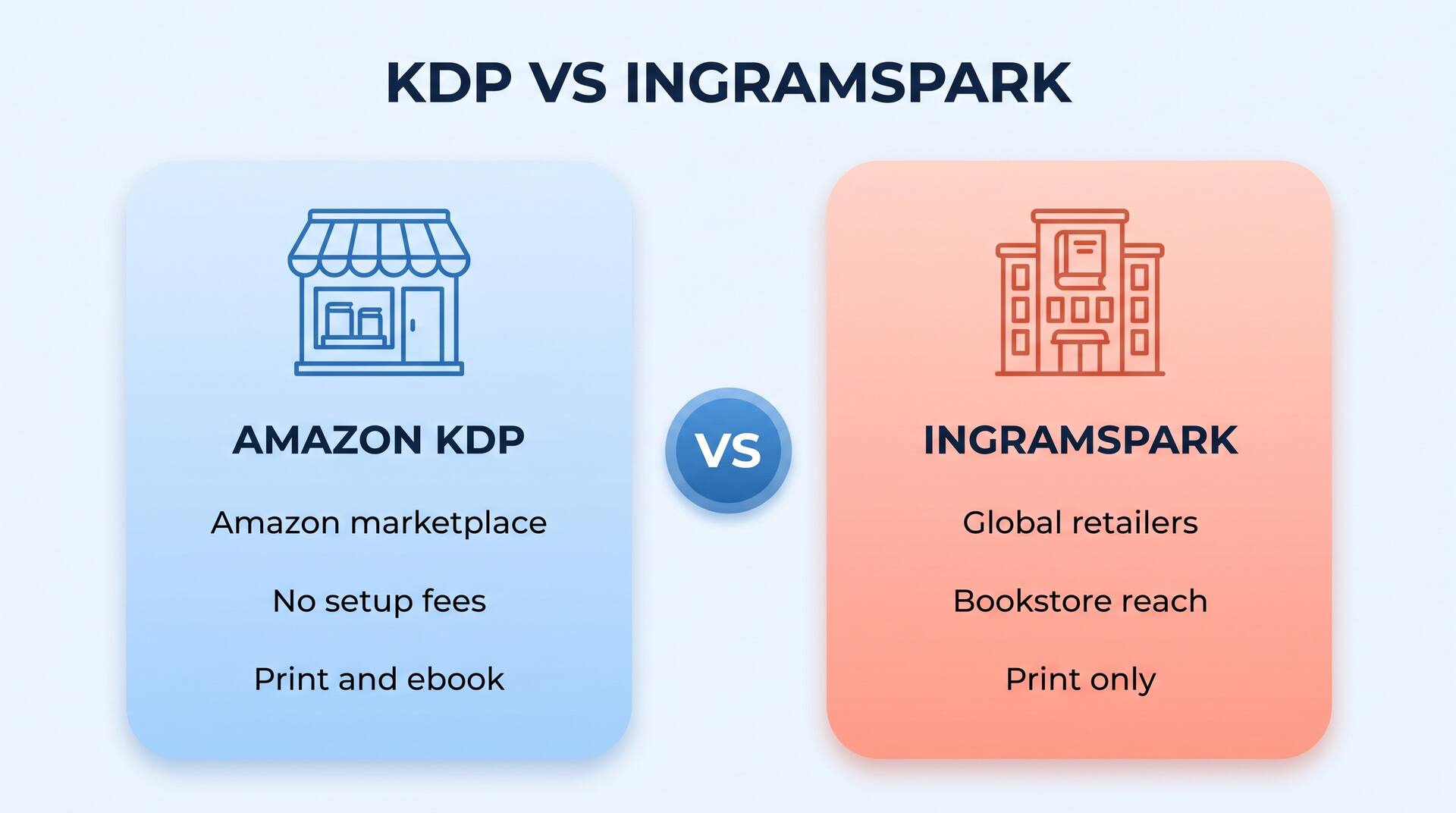
| What you're comparing | Amazon KDP | IngramSpark |
|---|---|---|
| Cost to publish | Free, always | Free to start; pay to revise files later |
| ISBN | Free KDP-assigned ISBN | Bring your own — none provided free |
| Where it sells | Amazon, plus limited expanded distribution | 40,000+ retailers, bookstores, libraries worldwide |
| Print royalty | 60% of list minus print cost (on Amazon) | List minus your wholesale discount minus print |
| Bookstore friendly | Weak — stores rarely order KDP print | Strong — built for the trade |
| Hardcover and trim sizes | Hardcover yes; common trim sizes | Dust jackets, more bindings, wider trims |
| Returns to retailers | Not offered | Optional — you decide |
| Best at | Amazon sales and Kindle ebooks | Print everywhere except Amazon |
Which one fits your goal?
Skip the theory for a second. Pick the goal that sounds most like yours and see where it points.
"I mostly want Amazon sales."
Pick KDPKDP pays the highest print royalty on Amazon, hands you a free ISBN, and gets your book live in about 72 hours. For an author whose readers all buy on Amazon, IngramSpark adds cost and complexity you don't need yet.
Distribution reach: the real difference
Distribution is the heart of this comparison. Both print on demand, but they put your book in front of completely different buyers.
What KDP reaches
- Every Amazon marketplace you enable — the biggest book-buying audience on earth
- Expanded Distribution that lists the book to some retailers and libraries through Ingram's network
- In practice, bookstores rarely stock KDP expanded-distribution titles because the discount is fixed and the books are non-returnable
What IngramSpark reaches
- Ingram's wholesale catalog, the one independent bookstores and chains order from every day
- Public and university libraries that buy through Ingram and Baker & Taylor
- International retailers and wholesalers across the UK, EU, and Australia
Notice the gap: KDP owns Amazon, IngramSpark owns nearly everywhere a human walks into a shop. Neither one covers the other's home turf well.
Royalties and printing costs
Both platforms deduct a per-copy printing cost that scales with page count and color. The difference is how the rest of the money is split.
How KDP pays
On Amazon, you earn 60% of your list price minus the printing cost. Through KDP's expanded distribution the rate drops to 40% of list minus print — which is why the same book earns far less when it sells outside Amazon via KDP.
How IngramSpark pays
You set a wholesale discount (commonly 40–55%) that the retailer keeps. You earn the list price minus that discount, minus the print cost. A higher discount makes stores more likely to order; a lower one keeps more money but narrows your shelf odds.
Take a 300-page, 6x9 paperback listed at $14.99 with a print cost around $4.45. On Amazon via KDP you net roughly $4.55 a copy. The same book through KDP expanded distribution nets about $1.55. Through IngramSpark at a 55% trade discount you net about $2.30 — but that's the copy a bookstore was willing to order in the first place. Figures are illustrative; your exact print cost varies with page count and trim.
Setup, fees, and ISBNs
This is where the platforms feel most different on day one, and where a small detail changes who owns your book on paper.
KDP: free, start to finish
- No account, setup, or publishing fee — ever
- Unlimited file revisions and price changes at no cost
- A free KDP-assigned ISBN, though it lists Amazon as the imprint of record
IngramSpark: free to start, pay to change
- No title setup fee to publish a new book
- A revision fee (around $25 per title) to update interior or cover files after publishing
- No free ISBN — you must own one before you upload
The ISBN catch most beginners miss
KDP will give you a free ISBN, but it names Amazon's imprint as the publisher of record, and that ISBN can't be reused on IngramSpark. If you plan to run both platforms — or want to be your own publisher of record — buy your own ISBN first and use it everywhere. One owned ISBN can carry the same edition across KDP and IngramSpark.
Print quality and format options
Both print to a solid standard; authors who order proofs from each tend to call it close. The bigger gap is choice.
KDP formats
- Paperback and hardcover, both print-on-demand
- A set of common trim sizes that cover most fiction and nonfiction
- No dust-jacket option on hardcovers
IngramSpark formats
- Paperback and hardcover, including case laminate and cloth with dust jackets
- A wider range of trim sizes and binding choices
- More paper and color options for illustrated or premium books
Returns and the wholesale discount
Two levers only IngramSpark gives you decide whether a physical store will actually carry your book.
The wholesale discount
Retailers expect a 40–55% discount off list so they can make a margin. KDP's expanded distribution locks this at a fixed rate; IngramSpark lets you choose, which is real leverage when you're pitching a local shop.
Returnability
Bookstores order on the assumption they can send unsold copies back. KDP print is non-returnable. IngramSpark lets you enable returns, removing the single biggest reason a buyer says no to an indie title.
Enabling returns means you may pay for copies that come back, so weigh it against how aggressively you're courting bricks-and-mortar stores.
Why most authors use both
The smartest setup isn't picking a winner — it's letting each platform do what it's best at on the same book. Here's the standard hybrid workflow.
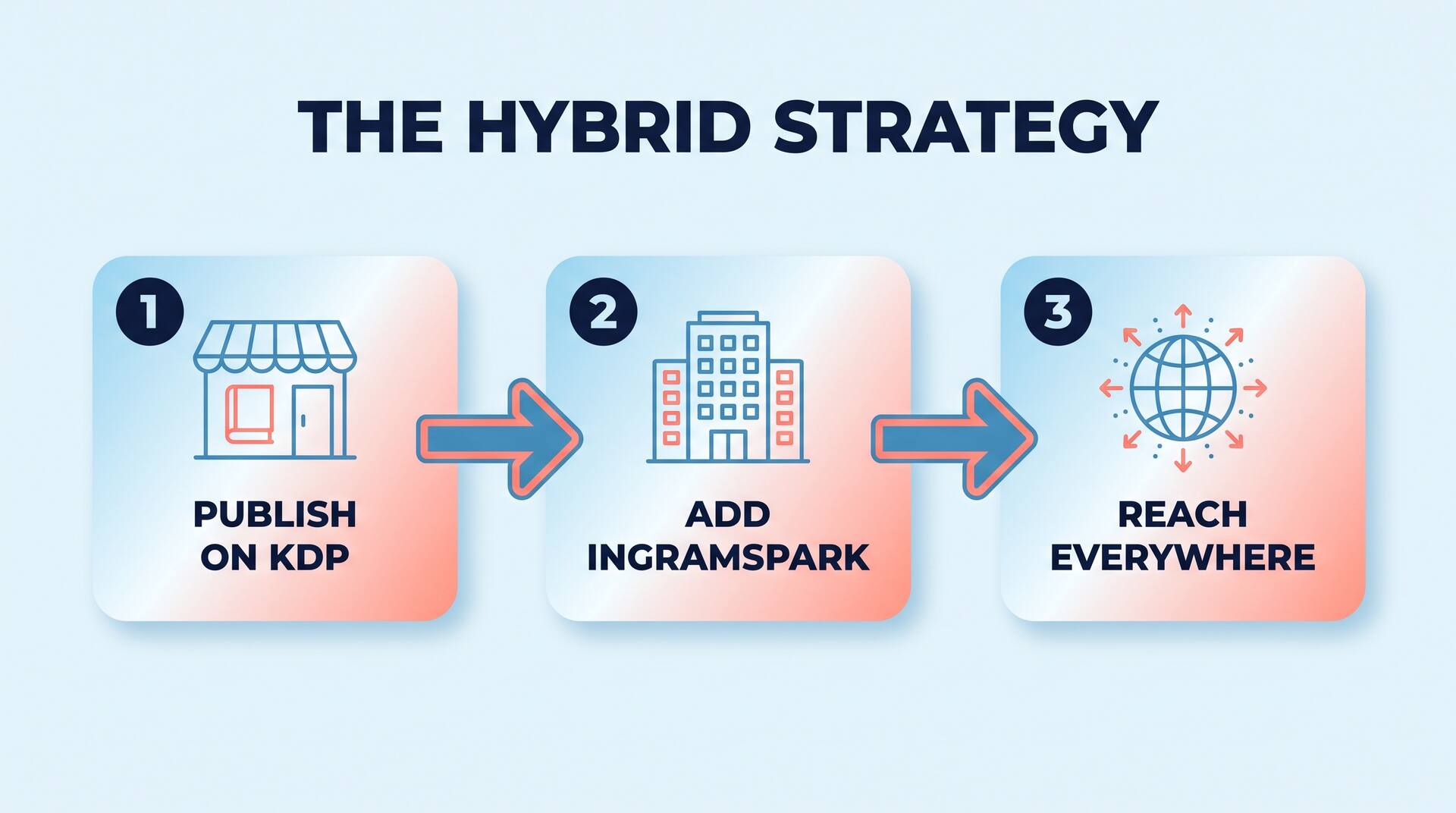
Publish the Amazon edition on KDP
List the book on KDP for the 60% Amazon royalty and fast availability. Use your own ISBN, not the free one, so the edition stays portable.
Publish the everywhere-else edition on IngramSpark
Upload the same files to IngramSpark with returns and a trade discount enabled. This opens bookstores, libraries, and international wholesalers without touching your Amazon listing.
Turn off KDP expanded distribution
Let KDP handle Amazon only and let IngramSpark handle the rest. This avoids two channels fighting over the same non-Amazon retailers and gives you the better discount and royalty on each sale.
The result: top royalty on Amazon, genuine shelf access everywhere else, and one ISBN tying it all together.
Before either platform: the manuscript
KDP and IngramSpark both assume you arrive with a finished, formatted book — neither helps you write it. That's the part that stalls most authors. AIWriteBook turns an idea into a chapter-by-chapter outline, drafts the manuscript with Gemini or Grok, generates a cover, and exports a clean print-ready file you can upload to KDP and IngramSpark alike. Our free KDP cover calculator and royalty tools handle the spine and pricing math both platforms leave to you.
Publish Faster with AI
Write and format the book first, then publish it on KDP, IngramSpark, or both. Start a draft free and export a file that's ready to upload.
Frequently asked questions
The bottom line
KDP vs IngramSpark is the wrong frame for most authors. KDP is the best way to sell print on Amazon and the only place to publish Kindle ebooks. IngramSpark is the best way to reach every bookstore, library, and wholesaler that Amazon doesn't. Treat them as two tools, not two camps.
If you're just starting and selling only on Amazon, begin with KDP. The day you want a shelf in a shop, add IngramSpark with your own ISBN — and you'll have the same distribution reach the pros use.
Explore the full Amazon KDP guide for royalties, keywords, and launch strategy.