

On this page
An ISBN — International Standard Book Number — is a 13-digit code that uniquely identifies one specific edition and format of a book. It tells retailers, libraries, and distributors which exact product they are ordering, and it records who the publisher of record is.
Since 2007 every ISBN is 13 digits. An ISBN is not copyright and it is not a barcode — it's just the catalog number the global book trade uses to tell your paperback apart from everyone else's.
Do you even need an ISBN?
This is the question that saves most authors money. Whether you need to buy an ISBN depends entirely on what you're publishing and where you want it sold. Pick the scenario that matches you.
Choose your situation
Kindle ebooks don't use ISBNs at all. Amazon assigns an ASIN automatically the moment you publish. Buying an ISBN for a Kindle-only ebook is money you'll never get back — skip it.
ISBN vs ASIN: the ebook exception
The single most common ISBN mistake is buying one for a Kindle ebook. You don't need to. Amazon uses two different identifiers depending on the format, and only one of them is an ISBN.
Ebooks use an ASIN
When you publish a Kindle ebook, Amazon generates an ASIN — Amazon Standard Identification Number — automatically. It's free, instant, and works only inside Amazon. No ISBN is involved or required.
Print books use an ISBN
Paperbacks and hardcovers do need an ISBN, because they can be sold through the wider book trade, not just Amazon. This is where the free-vs-own decision actually matters.
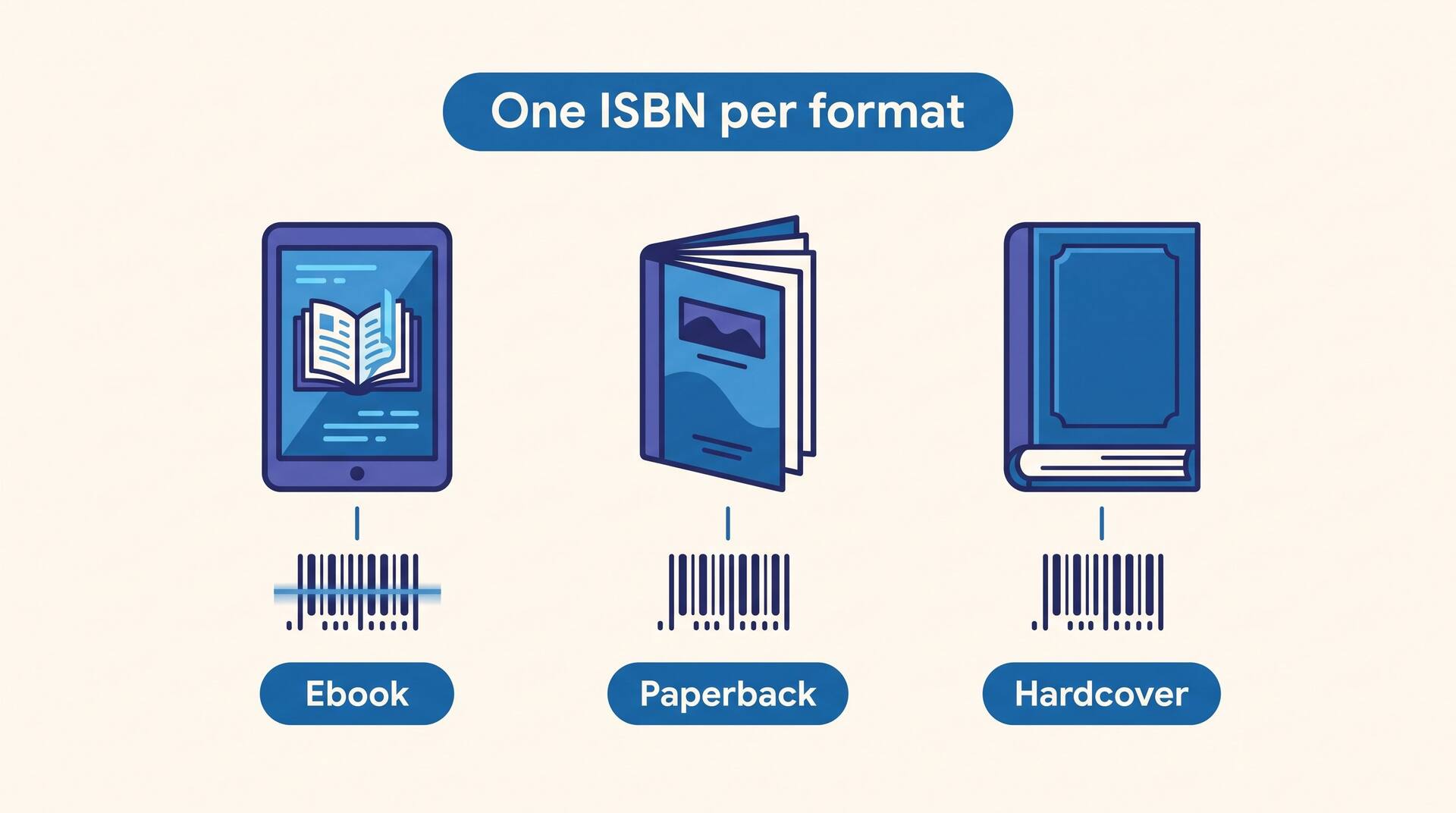
One ISBN per format and per edition
An ISBN identifies a specific version of a book, so each distinct format gets its own. This trips up authors who assume one book equals one ISBN. It doesn't.
Say you release one novel as a paperback and a hardcover, then later add a large-print edition. That's three ISBNs for one title. The Kindle ebook needs none — it uses an ASIN. This is exactly why authors planning multiple formats buy a 10-pack instead of single ISBNs one at a time.
Free KDP ISBN vs buying your own
When you publish a print book on KDP, it offers you a free ISBN. It's genuinely free and genuinely usable — but it comes with strings. Here's the honest comparison.
Free KDP-assigned ISBN
- Costs nothing and is issued instantly inside KDP
- Amazon's imprint ("Independently published") is the publisher of record, not you
- Locked to Amazon — you can't reuse it on IngramSpark or another distributor
- Perfect if you only ever sell that print book through Amazon
Your own ISBN (Bowker, Nielsen, etc.)
- You — or your imprint name — are the publisher of record
- The same ISBN works across every distributor and bookstore
- Required for true wide distribution into libraries and the trade
- Costs money, and single ISBNs are far pricier per unit than a pack
Where to buy an ISBN, country by country
ISBNs are issued by a national agency, and which one you use depends on where you're based, not where the book sells. In some countries they're free; in others they're a paid product. Prices below are approximate for 2026 — always check the agency's current rates.
Rule of thumb: in the US and UK you pay, and packs slash the per-book price. In Canada and India ISBNs are free but you must register as a publisher first. You cannot buy a US ISBN if you live in the UK — use the agency for your country of residence.
What about the barcode?
What about the barcode?
An ISBN and a barcode are not the same thing. The barcode is the scannable image on the back cover that encodes the ISBN (and sometimes the price). The good news for most self-publishers: KDP generates the barcode for you automatically and places it on the print cover, so you don't need to buy one.
You only need to source a barcode separately if you're producing covers outside a print-on-demand service that supplies one. Bowker sells barcodes, but for a standard KDP or IngramSpark workflow you almost never need to.
Mistakes that cost authors later
Buying an ISBN for a Kindle ebook
Kindle ebooks use a free ASIN. An ISBN here is wasted money — it doesn't make the ebook more discoverable or more legitimate.
Using a free KDP ISBN then trying to go wide
A KDP-assigned ISBN is locked to Amazon. If you later move to IngramSpark, you'll need a brand-new ISBN and effectively relaunch the book as a new edition.
Reusing one ISBN across formats
Paperback and hardcover each need their own ISBN. Sharing one breaks how retailers and libraries track stock and can get a listing rejected.
Buying singles when you'll publish more
A single ISBN often costs almost as much as a pack of ten. If you have any plans for a second book or a hardcover edition, the pack pays for itself fast.
Get the book ready before the ISBN matters
An ISBN is the last 5% of getting published — it only matters once the manuscript, cover, and front matter actually exist. That earlier 95% is where most first-time authors stall. AIWriteBook handles the upstream work: it turns an idea into a chapter-by-chapter outline, drafts the book with Gemini or Grok, generates a cover, and even builds a proper copyright page where your ISBN will live. Then you export a clean file and assign whichever ISBN your situation calls for.
Write the book first, sort the ISBN later
Start a draft free, get an outline and chapters in minutes, and export a print-ready file with a copyright page ready for your ISBN.
Frequently asked questions
The bottom line on ISBNs
For most self-publishers starting on Amazon, the ISBN question is simpler than it looks: skip it entirely for Kindle ebooks, and take KDP's free ISBN for a print book you'll only sell on Amazon. Spend money on your own ISBN only when you want to be the named publisher of record or distribute wide through IngramSpark, bookstores, and libraries.
If that's the plan, buy a pack rather than singles, use the ISBN agency for your country of residence, and remember that every format and every new edition needs its own number. Get those four things right and the ISBN stops being a mystery.
Explore the full Amazon KDP guide for everything from keyword research to launch strategy.