


The definition, in one paragraph
Chekhov's gun is a rule of narrative economy: if you place an object, a skill, a wound, or a piece of information in front of the reader with any emphasis, it should later do work. The famous shorthand is that a rifle hanging on the wall in act one has to be fired by the last act. The point is not the rifle — it is that showing something to a reader is a promise, and unkept promises read as sloppiness even when nobody can name what went wrong.
What Chekhov actually said
There is no essay, manifesto, or published lecture where Chekhov states this rule. It survives in two kinds of documents: letters to younger writers who had sent him their plays, and memoirs by people who spoke with him. That is why half a dozen wordings circulate, each presented confidently as the quote.
One must never place a loaded rifle on the stage if it isn't going to go off. It's wrong to make promises you don't mean to keep.
The translations differ — some render it as a pistol, some as a gun, some drop the second sentence entirely. The second sentence is the one worth memorising.
The version most sites quote — hang a pistol on the wall in act one and it must go off in act two, otherwise don't hang it there — survives secondhand in a memoir rather than in Chekhov's own hand. More force, less nuance, which is probably why it travelled further.
Two things follow. This was advice about one beginner's manuscript, not a law for all fiction. And the sentence about promises is the actual principle — the rifle is just the example that stuck.
What the principle really governs
Read literally, this is a rule about props, and it turns absurd fast: a novel where every teacup is load-bearing would be exhausting. Rooms need furniture.
What it actually governs is emphasis. A reader tracks what you point at. Give an object a paragraph, a close-up, a character's odd reaction, and the reader files it as significant and starts waiting. The cost of a false promise isn't confusion — it's a slow erosion of trust.
So the working question is never "is this object used?" It is "did I make this feel important, and did I honour that?" You can mention a rifle. You cannot linger on it.
Four guns that fire
Real examples where a planted detail pays off late:
The Seagull
Chekhov's own play does it twice over. Konstantin shoots a seagull and lays the dead bird at Nina's feet in act two; the image returns at the end, and so does the offstage gunshot.
The Lord of the Rings
Bilbo gives Frodo a mithril shirt in Rivendell — a curiosity, an heirloom. Chapters later, in Moria, a cave troll drives a spear into Frodo and the shirt is why he stands back up.
Harry Potter and the Chamber of Secrets
A blank diary turns up early, discarded and apparently worthless. It ends the book as the villain's vessel, destroyed with a basilisk fang — a setup so understated that first-time readers rarely notice it was one.
Jaws
Hooper brings compressed-air tanks aboard and Brody is warned not to knock them around. In the final minutes Brody jams one into the shark's mouth and shoots it. The safety warning was the plant.
The pattern: every plant arrives as ordinary business, not as a signal. The reader gets the information without being told it is information.
Chekhov's gun, red herrings, and foreshadowing
These three get collapsed into each other constantly, which produces bad advice — most often the claim that a mystery full of false leads "violates Chekhov's gun." It doesn't.
Chekhov's gun
A concrete element planted early that performs a real function later. Its job is structural: it makes a late turn feel inevitable rather than convenient.
Red herring
A detail planted to be misread. It still fires — just as the misdirection it always was. A clue pointing at the wrong suspect, later explained, is a kept promise.
Foreshadowing
Tone or imagery that prepares the reader emotionally. It need not be an object or be used mechanically. A storm before a death foreshadows; it is not a gun.
The clean test: a red herring is a gun aimed somewhere false on purpose. A broken Chekhov's gun is a gun nobody ever picks up. Only the second is a craft failure.
The setup and payoff audit
This is the part you can run on a draft today. List every element you gave weight to — objects, injuries, secrets, unusual skills, named minor characters, promises made in dialogue — and fill in three columns.
| Setup planted | Where it fires | Cost to cut |
|---|---|---|
| A locket the protagonist is described touching twice | Nowhere | None — cut it, or make chapter 19 need it |
| Mentor's limp, explained in a full paragraph | Chapter 22, he can't follow into the tunnel | High — the escape stops working |
| A phone number written on a receipt | Chapter 4, resolved immediately | Low — this is plumbing, not a gun |
| Brother's gambling debts, raised in dialogue | Never mentioned again | None to the plot, high to the reader's trust |
The third column does the work. Anything expensive to cut is load-bearing and stays. Anything free to cut is either a broken promise or clutter, and the fix is binary: give it a job or delete it. Don't trim it to half a sentence — a half-emphasised object still registers.
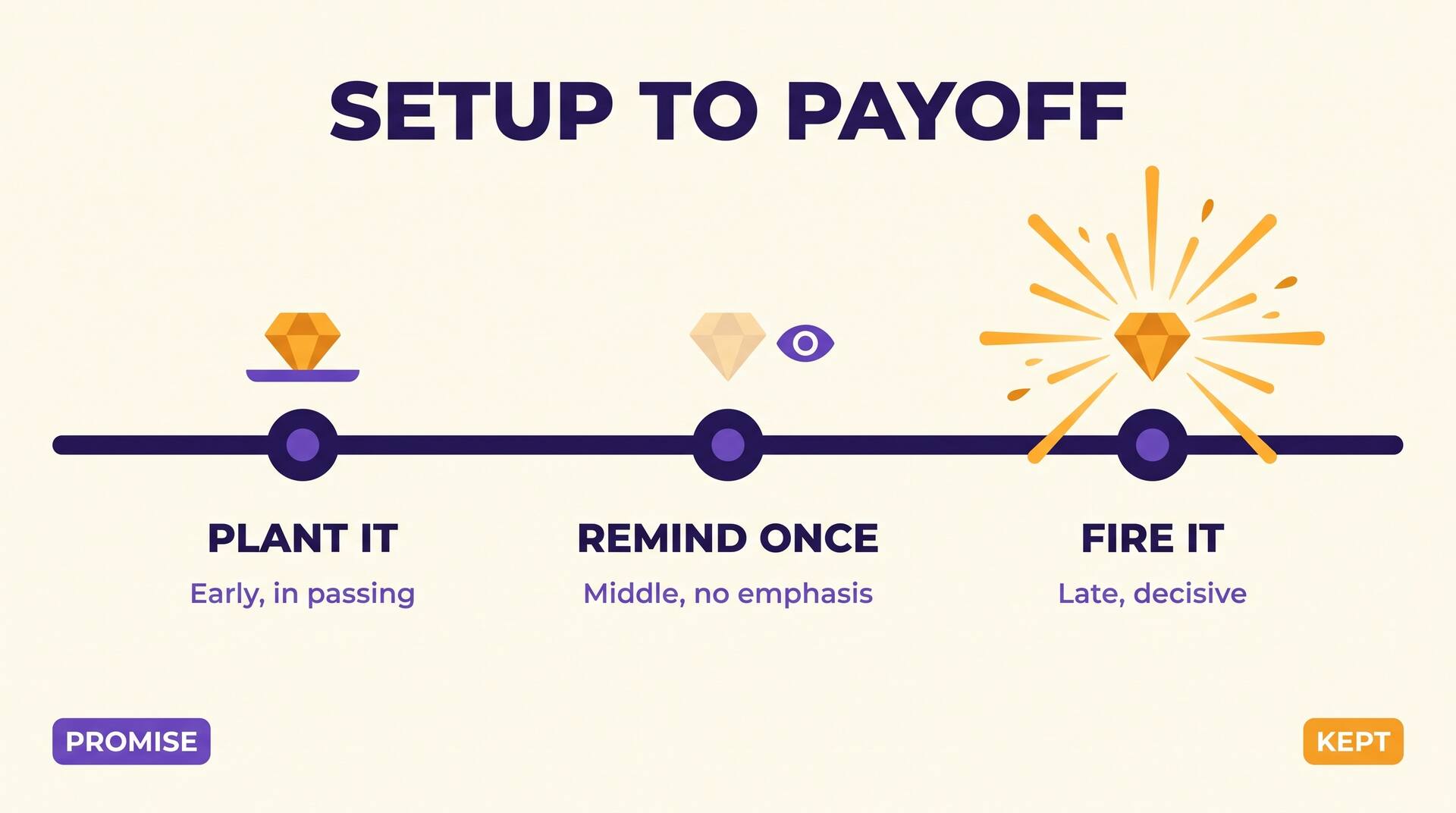
Run it backwards too. For every late turn, ask what earlier moment paid for it. If the answer is nothing, you have the opposite problem — a resolution arriving from outside the story, which is the territory of deus ex machina, and the reason readers call an ending unearned.
When to break the rule
Chekhov was advising a beginner writing for the stage, where every prop costs money and attention. Prose is roomier, and three cases justify ignoring him.
- 1Texture. Literary fiction earns its density from details that mean nothing beyond themselves. A world where every noticed thing is a plot device reads like a puzzle box rather than a place.
- 2Fair-play mystery. The genre contract requires more clues on the table than the solution uses. Unfired possibilities are the form working correctly.
- 3Deliberate anticlimax. Sometimes the loaded thing never going off is the point, and the waiting is the effect. This only works if you commit — one unfired gun in a tight book reads as intent; four read as a lost draft.
Everything else is not an exception. It is a note you meant to come back to.
Planning payoffs before you draft
Setups are cheapest to place when you already know what they're for, and a chapter-by-chapter map is what makes that possible — one screen showing which chapter plants a thing and which chapter spends it. Our free outline generator drafts that structure from a premise in minutes; the plot twist generator works the other direction, letting you pick the turn you want and reverse-engineer what has to exist in chapter two for it to land.
Writing the whole book in AIWriteBook, the outline builder keeps that outline live beside the draft, so a payoff can go into a later chapter's brief before you write it — Gemini or Grok then draft that chapter with the setup already on record. It won't track your promises for you, but it makes them visible.
The audit still belongs in revision. Planning reduces orphaned setups; it never gets you to zero, because drafts grow details on their own.
The short version
Chekhov's gun is not about guns and it is not a law. It is a working writer telling a beginner that attention is a currency, and not to spend the reader's on things you have no plan for. Plant with a light hand, fire with a heavy one, cut anything you emphasised and then forgot.
Setup and payoff is one of the load-bearing skills of long-form storytelling. If you're building the rest of it, our complete guide to writing a book covers structure, drafting, revision and publishing in order.